WHY Not Wednesday with Eileen McDargh
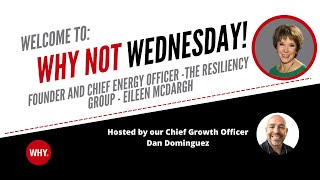
Eileen McDargh, an executive coach and Chief Energy Officer, explains her Why Operating System: why you do something, how you challenge the status quo, what you contribute. She reframes resilience as energy management, not bouncing back, and shares how this framework shaped a career leap she almost didn't take.
Chapters
Hello and welcome to why not Wednesday. I am so excited to talk to all of you today because we have an awesome guest. Eileen McDarg is with us today, and she is one of our earliest adopters of the YOS Discovery. The Y Discovery. Back when she joined, we just had the Y discovery. So Eileen is amazing. She. Since 1980, Eileen has helped organizations and individuals transform their life of their business and the business of their life through conversations that matter and connections that count. And let me tell you, she is all about connections. She's become known as a master facilitator, an award winning authority. She's an internationally recognized keynote and executive coach. She's a certified speaking professional and a hall of fame speaker. Something I didn't know, hall of fame speakers are very, very rare. So she's one of that 1%. So in 2020 and 2021, Global Gurus International, a British based provider of resources for leadership, communication and sales training, ranked her third as one of the world's top 30 communication professionals. So we're talking about somebody that knows how to communicate, loves to connect, loves to contribute to others. She's written eight books and her newest book is Burnout to Breakthrough, one that I read and that I highly recommend. Building resilience to refuel, recharge, and reclaim what matters. Her title is the Chief Energy Officer at the Resilience Group. So I am so excited to talk to you, Eileen. Thanks for joining me. How are you?
I'm great. And I've been looking forward to our conversation ever since you asked me. So thank you, Dan.
Well, thank you for being on and thank you for being an early adopter of the why discovery. You know, it's been more than a year. I remember those early conversations we had. You know, the coaches that are on and they're listening and they're spoiled, Eileen, because they have the yos discovery. You and I went through that very manual process of discovering your why, your how and your what, and you've sort of had an evolution. And I will tell you, a few coaches have had that similar situation where they had something that they thought was their yos. But when they took the yos discovery, maybe one thing tweaked and it changed positions a little and it didn't happen a lot. But for the few that it did, the new one makes a lot of sense. So let's start with that. Let's talk about your yos. Okay. Your why operating system is to make sense of the complex and challenging. That's your why. Your how is to challenge the Status quo. You love doing things differently, you love making things fun and you'll do things and you ask the question, why do we have to do it that way? And I can't tell you how many times I've heard that question in the short time we've known each other from you. So I know that challenge is part of your top three. And your what is contribute something that's so important to you. You love helping others, you love making a difference and making an impact. So tell us about your yos as it is today and how does that feel?
Well, that's so interesting. So first off, let me just tell everyone who's listening. When Dan and I started, we're talking about formative stages and my challenge came up a lot because I said, well, why are we doing it this way? Well, this is missing. You can make. So what I was doing and I didn't realize it until we actually came through the new assessment, the yos discovery was that I was saying we can do this better. This doesn't make sense. This doesn't make sense. And I'm sure there were times in which Dan and Gary and the rest of them said send that woman away.
She'S asking too many questions. But it was always in the intent of how do we contribute and come up with a really wonderful product, which it is. And it will continue to evolve.
Yes.
And you know, it really will. I mean I had a three ring binder that was this thick of all the paper stuff and now I don't need all that paper stuff. So the make sense I struggled with because when I first took it, my why was to contribute. I think my how was simplifying what was clarified or that this just didn't seem quite. But this one, this one does. I wanted to fight against it, but the more I look back on my life and what I do is I really help the individuals and the clients. I don't make sense of what's going here, what would happen if. And then at the end of the day we want to contribute to their, you know, bringing the best of who they are into their business and into their lives.
Yeah. Well, you know what, we're getting some, some feedback. David Gregory. Yes, the contributes. Yay. Contribute, he said. And then Watson Jordan said, challenge for the win. Right. So you know, one of the things that, that, that we found and it's so great that you've been so vocal and yet so keen with us because.
And David and watching and everybody who's listening, we're a better weight company at the end of the day, we love finding better ways to do things and then sharing them with others. So in your challenging, in your challenge, you forced us to look at things differently and then enforced us to improve. And I think all of that has contributed to the improvements that Watson and Lynn Everard and Tanika. Who is commenting? James Madison. Hey. He said we're two of his favorite Y people. Thank you, James. You know, that's what's led to the evolution of the Y Institute to where we are today. And as you said, we're going to continue to do that. I think what's really fun. And James, you know, gave us some suggestions when he came in. I know for a fact, Watson, Jordan gave us some suggestions. You guys, as the founding coaches, have had a big part into how we build what we do going forward. Better way, all the way, says James Madison. What have you. What's been the most important change that we've made that you suggested?
Oh, geez. I mean.
I was kind of a pain in the neck because I. Why do we have to do it this way? Well, there are a couple of things, I think. One is that the institute became more forthrighted, how it was developed. You know, it was just. It didn't just spring forward, but we needed to know what the history is.
Right.
I think. I think the other one is to be able to share information with each other. I love the resources that you put up. I don't know yet. Maybe you will. Tell me, do we still have a qr, a QR code that's only going to last two hours? That's the next change you want to see?
Absolutely, yes. We're working. Absolutely.
You know, so I don't know why that is. So there are just many things, and to be fair to everyone there, they probably have a lot more experience than I do with this because I did not pop out, say, I'm going to be a coach. What I wanted to be was a mentor and a consultant. And in that process, now what this has allowed me to do, and I told Dan, I just had a conversation with a major energy company that that is looking. I love this. They're looking toward the future, and they know that they need to get off of fuel, they need to find alternative. They want to be sustainable. I'm going, yes, challenge the status quo. We can do better than this. So the first thing I want to do is as soon as we get the okay, as I'm taking the eight senior people through the yos so that they can figure out who sits around the table and what's our what's our.
Vision together and isn't that and you're going to do that using the why you're going to get to know each and every one of them and how they view the world. Right. And learn their why operating system. I want to comment on what you said because Watson Jordan commented he said refinement and enhancement and I think if there's one thing that we're always trying to do is refine and enhance. As a matter of fact today we're in an all day meeting so we're here at the Y Institute campus with the whole team is here and we're looking at ways taking those suggestions that all of you guys have given us and how are we going to implement because we can't do everything as you know we've got to prioritize so really being focused on that primary priority and that is to get the Y discovery in the hands of as many capable and amazing individuals like yourself as we can find. We got Tanika who recently joined and her what is contribute her why is challenge I believe so she gave us a big on the challenge right now. You been in this industry for a long time Eileen. I, I mentioned it in my post. I hope you're okay because.
That happened Dan. Because I'm only 23 so I have.
Exactly. Well and what I mentioned that you know you've been doing this since 1980 but you approach your work with an energy that I don't see in a lot of people. When you have the title of chief Energy Officer you truly live up to it. So tell me what it means to transform the life of business and the business of life through conversations that matter and connections that count because that is a really cool statement. But what does it mean?
I've had that statement for a long time and frankly I resisted that notion of energy for a long time because it sounded too airy fairy. You know that doesn't mean anything and I realized that really and what it's what resiliency is. It's energy management. It's not bouncing back. It's how do I find the emotional, mental, physical energy. Energy comes from connection. Just like that energy company I'm going to talk to if it's a good connection power plant house it works that connection.
So transforming the life of work and the work of their life to me says that there are two things and they're not separate. In fact I'm going to talk to another group next week and it's, it's think of it as the, The.
The.
The helix model of the DNA, right, where don't separate work and life. They go together. They might be separate, but they come back together again. So that's why, to me, it's not only transforming the life of work. How do I. How do I approach this thing that I have, but also the work of my life, because they're not separate. And it will come through the connections, through the conversations I have with myself first and then the connections that I have with you, Dan, with James, with what, with any of these people. What is it that we do and how do we come together? So that's really what that means.
And our community is pretty amazing. You know what's really cool? As we've grown, I see people. I see. Just last week, I think it was, you had a question and you said, you know, I really like the way James talked about this. And then you connected with him. I think you guys spent some time on the phone. He sent me a text and said, oh, we had an amazing conversation. And then you. The coup de grace was he got the lemon cake in the mail from Eileen McDarg. That was a conversation that mattered. Exactly, Lynn. And a conversation that made an impact, a positive impact on James. All right, so I know you said you're very selective, so I know there's a lot of people listening. They're going to want to do something for you because they want that lemon cake.
How does, how does one qualify for the lemon cake? Because I've enjoyed it and it was delicious.
Well, let me tell you, it's not. It's my personal recipe. I don't give it out. And then I have to mail it. The mailing costs more than the lemon cake.
Does it just.
In fact, if you go to my website and under the videos where it talks about virtual, I start off with showing my lemon cake. I said, this is a demonstration. I said, unfortunately, if you are out of the States, you can't have this. It's too expensive.
It's too expensive right now.
And so what I said, I'd love to. And it was. Part of. It was eaten. And I said, it's a sample. And this is what I offer to you on this video. It's a sample of what I do. And I used my lemon cake to put. So, you know, it's when people. People are kind and they go out of their way. And sometimes I do it just because they need that boost. I have a friend who now is. She's. She is Ms. She's. Her husband passed away Two years ago. She's in a wheelchair in New York. She needs help for everything. And I sent her lemon cakes. And you would think that I had just given her a gold star. And so that's my contribution to the little bit that I can do with her life, which isn't much.
Well, I'm gonna. I'm gonna. I'm gonna talk about your statement, because we could talk about lemon cake for a long time. Your. Your statement. When you. Are you helping your clients make sense of their situation? Is that. Is that how you transform the life of their business and the business of their life? Because when you come in, they're probably not. It's not.
Well, you know, I think it's. I think it's really two things. And when I've taken management teams away from or like this group that'll be coming up, you know, I first start off with who sits around the table? How do we make sense of who's around the table? And I also ask them, you know, what I call, what are your prouds and what are your sorrys? What are we most proud about? What are we really. Individually. And then challenge, how do we make this. So if we look at this right, what is it that we can do that we're doing stuff the old way that we've used to done? And in. When I do that, I just barely throw out the bait and let them nibble.
When you're doing that, you're. Well, you're challenging what they're doing, right? So. And you just throw a little bit out and then you let the fireworks happen.
That's right. Whatever that. You know, whatever that looks like. And so in that, I mean, they own. I say to them, you own the outcome. I don't. And I make a big to do. Also, Dan, about the difference. There's a difference between content and context. The content is the who, what, when, where, why. All the data. Right. Context is what's happening right now. Because when that context changes, the content needs to match what the context is.
Yeah.
Take the trees, Eileen.
That's important. It's important. And when I talk about work life integration, I will ask the group, where are you right now? This isn't something that happens in a vacuum.
Right?
Your life look like now. If you're caring for an aging parent, that's real different than you got a newborn. If you just got a new job and you're trying to figure out what it is, then you're three weeks from retirement. Context is very different.
Could be the same job, right? Same exact Job different. Oh, I like that. Watson. Jordan likes it too. Thank you, Watson. So let me ask you this question. What is a connections that that counts? How do you bring that to the team?
Well, when we say conversations that matter and connections that count. Yeah. When I think of connections that count, it means at the end of the day it moved me forward, not backwards.
Yes, forward.
And so when you move forward now, it might be that you, that connection showed something I don't want to know about myself. If I'm willing, it moves me forward to a new place. And I have always contended it's what makes me different. When I talk about resilience, it's got nothing to do with bouncing back. It's all about growth. Stay in one place. You're not growing. Well, the truth of the matter, Dan, just like the Y Institute, the Y Institute is different today than it was yesterday.
Yes.
You're different today than you were yesterday. And so am I in small ways and sometimes in big ways. And so those connections that count take into into account, yes, that, that, that context and how do we grow through that? But that takes willingness on the part of receiving. Sometimes people don't receive it.
No. And you know what you bring up. So I want to recognize. Tanika says she loves a distinction you made between content and context. So thank you, Tanika for commenting. You know, one of the things we've talked about recently on my LinkedIn post and with with our our followers is the concept of a soul tribe. People that belong to your your tribe that are the people that get you. So you and I share something that Veronica, Kieran and I share and that is we share the same why, how and what in a different order. I'm a contribute challenge makes sense. Your make sense challenge contribute. So we both have challenges. Our how and so that's a lot of what we do. And I knew we were going to have fun on this conversation because that's a big component of challenge. It's got to be fun. If we're going to do it, we're why not make it fun? Right? But we also, you know, we share that the same beliefs. We believe in a lot of the same things and we work with people, we care about people in the same way. And so I think that's important when you talk about those connections that matter. So thank you for that. That's an awesome perspective. Let me ask you this, you mentioned I asked you this in the pre interview. You became a Y coach. What made you want to do that?
So I have as far back As I can remember. And it probably was junior high, but at the very least, it was high school. I have always said, why am I here? And I did that early on. Now, I was raised Catholic, and so there was always this, why am I here? Okay, what does God want me to do? So, as I mentioned to you earlier, I figured I was going to be a nun.
But I would have none of that. No pardon.
I do things just for myself, but I was always circle for that. And I have a twin brother who, when we were in high school, made me this memo pad. And it said at the bottom, it had my name at the bottom. It said, to make a difference. So I have always, always been looking for, am I on target? Am I on the track where I'm supposed to be? And you guys use that wonderful Mark Twain the day you were born, the day you discover what. So I have always been searching and looking for clarification. Is this it? Well, maybe a little bit of this, but maybe not this. So when you came to me with the, you know, the ability to. Well, let's be. Even though the whole institute was not clearly thought out and stuff, that. That intrigued me because that is and continues to be a primary part of my life. Am I on purpose?
James Madison is listening, and he's all about living life in purpose and on purpose. So I know he's going to. He's going to comment on that, but, you know, I love the way you've learned. So how. How is it making a difference? So, first of all, primarily, Eileen is a keynot speaker. She speaks on stages to hundreds of thousands of people. And.
Yes, but. But now you're doing some virtual stuff. And. But you also do some coaching. How does your. How has your coaching been impacted by using the yos? And I know you've recently done a program with some people, so tell me about that.
Well, actually, I think the people on this call probably use the yos a whole lot more than I have.
Yeah.
To be truthful, because when you're doing a keynote speech, I'm, you know, I have 45 minutes and. And my focus and what they hire me for is resilience and understanding change. So I. I don't do that. I will finally, finally get to do this when I have, you know, my. My energy group. So I have been experimenting with it. I've given it to my siblings, I've given it to some colleagues just so that, like you said, so that I can practice. So it is my hope that as I become more and more comfortable with it, and as you all continue to refine it, that I can use it more and more. But it is, and I think you've said this, Dan before, it is a piece. It's not the entire puzzle. It's a piece.
And that's important. You know, one of the things that I've learned as the chief growth officer in trying to expand, who do we want to offer this to? And everybody that's listening that's commented so far, they're established coaches. They know how to add this tool to what they already do in order to maximize its impact on the people they are working with. Because if you are, if you're a coach that's just starting out and you, you're just maybe getting your first certification and you don't have any clients, this is going to be a hard tool for you to use at that point because you don't have anybody to try it on. And, and then what do you do after? You know their why, how and what, right. What, what do we do do with that? So you've got to have a purpose. You've got to have something that you're going to do with your clients afterward. And that's what Watson does. That's what James had. You know, James came to us, he said, dan, I was looking for a better way to do exactly what you guys do. And now you, you gave it to me. You're, you're speaking to stages. Does that often lead to individual engagements for you?
It would lead to, generally, it would lead to spin off to other audiences.
Right.
My, when I talk about my consulting, I'm trying to remember there's one client I've had for 22 years on and off. And I, I think because I did a small facilitation with the team, the woman who was the president company gave my name to the pharmaceutical company and they brought me in. And once they did that, then they, then another group and another group and another group. So the, the individual or team, if you will, consulting comes other than being on the stage.
Right.
So like next week, I'm with Texas Real, Texas Realtor Association. Right. I would be in. They gave me 40 minutes. I'm kicking off there their program. They have specific things. You know, they're going to celebrate the fact that for the time in two and a half years, they finally get together and they've been able to hang together and do some pretty incredible things in the midst of COVID in Texas. That's what they want to talk about. And I'm going to give them some ideas about how to. How to build resilience and that they got 38% more people coming into the association. So there is not. It's not the opportunity, you know, to do why, how, and what. I mean, I've got some real specific deliverables for them.
Yeah, no, that makes total. That makes total sense. And Watson said it's the first piece, the foundational cornerstone. If you can help them discover their why operating system, it really sets a great tone for the rest of the relationship. Let me ask you this, because it's the name of the show, Eileen, and we always want to get this question in before we run out of time. Tell us about your biggest why not moment, a time in your life when you said why not to something, and how did it turn out?
Those. By the way, those are great questions, and I have a number of why nots, I'm sure. But I guess the one that brought me to this is I had gone through divorce, moved out to California, have an incredible husband. We've been married 41 years. And when we got married, when I came back to California, basically the only thing I had was $1,000 in the bank and would fit in the back of a Camaro. And if you've ever owned a Camaro, you know, it ain't much. And I. My. It was a garage apartment. It was 400amonth. And I bought my sofa for 25 at a rummage sale. When we got married, not only did I marry Bill, who himself had gone through transition, but had three children. So I adopted his three children. So now. And I'm working for a PR firm handling their multinational accounts. And I thought, if I write another press release, I'm gonna throw up. I don't like this. I don't want to do this. And in the middle of the night, dad. Now here we are. Between the two of us, we have. Next. I think I got my $25 sofa, and I woke up and I was. I can still see this. I'm standing on the edge of a cliff. And this voice said, jump. I'll catch you. And I slapped Bill awake. I said, bill, I'm quitting. What are you going to do?
I don't know, but I can't do this. And he said, I love it. We'll always be okay. And that's what put me on the road where I am now. It was, why not? And sometimes what we. What guides our path is not that we know what we want, but we're really clear on what we don't want, Right?
So it wasn't so much what. Because. Did you have a plan? Did you. You just knew you weren't going to do.
I knew that I was a strong writer. I knew that I could. I didn't want to if I did not want to write another press release, but I could help clients. You want your annual report written? I can do this. You want some marketing company? I can do this. And really, within the first month that I. That I resigned, I had a colleague who said, will you create a program for the community college on how to develop a business plan? And I thought, well, why not? I came from the field of education. Sure, I'll do that. That led for me doing another program for another college on the art of persuasion, another one communication at the home of the heart. I had forgotten how much I loved to teach.
Yeah.
That ability to teach is what put me in front of people to teach them more. So I started out as a trainer and eventually was asked to become a keynoter. And now it's. It's both of those things combined together.
Yes. Tanika says that's really powerful. Know yourself and live and work on purpose. I think you. You've always had that knowledge of what you're. You were put on this earth to do, and that is your. Your what of contribute.
Your.
You. You want to make a difference. You want. You want to make a difference in the lives of others. James says the still small voice as trusted advisor. So, you know, we've had a lot of our coaches, you know, and that's what's really cool about our community. They've gone through similar experiences and they've had to make that why not choice at some point in their career, and it's worked out and it's led us to be together in this tribe that we call the why society. And we're. We're so glad to have you in it. Eileen, what would you say? You know, I've got two more questions for you. One is how has knowing your yos impacted your personal life? You and Bill?
Well, that's interesting. You know what? Bill and I haven't even talked about it.
Really.
We. We really have. I mean, he knows that I've done this.
I think if anything, it's. I find my brain starting to say, okay, you know, how do I. How do I make sense of this? And I realized I'm now beginning to live that what is it that I need to challenge and then how do I contribute? And I'm at the stage of my life, Dan, where I'm trying to figure out Acts 3, how do I make sense of this? What do I need to challenge? And whatever I do, will it be a contribution. So he just accepts everything that I do. But I think for me personally, it will begin to be helpful in guiding me toward what will be my act. 3.
Love it. That is really cool. So here's my final question. We ask this every week because I'm going to get it. I'm going to. I'm going to take myself off camera and let you answer. What would you say to someone, Eileen, that is considering becoming a Y coach? You know, they're on the phone with Dan. We've talked about what would you say to them if they're considering joining the Y society?
Okay. So I think what I would say is this.
It is always powerful to be around people who value the same thing that you do. Looking for and helping people understand their why, which I call their purpose. And if I surround myself by other people like that, I. We can really support and encourage each other. I think that's one of the values. Also, the assessment, the tool that the institute is creating and will continue to create and refine. And refine. And refine is powerful and easy. That's the other thing. People don't have time to go through 45 questions and 9,000 this and that. So it's easy to administer and it's easy to explain. And it is a. Is very complex. Too much bombarding us. It's the ease of that assessment that I think is one of the beauties of it. And as long as it keeps getting more refined. More refined. I think it's a fabulous tool to have in your toolbox.
That was perfect, Eileen. Thank you so much. And, you know, you just pulled on Gary's heartstrings because you said, it's water, it's clear and it's simple, and. And you. You and you finish with simple. Simplicity is so important. I find that the best coaches are people that either help people make sense or help people make things simple. They use their gifts or they make things better. So, you know, thank you so much, Eileen, for being with us today. We could probably go on for another hour, but we're right at 30 minutes. And I know that it's important for us to stick to our timeline, so thank you very much. Have a great rest of your day, and I look forward to hearing how your conversations with the energy company go.
Me, too. Me, too. Yeah. Thank you guys for being with us.
More from Dr.




Women In Leadership: A Need For A Greater Systemic Change With Belinda Clemmensen






