WHY Not Wednesday with Erica Groschler - TPS Consulting Ltd.
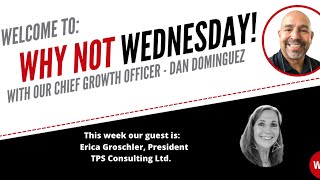
Dan Dominguez talks with Erica Groschler about her work in organizational development and change management at TPS Consulting. Groschler shares her approach to conflict resolution, team dynamics, and balancing her career as a single mother.
Chapters
Foreign.
Hello, why Society and welcome to why Not Wednesday. Today we are live with Erica Groschler who is joining us all the way from Canada. And as you can see in the top right hand corner of your screen, we've got Bella who is making her debut on why Not Wednesday. So welcome Bella. Welcome Erica.
Thank you, thank you.
This is so cool that we get a chance to see. Bella has been working behind the scenes for the first few episodes of why Not Wednesday, but she makes the show run, she does a lot of the stuff in the background and she comes up with a lot of great questions. So I invited her to get on the air today. So if you're, if you're watching live and you want to make a comment, let us know any questions you have for Erica. For myself, I want to make sure and give Erica a proper introduction. So I'll tell you a little bit about her. Erica is president of TPS Consulting Ltd. In beautiful white Rock, British Columbia. She is a single mother of a 22 year old son and a 20 year old daughter, God bless her, who are both at university. She's built a consulting business for the company she was working for at just 27 years old with over 15 associates in Canada in the US generating revenues of close to a million dollars. And Erica is now running her own practice as a solo practitioner. She calls herself industry agnostic, so we got to make sure and ask her about that. And she helps her clients thrive, whether it's by helping them individually through coaching or working with them around team dynamics, strategy, organizational culture or leadership development. She also teaches with the University of British Columbia's Executive Education Custom client projects. So what's important to Erica are integrity, courage, relationships, growth and tolerance. And we wouldn't be why not Wednesday if we didn't give you her yos. Her and I talked about it in the post about the interview. But her why is to contribute to the success of others, her how is to make sense of the complex and challenging and her what is to build trust. So did I get all of that right? Erica, you did fantastic. Well, thank you so much for being on. Thank you for joining. You've been with the Y Institute since I think about August, so welcome aboard. How has it been for you to know your own yos and to start using it with your clients?
It's helped me, well it's on my website so that's the first thing it's helped me around branding and being so crisp with being able to communicate with people what it is that I bring as a as a solo practitioner, but also through my company. And I think the piece that really was illuminating for me when you and I did it was actually my how because that's the hardest thing for me to explain to people is helping them work through their complex, challenging issues and then navigating that through always through my what, which is trust. And everything for me is even when you and I talked, I said, I don't care if I don't get anything out of this. This is about making a difference and helping contribute for others. So the I think I knew about the other ones, it was the how that just really succinctly helped me. And so that's probably been the biggest, biggest piece. The other piece for me is in my interactions with other individuals, getting a sense of what I think their why might be. Even if we haven't done a wire YOS with them, it's helped me bring more empathy to understanding what's going on. Particularly I had a colleague that I work with who's got clarify, I'm sure as his yos and the way in which he was asking all these questions during the summer and how I noticed other people were reacting to him.
Right.
Once I personally understood what was going on for him, it just brought farmer empathy. And I was able to kind of facilitate and navigate those conversations so that he felt heard and got the information he needed for us as a team to move forward. So that's how I've been noticing. It's already helped me since August.
Awesome. And so you now you said. I remember when we first started talking, Erica, you said, Dan, because we hadn't launched the yos, so we went through your Y operating system and we figured out your, your why, how and what.
Yeah.
But then I shared with you the automated process and you said, wow, I love that. So do you use the manual process or the automated process?
I have only is the automated because it's efficient.
It makes sense. Right.
And I was really excited after we did the learning in August and I was all excited that I had a client group that was willing to pilot it in September and unfortunately that session got canceled. So. So I, I have yet to actually take them through a session on their collective wise as a team. I have done some individual coaching around their assessments with probably about eight people so far.
Yeah, great.
Outstanding.
I was just wondering if you could tell us a little bit more about TPS consulting and exactly what it is you do.
And yeah, I mean it's the breadth of what's called organizational development. So it's leadership Development, which could be in the form of actually doing programs, or it could be through coaching or it could be through. Those are probably the two main ones. Leadership development's a broad category. Organizational culture, which is a big passion of mine, is going into an organizational system. Could be a department, could be a organization as big as 5,000 that I've done this. And so we figure out what's really going on. Makes sense, right? Then figure out what are the interventions and solutions to help them move from what their current state is to where they're trying to get to. And then another big piece is dealing with often dysfunction in teams and helping them move to being high performing teams. And a lot of that might also include some conflict resolution. And then another key piece, like even yesterday I was helping addictions and concurrent disorders group that just opened up a facility and they, they, it's beautiful. And the staff are really struggling, even though it's beautiful compared to their old place they came from. And so I was, I was working with the leaders to train them on normalizing what happens in change and giving them tools and strategies and resources. And then we're going to do ongoing coaching in between so that there's in the moment almost labs where, where they're together and we're working through what they're facing at work. So that I'm in the background. They're the ones who are the leaders supporting their people.
There's a big gap. You covered a lot from when you go from dysfunction to high performance. Because listen, I, I've led teams, I've led small teams, you know, small regions and I've led national teams. I can tell you there's a lot of ground between dysfunction and high performing.
Yeah.
What's the biggest key that you have found? To get somebody to number one, acknowledge what the dysfunction is. Because sometimes a team won't even acknowledge that they're dysfunctional. So how do you get them to recognize the dysfunction and then move to high functioning?
So I love when there's a huge pain point because then they really want something to be different.
So I would say I had one organization, it was actually.
The athletics division, so the varsity of a university and they had very high turnover. So pain point. They had people calling out gender as an issue around hiring practices with leaders. Right. And so they were really dealing with big attrition issues and low, low morale. Right. And so through that process of conducting 45 hours of interviews and focus groups with, with everybody, including the coaches, it became obvious what was contributing to ultimately some of the dysfunction and really dysfunction. Some of it's in the system itself. Like the goals weren't clear. Right. They'd had turnover of even leadership. And then some of it was actually related to how the leaders were and not being aligned and not, not be communicating the way one would expect. So there were sort of almost four or five big bucket recommendations and, and I worked with them for 10 months. And the biggest, the biggest piece, Dan, that I would say around that is engagement. They need to have voice. So this back to my values of tolerance, right. They need to feel like they are part of this process and that it's an invitation from a place of what the possibility is that they can create rather than being stuck in what's not working. So there's a part of honoring where they're at and what sucks about their situation and then there's a part of it of them co creating together what their future is going to be and through that. And, and some of it, by the way, is having some really hard conversations, including when I presented the report and I called the leadership and I knew in my head I was like, I'm going to lose this client. But I said, I can't believe that you're not sitting here aghast at what these results are showing right now. Right, yeah, go ahead.
Yeah. So you're working with them, you're asking them questions, you bring it all together and you kind of as a makes sense person, you kind of get to the bottom line and say, okay, y. This is what's wrong, this is what you need to fix. What are you going to do? Or how can I help you? What's, what's the next step that you take with them?
So this, this is the part about organizational development which is there's not, it's not a recipe, it's, it's, in fact I believe it's like, do you want to go through door number one, door number two or door number three? In a way it doesn't matter. Some things are fundamental. Leadership is sponsorship and them owning it. And the self awareness piece is critical and key. The way the avenues and things you do, it's not as much of a factor as much as following where the energy and, and like interest is. Because sometimes I'll prepare a report and there's, there's too many recommendations for them to actually go with. So I let them choose. So there's a lot around again, voice and engagement that they choose. I, I'll be directive if I think there's certain things they must do. And I will Put that in there as critical. And then also, Dan, I'll bring in best practice. Like what's the research showing about high performing teams? You know, if there, if there's issues around, for instance, psychological safety, which is so that people feel safe to speak up in the workplace, which is a big topic coming up these days in, in Canada anyway. It's on the federal health and safety site that people have a right to be psychologically safe, not just physically safe. Then, you know, I was working with a team, an organization where we were working with the senior leaders. It became very apparent they weren't feeling fully psychologically safe with their exec team. And I done work with the exec. So this is working the system. And so I made a recommendation that maybe we should do a customized workshop with the exec around psychological safety. Right. So I was able to tie it. So there is, there is an aspect that's very flexible when I'm doing true, true big work like this, that has to be responsive to what's showing up in the organizational systems, that it's the right. And this is my how solution.
Right.
And I get there because of the trust that I established with the clients. That's. And these are the projects. Then I like discrete things. Like yesterday I went in and I did a, you know, half day session on something. So some things are kind of one offs and some things are broader.
Thank you.
Yeah. With you talking about everything about psychological safety, you know, at the Y Institute we do believe in having all these difficult and challenging conversations and having the ability to just ask and push limits and finding your passion and that leads into, I know you've come up with crunchy conversations. So what would you consider or what are, what are crunchy conversations?
First of all, I made that up. Dan has permission to use it as much as he wants because he fell in love with my statement, sort of the way you described it, Bella. So for me, I grew up in a family environment where it was, it didn't feel psychologically safe or safe. So I was, I call myself a recovering avoider, accommodator in conflict. So I, doing the work that I do forced me to step into having these types of courageous, candid conversations, speaking truth. I'm known as the truth teller in my family, Brene Brown, if any of you have heard of her, she has an amazing saying, clear is kind. And so for me it's about actually being clear. Be straight, tell it like it is, but, but balance that with huge empathy and, and hurt like you're not, you're not going in to be mean in that conversation. But, you know, it's not really kind when you go in being really flowery and not really getting your message across. So for me, that's what a crunchy conversation is. But a big part of what I do when it's in a team dynamic, whether it's 2:15 or whatever, is it has to feel safe enough for them to have those kinds of conversations.
Otherwise it very unsuccessful. And if I get, if I get triggered or fused by what's happening in a team, I've lost them. I have to be clean and clear in allowing that type of conversation to occur. And having them feel courageous is courage. It's a courageous, candid, and authentic and empathetic conversation with someone.
You got Lisa Schermer Horn, who's. She's a coach out in Vermont and she's one of our coaches, but she says she loves the term. She was on, I think last week, she loves the term crunchy conversation.
I watched that episode and Lisa, the first place I learned to ski was Smuggler's Notch. I lived in Montreal and I love Vermont.
Awesome. So crunchy conversations, you know, you're. You're touching on two things that we believe in. Number one, we believe in having those challenging conversations. Just asking. We also believe if you talk to one of our partners, Jerry Lujan, he is all about psychological safety. It's so important to have that ability to be able to say what it is that you're feeling and not feel like you're going to be in trouble for doing it. Right. So you take psychological safety and you add that challenging conversation and I think it's the only way to improve. And so it sounds like when you bring that into a team environment where you are at, you're looking at teams from three people to 15 people. You're really encouraging them to first of all build that psychological safety and, and then also be able to have that crunchy, challenging conversation. I think of the reason I love that. I think because I love food. You know, I think of a crunchy conversation is a conversation you can really just dig into.
And get a lot out of it.
I just saw somebody said they love Montreal.
Love Montreal. That's Lisa, go ahead.
The one thing to know about teens is they change, right? So you could be a pretty high performing team. Think of sports teams. We all know our roles, we know what we're all up to, which is to get the, let's say, ball in the net, right. And then you have some team members change or one Team member change. And so the, the play that we all knew and how, how to depend on each other shifts. So part of normalizing what's going on in teams and the dynamics in teams and possible conflict has to do with the dynamic of changing members on a team. And so a lot of that that I do is to help Norma just what happens on teams, they come and go. And so whatever we can do to have sort of principles or norms is helpful. And we got expect that we're going to go back to the forming stage and what's called the storming stage, which by the way is where those crunchy conversations really need to happen Right. Before we can move on to the next stages to really be a high performing team.
So you believe in, you know, I brought that up to our team that you do forming, storming, norming and then performing, right?
Yeah.
Fantastic. So you help teams go through that, which is a very critical part of every team. And then you may, you may think you're done storming and then you get a new member and you got to storm all over again.
Right, Exactly. And a lot of what I like to do is around the awareness piece so they understand what's going on. Same thing I did yesterday on Change. Because a lot of people are in their heads thinking what's wrong with me? Why aren't I performing as well as I could with this team? What's getting in the way? And they just don't understand. This is just. That's the struggle of becoming a high performing team. No sports team starts where they're all hitting it in, in a concise, predictable way.
Yeah. So I, I know Bella has a question, so I'm gonna let Bella go next. Go for it.
My question was just that, do you think that like avoiding those hard conversations and stuff, do you think a lot of them are from people that have contribute or trust in their wireless? Because I know that I'm a little bit the same way. I tend to avoid conflict or anything like that. And I wonder if it is.
I don't know if there's any correlation with that. What I will tell you is our.
What we would have grown up with in our family environment, what we would have grown up with, with the messages we would have had about conflict. Culturally, different cultures. I'm, I actually am going to help a master's program that has a lot of international students that are dealing with conflict. Right now they're in a one year master program and there's three different. I mean there's Canadians, but there's Three other international groups that are in that session, in that cohort, and they're struggling, apparently. And so.
I think it's really important when I teach stuff about conflict, there's a big part about being compassionate with ourselves. Because, I mean, I joke when I say I'm a recovering avoider, accommodator. I really am. And by the way, sometimes it's really beneficial to avoid. Like you don't want to be just, you know, in conflict all the time. Sometimes it actually makes sense not to. The thing if we're a true avoider is we will rationalize every reason why now is not the time.
Yeah.
It's other stuff to get done. Right.
And if we're accommodating, we are yielding all the time and saying yes when really we mean no. So we're not even being straight with ourselves. So I always encourage people, start with the safe relationships, have those types of conversations with the people who you really trust. So you had said about value of trust, like, don't start with someone where you almost perceive it. Like, I'm not just going to be a safe conversation for me because it's like the gym and building our muscles. Start with like the 2 pound weights.
30 pound weight. That's how I encourage. Or if you're like me and have a compelling reason for why it's important for you to have those difficult conversations. Because I couldn't coach others to do that if I wasn't doing it myself. So it was actually that which is contributing to make that difference for them. I couldn't do it authentically if I wasn't willing to do it myself. That was my biggest driver. Because I have lots of good reasons why I should not step into conflict dressing.
Yep. I completely relate to that.
There's probably a lot of people watching that are in your situation. I know there are because I've talked to them. You're a single mother of a 20 year old and a 22 year old. So you've got, you've dealt with teenage years as a single mother. Now you're putting them through university. Have you used the yos with them? Do you know their why, how and what? And did that impact how you view them?
I haven't done it with them yet because they're in the middle of finals. And when I, I actually, I actually got a message from my son the other day that said, you need to tone down on the amount of stuff you keep sending me.
Maybe during the holidays, my daughter's gonna be back home for that. So I can probably get her to do it. So I haven't done it with my own kids. I have had my son do assessments in the past, both of them. I've done strengths finder with both of them and it's made a big difference for how I parented them.
And it's funny because I was saying I can sort of tell sometimes what someone's why is. I'm not sure I've connected that yet to my own kids. So it's a great question. Of course now I'm going to be like wondering about that after the session.
That's okay because you have the tools to do it. What I have found and we talked about this, Erica, and you wanted to talk about it. Our why, how and what shows up differently. I think for me, I'm a contribute with a how of challenge and a what it makes sense. But my challenge is really the, the characteristic that most people notice. If you were to talk to people, they would probably guess, oh, Dan's a challenge because he doesn't do anything by the book. It just happens to be how I contribute and it's also how I make sense of things by challenging. So you see a lot that I. So I think we all have different degrees and that's research that we've still got to do with all the data that we've collected with all the clients we've had. I think it's going to be a lot of fun. We have a couple of people on the team now that are. That have doctorate degrees that can't wait to dig into all that data. Have you found that indifferent? Because you said it about yourself. Even though your contribute and trust is your how and your what, your why and your what, the make sense is the part that really resonated with you when, when you took the assessment.
It did. Because at the end of the day, that's why a client's paying for me. So I my driver around. My why is I don't want to do something if I'm not making a difference. Similar to when you and I were talking about what they. About my what is just sort of like my, my operating system. Like I can't imagine not doing things through, through trusting relationships. But that's not, I mean, yes, that's what the clients are paying for in a sense is my what because they come back and I get repeat clients. But the how is really what they're paying for is we're struck, we're struggling. We can't figure this out. Please help us. And so that's really what for me was the biggest aha. To be able to explain it in a crisp way. Yeah.
And people with your why are famous for. I, I can't tell you how many coaches I deal with that have make sense in their yos that talk about helping people get unstuck. That is what you're really good at. Because other people, you, you don't realize that it's a superpower to be able to take in so much data and come up with a solution quickly because other people do not have that superpower. So you don't see it in others. But that's why they hire Erica and that's why you're there. I love that you, that you brought that up because that is definitely a strength of people with the, with the make sense in their top three for sure.
Thanks, Dan.
Yeah. So you, you've got to tell me about this because you. We mentioned you're, you're a single mother of two. Two amazing kids who your biggest why not moment.
Yeah.
Tell us what that was. Tell me about a time when you said.
Right. I'd ask. I mean I said do I talk about when I left my marriage? But fortunately, I think it was Lisa that did this in her last one, if I'm right. So really there were two things I made a decision to do when my daughter wasn't even two and my son was four and a half. So I don't recommend this to many. So I left my marriage and I left the business partnership that I was in. At the same time, I had no idea what the heck I was going to be doing. I, my biggest fear was I was going to end up on the streets with my two kids.
And it was the best decision I ever made for so many reasons. And, and I don't. I wouldn't be where I am now. I'm engaged. I just got engaged last month. Congratulations. Thank you. I've had 17 years of horrible dating experience.
And also the toughness of raising, you know, two kids. But I have two. I'm there. That, that's all I care about. I am so proud of where they both are at and, and they bring me joy. And you know, I feel like my work is basically done even though it's not. And yeah, so it, that was a big why not?
And, and yeah, yeah, that is so. And the other thing that you did and Lisa Schermerhorn says you are courageous. And, and I, I have to agree. I mean, yes, a two year old and a four and a half year old.
Stupid. I don't Know, but thank you for.
Well, you know, and when I ask that question, I always say, look, think of a time you said, why not? You know, and it was. You said, why not? What, what's the worst that could happen? You probably weighed all those things in, in your mind. And the worst thing that could happen, you were going to be homeless, on the streets with your two kids. But you said, you know what? I, I'm. You. You bet on yourself. And at 27 years old, you were leading a company with almost a million dollars in revenue. And is that the position that you left?
No, no, no, no, no, no, I. No, no, that one. I was working for a consulting firm I moved out to, from Montreal to Vancouver and built the business for them from scratch. We've been in business out here for at least seven years. And when I came back from my second mat leave, I lost my job. That was after the year prior. We were talking about the regional directors owning their company. And so. So no.
And that was. That was basically my. Like I told you, my daughter wasn't even two and so she would have been six months when that happened. So I'd been through a lot of change during that two and a half year period. Yeah. Again, don't recommend that to many people, but, you know, it was just clearly what my journey was meant to be.
Yeah. And, but. But you took that and you've turned it into something really positive because you've been.
I re. I, I changed what I did at the time. We did technical training. I'm an instructional designer by trade, and I thought that the training business was moving more to E learning. And I just declared I wanted to do organizational development, leadership and change. I had no idea how I was going to do it, but I put it out there and, and I sort of did a hybrid for a period of years.
I love that. Bella, do you have any other questions you want to ask?
I think I asked my last one.
All right, Well, I have another question, because one of the things that you talk about is you've been doing this for 25 years. Right. And you had a young family. What's been your. What would you say has been your biggest key to success? To be able to do this for as long as you have.
Well, one thing that I am incredibly grateful for is that I was able to get a gig that was. I didn't know this at the time, but it ended up being three days a week as a consultant with one organization, large organization, 20,000 employees for 10 years. So I always say they help me Raise my kids, but I didn't know at the time that's what I was stepping into. And it really was my first entry of my learning lab to do organizational development. And they provided so many learning opportunities that I got to partake in. And so I feel like I did a master's in organizational development just through those 10 years.
So that, again, that was like a gift that I didn't even know as I was working with them. And I still have friendships from those clients, you know, during that, from that period of time.
Well, and we know that about people, people with your, with your yos. That you're a relationship builder, right. As a contributor and a trust. Trust builder, you're somebody that's going to maintain those relationships. Let me ask you this question, because I think this is another good one for people that are watching. If you're somebody that's in, in your, in your 20s, you're in, you're in a relationship that's not that great, you feel like, hey, I've got to stay because I've got two kids. What, what, what advice would you give somebody who's got a tough decision to make, whether it's leaving their marriage, leaving a bad job, leaving, leaving the, you know, moving to another place. What, what, what, what advice would you give to somebody in their 20s and has that tough, tough decision to make?
Well, first of all, regardless of age, I think it's, you know, really check in with, with self. You know, check in. I mean, the quick version, because I know we're almost over. What are the payoffs and what are the costs if I make this decision? And if the costs or what are the, what are the payoffs to the cost if I stay? Actually, if the costs are greater than the payoffs, that is telling me something, which is really what it was for me. Is it? I just was not. I wasn't happy. I can't imagine that my ex was quite happy. And I. My biggest piece for me was, did I want my children to be raised in this environment and, and exposed to, you know, basically, this is our family. And, and I, and I am not, by the way, I'm not encouraging every person should leave their marriages because I think when your kids are young is the hardest time for relationships to work. I've never doubted my decision. So I think that's. The other piece is just check in, almost futurizing. It's 10 years from now, you know, what are you seeing for yourself? And then access support, which I did. But there will be a lot of gremlins and. And you shouldn't. Not just from yourself, but other people who might be threatened by a decision like that. Yeah.
Thank you so much for sharing that, Erica. I always like to give our guests one chance, and we're right up against our time. But what's one question I haven't asked you that? You said, you know what? If you'd have asked me, this is what I would have said for me.
Oh, I'm. I'm happy with all the questions both you and Bella asked me today, so.
Excellent. Well, I'm gonna. I'm gonna give Bella a hand for her first time being on camera. Great job. And, Erica, thank you so much for sharing so much about your personal life, your professional life. We're so glad to have you as one of our Y Institute coaches joining Mike Knapp. And. And we have quite a few coaches in Canada, so thank you so much for being part of our Canadian force up there. And we look forward to seeing you hopefully at our virtual conference or maybe our in person conference in April when we get all the coaches together for recertification. This has been. Why not Wednesday? Thank you, Erica. Thank you, Bella.
Have a great rest of the week, everyone.
More from Dr.




Women In Leadership: A Need For A Greater Systemic Change With Belinda Clemmensen






