WHY NOT Wednesday with Father Nathan Cromley
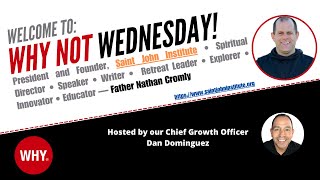
A recorded interview (WHY NOT Wednesday) with Father Nathan Cromley exploring Christian leadership and how faith reframes leadership practices. Father Nathan contrasts secular leadership frameworks with a Christian perspective that aims for deepest human fulfillment, describes servant leadership as using personal greatness to lift others, and explains how he applies these ideas across teens, couples, and business leaders. He describes his ministries (Eagle Eye Ministries, St. John Leadership Institute, St. John Leadership Network), programs (management workshops, masterclasses, retreats), practical logistics (workshops are multi-day with prayer, meals and training), a personal "why not" vocational moment at a La Jolla beach, and asks listeners to visit stjohninstitute.org to donate or view events.
Questions this video answers
Since 2007.
Born and raised in Toledo, Ohio; currently ministers in Denver, Colorado.
stjohninstitute.org (spelled out as 'saint' in the transcript).
Approximately 115 events last year.
Multi-day (arrival day + two full workshop days + departure day), with meals, prayer time, and ~6–8 hours of training per day; masterclasses for owners/executives occur ~4–5 times per year.
Chapters
These last few years have made us question everything.
Our relationships.
Our jobs.
What constitutes an office.
And who we are.
In a.
World filled with chaos, confusion and uncertainty. It's time for some clarity. It's time to start understanding one another.
It's time to start understanding ourselves.
We envision a world where everyone knows their why.
But even more, we.
We envision a world where everyone knows their yos.
Their why, their how and their what. The operating system that drives you, that lets the world know where you stand.
What your unique gift is, and most importantly, who you are.
Yoshi, are you ready?
Hello everyone and welcome to why Not Wednesday. We have got a great guest for you guys today. Our guest today is Father Nathan Cromley, who is a speaker, he is a writer, a retreat leader, an explorer, an innovator and educator, and someone who is totally devoted to Our Lady. He was born and raised in Toledo, Ohio, and he has joyfully served as a Catholic priest of the Brothers of St John since 2007. He currently ministers in Denver, Colorado. Father Nathan's teaching and dynamic witness has touched the lives of tens of thousands of teenagers, married couples, families and business professionals throughout his career. Welcome to the show. Father Nathan, how are you?
I'm glad to be here. It's really an honor to be part of this wonderful podcast.
Well, we appreciate you being on. I know that Gary Sanchez had you on his beyond you'd why podcast. I can't believe he beat me to it. I know we're going to be airing that soon, but I'm glad to have you on and to share your wisdom with our audience. Our audience is a lot of our why coaches, a lot of potential Y coaches and business leaders. And you know, one of the topics that I definitely want to talk to you about is the topic of leadership from a Christian perspective. You know, oftentimes we, the, in our society, we talk about leadership from almost.
Not from a Christian perspective. We talk about leadership almost just a very.
Business like approach to it. But you take, you take it, you take a, you take a leadership approach from one of the greatest leaders of all time, Jesus. And, and, and the Christian perspective. What's it mean to what, what is Christian leadership to you?
It's, you know, I'm glad you asked. And it's a, it's a question a lot of people have. I want to just maybe back it up for a second and make us realize something and that's that you are always defining the parameters of how you look at something. There's always a set of givens that govern Your judgments on that thing. So when we say we're doing leadership and we say we're just doing leadership, not Christian leadership, it's actually not really correct because the fact is someone, some philosophy is predetermining the parameters of how you define that. For most of us today, it's modern science. We say, well, we're going to accept what psychology tells us, what sociology tells us, what history tells us, and there's nothing wrong with that. But when we're talking about Christian leadership, we're talking about the, the. Could we define the parameters of leadership according to the faith, the, the faith that Jesus Christ came to bring to the earth? And when you realize that you always have someone defining how you're defining leadership or the parameters by which you define leadership, that it suddenly becomes an enticing option to compare them and say, well, you got standard leadership, which is actually governed by, say, modern science or history or whatever we want to define it by. And then you have another, another set of parameters. What happens when you put the faith of Jesus Christ as the parameters of your definition of leadership? I think some really neat things happen. Leadership stays the same no matter where you are and what you're doing. Leadership is going to be the study of our influence. It's going to be how we impact the world around us and how well we do that, how deeply we do that, et cetera. When your Christian leadership comes in, we don't change the mechanics of what leadership is, but we offer a new perspective with the why behind the leadership opens itself to the infinite example. And the knowledge that we have of the human person that we're impacting is suddenly broadened beyond anything that, well, a secular approach could ever give. So in, in a real sense, a Christian understanding of leadership, it applies the same rules, the same things. Everything that's true in a non Christian stance about leadership is going to be true in a Christian stance, except that the Christian stance is going to go even further and allow us to go even deeper and what we're trying to accomplish with our people.
Great.
Thank you. Thank you for backing up and thank you for backing up and giving us that, that background that's so important. And you know, what you talk about tough leadership, you know, when we think of the story of Jesus, you know, people say, well, you know, how hard was that? You know, they were being persecuted not only by his fellow Jews, right, because he was bringing something to them that was completely different. But, but the Romans didn't like what he was doing. And if you followed him, you, you Basically.
And then.
And then there. There was the zealots, right? One of whom became one of his disciples. So there was all these things. Why would someone want to follow that guy? I was in the military, and one of the lessons I learned. I remember one of the lessons they teach you is if you're in an ambush, you turn your weapon towards the fire and you run towards it. It's so counterintuitive, but that's survive. And not all of you are going to survive. But if all of you turn towards the fire and aim all your fire towards where that ambush is coming from, you have a chance of taking out the sniper or the ambush. If you turn and run, there's no way you're going to get. So I always said, you know, if you can do that, that's leadership. Well, same thing. What would. What would cause someone. What do you attribute, you know, what would, you know, I guess take us back. I know this is something as a religious. You do take us back if. If you're in Jesus's time. What would make someone want to follow Jesus, given all, everything they had going against them?
Well, it was. The secret of what Jesus brought to us is that his perspective was the deepest. His impact that he was trying to make on people wasn't just to help them get a new job. It wasn't just to help them to make more money. You know, things are very good. It wasn't that they find friends and influence people. This is. He was shooting for the deepest transformation and the deepest fulfillment of their deepest. Why. So when you think, well, what's. What made Jesus so special, why people follow him? It's because he was offering. Think of it this way, like when you. Even. Even if you don't have faith, if you just sit back and say, what do Christians saying that they give the world? We're actually saying we give you a chance for fulfillment at the deepest level of what you could possibly imagine, despite all obstacles from the outside, from the inside, from the future, from the present, and from the past. So it's like we are, from a Christian perspective, really offering the world a very persuasive model for leadership. Our leaders ought not to be able to be stopped as they move us towards the deepest of goals. If there's one criticism you could make of Christian leadership, it'd be that we're not shallow enough, you know, that people don't want to really have this deep thing. They just want to have some superficial existence. And I'd say, yeah, that is true. We do kind of come up short a little bit there. It's because it's called the cross. The whole problem is that you kind of have to be willing to lose everything to gain the big thing. That is. That is one hitch in our proposition, but I think it's a good hitch in the end to be stuck on.
That's really good. In the introduction, Father, we talked about the different impacts you've had. You work with teens, you work with business leaders, and you've worked with couples. How is it different in terms of talking about this deeper leadership? Let's take them one at a time. With teens, how do you get into this depth of leadership and how do you get them to understand, not shallow it is right. And. And bring out the best in them?
Well, you know, it's just like anything you. You need to know your customer, so to speak. You need to know the one you're talking to, and you need to know the deep needs that they have that are driving them and then to connect the Lord, the message with those deep needs. So I don't just. I work a little bit with teens, much more with young adult community, those over 18. But in both of their situations, though, what's driving them is the need for inclusion in a group and the need for friendship. And so the impact of a Christian leader there is to speak into that about that. If they give themselves away, if they give the best that they have as an act of service, they'll actually find that approval. And the friends that they're looking for, married couples, that. That impact that I think Christian leadership brings, it's the same thing as to say that you can live a life that's on fire, that mediocrity does not have to be your lot, that your, Your marriage has a significant family, has an impact it can make far beyond survival or a selfish end. You can transform culture and fight back, so to speak, against the negative negativity around you by creating a culture within your own love and your marriage. And of course, the business professionals, I think it's a similar line, but it's the, the impact that they could do with their wealth, with their work and with their workers with their wealth by. By having it be managed well so that it grows the business and the business's impact and the charitable giving, that they can do the work itself by making good goods and good services. It's like this kind of sounds silly, but doing things that are good for the world and doing them well, and then by their workers thinking that every day every family that works for you is being Transformed by you. And so a Christian perspective taken in the workplace says that what I'm playing with here is power. And with great power comes great responsibility, right? So I'm now going to utilize that power to its best end for. To really transform the society from the inside. So in all three of these, there's the same dynamic that's at play, and that is that I am made in order to make the biggest impact possible at the deepest level. And I do that by relying upon a power that's greater than me, relying upon the power of God. And what I try to do at St. James Institute is to connect that power of God and the power of faith to the need, which is cultural transformation of the workplace, of society, of the family, right? And the bridge between making that cultural impact and the resources we have given to us by God is the heart of the leader, the one who steps up into it. And in the end, it's really a wonderful thing. That's where we overlap as Christian leaders with leadership.
Coaches were in the secular realm because both was trying to do the same thing. We're trying to get our people to put their identity behind their actions. It's just that in a Christian perspective, we're trying to do it really by the whole wholesome game, right? And the whole person, including every aspect of the depths of their heart. So we work together to the same end, which is.
So now you brought up a lot of things there that I want to dig into. You know, in leadership we hear all the time it's almost cliche. Everybody talks about servant leadership, but servant leadership, I mean, you can't. I can't think of a better example. And I'll let you quote the quote because it he that he, Jesus, talked about serving others. I'm not here to serve for you to serve me. I'm here to serve you. And that's what he did. Everything he did was in order to make other bring his disciples forward to teach them. And, and I love this when you talk about St. John Institute, raise up saints to lead. We bring faith to leadership and leadership to faith in the home and in the workplace. Talk about servant leadership from your perspective. What does that mean when, when we put a Jesus perspective on it as, as it. As the ultimate servant leader. How do you bring, how do you define servant leadership?
Well, I, I'd love to just say again, this is an overlap to my friends who aren't in the faith or aren't using faith or whatever. Don't isolate Christianity from the, from the conversation. Just like Christianity Mustn't isolate your secular insights from our conversation. The two need each other. It's just, we're operating on two different levels, but we're doing the same thing foundationally. So a servant leader is someone who develops their greatness in order to lift up the greatness of everyone around them. So obviously from a Christian perspective, we can go really beautifully on this. Go, go nuts on it, because our Lord. You quoted John chapter 13, where Jesus washes the feet of the disciples and says, I have done to you, so you too must wash one another's feet. Right. So, and this is a beautiful thing, so we can, we can wax eloquent on it, but foundationally, I'd like to issue kind of a challenge to, to those who aren't in the faith or practicing faith with your leadership. What are you developing your people towards if it's just that they achieve their goals for their own sake? I think we're, we can lead people to being anti leaders where actually they're not really leading, they're, they're out. They're in a position of power that's bringing, bringing other people into servitude in one way or the other as they advance themselves. And so that, that's necessary to a degree as a part of leadership. But leadership has to be capped off by a real benevolence, a philanthropy towards other people. And that's why I think all authentic leadership is servant leadership. Because if I develop myself and I cut to the edge of things and I make everything happen in the world around me and I'm a great leader, it ought to be to lift up everyone around me instead of exalting myself. It was St. Thomas Aquinas, who's a Catholic thinker, Catholic priest in the Middle Ages who gave this definition. He said the difference between a tyrant and a king is not in whether or not they have power, but in whether or not they use power for themselves, tyrant or for their people. The king and I, that's where servant leadership comes in. I've been given my power and my resources and my success and develop myself, my skill set, so that I be the most effective at lifting up everyone else to a better place where they themselves are better leaders. And then there's no problem with self development. Otherwise though, we can really run the risk of creating people that are, are not really leading people to fulfillment, but are leading people to. I don't, I don't even know. It's a. Serving them in one way or the other.
Right. That makes, that makes a lot of sense. You know what? You know, I just realized, Father Nathan, we started talking so quickly about leadership, I forgot to go into. Into your why operating system, which everyone who watches this show is expecting to hear.
Okay.
And I bet they can guess just from. From hearing you talk for the first 17 minutes. Your. Your why is to challenge the status quo and do things differently. We know that with people with this why for them, it's not about doing it the way everyone else has done it. It's about thinking outside the box, challenging people to look at things differently, to dare great things as your podcast, it is called your how is to find a better way and share it with others. And what we know about people with the how a better way is they love to find better ways to do things. And when they figure those things out, they share them, which I think is a lot of what you do in your ministry. You find better ways to do things and then you share as you challenge people to do, to look at things differently. And then ultimately, your what is to make sense of things. You help people make sense of things, whether that's. That's understanding leadership, whether it's understanding scripture or how the two fit together. So I wanted to make sure and share that with our audience because they're probably saying, oh, man, this guy has got to be a challenge guy. He is. He's just the way he's talking. But I did want to bring up your podcast that. The Dare Great Things podcast, because you talked about being a great leader or just living to your full potential. Tell us about the Dare Great Things podcast.
Well, you know, I was. It's a. It's a podcast where I share some of the talks that I give to folks. And so it's. It's not a chit chat kind of podcast. And unfortunately, I'm not as sophisticated as you guys with your whole interviews. And isn't it. I mean, you've just quite a. This is an impressive podcast. Mine's very humble. It's just me talking. But what I try to do is I try to show the interplay between faith and business leadership, and then I'll fold in some family leadership as well. And I really. It's an inspirational kind of aspirational podcast. It's not so much of a teaching, although we have our moments there, as it really is kind of giving key insights in ways that inspire people. So it's great for when you're on the road or when you're. You're jogging or something like that. But I really, I think there's just so much to give to see where these two overlap. I mean, isn't it. I'm astounded when I see that the faith. What is this supposed to do? It's supposed to make you bear the influence of God in the world. Well, then I look at leadership and their leadership, people are saying, we wish we had people that could bear influence. I'm like, well, the faith is supposed to produce people who bear influence. Wouldn't it be great if we produce them to give them to you? You'd be, It'd be a win, win for everybody. And so I, I don't know why I'm one of the few voices saying it, but I'm gonna say it as often as I can because it's obvious to me.
Well, as a, as a, as a better way guy and as a challenge guy, you've got not just one ministry, you got three integrated ministries, Eagle Eye Ministries, the St. John Leadership Institute, and the St. John Leadership Network. And I think that all starts with the St. John Leadership Institute. Right?
Yeah. That's kind of the heart of it, right? That's where we come up with some of our ideas and then, and then we develop them. Our young people is really to inspire. The Leadership Institute is to equip, and then Leadership Network is to engage, is to get people in the field. And we're starting a fourth that'll be coming out in the next month or so called dare great things.org dare great things.org and that's a content hub so that everyone who interacts with us can then go and be enriched by ongoing content. So, yeah, I'm definitely challenged. Without it, I don't really know what to do. That's why I left Mike. I got your survey done. I said, man, how did they get so accurate about me? It's a pretty well created machine there. Because it's true.
Well, we've enjoyed. Both Gary and I have enjoyed talking to you and learning more about you. When you train leaders, when you bring business leaders, what is the biggest challenge that they bring to you? Because I know, listen, I'm a Catholic and I go to confession. I know what my challenges are. But when you come together with other fellow business leaders and you get a chance to kind of bare your soul and say, this is the biggest thing I'm struggling with, what's the biggest challenge that you're able to help them with when you, when you put these leadership retreats together for business leaders?
We give hope. We give hope and perspective of positivity and encouragement. I think that Their biggest challenge is themselves changing their mindset from, from mediocrity in many ways, with all due respect to everyone who lives in an atheistic mindset, because I think it's fine, I'm friends with everyone in the world, but boy, I find sometimes that mindset can be so self limiting because in the end I've got people who are like, well, I'm successful, but you know, what's that? I can't wait to sell my business for the highest profit I can. This or that or this. And they lack a motivation that they can rediscover when they, you know, they, they go through the methodology that we give at the St. John Institute. We work with people with faith, we work with people who don't have faith, we work with secular audiences as well, but we give that same spirit of, you were made for greatness, you were given what you have to bring people up with it. My goodness, you know, don't get in your own way. Instead, rediscover hope. Rediscover a positive vision for why you are successful, why you're striving to be successful, and the great things that can come about through it. And of course, if you have faith, well, that dovetails into all kinds of wonderful things. And if you don't have faith, it still is a wonderful message that they need to hear. Because here, here we. You work your whole life to be a leader and you're successful in your business, but then it's like you, you don't know why. I'm like, I could list every name of your employee and say why. And if you just focus then and on them and making their work experience better and developing them more and encouraging them to bring the good things that work home into their family life, we, we would all be contributing to society. So my biggest challenge in general for the Christian folks that, that work with me, which are most to the people that I work with.
They'Ve defined their leadership in a worldly way. And it's just kind of like a box that they stick in. And I just love to blow that box open and say that God puts you. When a leader gets a hold of that message, it is so amazing to see the transformations they bring even in the workplace. And instead of listening just oftentimes in a way that's not Christian or not content with the Christian faith, now all of a sudden they're like, I own this business. Why wouldn't I stand for this? And then put forward a message that's consonant at least with the values of the gospel. And they do that. And then that of course brings new life into them. So I would say, all told, is the lack of the willingness to experience challenge.
I wish I could bring my iOS yos to bear more folio with that.
Well, we, we can help you with that. That's a whole separate conversation, Father Nathan, but let's talk about this because I want to make sure we, we talk about your why not moment, you know, when, so we always ask this question throughout the show is what's a why not moment for you? A time when you said, you know, why not? Why shouldn't I do that? And I think you dare people to do this, you challenge people to do this. But you, you had, you had a big why not moment in, in your life. Tell us about that why not moment.
Well, so I'm a Catholic priest and I'm dressed in his garb because I'm, I'm a friar, so I'm a special kind of priest who has renounced the things of this world, right? So I, so that's why I'm dressed like this. I wear this everywhere I go. And so having renounced money, having renounced marriage and my family, renounced obedience, by obedience, I've renounced my own will. And you know, I've just really given everything that I have to God. I very spiritual kind of life. And yet if I started this endeavor working with the business professionals, I would be plunged in things that are very worldly and I would need to fundraise, spend a lot of my time fundraising to keep my non profit going, which by the way I'm doing right now. If you want to support me, go to our website, you know, like that kind of thing. It was such a mindset change. And I kept thinking about all the people whose lives could be impacted if I did that change. But then I was thinking also about all of the ways that that would impact me and in many ways live a life that's not my natural self, which is a self, self sacrifice in prayer, so, etc. Instead I'm on podcasts, you know, doing business leadership. And I was mulling it all over because I'd had a phone call with someone who had said how much this was going to cost me if I, if I did this. And I was again thinking about all of you who are watching this and I'm like, they're waiting for a message, you know, will I give it? Am I the one? Is it worth it? And I was happened to be in La Jolla, California, which if anyone's ever is my favorite place on earth. I think there's a beach there, and it's just marvelous. And I remember I. I was thinking all these things, and I just started running. I just. I just took my sandals off and just started running along the beaches, jogging, you know, and the sun was setting and I stopped. It was one of those runs where you felt like you could run forever. I must have run two miles, you know, And I. And I just stopped at the beach and I watched as the sun went down and turned all the ocean orange and the waves were coming in at my feet. And I was all alone. And it was like between me and God. And I thought to myself, well, what's a life anyway if it's not given? And I just kind of was able to smile and look down. What would be a whole adventure of life that I didn't have to take if I didn't need to, didn't want to? I said, what? Why not? You know, to put it in your language, but foundationally, I said, all of that is meant to be given in love. And so I just made a covenant with God and I said, let's do it. And I took that fork in the road and I've never looked back. And it's something I don't regret ever, because of the fact that. Because I'm able to bring that hope and the truth of the greatness of the human person and into so many people's lives and meet people where they're at and fight for our culture and just the. The cost was one life. Well, there's. There's little parables about what happens when one life is given and the many are saved. And so I'm. I'm just kind of happy to be a small part of that and to have said yes to God when I could.
And, you know, well, let's. Let's do. Let's do this. If somebody wants to help the St. John Institute or, or any of your ministries where. What's the best way to do that?
We have a wonderful giving page on our website. So you go to any of the websites that you saw there, that all goes the same giving page. You go to st. Johninstitute.org that's s a I n t all written out. Johninstitute.org and then you donate in the upper corner. We made it easy for you and I thank you.
Advance because it goes. Doesn't even go to me. I don't even get a salary. I took off all poverty, so I don't even get paid.
So we're, we're talking for God and.
Do it for you. So another thing you could do if you're not interested, if you're not interested in donating, it's just go to a program because all the program things go to sustain the ministry.
Excellent. So what kind of programs? I know you've got a list of them. Which, what is the. If I, if I'm a business leader and I want to incorporate my Christian values into my business, what's, what's a program that you have that somebody should attend? I know you've got something coming up in Denver soon, right?
We've got management leadership workshops in Christian management that we do for managers or professionals who are at a level in an organization. And then we have a master class for business owners or executives who are over, you know, large parts of the company's culture. And we have, so we have four or five of those a year. We have retreats also for business women, we have retreats for businessmen. So you have a lot of faith based opportunities. But then I also come into your company, even if it's a secular company, it's fine. And work with the people and doing, you know, management training or bringing a Christian perspective to your leadership team. I'm able to speak on all those subjects.
I realize I muted myself. Sorry about that. So, so when is the next, next workshop coming up? And I'm sure they're listed on your website. We've got the St. John Institute website on there. And how many people come to those? What's, what's, what's the format, Mike?
Oh, well, it's usually a, a two day of classes, an arrival day and departure day. So it's basically four days nights, but you know, with your travel included in there and two full days of a workshop and we have meals and prayer time and then we have about six to eight hours of training a day given in at our place in Denver. So that's what we've got coming up is coming up in September. But we, if you go to the calendar, we did 115 events last year. So it's, it's hard to just say we do 115 of them. So what is that, 10amonth? So just maybe head to the website.
Go.
Into events and you'll see the calendar with upcoming events. Every Thursday morning I do a phone call and so you can sign up for our newsletter and then you'll get a text reminding you about the phone call. And I just love that you want to be doing them tomorrow morning.
Outstanding. Well, Father Is there what's. What's the one piece of advice you would give a leader who want. Who. Who is struggling to incorporate their faith into. Into their business?
Be not afraid. Remember that faith equals love. So if you are scared about the faith aspect, we'll put it behind love and work to love your people. The faith in business doesn't have to be explicit in the workplace.
It needs to be in your heart. Ground yourself really in your faith and in the Lord and then do what is good for your people. Then if the situation arises and it's appropriate to share your faith or put a symbol of faith around you, we'll do it. But you're already living it out. If you actively are truly loving by good goods, good work and good wealth. Those are the three things. Make sure your work is good, your goods are good and your and your wealth is is what is good and you'll be fulfilling God's command and do good things for people. I think in the end we can be really scared by it. Don't be scared. Put it behind love and make sure love is present in everything that you do and you'll be glorifying God.
That is amazing, Father. That is a great answer. What do you say we end the show on that note?
Why not?
Thank you so much for being on with us, Father Nathan. There was so much wisdom packed into that half hour. I really appreciate you sharing it with us and know that you've got some friends at Y Institute. We're going to promote this. We're going to let people know how to send money your way and sign up for your workshops and and come learn how to lead with faith. Thank you so much for being on. Have a great rest of your week and I look forward to talking to you again soon.
Take care.
More from Dr.




Women In Leadership: A Need For A Greater Systemic Change With Belinda Clemmensen






