WHY NOT Wednesday! with Frank Wagner
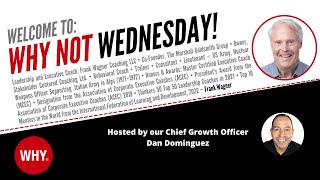
Frank Wagner met Marshall Goldsmith in 1972 and co-developed stakeholder-centered coaching. He shares how he coached a leader to develop his team instead of commanding growth, and describes his practice of sending twice-monthly quotes to his seven grandsons, aiming for 100 total.
Questions this video answers
1972
Week of Wednesday, May 10 (the host references that week; interview refers to May 10/11, 2023).
He sends each of his seven grandsons two quotes per month, aiming to collect 100 quotes.
Chapters
There's a certain kind of coach who believes what we believe.
Who leads people to greatness, who gets people unstuck, who unlocks all of your passion. A coach who helps people discover what drives them to tap into their superpowers. Then knowing your why is the first step to untap potential.
To focus.
To breakthroughs.
A coach who's looking for a better way.
Are you that coach?
Hello everyone and welcome to why Not Wednesday for the week of Wednesday, May 10th. I am excited to introduce you guys to our guest today. Frank Wagner, who began his consulting career at the center for Leadership Studies with Paul Hershey back in the late 1970s. He's in the green room right now. We're waiting for it to bring him on, but you know, he said let's not do a lot of time on his introduction, but how can I not, you know, He's a co founder of Marshall Goldsmith. With Marshall Goldsmith he co developed the highly successful excellent Manager program originally for IBM. Then of course they, they spread that to many other Fortune 100 companies. And then Marshall Goldsmith himself asked Frank to oversee the design and training of coaches in using his principles and methods of helping successful leaders improve. And then together they co created the Marshall Goldsmith stakeholder centered coaching, which I've been working with a lot of Marshall Goldsmith stakeholder coach centered coaching certified coaches recently. And I've got to tell you, this guy did a fantastic job. Everyone I've talked to that knows Frank has nothing but good things to say about him. He's definitely made an impact on those people on the coaching industry and on leadership overall. And I can't wait to talk to him. So without further ado, let's, let's bring on Frank. How are you doing today, Frank?
Well, I think it's good if we end right now because I can't get any better than that supposedly. So thank you so much for your warm introduction, Dan.
So Frank, you, you are, you're, you're a hero. You're. You're. You know, one of the things I found out, Frank and I are both army veterans. So we were just having a little conversation before, before we came on the air and, and we were sharing army stories and I know Sunil, my EA who manages the show, if you've been on the show, you know, Sunil, he was probably getting nervous because we had to go live and Frank and I were just going back and forth. But Frank, what a great, great.
Legacy you've created with the work that you've done with, with the Marshall Goldsmith organization, with the Coaches that you've helped train and bring on over the years. Tell me a little bit about it. I mean, how did you and Marshall Goldsmith.
Me?
Well, we, we met in 1972. So I mean anyone on the call, you can maybe think back and say, gee, can I remember what I was doing in 1972? Well, I had just gotten out of the army and I was headed back to UCLA Business school where I received my MBA prior to going into the military.
Right.
And I started the PhD program in in. Interesting because our school was pretty avant garde. They called it human systems. And there are only two other people besides myself who started and one of them was Marshall. So, you know, we became good friends as doctoral students together. We ended up teaching together as our first professional life after getting a PhD and then became consultants with Paul Hersey. And then the firm that they started, Marshall started with Joe Kilty and was. Did leadership training for 20 years. And then we sort of morphed into the coaching arena. So that's it. Marshall for over 50 years.
Yeah. That's fantastic. And you know, one of the things that one of the things we're going to touch on Frank is, is your yos. Because, you know, we're the Y Institute and we talk about that. And when I tell people your yos, I don't think a single person is going to be. Is going to be surprised that Frank's why is contribute your why is contribute your how is better way and your what is trust. So what we know and what I like to do, kind of to set the tone for our viewers, anybody who's seeing for the first time. So what we know about Frank is as a contributor, he. He wakes up every morning wanting to make a difference in the lives of other make a difference, make an impact. You want to be part of a greater cause and you care about the success of others. So that's your why. Your how is to find a better way. So what you do, the way you contribute to others is by finding better ways to do things and then sharing them. And then ultimately what you can count on from Frank is that he will be a trusted source. You can count on if he says he's going to do it, you can count that it's going to get done. He's a man of his word. He does that and he probably expects that from others. How did I do with that, Frank?
Well, it's funny Dan, because I can't remember now how long ago was that I did took the Y assessment, yos assessment and just not knowing what I was going to receive in terms of the results. When I read the results, I said, I don't think I've ever had a profile. That first of all was so easy to do and so time efficient. That nailed me so perfectly. You know, I don't know whether that's the experience, how many other people have that way, but I mean, it really nailed me. And you know, as an example, the, you know, you mentioned Marshall Goldsmith. Marshall's latest best selling book is called the Earned Life.
Right.
And, and you know, for the first time I was actually one of the examples in his book the Earned Life. And you know, he usually mentions all these really famous people, right. And he does the same thing in the Earned Life. But you know, for instance, in, in this book, right after me, he spends a long time talking about Alan Mulally. And I mean, I know, well, and, and people, anybody read. Well, most people read the book would maybe know who he is. They said who in the world is Frank Wagner? Because I don't like to be out in the spotlight.
And that's what we know. And you know this, we know that about contributors. You're all about putting other people in front and making them look good and helping them succeed. You make an outstanding leader because you're always going to make sure that your people succeed. And you know the other thing, and I want to put up Watson's, Watson's comment, he says, wow, an innovative, powerful relationship powerhouse. And, and that is definitely you, Frank, just for, and I'll speak for me. You've introduced me to so many people that I have developed great relationships with. You introduced me to the, the current CEO of Marshall Goldsmith is Brandon Murgard. And we had a great conversation. You introduced me to Julian and we had a great conversation. And through them I was able to meet some other Marshall Goldsmith coaches who are now part of the Y Institute and the, the Marshall Goldsmith family. As a matter of fact, John Saunders is on. He, you know, you probably know him and Bill Summers, you were asking if he'd be on. So there he is. He is in Minneapolis via Austin, Texas. So you've got so many fans. You know, I know you're, you're being, you're being modest because Marshall included you in the book and told a story about you. But I think you deserve to be in there. And I'm sure all those people that are listening and that are commenting would say the same thing. What's, what's the biggest for you? What's been the biggest positive impact you feel you've had in your career with, with the Marshall Goldsmith Organization?
Well, yeah. Well, first of all, let me. The reason why I actually brought up the book is. Yes, he, he uses me as an example in terms of one of the key frameworks. Just like the, you know, YOS is a framework.
Right.
You know, and, and you know, and based upon, you know, Simon Sinek's groundbreaking talk and work about to help people understand where you start and what's in the middle and that's your why. And then, and then it builds out in terms of how and what. And not everybody intuitively would know to put it that way.
Right.
And so it's a very powerful model. Well, Marshall has a, among other things, has this model that he just put together for the first time for this book and it talks about the three A's and at the base of the model it starts. This is the reverse of the Simon Singh model. Starts kind of the outside and goes in it says you have actions. Actions. Okay. What's actions is what you're doing now. Everyone acts, everyone does something like, you know, they have a profession. But what do you actually do?
Right.
Then you have the next level up is your ambitions. And the ambitions are what you want to accomplish. And now ambitions have a time boundness to them. You know, I want to be a CEO of a Fortune 500 company. Well, if you, if you're not a CEO of Fortune 500 company, you didn't achieve that ambition. If you have the day you became the CEO, the ambition's accomplished. Ambitions have a timeline. But see, so there's actions, there's ambitions. And by the way, remember Marshall's book the Earned Life? The people that really have a very good earned life, there's a connection between their actions and their ambitions. They're successful people because the actions line up with their ambitions. A lot of people have ambitions, but their actions don't line up with them. The last A. And the reason why I'm bringing this up, it's very similar to the why and it's your aspiration. So your aspiration is a pursuit of something that does not have a time bound element to it. So you show see and see. I love the way that's coined for me through the why profile.
If you just say one word, it's contribute.
Right.
And but the elements of how you contribute is, you know, is to others, but. But it's also connected to a larger goal or you know, a facet. And see, I'm more of that tactical guy. I like to be in the trenches with people and although where I think I either was fortunate, just lucked into it, is my clientele are leaders. And leaders have a. Have a bigger impact. And depending on where you go and how high you are, the leader is the organization. You're having a big impact.
Right.
So I love, for instance, the work I've done in places like the International Red Cross or unicef or, you know, the, the. The. The Nature Conservancy.
Right.
Like I, like I coached the chief scientist of the Nature Conservancy. I mean, I didn't realize how big they were. He had 800 scientists around the world reporting to him. No, I'm only working on one. With one person.
Right.
But based upon that work, what kind of an impact can that have on our planet on lots and lots of people. So, you know, like I said, the. I can't say is like, how did they kind of get into my brain with my yos.
You know? And then so like, so the next thing is, okay, my. Why is contribute to the success of others. That's the way I describe it.
Right.
I don't bring the higher, you know, the bigger cause, the higher purpose.
Right.
You know, that, that kind of thing. But then, you know, when you talk about my how.
Right.
Which is, which is, you know, finding a better way.
I'll give you just a perfect example. I sure. I'm a guy that remembers what happened yesterday. It's sort of like my deceased business partner, Chris Coffee, who was an actor before I met him in Hollywood, is, you know, in Hollywood, you're only as good as your last movie, right? Well, so I was coaching last week. A president of a large organization. They have 1500 locations around the United States. They have 30,000 employees. And I've been coaching them. I'm almost done with my year coaching.
And just last week was one of their quarterly board meetings. And he's being groomed to be the next CEO.
He's the number one internal candidate to replace the current CEO, yet you can always lose out to an outsider.
Right?
So the board meetings are very important because the board actually makes the decision. I mean, the CEO would have this guy replace him, and he's part of the board, but the board makes a decision. So one of the things that the board is very, very interested in is that they really have. They really drive for growth, right? I mean, they really are pushing to grow, grow, grow, grow. So he was, we were talking about him getting ready for the board meeting, and I listened to him, what he was saying, and what I did is I picked up on Something I had just read that morning at breakfast, and it was. It was an article about the Ukraine, and a key part of that was about Putin. So I listened to the guy explaining what he's going to do, because I asked him, okay, how are you going to. What are you going to do in terms of the work this week? And he's describing about this aggressive growth and how we got to drive growth and all that. And I said, oh, it sounds to me you're acting like Putin. And I mean, it just. But I didn't know I was going to do this. It just came to my mind. So you're just acting just like Putin. And he acted like. I could just see, like I slapped him across the face, right? And I said, now let me explain why. I mean, look at what Putin has done in Ukraine. I mean, how much good has he done with his actions? And he's pretty much acting like a dictator on this thing. And it sounds to me you're acting like a dictator. You shouldn't be talking about your role in helping drive this culture of growth. You should be describing how your team all the way down to the bottom of the level of the organization is driving growth. You want to be more like the Ukraine and less like Putin. And he stopped me, started by. He just said, thank you. See, but see, that's like finding a better way. I mean, I was playing very. Just to remind him to do much more of building up his team. And the board's going to believe they're successful if all the way down at these centers, these 50 centers, people are driving growth. It's not just being done at the top of the House. So, you know, that's.
That is such. You know, but you covered both, Frank. You really covered a better way. And a better way is to contribute. Right. To do care about the success of others, make it about his team. Right?
Yeah, I think it's. And then the other thing, too, is, remember I. I chose a particular field of both study in my PhD and then in my career, and that's around leadership.
Right.
You know, I mean, I work with all these people, and I keep thanking God that I didn't go into. Their line of work is too complex and rapidly changing. And you got to keep up. Leadership's a timeless thing. I mean, it's what was good for a leader a thousand years ago is probably good today. Now. It doesn't mean we don't have enhancements and refinements on what we're doing. But when you look at leadership, I mean, there's only one thing you need to be a leader, and that's to have followers.
Right?
And what you're doing and people, what you're getting at people because they're willing to follow your influence. And if you read tons and tons of leadership books, you'll say it all winds up being about trust. That's why. What was trust?
Right.
Build relationships based on trust. So that's what I, so I, I've got it. I've got a, you know, again, my success. You talk about my success of anything is just be a living example of what you're preaching to others.
That is such, that is so, so good, Frank. And I asked you the question, you know, because you, you've been there a while. You've known Marshall for 50 years. You've been at Marshall Goldsmith. I think every coach that's come through in the last 30 years has had an experience with Frank Wagner. Everyone I talk to, if I mention your name, they, oh, I, I, all of a sudden I transfer that trust and now I've got to just keep it right. Because you're such, you're such a legendary name with these people. When I asked you the, the question, what, what's, what's the experience been like working with all these leaders who work with leaders around the world? You've been able to magnify your impact through these leaders. What's the most rewarding thing you've done when working there?
It's hard. I mean, every, every day it's rewarding. You know, in terms of, you know, again, I have my own daily checklist. I ask myself five questions every day. Well, actually, I have two. Two checklists. One of my checklists is the five principles or values of our stakeholder center coaching community. But I also have my Frank Wagner personal ones. And by word, I learned to put together a daily checklist from Marshall. He's been doing it a lot longer than I have, and I've refined mine over time on this thing. And so my first one is, did I do enough? Am I going to do enough to make a pot to, to ensure I have a. I'm fully healthy in all respects. Right. So, and so because, and this is, I learned this from a, from the, it used to be called the Human Performance Institute, a bunch of psychologists and sports physiologists in Florida to work with premier athletes. And so you look at your physical health, your mental health, your, your emotional health and your spiritual health. So those are my crimes to have. I'm doing enough to maintain my health, then, you know, Then. Then my second thing that I'm looking at for myself is I want. I want to make sure that I'm treating every single person I meet with dignity. I uphold their dignity in terms of what I do. I choose to be grateful for. For what I have. And. And then I do enough. And here's the thing we. I do enough to make a positive difference. So you say, what's your greatest thing you've done? My greatest thing is, did I make a positive difference today?
And I don't get to decide whether I made a positive difference. I've got to get an unsolicited. Here's my high standard. I got to get an unsolicited comment from someone I'm with that what I've done in terms of contributing to their success has made a difference.
That's when I can feel good about myself. And then I do. I said, dude, did I do my best to avoid regrets? If I can do those five things every day, I'm in good shape. That's what I do.
That is a. A great checklist. And, you know, I've got a comment from Bill Summers, said St. Francis of Assisi said, if you're walking isn't your preaching, there is no reason to walk somewhere to preach.
And, boy, well, thank you for that, Bill. Yeah, See, that's my patron saint. And by the way, my. I have seven grandsons. The oldest one who I just got a text from Today, he turns 30. One month from today, on June 10, he will turn 30. I've got then after him, I've either six other grandsons. The youngest is 16, and he is going to be confirmed in the Catholic Church. And, and. And he asked me to be his confirmation sponsor, and he picked St. Francis as his, you know, as the saint that's going to kind of represent him. So I just sent him this last week, a book about St. Francis. So thank you for that, Bill. Yeah. In fact, you know, another little quote of St. Francis is. Is preach. Always use words when necessary.
Yes. And as I said before, Frank, you're such a great example of that. We got another one of our luminary coaches, Raymond Kemp. He's a former fleet master chief of the Navy. He spent more than a few years in the military, Frank, almost as much.
As you and me together.
Right. If we combine you and I and then multiply it times three, that's how much time Raymond Kemp spent. He was. He's a great leader, and he says that is a great standard, making a difference. You know, I think at the End of the day, we all want to make a difference and make a positive impact and you're such a great example of that. You know the, the other thing, I like what you, what you said, we talked about it in the pre show. It's not about what you've done all the time. It's what did you do today. Right. And you take it one day at a time and you build on it and then eventually you create that standard that you live up to with that amazing checklist. So thank you so much for sharing that. I will tell you, speaking of St. Francis, we had our dog died this, this weekend. And.
And so you know, he's, he was 12 years old, my daughter's 11 and he's, you know, he's been her dog since she was, she was born and we, we got him. St Francis has been around us this week because I, I got a little. We, we buried him under his dog house so he's going to always be there where his dog house used to be. But we got a St. Francis statue that we put right in front of his dog house. So kind of watching over him. And, and our daughter calls our farm St. Francis Farm and Field. So that's, that's, you know, she, she loves the sheep and we got chickens and all that good stuff. So. Thank you for bringing up St. Francis. He's, he's been a presence in both our lives this week.
Well, no, it was Bill Summers who brought up St. Francis.
That's right. Well and, and, and then you've got a big event coming up with your, with your 16 year old grandson coming up. That, that's, that's all related. Hey, what's the, the latest book you read?
His book I read was by another person in a. One of our wonderful aspects of our military system and that's the U.S. navy and that's Admiral McRaven.
Yes.
And, and I first heard of him by, you know, the quote, you know, huge talk he did at the, that was turned, that went viral at the University of Texas titled make youe Bed, which then got turned into the book.
Right.
And by, when that book came out, I just, I read that book in a day or two. I actually summarize, I underline books when I read them and then I, if I have the time, I type them all up to have a kind of a summary using the words of the book, not my interpretations.
Right.
And but when I was reading that book, I couldn't believe how many parallels there were to our stakeholder center coaching. So I added how this relates to stakeholders and coaching. So I've always loved, you know, Admiral McRaven's both service and. And his books. And he came out with a book. And by the way, this book was sent to me by, by a. A woman who's a very, very good friend. And it's called, and the title of the book is the wisdom of the Bullfrog.
Yes.
And now I didn't realize he had written another book. I never did not hadn't heard about it. The wizard of Bullfrog. Again, I read it almost as fast as I read make your bed. And in the end of the book, there's a way to kind of. I forget what those little funny little rectangle squares are.
A QR code.
A QR code.
Thank you.
You can just click on the QR code and up comes a link to this page, which is a summary of every chapter. Now, this is kind of small, but if someone really kind of puts their glasses on and leans in, they can see, for instance, run to the sound of the guns. Well, you may say, well, I kind of understand what that means, but some of them, you don't even know exactly what he means. But underneath it is in small italics, it really explains that chapter. And then it gives you the three key points of the chapter.
Wow.
That this one page is a. Is a great value add to anybody who's a leader, who's a coach in terms of that. So, you know, I know from my preparation to get ready for you, you said, you know, you can always give some sort of takeaway. Well, my takeaway is the latest lessons I got in leadership from Admiral McRaven. And by the way, what's the. When I got the title of book on it, what does it mean, the wisdom of the Bullfrog? Well, the bullfrog is a very prestigious honor you have if you're a Navy seal.
Right.
And.
It means you have the longest tenure of any Navy life who's still on active duty.
Okay.
So at one point in time, Admiral McRaven, when he first got it, he was tied with another person. And. But then that other person retired, and he was the exclusive bullfrog for that. And so it kind of, it gives you. Once you understand the word, you realize that this is wisdom from someone who's been around.
Yes. And. And Raymond Kemp says, let's go, Navy. He is a good man, solid leader, and a great American. I don't think you. You would disagree of your. Of these lessons up here. Which ones are. Which one's your favorite?
Frank, you Know.
I don't like to play favorites. Oh, here. Well, how about we just go right up to the second, the second parent. You can't surge trust. And I'm only saying that Dan, I can't say I've honestly thought about enough. But yeah, since that's my what I'd say that's probably, you know, it's where I live.
There's three. I mean the summaries are great. Frank, engage with your employees on a personal level to show them you're a leader of good character, a trust, trustworthy individual. Only promise what you can deliver. The quickest way to lose trust is to over promise and under deliver. And know that trust is built over time. Don't rush it.
Yep, yep. See, See that? See and see. So he's just connecting right back to my yos.
Yes, I love, I love that. So, so Frank, in, in, in, in your transition, right? We're, we're. What, what, what's the, what's next for Frank Wagner? I want to hear a little bit more about that.
Well, you know, what's next for me is, you know, I, I was planning with my business partner, Chris Coffey, who was my partner from since 1986, that we're going to retire, at least in the formal sense, in about three years. And, and, but he died last year. And see, I realized, you know, I've never had the intention of like growing a business or managing a business. And I was willing to do it because of what we were accomplishing and because I had Chris as my business partner who could do half of the kinds of, half of the work that I don't like to do. With him dying, I had no one. I had to fill him. I said, I'm done. I'm retiring this year. And that was last year. So in the early part of this year, I transitioned the business to Brandon and Julian. And it's very interesting because I was very careful in selecting who I wanted to, to do this. And because Marshall and I have over the years, he always calls me up, at least with one action item. He says, frank, how do we bring in younger people? Because see, we were so fortunate. I mean we got our start so young in life when I was still in my twenties. Now I wasn't in my early twenties, it was my late twenties. I was going into companies like IBM and teaching people that all were the age of my father how to be better leaders.
Right?
And you know, and I'm sure they, when I walk in the room, they were skeptical and it was kind of Scary at first because I knew that towards. After a while, I just looked forward to it because it's not how you start that matters, it's how you finish.
Right.
And we, and we had such a phenomenal program with situational leadership.
The program sold it. But then you walk out and people are going to you, like, thanking you for all this stuff, like, did you make a difference? Yes. So, you know, I've been reinforced with that for a long, long time. So, you know, the, the. I'm segueing to basically doing the same thing I'm doing now, but devoting a little less hours to it. You know, I'm still going to be an active coach. I still have a weekly meeting with Brandon and Julian and helping with the business. You know, like, I'll use Al Mulally as a good example. I mean, I phrase a little bit differently, but. But his is lifelong learning. You know, I'm not going to shut down. So, you know, I'm not retiring in the sense of I'm going to go play golf and travel and that kind of stuff. You know, I'm, I'm, you know, I'm going to stay active.
Will you retire from your current role? You're never really going to retire when you've got so much wisdom inside of you that you. We've got, we've got to share. Right. We want to make sure that Frank Wagner shares that with as many people as possible. You're never going to be actually able to retire because I think Julian and Brandon are going to want that weekly call as long as they. As you'll allow them to have it. It's been, it's been such, such a great opportunity to spend some time with you, Frank, if you had one, let's get a parting thought from you as we close the show. We're here at the, at the top of the hour. What's, what's, what's a closing thought from you you'd like to share with our, our why coaches, our Marshall Goldsmith coaches that are listening. Anyone?
Okay. Well, again, is you. Anyone on the call now knows I stick with my recent past. Just very quickly, how one thing I decided to do back in October of 2020 was twice a month I'm going to send each of my seven grandsons a quote.
And some of them are funny, some of them are inspirational, but they're going to get a quote to get two quotes a month, and I'm going to do it till I hit 100 quotes. So that's going to take me, I think what I think it's going to take me four years and two months or something to hit 100 quotes. I'm well on my way to that at this point in time. So Sunday I sent a quote to Connor, who's the oldest, who will be turning 30 next month. He gets it on Sunday. Then, then his brother Dylan gets it on Monday. And go right down to Noah, the youngest, who's 16, gets it on Saturday. And I said I had gotten a text from my grandson that was because of him getting back to me about the quote I sent now. So what is the quote I sent which is the wisdom I'll leave with you? A wise man changes his mind, a fool never will. So just food for thought. A wise man changes his mind, a fool never will. So that's what I'll end today with.
Well, thank you so much for being on today, Frank. It's been a pleasure. I look forward to continuing our conversations off the air here and continuing in this, this fantastic relationship with you, the, your organization. And I wish you the absolute best in this next phase of your life. And thank you for being on why not Wednesday?
It's my honor, privilege and thank you so much for the offer, Dan.
Looking forward to continuing our conversation, Frank. Have a great rest of your week.
More from Dr.




Women In Leadership: A Need For A Greater Systemic Change With Belinda Clemmensen






