WHY Not Wednesday with Gordon D Melville
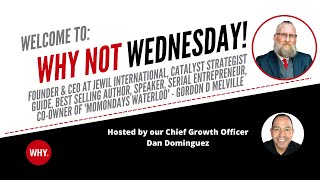
A live YouTube interview with Gordon D. Melville about his career journey from car sales to coaching and working with leaders like Grant Cardone and Zig Ziglar, his prolonged health crisis and recovery, and his focus on mental awareness for entrepreneurial men. The conversation covers practical adaptations (heavy sleep requirement, condensed productive hours), destigmatizing mental-health struggles via a spectrum model, and simple therapeutic practices such as prolonged, heart-centered hugging.
Questions this video answers
288 times
16 to 18 hours per day
Two to three hours per day
September 2015 (after which he was bedridden for about two years)
June 20, 2020 (spoken as '20June of 2020')
Chapters
There's a certain kind of coach who believes what we believe.
Who leads people to greatness, who gets people unstuck, who unlocks all of your passion. A coach who helps people discover what drives them to tap into their superpowers. That knowing your why is the first step to untap potential.
To focus.
To breakthroughs.
A coach who's looking for a better way.
Are you that coach?
Hello and welcome to why Not Wednesday. It is so great to be here with you today and we've got a great guest for our why Not Wednesday today. Our guest today is Gordon D. Melville. Gordon is a best selling author, a set, a serial entrepreneur. He's the founder and CEO of Jewel International and a keynote speaker who teaches entrepreneurial men to navigate mental awareness and health in a world of judgment and toxic masculinity. He's worked with the likes of Grant Cardone, Tony Robbins, and Zig Ziglar, developing his own coaching specialization. When. When our good friend Gordon isn't writing, podcasting or coaching, he can be found focusing on his spiritual health alongside his wife of 30 years and his three young sons. Welcome to the show, Gordon.
Thank you so much for having me, Dan. I appreciate it. It's great to be here.
You know, I had an opportunity to meet you. It was about a month ago. I was so impressed with you, Gordon, that, that I said as soon as I met you, we, we spent probably half an hour to 45 minutes getting to know each other and a lot of people will say, well, okay, so what's the big deal about that? Well, we're going to talk a little bit about why. I thought that was so impressive. But what I always start the show with is what is your why, how and what it's called why Not Wednesday. And so we always want to let everybody who's watching know, hey, what's the why of the person we're talking to? So your, your why operating system, your why, how and what are contribute, better way and challenge. And so what that tells me is that you are someone who believes that success begins when you contribute to a greater cause. You're able to help others. How you do that, though, is really cool, is by finding better ways and sharing them with others. And what you ultimately bring are out of the box solutions. How does that resonate with you, Gordon?
Absolutely. No, I, I was thinking about it and, and all of those things are absolutely true. Contributing. I, I'm not doing what I should be unless I'm giving back to somebody else. I have to be able to fill my own cup. But, but I need to be able to pour out of that cup as well. Yeah. The better way. I've walked into lots of places where I'm like, and I've done career pieces where we've walked in and troubleshoot in a dealership or troubleshoot in a, in a business and go, okay, here's the low hanging fruit. Here's the things that you could be doing better. Right.
Right.
And then the challenge thing.
And, and I think when you and I talked before, we talked about that, that gets us into trouble sometimes because. Right. We're challenging what's going on. We're challenging the status quo. We're, we're pushing back a little bit and, and even further to that. For me personally, if I don't have a challenge, like, once I understand, I go into a new space, once I understand it and there's no challenge anymore, I lose interest and then I need to be, I need something else to stimulate me. Right.
You need that next challenge, right?
I do.
And it also comes with better way. Right. You, you'll, you'll take it. You'll come into a place or a situation and you'll make it better. But once it's better and it's running smooth, that's no longer a challenge for you. You've got to go find that next place. So you know, people with your why are amazing. Our founder and CEO Gary is, is a better way guy. So if you listen to his podcast, he talk, he loves making things better. He loves fixing things and making them more optimal. Creating things from something that was already pretty good and making it better. This process of discovering your why came from that. Now you mentioned it a little bit. You've been in all kinds of enterprises in your life. Walk us through your timeline because you work with some big names. Grant Cardone, you know, Tony Robbins. Tell us about what that's been like. And, and you started in car car dealerships, right? Selling cars. So walk me through that.
Absolutely. I mean, the, the, the skinny, I guess the Coles Notes or Cliff Notes on that. Yeah, I, I, I graduated from high school, I went to Bible school. I got kicked out of Bible school. That's another whole, another whole long story. But. And then I went into massage therapy and so I wanted to get my massage therapy license and I went most of the way through and two credits shy of what I needed, I ran out of cash. So I went into a kitchen to earn money to go back to massage therapy and showed an interest in the kitchen. So I got my chef's papers instead of my massage papers. But eventually I was working 115, 120 hours a week for 500 gross pay every two weeks. And I was like, okay, this is crazy. I gotta find something else. And I opened a newspaper and there was an ad for a dealership that said, hey, we'll give you a free car. And I'm like, I'm in. Score. So I. I called them and. And they hired. I had to take my earring out and shave off my goatee. Just the times, right? You're talking, right. Almost 30 years ago.
And so I started in the car business. Three months in, I got to see Grant. And so he took me from being a 12 to 15 car a month guy to being a 40 car a month guy. And then I was headhunted to go teach his stuff and to. And to market Grant. And so I went and it took me a little bit. That's a long story too. But long story of it is eventually, a few years later, I went and did that, so. But the gentleman that was looking after Grant at the time was Bob Moore, who died of COVID last year. But.
Bob had put Zig Ziglar on his first stage. Nobody knew who Zig was until Bob got a hold of him. So we had unbridled access to Zig. So he would literally sit there and. And I knew it was special. I just didn't realize until many years later how special that was. Yeah. Because literally, it wasn't like I was in a big room of people. We were literally sitting at a table with two or three of us and. And Zig. And, you know, I think I mentioned that I. I smile and it warms me every time I hear somebody go, well, I can have anything I want as long as I help enough other people get what they want. Which was a big Zig thing. Right? But he said that to us and said that to me with. With egg yolk running down his chin like we were having breakfast. And. Right. So. But Zig plugged us into everybody else, right? Zig told us, right. Taught us to be journaling. He taught us to be going to conferences. He taught us to be reading, voraciously, reading. So for to six books a month, consequently, I've read more than 2,000 business books because I read four to six, seven, eight, sometimes a month on average, because I just can't get enough of that. I have five different journals that I've been journaling for better part of 30 years. Right. So those things, that's how it all got plugged in and then as I was already so I, I was working with Grant one on one, right. We were teaching his stuff and, and training with him. And then I was training simultaneously personally with Brandt, personally with Zig.
Right.
And then he plugged us into Tony Robbins and he plugged us into John Maxwell and Les Brown and Jim Rohn and all these people that were an.
Iconic thought leaders. And so that kind of, that, that personal development journey has been going on for the better part of 30 years. It's, it's, it's, it's literally saved my life at really dark times. If I didn't have that positive peace and the ability to be able to have tools and strategies to be able to reach out and keep myself in a positive space or get myself into a more positive space.
Right.
I wouldn't be on the planet anymore. So.
Anyway, yeah, no, so, I mean.
Gordon, there's so much there, there's so much to dig into. Zig Ziglar, you know, as a contribute guy that had to resonate with you so much. You know, you can't get it. You can get everything in life you want if you help enough other people get what they want, you know. So I want to recognize Lynn Everard said, hello, Dan and Gordon, he's out of Florida. Thank you, Lynn, for listening. Isabella said, hey, Zig Ziglar.
Wow.
We, we just had Les on our podcast. So we, you know, we, we really enjoyed meeting Les Brown. And as you said, these are icons. These are people that if you're in the sales world or if you're in the self improvement world, these are people we've all grown up listening to. You mentioned John Maxwell. A lot of our why I certified coaches have, have been John Mark, John Maxwell, certified coaches. So you're talking people that are leaders of amazing leaders. Lynn is taking us back. He says, I had an amazing cassette tape collection of all those guys.
That's awesome. I still have a bunch of those tapes, Lynn. Yeah, I'm not sure what I'm going to do with them. I don't want to throw them away. They are too valuable to me. They have intrinsic value to me. Somehow I don't want to live.
You've got to digitize them. And you mentioned something else, you know, and here's, here's what's really cool because we never know what something we learn when we're going to use it, right. And you had this exposure to these amazing thought leaders in the industry, in the, in the world of self improvement in sales and marketing, but where it really Became, I think, probably very valuable for you when you had a significant health event that altered the way you do what you do significantly in terms of your capacity to work. Can you share a little bit about that journey and how you got what happened, whatever you're comfortable sharing and how it's changed your life?
Absolutely. Essentially, I was the Energizer Bunny. I was the guy that was at work at 5, 6 o' clock in the morning, was still there at 1 o' clock in the morning, 10 days a week, 480 days a year. Like, I was just that guy. Right. And so, but the challenge was I was doing a lot of personal development, but. And so I knew I was teaching self care, but I wasn't doing any self care.
Right.
And so it's, it's okay. And I looked around, people said, we gotta pace. And I look around and go, well, Tony's not pacing, Grant's not pacing. All the people I look at and want to emulate, they're not pacing. What are they doing? Well, they're doing self care. They're building that self care into their regiment and a routine every day. So they're looking after themselves first. And we were always taught it was selfish to look after yourself first. And so that paradigm kind of sit sat in my brain, in my subconscious, and really dictated my autopilot. And so I sort of put myself in a position where I'm like, no, no, no, no, no. I. Everybody comes before me. And something Tony said was, gordy, you get on a plane, the first thing one of the flight attendants says is the unlikely event of an oxygen depressorization when the mask falls. Put yours on first before you help anybody else, because if you pass out, you're no good to them. So consequently, in my body, in September 2015, basically said, hey, Gord, you know what I've been trying to tell you? I need help. You aren't wanting to help me. And so you know what? I'm out. And so for better part of two years, I was pretty much bedridden and it got really dark in a hurry. When you take an Energizer Bunny and force them into a space where they can't move, they get frustrated really quick and angry and all these emotions come. So, yeah, there was a suicide attempt in the middle of all of that, which I believe Papa saved me in that moment. And so I've showed that you that before. That's a semicolon, right?
Yes.
But I am heart centric, so I used a heart instead of the black Dot. Right. But it's also on the inside of my right wrist. So when I shake hands with people, if they know what a semicolon is, which is the sign for suicide survivor, if they know what that is, they know I'm a safe space and there's a connection. And so I was in a Starbucks not that long ago, and I went to pay and I held out my debit card and. But that tattoo showed as I was reaching out to her, and her eyes filled up. I don't know this girl where I just walked in, ordered my drink, right. And. Right. And her eyes filled up and she, like, direct eye contact. And then she pulled her ear forward and she had a tiny little.
Semicolon behind her ear. And like, there was instantly there was connect. We didn't talk any. There was no conversation. There was no deep. But instantly she knew there was a. There was. Right. A connection there. And so I think, to make the point about. We've all heard life doesn't happen for. For. To us. It's happening for us. We've all read that. Absolutely. I take it another step and go. It's happening for us to specifically and uniquely equip us to be help. Able to help other people get through what we just got through. So as a performance guy, I was pushed. Push. And when people said, well, I'm depressed or I can't get out of bed or whatever, I'm like, put your lazy feet on the floor. Get like. I had no. I had sympathy sometimes, but I really didn't have empathy because I didn't understand that. So Papa made it abundantly clear to me. And I call God Papa because of my relationship, as you know. But, yeah, he made it abundantly clear to me. He saved me in the moment. Yeah, that's another story. We can go into another time. But he saved me in the moment because there was more for me to say.
Right.
And it was more for me. You know, he's like, no, no, I've got. I've got plans for you that. That you haven't gotten to yet, so you can't go anywhere. And so it's. It's given me this massive empathy for specifically entrepreneurial men, because that's what I was. Right. I. I didn't know in the moment there was shame and embarrassment that I even got that far. So I didn't. And I was looking after. I was in the financial world then, and I was looking after about $20 million for people. They're not giving their money to a suicidal guy. So consequently, I didn't say anything to anybody.
Right.
I didn't even tell my wife at the time. But the point is, what that's done is give me. Opened up the world to be available to watch and to be a resource for. For men to be able to go, hey, how do I. How do I fix that? Right? How do I. How do I deal with stress and anxiety and depression and those types of things? Because, as guys were taught, don't show emotion, don't cry. That's weak, right? You got to be strong.
So that's that. That's that judgment and toxic masculinity that we talked about in the intro, right?
It is. It is. And the one thing that comes with that is the. And we had talked about that a little bit with stigma. And every time I hear that word, it makes me angry because it's kind of a trigger for me when I hear that. Right. Because I think it's a sanitized, civilized word that we use so that we don't have to actually admit what we're doing.
Right.
And anywhere you find the word stigma, take it out and put the word judgment in and it's more accurate because that's all we're really doing is saying that person. We're putting ourselves above somebody because of something that we probably don't understand and don't have all the information for, but we're judging them. And then we call it stigma so that we don't have to say, hey, you know, I'm judging. I'm just. I'm judging.
I'm being judgmental. Right.
I don't want to say that about myself. So I'm. So I want to use another word that. That doesn't sound so bad, right?
Yeah. It's a safe word. Right. So let me. There's a couple of comments. Lynn Everett said he presented on a stage after Roger Dawson finished his presentation once. So you're familiar with that name?
Yeah.
Bella says contributes, give a lot and forget to replenish themselves. And Bill had a great answer to that. He says, bella, yes. Who fills your cup, you have to fill in order to give. You know, Les Brown, who we had on the podcast, talks about. He spends like, two hours every morning filling up, because if he fills up, then he's got more to give. And that's part of. You know, I'm sure you have a morning routine, Gordon, but here's the thing that impressed me about you, and I want to make sure we talk about that is your productive time every day is how many hours it's getting a.
Little bit better, but two to three maybe.
Yeah.
I sleep 16 to 18.
So you sleep 16 to 18 hours a day because of your condition, you've got two to three hours to get done. What most of us have eight to 10, 16 to 20 hours. Right. I mean, I sleep four to five hours a day, so I've got a big.
Big gap of things that I can get done. But I learned from you and I'm trying to build that up to at least six to seven hours a night because I know how important it is. And everybody tells us you've got to sleep and, and, and, and so for you to be doing everything that you're doing, the podcasting, the coaching, the guest speaking, with only two to three hours of productivity a day, just for you to be here today with us, it shows me your commitment to give back and your generosity.
How did you deal with that? Because you went from being that Energizer bunny and working the 20 hour days to going to, okay, now I've got to get it done in three hours. What's that adjustment been like?
Well, in fairness, a lot of stuff goes away. So for a lot of that time there wasn't anything happening. I was still working until I think my last paying client was 20June of 2020, I think. And not because of COVID I just, I wasn't reliable to be in the space as much as I needed to be. So I just, I didn't want to put myself in that space. So it's been. But what happens is you have to sort of look at, you're reinventing yourself because you're looking at the things that you go, okay, so if this is the space I've got and, and that's a good thing for me, right? My, my, my, I'm a. One of my talks was a rhinoceros and a two by four. And, and because a rhinoceros, a group of them is called a crash. And I was trying like a gaggle, geese and whatever a group of rhinoceros is called, a crash. And I'm like, why? Well, they run 40 miles an hour, but they can only see 20ft. Consequently, they keep just slamming into stuff all over the place, right? That I, that's the way brute force, that's the way I've lived my life. And then two by four, anybody you ask my parents, they will tell you, yep, absolutely. You know, I need a real hard smack to get my attention and to divert me, right? So that combination, I think that's why papa did what he did so that I'm like, hey, he tried to help me or get my attention. I wouldn't listen. So I got a 2x4. And. And so what you start to do is go, what are the pieces of my life and who I have been that are serving me that I can bring forward? What are the pieces that can serve me if I modify them or pivot on them a little bit? What are those pieces? And then what are the pieces that just aren't going to serve me anymore, no matter how much I like doing them? It's not that they're bad things, right? They're just not serving me. So then that goes away and what happens is it becomes a productivity streamline of stuff that where you're going, all right, I'm making choices based on where I'm going to spend that limited energy on. How, how is this getting me closer to my goal and is it uplifting me or filling my cup? Because I think those are the two things. For me, it's. There's two things some people don't, but I, because of my history and because of my health, filling my cup is imperative. And I, I'm a walking billboard for self care. Like we all, when we're young, we're bulletproof, we can just do it. It's not your body is, is you're hurting yourself. Whether you feel that in the moment or not, you will at some point figure it out. So being able to do that and then prioritize it, what are the pieces that yes, this is going to help or yes, this is important to me. I have to have to get this done today. And so.
I plan weeks in advance sometimes to try and make sure that. So today I knew I wanted to be here with you today and I wanted to be and show up with as. It takes a lot of energy to look like you're okay when you're not okay. Right? And anybody that's got chronic illness and right at the moment I've got migraine level pain. That's not a migraine. Three neurologists and a bunch of tests tell me. But I wake up with it. I go to sleep with it. It's always there and it's been there for three years. So what happens? It's the energy that it takes. So I slept for a good hunk of today so that when I got myself together and did some prep and whatever was ready to get on with you, which is wonderful and like I said, it's an honor to be on with you. It was, it was Important to me that I showed up the way I needed to, the way I wanted to for. Right. And then I have some other zoom calls today and some other stuff going on, so I'll. I'll take a quick nap between them. I've learned to power nap.
Right.
And to look after. And if, if I've had. When I was doing the financial thing, I said to a client, it was during tax time even. I'm like, I know we have an appointment, but I want to show up. 100 for you. And he goes, yeah, yeah, me too. And he had several million dollars with me. And, and I said, but right in the moment, I can't. I need to take a quick nap. Can we push it back? He said, no. I said, can we do another. I'll meet you whenever you need to meet? He said, no. He said, you come and see me at a hundred percent or I'll take my money someplace else. And I was like, okay, well, happy hunting then, because I, I can't. And he did. He picked up his money and took it someplace else. And I'm like, you know what? I had to be okay with that. Right, Right. Because I'm like, no, no. If that's what you need to do, no problem. I'll go find somebody else that's got the amount of money you had that understands and has some empathy and can work with me.
Not only that, how much, you know, how much are you going to enjoy the benefits of managing $2 million if you die? Right. It's just not the point. So it makes a lot of sense. You know, you brought up a couple of things. We talked about stigma already. Talk about mental awareness, because that's so important. I want to make sure and share that from your perspective with our, with our listeners.
Yeah. So a mental aware. People talk about mental health, mental illness, that kind of thing. Some of that had was mental illness. Well, that's negative. So we'll call it mental health. Well, that's still. So mental awareness for me incorporates all of those things. So there's so many things about our mind and sort of a Napoleon Hill concept. And I, I. Right. I'm. I'm certified to teach TGR and Laws of Success. And one of the things that really, really came to the forefront for me when, when I was learning that technology is that understanding how to, how your brain works, how does your mind actually work, and then figuring out and mastering control of your own mind and your own emotion. Right. Because if I can do that, it goes back to the whole stimulus, pause, respond Instead of stimulus, react.
Right?
I want that pause, the powers in the pause. A lot of times we don't use the pause, right? So that mental awareness becomes a. It incorporates mental health, mental illness, but also mental control, control of emotion, all those other things that, that control literally dictate on some of it on autopilot, right? We don't think, you, we're not thinking, I gotta remember to breathe. That's, that's in our subconscious. It just happens, right? The thing is our subconscious doesn't have a filter, right? So anything that goes in, even things in the background, right, you and I are talking, but if there's anything else happening around us, there's a radio on, there's a TV on, there's something else going on that is going directly into your subconscious without any filter, whether you like it, agree with it or not, right? It's right. It's just going in because there's no gatekeeper there, right?
Yep.
So that being aware. I can't help an alcoholic until they admit and are become aware, yes, I have a problem. No matter how good my program is, if they don't admit they have a problem, I can't help them. So that's that mental awareness of what's going on, right? Where are we at? I can't, I can't grow. We talk about. And coaches, right? Coaches will say, well, if I, if I'm not coachable.
It doesn't matter how good the program is, right. It's just not going in if my ego's blocking. Hey, no, no, I already know it.
All right?
Right, right. It's not going to work. So that mental awareness is a huge deal for me, understanding that it incorporates all the other pieces.
So there's a couple more questions I have for you. Talk about spectrum inclusiveness. Because that, that's. We're hearing a lot about spectrum, right? So, okay, what does that mean?
Spectrum inclusiveness for me is we think of mental awareness, mental health as the heavy duty stuff. Ptsd, depression, suicidal, right? All that, all that schizophrenia, all those heavy duty things and people. It goes back to the whole judgment piece, right? As far as spectrum, right? Because people look at those people and go, well, they're messed up. I'm not, I'm not messed up like that, right. I don't have that. So it's exclusive. It's them and me. Soon as, as long as we do that, people will choose suicide over asking for help. Because there's judgment and there's embarrassment and there's shame and all these things. So once we understand everybody is on the mental awareness spectrum. All of us are. Right. It's inclusive.
Yeah.
We don't have to be on that far end. We could be on part of the other end that says, or just a little bit of stress, anxiety or depression or whatever because of work or home or a low, you know, there hasn't been sun in five days. We're all a little bit low energy. Well, that, that's on the other end of the. Right. But we're all on that spectrum. As soon as everybody understands we're all there and it's inclusive, the shame goes away, the embarrassment goes away and people will reach out for help. The one thing that I learned really, really, really was wildly eye openening for me.
Right.
Being in the suicidal space, I had always said, why don't people just reach out? Why, why don't they just like ask for help? And the thing is, when you're in that space, you believe you're doing your family a friend and friends a favor. They will be better off without me. So if that's the mindset, why the heck would I reach out for help when I'm doing them a favor?
You're doing something good, right?
Absolutely. In your own mind, that's what's happening. And you don't. And so whether it's a. I don't see a way out for myself, I don't want. And, and having chronic pain like this, I run into lots of people who have committed suicide to get away from the. I can't stop it any other way. I can't find. I needed to end. It just drives you crazy. I needed to end. I needed to end. I needed to end. And so they, they choose that exit. Right. And so that's my, my whole thing in terms of my, my mission and my, my, my pitch and the things that I'm teaching is we have to as a society get into a space where we go, no, no, no, we're all on that same p. I don't look at somebody with a broken leg and go past judgment. You know, idiot or. Right. What happened? But we do, we do because we understand that we all have some level of disability.
Right?
Right.
You're looking at that thing on the wall back there. I jumped out of planes when I was in the army. I feel that in my knee today.
Right, Absolutely.
We've all got some kind of limitation based on, on what we've done. And when you look at mental awareness, I can see where, hey, look, we've, we've all got some kind of Physical disability. We're not all at 100% like we were when we were 18 to 22 years old. So let's look at it that way. That's a great perspective. I want to make sure we touch on one other thing, Gordon, how to hug. I mean, we've touched. You've touched on some dark. You've taken us to some dark places and how to deal with those. This is a positive one. Let's talk about hugging.
It is before I leave that remind me, I'm going to make a note. I've jumped out of a plane 288 times. So you and I, we'll talk about that another time.
Absolutely. Let's do that.
Yeah. Hugging. So that contact, and especially with COVID where we haven't been able to touch, we haven't been able to see and whatnot. So I really, really miss that. But when we hug. If you watch people hug in movies or in your own life, pay attention to how you're hugging. Because lots of times when you hug and a hug hack mini at all is awesome. Right? Don't get me wrong, any hug is great, but. And guys, we do this thing where we grab hands and we bump shoulders or whatever. It's like, you know what? Give me a break. But.
But hugging, if you watch people, they will go, so if I'm looking at you, my head would go to your left. Is typically how people hug, right? They lean in that way. And I think it's because that's how we shake hands. And it's that side. Right? That's not how. That's not the best way to do it. The best way to do it is take your head to the right side. And the reason for that is as soon as you go to the right side, our hearts are over top of one another. And anybody that understands energy will feel that. As soon as you grab somebody and hold on to them, that energy transfer between their hearts, they'll feel that and they'll go, wow, this is an amazing hug. They won't know why. If they're not sure about energy, they won't. Or no. No awareness of that. They won't know why. The other thing is holding onto somebody and giving a hug that lasts more than I've heard 20 I've heard 30 seconds. Yeah, there's clinical, medical, scientific, provable, therapeutic property. There's endorphins, that. Right. So when I hug people, they can tell because of the energy. Wow, this is awesome. But they. You can feel their body kind of go limp. Like they're going to let go, and I just don't let go. And a lot of times, what you hear in my ear, what I hear from men, women, children, everybody is, oh, real hu. Because they haven't had that in so long, or they didn't have it growing up, or they haven't felt right.
Bill's agreeing with you. He says hugging releases the neurotransmitter oxytocin.
Absolutely.
That's what feels so good. You know, I'm gonna. I'm gonna try that, because I'm a hugger anyway, but I'm the brief hugger. I. You know, my really good friends, we give those big hugs where we just hang on to each other. But, you know, I think that's absolutely correct. And especially when we've been missing that physical contact, there's a. There's some young people that haven't had a real hug in a long time because they haven't been around to do that. So, Gordon, we're. We're almost at the end, but I do want to ask you the one big question. And I'm sure, you know, with the ha. With the. With the better way challenge guy, I'm sure there's a few of these moments. What. What's been your biggest why not moment? What's the time you said why not to something and it's worked out for you.
There's been a bunch. There really has. Even things like the. The skydiving and the. And the bunch. Those are those role. You know, what. Why not? Right, right, right. And a lot of people would tell me, hey, there's lots of reasons why not, but not to do bungee jumping or skydiving. But the one thing that. That I kept coming back to when I was thinking about it, and thank you for that heads up. Because it. I thought about it and thought about it and thought about it, and the one thing that really made a monster monster change in the whole rest of my life, if I go back and look, was saying yes to going on the road with Grant, because that. That connected me to Grant. It connected me to Zig, which connected me to everything else that put me on the path of personal development, that I may or may not have gotten there on my own in some other way, and maybe it happened later, but I look back and go, you know what? I said, okay, you know why? Why not? I was in a place where at the time, I was like, you know what? I need to be away.
And. And making that one. What I thought was an insignificant decision at the time. Oh, no big deal. I'll go and do it for a bit and see what happened. The thing is that one. That one decision radically shifted because from that, I was in every major city in the US And Canada. Right. I mean, there was so many things that happened as a result of that one pivot in that decision. Right. I'd been in the car business. I came back to the car business. Retail. Retail. But those seven years I spent on the road with two different organizations and with Grant and somebody else, and. But those seven years are things I'll never. I'll carry with me the rest of my life. And. And versions of an impact of. Positive impact of I'll carry forever. And I think if I didn't have my personal development.
Yeah.
I probably would not be here. Not possible. I would not be here because it's so hard to do some of the other pieces.
So, you know, and I think we all go through those moments where we doubt ourselves or we have those negative thoughts. And it's that time when you've had the opportunity to work with the Mount Rushmore of personal development, and you had those guys in here kind of saying, hey, wait a minute, I know you're going there, but let me. Let me. Let me. Let me tell you why you shouldn't go there. And that's that mental conditioning that helped you get through that. Gordon, this has been a blast. That 30 minutes flew. You know, I haven't gone over time in a long time, but this was definitely worth it. And I really appreciate you being on. We'll edit. We. For those of you that are on Facebook, you're not listening to us live. We're gonna. We're gonna air this later because we had some technical difficulties, but we've got the recording. We'll get it out to Gordon. And I know that's the space where you live and. And I live on LinkedIn, so our LinkedIn fans are getting a chance to see you. The folks that are watching on Facebook are gonna get it later, and we're live on YouTube, too, so. Thank you, Gordon. Have a great rest of your week. Go get some rest and get ready for your next call.
We will. Thank you so much. Make it a great day, Dan.
You too, Gordon. Have a good one.
Thank you.
More from Dr.




Women In Leadership: A Need For A Greater Systemic Change With Belinda Clemmensen






