WHY NOT Wednesday! with Greg Cagle
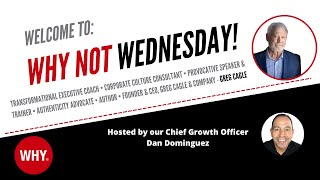
Transcript of a Why Not Wednesday conversation featuring Greg Cagle and host Dan, focusing on leadership, authenticity, purpose ('why'), and organizational culture. Greg introduces concepts from his book The Four Dimensions of Culture (complacent, compliant, committed, courageous), explains how leaders' self-knowledge shapes culture, and connects personal 'why' (challenge) to coaching and culture work.
Chapters
There's a certain kind of coach who believes what we believe.
Who leads people.
To greatness, who gets people unstuck, who unlocks all of your passion. A coach who helps people discover what drives them to tap into their superpowers.
Knowing your why is the first step to untap potential.
To focus.
To breakthroughs.
A coach who's looking for a better way.
Are you that coach?
Hello, everybody. And hey, welcome to why Not Wednesday. Can you believe it's already February? January is behind us. It's time to look at January and assess. Hey, how did we do? We had a great month on why Not Wednesday. And we're so excited for our guest today. Today we're going to bring you Greg Cagle. He's a passionate advocate for authenticity, a transformational executive coach, a corporate culture consultant. He's an author. He's written a couple of books. He's a speaker. He's drawing from over 25 years of experience in growing and leading companies to deliver remarkable vision, drive. And of course, because his why is challenge outside the box thinking to business leaders and teams. He's got extensive experience in leadership training and executive coaching. And the work he's done has been with Fortune 500 companies, the US army, special operations. So who are Greg? And the C suite of many privately held companies across the United States, Europe, and Latin America. We've been having a lot of fun introducing Greg. I know I've gotten a lot of comments on social media about what, what it means to get punched in the face by your why. So let's welcome our good friend in yos, one of our newest YOS certified coaches, Greg Cagle. How are you, Greg?
Man, I am. With an introduction like that, I could be nothing more than just excited. So you just energized me. I got to live up to that, right?
Well, you know what? That's my job. I want to energize you. I want you to come out of this. I've been excited about this interview all week. And guys, for those of you that are listening and that are in the comments, notice this is our third challenge why in a row. So next week we're going to go to trust, but this is our third challenger in a row. So we're on. On a lot of. We've had a lot of creativity. We've had a lot of fun. Everybody, if you know me, you know that my how is challenge. So I, I click with these kinds of people. And, and Bruce, I see your comment out there. Greg, this is the person you're gonna have to explain what you meant to by getting punched in the face. So we'll get to that question in a little while. But, you know, I love that. You know, as we were doing research, Sunil and I were doing research on Greg Cagle. We, we said, you know, he's got a proven. Let's do this approach. What's it mean? I love the phrase, but what, what does that mean for you, Greg?
Well, what it means for me is, you know, there are talkers and there are doers and there are people that think a lot and strategize a lot and try to figure things out, and then there's time to just put rubber in a road and get things done. And I've always been that guy to challenge and say, listen, if we're going to wait till we get it perfect, we're never going to get there. So let's get a general direction of where we want to go and an understanding of how we want to get there. And then let's, let's get it done and we'll move forward.
Yeah, it's just, let's do it right. You know, we, we say, we say this at Y Institute all the time. Get that, that s F d done that shitty first draft. Sometimes you just need to get started and then we can always make it better, right? Gary's a better way guy. We can always make it better. But get something started. You got to take action. And I was on a, on a, on a thread earlier in the week that talked about ideas versus plans and execution. Yeah, ideas are great, but they're nothing unless you put a plan together and execute on the plan. Ideas die every day. Right? We all, when you know, everyone, you never want to go to the grave with that great idea in your head. Did you put a plan together and execute it? So I think that's what you mean by let's do this. Did I get that right, Greg?
You got it, you got it? Yeah.
So we're gonna add to it. Yeah. So I want to say hi to Watson Jordan, who's watching from Carolina, Bruce Kirk, who's from Philly. And, and I made, I made fun of, you know that your, his comment to. In response to you're getting punched in the face with your wine because he's from Philly. So I put a, A, a Rocky picture on my LinkedIn and I said, hey, let's queue up that Rocky music. Hey, look at Charlie Timmons is with us. He's a, he's a future yos coach. Thank you so much. Charlie for joining Better way Challenge Trust. So he's got your why. So we always start this way. Greg, we're going to start with your yos. So your why is to challenge the status quo. Your how is to make sense of the complex and your what is contribute. And we talked about this in the pre show. We share the same top three, you and I. I'm contribute. Challenge makes sense. Your challenge makes sense. Contribute. How did it feel to you when Gary took you through the process and you discovered your Yoshi?
It felt three things real quickly. So it felt different in that, you know, there's a lot of different personality assessments out there that try to give you some indications about who you are, what you're about. This was different. This was different in that it really.
It freed me up to understand that, you know, some of the things that I looked back on and maybe struggled with to, to fit in in certain areas or maybe labeled a certain way, it freed me up to go, wow, you know what, there's value in this. And for me to try to get away from this is doing myself and anybody I'm trying to serve a disservice. And that, that emboldened me and gave me confidence to kind of lean into my natural talent, which is challenge.
Yeah. To challenge it and do it. Just do it right.
Do it.
Love that. Hey, so you're getting some comments. T.J. davidson in Texas. Hey, I want to say hi to Danielle Dobson. She's all the way from Australia so I know this is a weird time for her. So thank you for being on Danielle. Love the do this approach. She says, and Watson says it's a discovery. Right. And that's the difference. Right. We, we tell people all the time and, and you, Greg, you're not going to be in trouble and you didn't make the mistake someone else did. When people call the why discovery and assessment, we say it's not an assessment, it's a discovery. It's about discovering who you are and you've got some great ideas. We've had some great conversations around the work that you do. And so for those of you that may not have seen the some of the pre show promo, Greg is the author of a book called the Four Dimensions of Culture. And you know, one of the reasons Greg and I have not had a chance and one of the reasons Greg is not yet certified is because his book has been so successful. He's been really busy with book related stuff. So I know when Greg signed up to go through our training to become a yos Certified coach. He said, hey, in two weeks, let's get together, Dan. And then we had to move that appointment because you've been so busy with your latest book, the Four Dimensions of Culture. And what I really like about it is you have, we had a great conversation about this. You see a place for this and the yos to work together because one of the things you state and I wrote this in the, in the pre promotion, you believe that culture is a leader's first responsibility.
Yeah.
And, and when I saw that, I said, you know, how can you establish a culture if you don't know who you are? Right. So tell me, tell me what you, how you see that coming together, Greg.
Yeah, so you said it. Culture is probably the most important thing for a leader to pay attention to.
Right.
So many times as leaders, isn't it true we get caught up in all kinds of reports and all kinds of things that indicate how our business is doing. We think measuring, we can predict the future and so on and so forth. At the end of the day though, everything that we want to do, delivering on our strategy. Right. Navigating crisis or even capturing opportunity, culture is what's going to deliver on that. And so the reason I wrote the book is because so many leaders, number one, wasn't, weren't focused on culture near enough. And then secondly, helping them understand how to lead culture. That comes to the question you just asked, which is how do you, how do you even build a culture or even lead a culture?
Right.
If you don't understand who you are and where you fit into that picture and how you bring value to the organization, every leader cast a shadow over the organization. And understanding who you are helps you determine when you are advantage and when you are disadvantaged in certain situations in business. And that's really the secret to building a healthy culture. And then you've got to understand, hey, where I'm disadvantaged, I've got to be able to understand other people's why and where they may be at an advantage. And I can bring them in and backfill, backfill me. Right, Right.
So we talk about that all the time. Right. We talk about putting the right people in the right seat on the bus. And so I want you to talk about the four, the four dimensions of culture as you talk about in your book. Because we talk about there's complacent at the bottom. So we're going from the top to the bottom and we didn't get a graphic up. But if you get this book, it's in there, it's a great book you talk about. There's. There's complacent, there's compliance, client, there's committed and courageous. Now, one of those is not good. Which one? Let's. Let's talk about that one first.
Yeah. Well, obviously, it's complacency. And the reason that we put that in the book is that I've never met an organization yet that was able to completely eradicate complacency. So you've got to understand that it's there, and you've got to understand how to keep it at bay. More importantly, you need to understand what causes it. And so we describe that complacent dimension as something we want to continuously fight against. And we help business leaders understand that there are ways that you can intentionally design a culture that keeps complacency to a bare minimum. And so, yeah, complacency is the negative dimension. The other three are positive. And we want those dimensions in our culture. We want them to be healthy, and we want them to be balanced.
And one of the really cool things is you described each of the dimensions. Now, it's going to be no surprise to anybody listening, especially our y coaches, that the complacent, the negative one is all about the negative dimensions, about resting on your success. That's what it's driven by. But it's committed to what these people that when they're complacent, what they're committed to is the status quo, which Greg does not like. Can you imagine that? He doesn't like the status quo. And, and so that, you know, we're going to try to get out of there. We want to get to compliance where we're driven by process and procedure and then committed to order and structure, which wouldn't seem to be a strength of yours, Greg, But I love that you put it. It's the first step up in the pyramid. Tell me about the importance of the compliance.
Yeah. So you really did it for me right there, Dan. Compliance is the compliant dimension is where, quote, quite frankly, your compliance lies. This is, or this is order and structure for the organization. Right. And so every organization has to have some level of order and structure to scale its success. And that requires rules. It requires processes and procedures and the. The methodical way of. Of doing business. And you're right, that's. That's not one of my strengths. And so in leading culture, I would always need to make sure I knew, hey, who on my team is greatly advantaged in that area. And it allows me to lean in on them to make sure. That we have that healthy, compliant dimension.
You know, you're bringing up a great point. Our guest in December, Dave Sanderson, who's also an amazing keynote speaker, he talks about finding the who's for your hows. Right. And you got to find the right who's. You got to find those who's that thrive on compliance, that thrive on process and procedure. And if you're one of our coaches, you know this, or if you've gone through the wireless, you know that we're talking about those right way people, those people that like to find processes and systems and drive them and create them so we can take all that creativity that Greg has and make it repeatable. So that's fantastic. The second, the next phase up is committed. So people that are committed are driven by production and they're, they're, they're committed to performance and achievement. So let's talk about that phase, that dimension.
Yeah, this is the dimension I think probably most leaders understand the best. This is performance and achievement. These are the goals that we set for our organization. Organization, the people within them. This is where we set out to achieve something. This is the one we're all going to climb. And this is all about goals, achievement and, and, and.
Reaching the highest performance for each individual in the organization.
Right. So getting to that peak performance and then the final one. Now we're talking, right now we're getting to the why the finals dimension is courageous. So if you, if you want, you're in that dimension, you're courageous, you're driven by purpose, that purpose, that inner drive. And you're committed to innovation, creativity and change. And once again, creativity and innovation. What are the odds that the guy with the why of challenge would have innovation, creativity at the top level? But okay, we're talking about courageous, a courageous dimension. Man. I want to hear more about this because we are missing that today in so many places. We deal with, we deal with big companies, we deal. You know, a perfect example. My family got stranded during the, that winter storm saga with Southwest Airlines. And it was so sad to see so many people that just couldn't do anything right because they weren't empowered, they couldn't be courageous to help. So tell us about the fourth dimension.
Well, the fourth dimension, as you might imagine, is probably my personal favorite simply because it lends itself to kind of the way I think and do. The biggest question I always get with this one is why do you call it courageous? And, and because I believe this, it, it takes courage to step away from what you know and enter into the waters of the unknown. It takes courage to question the status quo. It takes courage to innovate. Look, nothing extraordinary ever came out of traditional thinking. It was innovative to begin with.
Right.
And that's very courageous. And so we call it the courageous dimension. We've got to have the courage to debate each other. We've got to have the courage to question our success. In fact, I say it this way. The best time to question success is while you're enjoying it. And you better enter into the courageous dimension when. When it seems counterintuitive, doesn't it, hey, we're successful.
Why do we want to question that? Well, because if you want to stay successful, you have to continuously innovate. So there, there's. That's why we call that the courageous dimension. And obviously, as a challenger.
Right.
That's where I live a lot.
Right. You're not afraid. Right. You know, and we talked about this even as we. We spoke earlier this morning. And, and I was talking to you about the interview and, and I was asking Greg, hey, Greg, is there anything that, you know, he hadn't seen the document with the questions which our team at Y Institute will tell you. That's Dan. He'll show up to the. The quarterly meeting, and he hasn't seen. That's what challengers do. But you know what? What I really loved is one of the advantages and one of the great power superpowers that challenge people have is you're not going to phase them. You know, there's not a whole lot that you can throw at him that's going to say, oh, my gosh, I'm so nervous about that. So, Bruce, Captain Kirk, he said courageous. All right, Bruce, since you're here, we're gonna. We're gonna have Greg answer the question because you were thrown off a little bit by the. By the power of his statement. Right. Of, you know, when your yos punches you in the face. Let me make sure I get that right.
The.
The quote was, when you discover who you are and live out that authentic you, your why will punch you in the face. Now, Greg, you said this. This is a quote from your first book, how many years ago?
This has been three years ago now. Yeah.
So this was before you knew your why, but you had this very cool why statement. So we, you know, why Nation wants to hear your answer. What do you mean by that?
Yeah, so just to make sure everybody understands, I don't advocate violence. But so what. What. What that was about, I wrote a book called Be Weird, and it was about Embracing your weirdness. And I tried to challenge people, and predominantly business leaders, right. To understand that they're unique and they're weird and that authenticity is a trust accelerant. If you want trust with your people authentic, this is the best way to get it. But in. In my coaching Dan, I. So I had so many times I would hear statements like, well, I. I'm trying to figure out what, you know, what's my why. Why, what's my purpose? Why. Why am I here? And finally, what I tried to help him realize. And this is where the statement in the book comes from.
Right. You.
You. Once you discover who you are and you're willing to live that out authentically, your purpose or your why will punch. It reveals itself right there. It'll punch you in the face. You don't have to go looking for it.
Yeah.
And. And I think that's what. I think that's what yos does so. Well, not. Not only does it help me understand who I am, but, you know, the whole understanding of why I am here to contribute and why that's important and the way that it. It's. It's explained is powerful.
Yeah. You know, I. I wish. Kate, I don't know if Caitlin Goney's on, but she. She was talking this morning. She and I had a conversation this morning and she was talking about how her yos just fit her perfectly. She. Her why is make sense and she helps people get stuff done. Makes sense. People just get stuff done. She can come in, analyze the situation, know what's neat, what needs to happen, give them a fight. By the way, her how is better way? Find a better way for them to do it.
And then.
And then her what is clarify. So she helps him. She gives him a clear plan of action. And it was so fun to talk to her because she is definitely living in her zone of genius. I have a question from. From Dave Tegmaier. I'm going to give you a chance to answer it. Doesn't being courageous require me to be vulnerable?
Yeah. So that is 100% correct. Because if you think about creativity, innovation and change, you have to be vulnerable. You have to be willing to say, I'm going to abandon traditional knowledge and experience, which is where we all want to hold on to get over here in the uncharted waters of what I don't know, so that I can discover new, creative, innovative ways to do that. Requires you to be vulnerable and say, I don't know, I need to figure this out.
All of that.
That is a spot on statement, actually.
Yeah. And you know that, that goes so along. You know, I've heard the definition of courage isn't when you're not afraid. Courage is when you're afraid and you still move forward. Right. Understanding that, hey, I'm going to be vulnerable. I don't know if this is going to succeed, but I'm gonna, I'm gonna say let's do it.
Well, there's.
Figure out what happens.
Well, there's a great quote by Dr. Renee Brown who you may have listened to or heard.
Sure.
Really very, very impactful speaker and but she says vulnerability is the birthplace of.
Innovation, creativity and change. And so Dave's statement about that is, is, is spot on. That's where it begins. Because if you can't be vulnerable, you don't explore.
Right. Right. Well, Danielle Dobson says absolutely agree. When you know who you are and live it, I feel that that is the purpose. Right. Knowing, knowing who you are and understanding what it is that you bring to the table. So, so Greg, one of the questions that I had for you is how do you see. So you're, you're, you're currently going through, through training and you and Gary have had a conversation. You were on his podcast. You're now on why not Wednesday. How do you see the yos fitting into the work you're currently doing? Because you work with some fairly big organizations and taking through, take them through this process of moving into the upper three dimensions of culture. So tell me about your. Because some something that you saw said, man, I want to bring this and I can't wait to have these follow up conversations with you. But I'd like you to share because we've got a lot of coaches on the line that are watching and then a lot of people will watch it on the recording because I'd love to hear your thoughts on it.
Well, it goes back to a basic concept of this. Business and leadership. Both are situational. Every day we come into work, we think we have our day planned out. But situations arise, situations occur and how we deal with those situations will determine how healthy our culture is. And so the ability to understand your why and the ability to know where you add the most value and where you contribute the most.
Right.
Helps you manage the, the dimensions of culture that you are capable of managing and leading and then understanding your, your, the people that you work with, why and where they plug in and how they can help lead other healthy parts of your culture is critical. I, in fact I got to say this, Dan, until, until, until I was introduced to, to.
Why. Why? I, I knew there was this, there was this link between, you know, your, your, your. Your organic natural talent and tendencies and leading well and, and how that applied to culture. And then once I got introduced to, to this, I, I realized this is the missing link.
Right.
This is it. And, and so I, I see this as a natural connection without, without question.
You know, it's, it's interesting too, because when we look at the nine whys and we look at the cultures of, of, of, of the dimensions of culture, the, the, the bottom one resting on success and status quo, that is not. None of the wise reside there.
There you go.
The nine wise, the gifts that, that, that we are given, the gifts that we want to bring to life, all reside in the compliant, the committed, or the courageous box. And we need people in every one of those boxes. You used a great example. Before we got, we came on the air, we talked about, you know, hey, Dan, your, Your why is contribute. Challenge makes sense. Of those in those three boxes, where are you going to struggle the most? And, and you know, it's probably the same place you'd struggle in the compliance space.
Yep. Or order and structure is, is what compliance is about. We're not order and structure people. We need people that do that, and they're extremely valuable to us.
Right.
So I'll, I'll ask you a question out of the, out of the compliant, committed or courageous, where you think your, your why lends itself to be most successful?
Yeah, I would say courageous.
No question about it.
Let's go. Let's go innovate. Let's, let's, let's do things differently. Let's. Yeah, absolutely. No, it is absolute genius. And we're talking about innovation, creativity and change. Right. Who says that challenges don't, don't like, don't like change. Right. And so I really appreciated that. And I think one of the things that I hear a lot, especially from people with your why, Greg, is, hey, I kind of have always known this about myself, but this really gave me the language, so I can express it in a really positive way as a gift, as something because, hey, guess what? Those challenges, these are the people that, that, that have been outside the box their whole life, right? They, they had purple hair in high school. They did the things that nobody else did. They were the, you know, you know, for me, I always talk about the fact that I was, hey, I was the ROTC battalion commander at the university, and I went from that to being the school mascot. And so those are two things. They don't usually go together. And you got to be willing to challenge the status quo in order to do those things. I'm sure you've got some stories like that. And that's going to get us to, to our last question because we always like to ask this question and give you plenty of time to talk about it. Tell us about your why not moment.
Yeah, so I thought about this because you gave, you gave me a heads up. You said, greg, I'm going to ask you about your why not moment. A moment where you just kind of looked at things, you said why not?
And when I thought about it, I thought about why not moments is really kind of defining moments in your life. You say why not? You go and it defines you one way or the other. So I'd say I've had several, especially at my age that's probably not that uncommon to have at least three or four really defining moments or why not moments. The one that I probably am the most grateful for is the one that most recent and that was for a long, long time in coaching and working with business leaders. And I felt like I had some solutions and I felt like I should probably author those solutions in a book. But when I thought of myself as an author, I'm like, are you kidding me? I don't even have a good grasp of the English language. And so I, and then finally I can't even remember why. Dan but there was something that clicked one day and I just said, you know what, I've got something to say. I feel like I'm going to explode if I don't say it. And I said, why not? Let's write one. And then again, the latest book, the Four Dimensions why not again. And I'll tell you, jumping in on those why not moments can be one of the most satisfying things because now I have, I can honestly say I've been blessed and humbled by how many people have responded to some of my work and they said, you said it. This is it. I've been looking for this. Thank you so much. Come speak to my, you know, come speak at my corporate event or yeah, you know, and so I'd say that why not moment was just saying, you know, why not? Let's, let's write a book.
And, and I love, and you know, just as we were talking about, as Dave Tegmaier brought up, that that required a little bit of courage and a little bit of vulnerability and, and you're self deprecating because the book is very well written. I don't know if you had a really great editor or, or you just really had some great thoughts and you really organized them in a way that make a lot of sense. So, so kudos on a very well organized book, on a very well organized concept. And you've used this process with lots of companies. Right. So what's the most common feedback you get when you take somebody through the four dimensions of culture?
Two things. One is, you know, I thought I knew what culture was, but I was wrong and now I understand it. It's the way we think, act and interact as an organization. And all of a sudden, what tends to be fuzzy and vague, this culture thing, what is culture right now, it becomes clear to them. And so I hear that a lot. And then the second thing is they begin to understand the impact that their actions and their interactions and the actions and interactions of all their other leaders in the organization affects culture. And, and they realize, you know what, we can actually design this. It doesn't have to be a culture of default.
Right.
You can actually design this. So that, that's, that's been the two things.
I love that because, you know, we often talk about if you don't, if you don't define your culture, it will define itself.
Yep.
And that culture is not always the best culture. Right. And so you put it on the leaders. I think it's, it is on the leader. And I think one of the important things we talked about is the leader's got to know who he is or she is, because if they don't know who they are, how can they set the tone for the culture of the organization? If we, if we're, if we're part of Greg's organization, it's going to be about challenging the status quo. Right. That's, you know, that's going to be at the very top of that. It's going to be about solving problems, which you do with this book. And it's about, it's going to be about contributing to the success of others that, that's gonna, it's gonna be interwoven into the culture that you create. And so when people look, when they're working with Greg, hey, that's what's important to them. Right. And that's what's important to Greg Cagle's company. And so I think, as if you're a leader and you're looking for a place to understand who you are so you can build your culture, there's no better place to start than understanding your why operating system. And we've got, you know, just look at all the people that are commenting in the chat, those are a lot of our yos coaches. And then we've got some other people that are joining in, so we're thankful for them. Greg, give us a send off. What's, what's, how can somebody get a hold of you? If somebody wants to work with Greg Cagle, what's the best way to get a hold of you?
I'd say probably the best way is just go to my website, geocaggle.com gocagle.com and you can reach out to me via email. You can kind of take a look at a little bit about what I'm about. We're in the process of redoing my website, but you'll get enough understanding there to know and just reach out to me that way or connect with me on LinkedIn. I'm, I've actually started to get pretty active on LinkedIn. I found it to be a lot more useful than I realized. And I think, I really believe that my connection with you was somehow through LinkedIn.
Yeah.
But, yeah, that's probably the best way. Yeah.
Well, that's fantastic, Greg. Thank you so much. We're right on time. I can't believe two guys with challenge in their yos we're able to finish on time, but it's been an absolute blast. As I said, guys, next week we're gonna have Corinne Forest. She's gonna be here with us and her why is trust? And you know, we had a great conversation when we first met, you know, Corinne. It was so for her. It was. She said, dan, when would you figure out her why? She said, did you know that I teach workshops on trust? This is so perfect for her. So Charlie Timmons says, hey, how can we help you, Greg? And let's see, Edith Martin says, great presentation, Greg. Thank you for your wisdom. We'll be getting your book. By the way, let's don't forget, let's give one last plug for the four dimensions of culture. And Greg, the answer to this question I'm going to ask you is why not? Because we forgot to do that in the pre show because we had so much fun. So what do you say we end on that note?
I'm confused. What?
No, no, no. All you got to say is why not? What do you say we end on that note, Greg? Why not? All right, everybody, have a great rest of the week. We'll see you guys next next week with Corinne Forest and we will have a great rest of the week. Greg, thank you so very much. I stay on because I want to talk to you afterward. And everybody, thank you for tuning in.
More from Dr.




Women In Leadership: A Need For A Greater Systemic Change With Belinda Clemmensen






