WHY Not Wednesday With Jackie Joy
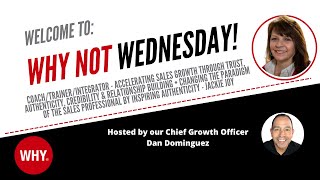
Jackie Joy talks about the Why Operating System, a framework built on core values like Contribute, Mastery, and Trust. She shares how she used it to move into 100% commission insurance sales and how it transforms sales from transactional to advisory by helping teams ask better questions and align on what actually matters.
Chapters
These last few years have made us question everything.
Our relationships.
Our jobs.
What constitutes an office.
And who we are.
In a.
World filled with chaos, confusion, and uncertainty. It's time for some clarity. It's time to start understanding one another.
It's time to start understanding ourselves.
We envision a world where everyone knows their why. But even more, we envision a world where everyone knows their why Os.
Their why, their how, and their what. The operating system that drives you, that lets the world know where you stand.
What your unique gift is, and most importantly, who you are.
Yos.
Are you ready?
Foreign.
Hello, everyone, and welcome to why not Wednesday. We are here today with my very special guest, Jackie Joy. How are you, Jackie?
Good. How are you, Dan?
I am outstanding. I am so excited to talk to you today. Let me introduce you and look at that great banner that we have to introduce you. So Jackie Joy is a sales trainer and executive coach for Selling from the Heart, where she helps sales leaders and sales professionals change their culture to one of trust, authenticity, and credibility. Jackie's passion for sales psychology and her love of learning and we're going to learn a little bit more about that has equipped her with an ideal skill set to coach others to find their own personal success while raising the bar on how people view the sales profession. And that's near and dear to my heart. So can't wait to talk about that. We want the sales profession to be elevated to that of an advisory role. Jackie enjoys the freedom of riding the back roads of North Carolina on her Harley Davidson, which is another thing we got to talk about and finding the tranquility of nature and the joy of serving others.
Wow.
Jackie Joy, welcome to the show.
Thank you so much for inviting me. I appreciate it.
We're so glad to have you. I want to start with, I mean, that bio that tells us a lot. And you and I met through Hugh Hornsby and Larry Levine and the Selling from the heart team. But, you know, out of all the people on the Selling from the heart team, you've got to be my favorite because you, you're, you're our Y coach. So you're the one that, that that is bringing the why to the Selling from the Heart team. So welcome, welcome, welcome.
Thank you, thank you, thank you. I appreciate it. Hey, Watson.
And you can tell Jackie has been here before because she's already take taking on the role of let's make sure we recognize people as they make their comments. So Watson's there. Liz Wendling says it's a sales party for sure. And you know we, we talk. I don't know if I, I put this cheesy post, but I talked about, you know, Jackie brings joy wherever she goes. And then we've got Bill McCormick in the house. Let's see if we can see his banner. He's just saying, Jackie. So Lynn Everard is here. Let's see, there's Bill's, Bill's comment. Lynn Everard is saying Dan and Jackie. Yes. And Captain Kirk, he said, you know, he told me earlier today he was gonna, he's gonna be busy, but he's gonna jump on for half an hour just to listen.
And Dave Sanderson, knock it out of the park, Jackie.
So, wow, I feel blessed.
And Jerry Fletcher from the north, from the northwest, the upper left corner is here. So everybody's here. So let's, let's get started, Jackie, because, man, we've got some cool stuff to talk about. So the first thing I always like to get started with is your why operating system. And let's introduce you the way we would introduce you if we were introducing you to a why aware audience, which this audience is. So Jackie's Y O S is contribute, mastery and trust. So we've been talking about you on the post a little bit, but tell us what that means to you and the clarity this brought to your life, Jackie.
Well, it's kind of funny. So it was very exciting to take the yos because this is me to a T. Yeah. Contributing to a greater cause. I love to put people in a better place than where I found them. I am, I'm being pushed into the limelight, more like throne. But I love being that behind the scenes person.
Right.
That helps make other people look good and feel good and be who they are. So contributing to a greater cause, not being the cause maker, but contributing to a greater cause. That is who I am. Mastery. That is all about learning everything, getting as much knowledge as I can in the. Oh, we just talked about it earlier and just went out of my head. What's the other company?
So which, which other company?
I'm a fact finder.
Oh, the Colby.
I don't know why that just came out of my head, but it did.
No problem. We'll. We'll forgive that one.
And I'm an 8, so I'm very high on the needing that information, wanting. And that's where that advisory comes in. I want to make people understand or help them to understand their products and services better so they can give it to their clients as an advisor and not pushing them into purchasing something and trust that that's who you know. To know me is to trust me.
Right.
I will make sure that I put your needs. I actually put most people's needs ahead of my own.
Right.
Well, I know that was the best idea, but.
It'S who I am, so it's no wonder that I work for it. Selling from the Heart.
Well, it's interesting because I posted about this. I said to say that Jackie Joy is the cog that makes the wheels turn at. Selling from the Heart is an understatement because you do put yourself, put everyone else ahead of you, and you make sure that the folks on your team are succeeding and they have what they need, even if it's not something that you're. You're the best at. Right. It's a. It's a typical contribute trait. You'll do whatever it takes to make sure the team succeeds. And that's why teams need contributors on the team. Does that, does that match up with you?
Oh, 100%. It took me a year to resign from my last company because I. I felt bad for my clients that I was leaving behind because I wasn't sure if they would have the same level of care that I was giving them. And I'm sure they will, but it just.
That's who I am. As Larry would call me, I am the mother hen. I make sure everyone is taken care of.
And Bill McCormick. McCormick just said that. That was the understatement of the year, I think, when I said that you're the cog that makes the wheels turn. So we know what an important book Selling from the Heart is. I know that had an impact on me. I posted about it. I've had Larry on the show. We've had the opportunity to talk about it. Tell me about the impact reading that.
Book had on you so I could relate to it. Now both Larry and I are contribute for our why.
Right.
And we are both for our what? We are both trust. So we are very, very much in line with each other.
Right.
So when I read the book, especially the part when he talked about going back to your clients and asking them, you know, and this, you really have to leave your ego at the door. You're putting, asking them, where did I do well in my presentation? Where did I lose you? How could I have done better? You know, And I went back to my clients, and this was long before Selling from the Heart book even came out.
Right.
I went back. I didn't have good leadership at the time, so I went back to my clients and asked them those questions. And my clients helped me.
Make my presentation.
Right.
Help me talk to my clients the way they wanted to be talked to. So it was, that's a real, you know, that's where it really caught my heart.
Right.
I'm also that hold your feet to the fire type of person, too.
Sure.
So it was the, hey, if you have an empty pipeline, don't look any further than the mirror.
Right.
You have to own responsibility for what you're doing and what you're not doing.
Are you doing the work that it takes for you to have a full pipeline? Right.
Absolutely. And most people in sales excuses are plentiful. They all need to read Wayne Dyer's excuses be gone because they're good at it.
Yeah. And we're, we're all, you know, and I'll say we're good at it. Right. Because we're sales people. We're all selling something. And I think that's, that's, that's an important distinction to make. I love what you, what we said in the introduction. You want the sales profession to be elevated to the role of advisor. And I think any time that I've been really happy in a sales role, it's been because I feel like I'm making a difference, a positive impact in the lives of my clients. And I'm sure you're doing the same thing, I think, at your previous company and what you're doing now. How do you elevate yourself to the role of advisor?
Well, one of the things you have to learn how to do is listen. And Bruce was nice enough to say, jackie is a great listener and an understanding friend. And thank you very much, Bruce. But I, I, that's one of the things I bring to the table. Too many in sales go, oh, I'm going to be great in sales because I can talk to anybody.
Right.
But it's not about talking. It's about asking pointed questions that will gear you in the right direction.
Right.
And then listening for their answer.
Right.
Everybody will tell you how they want to be sold to. They will tell you all of their pain points if you give them the opportunity. And when you ask those pointed questions, most salespeople stop it. I call surface level questions that they might hear one pain point. And Liz will love this. They'll just attack that, like, oh, I know what to do to help you. Da, da, da, da, da. And then they'll just start riveting and following up, and then you lose them and they ghost you.
Right.
You never listen to them in the first place.
Right.
Most people they'll tell you what you want to hear first, but they're not, you're not getting the underlying issues and challenges that they might have.
So you're talking to. One of the strengths that Larry has is a clarifier of asking next level questions. Because a lot of us stop at that first question. So how can. What is it you need? You know, what's your most important need right now? And then once they tell us that need, we start trying to fill that need. What you're describing is, hey, let's ask that next level question. So what is it that's keeping you from getting that need fulfilled? And what's the best, what's the best experience you ever had when that need was fulfilled? What would it do for your company if that need was fulfilled? Those are all great questions that I'm sure you're good at. I know Larry's good at. We call them next level questions. And I think you just got a kudos from Liz. She said preach. You know, the, the other thing that I love from, from Bruce, you know, he said you're a great listener. He, he taught me something and I can't wait to have him on the show. He talked about sales is not about storytelling, it's about story listening.
Yes.
And that's something you're really good at, Jackie. So. And before I turn this into a listening session for you, let's get to the next question. So why do so many people walk away from the sales profession, Jackie, in your opinion?
I think that they walk away 1. First of all, because of training, they're not being taught how, you know, they're great at product sales.
Right.
And they're, you know, their company talking about their company. But to really communicate to a client. And people call them people skills. Some people call them soft skills.
Right.
It's that human to human interaction where you don't have the end result in mind.
Right.
Because when you start with the sale in mind and people can smell it like a bloodhound.
Wait, what is, what does Larry call it?
What?
Commission breath. Right.
Mission breath. No, he calls it no empty soup.
No empty soup.
Commission breath. You know, it is. People feel it. People, your energy arrives before you do.
Yeah.
And they know that that's what you're looking for.
Yep.
So, and you know, communication with. We're taught from a very young age to have one sided conversations, whether you're in kindergarten, elementary, middle, high school, college. The teacher is talking and you can only respond unless I ask you a question.
Right.
And then they, we Tell them to go out into the world and have a two sided conversation.
Right.
But no one teaches you how.
Right. And but it is, it is such an important thing to know the right questions to ask. And I know Liz is all about ask. It's about asking the right questions. You mentioned something in the pre show about core values and alignment. Talk about that.
So there are many. I recently read a book, wait a minute, it's at my fingertips. I'm going to give a shout out to Stacy Hall. Selling from your comfort zone. And I really feel that, you know, there's a lot of whether you call them your core values or not.
Right.
You know in your gut whether you're selling properly or not.
Right.
Whether you're selling to put the almighty dollar in your pocket or whether you're selling to really make a difference in that person's life. And I firmly believe I had this little aha moment last week at our breakthrough convention after reading her book going that's where a lot of mental illness is coming from within the sales professional, the depression, the anxiety and all that. Although we might not be able to articulate it subconsciously, we know what's going on. So I think people are getting really stressed out from not following their core values. That makes my top three is growth, strength, growth, growth, contribution and authenticity. No surprise there, right?
Authenticity and sales. Imagine that.
What a concept.
What a concept. So let's talk about this because this, I can't wait to share this with the audience. Let's talk about the name of the show is why Wednesday? So let's talk about a time when you said why not to something. A time when you said why not to an opportunity, a circumstance, a choice and it made a significant positive impact for you.
My biggest why not was when I started in the insurance space. I had been, I had gotten divorced. I was living paycheck to paycheck. Single mom with three kids.
Yeah.
Making $40,000 a year at a school board. And at the end of every paycheck was okay, so what bill do I pay this month to hold me over to next month? And I'm like, I can't keep living like this anymore. I have a lot more to offer.
Right.
So I went from that to a hundred percent commission sales. Most people would think that I am blessed, whacked out of my head.
Right.
You know, because I had three kids to support.
Right.
So. But what I knew about myself is I was not going to lose my kids home. I was going to do everything I could to put food on the Table and so within a year, I doubled my income. Within two years, I was making six figures. So I was a success story. But it's because I was tired of living in corporate world of someone taking my freedom and telling me when and when I couldn't have vacations, when I couldn't. Couldn't go to my kids events, when I, you know, all of that was more important to me. So I knew I wouldn't let my children down. So. Because it's that contribute.
Yeah.
I was the contributor to my children's lives. So that's where I said, why not?
Wow, that's a, that's a big risk to take. Especially like you said, with two kids at home that are dependent on you two. And you're leaving three and you're leaving the, the comfort of that steady paycheck so you could always downside. Yeah, you, you nothing to fall back on. Right. So everybody, everybody's worried about what are you going to fall back on. And I think you were more concerned about the future you were looking forward and what I, what you. You had coming ahead of you and you saw the opportunity and so you never regretted it, not for a minute. So let's, let's talk about this because at Y Institute, we're always asking the question, how do you incorporate what you've learned? So you're now a YOS certified coach. You've got the tools, you're working with your clients. I had the opportunity to be with you last week at the Breakthrough Sales Leaders retreat. How have you incorporated the tools, the teachings and the mindset of why into to what you do?
So I was already incorporating a lot of this in who I was already.
Right.
Didn't know the names of all the tools, but because it's who I am intrinsically, it was not difficult for me. But now it's being able to spread the. You know, everything starts with understanding your why. So when a leader, if you're a leader out there, if you understand the yos, which is the Y operating system of your team, which is your why, your how and your what right, you can communicate to. To them on the level that they understand. So you're not talking to everybody like they're the same generic person, which is what's happening today.
Y.
Everybody's talked to the same way. And it might only resonate with one person in the room, if any.
Right.
So it's being able to understand, hey, you're a clarify. I need to give you more information. Hey, you're a challenge. You're an out of the box thinker. So. And putting them in roles and positions that will enhance who they are. If you're a salesperson, then you can start a deeper conversation going, you know, hey, Mrs. Wendling, I.
Before I tell you what I do, let me tell you why I do what I do. Because I feel success happens when I contribute to a greater cause, when I put people in a better place than where I left them. So now you're going to have much deeper conversations and these surface level sales conversations. Sorry, Liz. Picking on you. You was the, the first name that came to my eyesight. So that's how I'm able to help use the tools to help enhance. You know, everybody's in sales. Whether you call it sales or not, you're in sales, right. So this is not just for sales teams and sales people. It is for everybody because we are all in sales.
So. So what, what does that, what does that mean? We're all in sales because you came from a. From you've always been in sales be. Obviously when you were on that school board, how were you in sales?
Because you are trying. If you have a certain point of view and you want others to come to your point of view, you have to sell them on your thoughts.
Yeah.
Who they are and what I usually say, because I used to recruit for insurance as well. And I would have people come in, they go, oh, I'm not. I've never been in sales. And I'm like, well, I beg to differ. I said, when you were this high and three years old and you were begging your parents to bring you to Dairy Queen, oh, you were selling.
Right.
You were selling hard. And I said, if you're in a relationship, someone was being selling, someone was being sold, and someone. Someone was selling and someone was being sold to.
Right.
So no matter what you do, if you're a nurse, you're convincing your patients to take their medications. If you're a doctor, you're convincing their patients, oh, by the way, you need surgery. You know, no one wants to hear that. So they have to convince them as to why that surgery is going to be best for them. So it doesn't matter if you're an attorney. Here's your best course of action.
Right.
You know, and they might not agree to it. So the attorney has to convince them why that is the best course of action. So everybody's in sales.
I want, I want to share some of the comments. This is a perfect one. Des Ryan says, love that we are all in sales. And that is so true. I Love the way you illustrated that. Because no matter what you do, my wife is an educator, so she's selling education. Right. She's getting kids to read the stuff that they have to read so they can pass the test, to learn the math that they need to learn so they can pass the test. Because if she doesn't do a good job of selling them on the importance of education, we're going to have a bunch of kids that don't value education. Right.
And I was one of those kids when I was growing up, I didn't want to be in school. I, you know, my youngest, he felt like he was smarter than the teachers, so. And we made it right. He's now successful.
Great, great. So, so tell me about the impact of, you know, knowing your why and knowing the why of your family. I know that that's had an impact understanding your, your husband's yos.
Oh, yes. My husband is better way challenge and contribute.
So.
But sometimes my mastery trumps his. His challenge. Just saying.
But I'm sure, I'm sure.
Really it gives you, you know, when you understand your family's yos, it helps you give grace. When they need more information, when they come up with a different idea that's better than yours, like, oh, okay, they need more information. They're not getting it the way I just said it.
Right.
You know that. So that's how it helps a lot. So it's actually my youngest son's a better way. It's. And he, and it's so interesting to watch him like, oh, yeah, that, that makes a lot of sense how you're that and oh yeah, make sense is my fourth in line, so.
Right.
And I say that a lot.
So you do say, you do say make sense a lot. Bella Sanchez is saying hi Dan and Jackie. We want to make sure and recognize her. Hello, Bella and Watson. Jordan. I don't know if we saw this earlier. He said platinum rule for the and benefit. Platinum benefit for the win. So you talked about that a little bit. Right.
The, the importance of talking to people in their language. You talked about as leaders, we have to under talk to our people in their language so many times. I, I coach my daughter's cross country team and I remember my youngest, my oldest daughter when she was young coaching and, and having a, a post meet conversation with the team and, and just getting upset at them because they didn't do handoffs correctly in half the room is looking at me and, and they're crying because they're in trouble. Right. But the other half of the room is looking around and they're blaming everybody else. Right. But I don't think everybody was getting the, the impact of what I wanted to say because I was just using one message for everybody. And I think what you said is you've got to personalize that. So as a leader, that's going to take a little bit longer. It's easier to get 20 people in a room give one message than it is to have 21 on one conversations. Right.
But if you're, if you're good at, you know, most leaders, if they're good at what they do, they will have what we call personal conferences. So it'll be more that one on one with each of their team.
Right.
So they can do a generic message in their sales leaders meeting and then during their one on one time, then speak specifically to how they hear it and understand it.
Yeah. And I think you mentioned it earlier. You talked about the importance of those one on ones and then talking to people in their language. And you know, we often talk about the fact that people want to be seen, they want to be heard and they want to be understood.
Absolutely.
How does knowing your yos help you do that or the yos of your team members?
Well, it helps you.
One like I said, give grace when they're struggling with someone. Something that. All right, I'll pick on Larry. Hopefully he's watching. Hey, Larry. So Larry's how is to clarify?
Right.
And, and for a while there he would ask so many questions like did this get done? Did that get. You know, it's like I just, I'm the do it and move on.
Right.
Then it's like, okay, now he's giving, you know, now it's taking me more time because now I have to answer whether I did it or so.
Right.
But knowing he is that clarify and needs to know, check mark those little boxes in his head that things are done well, now I can give grace going, oh, he just needs more information. Got it. And it takes, it doesn't feel like, oh, he doesn't trust me now because he's asking me all the time. It's so he can move on and, and pass. So it really helps you understand each other on a whole different level. You know, our other partner, Daryl Amy, he's a better way. So he was on, he. We're on our third CRM because he likes shiny objects.
Right.
I forbade him to ever go to another person that sells a CRM because.
You'Re going to have a new CRM if he does. Right.
I'm the one that ends up having to implement it.
It all.
So. But it's, you know, understanding I get, you know, I get where you're coming from now. So when you understand that of your team or even understand that to your clients.
You can, you know, and if it's a big client, tell them you'll pay for their yos.
Yeah.
So you can understand how to talk to them on their level.
Right.
I mean, that's our. One of our mentors, Don Barden, who wrote the Perfect Plan, he would give clients the Colby to understand what's important to them, how they're thinking, how they're processing. So when you do that with others, some people call it, hey, it's cheating because you understand. No, it's not. It's talking to them so they're seen and heard and understood.
I love that. And Bruce is talking exactly that. Talking YOS language is not to manipulate, but rather facilitate greater understanding.
He says it's so much nicer than I just did.
Well, I think you guys are both doing a great job. And we can't wait to have Bruce on because he does a great job of chiming in every week.
Bruce is a rock star.
But thank you. I, I appreciate that about Bruce. I had a chance to talk to him earlier in the week, and, and he's got a lot of great things going on. I talked to Dave Sanderson this morning, and he talked about what a great tool the YOS is in conjunction with the Colby because he's also a. An advocate of that. And our, Our. Our partner at Y Institute, Jerry Lujan, is actually going to be at colbycon this week.
Oh. And.
And talking. They're going to have the opportunity to talk a little bit about how you use the YOS in conjunction with the Colby. So it's going to be. It's a big week for Y and, and for Colby. And I know that that's an assessment that, that you like and you see it fitting very well. What would you say, Jackie, to someone who is, who's. Who's listening today and is maybe had a conversation with one of their clients and they're thinking of hiring one of our coaches and, and becoming YOS certified or looking at this and adding this to what they do in their company? What would you say to someone?
Do it.
That easy, huh?
Just do it. Just do it. You know, no. Shout out to Nike. Just do it. Just do it. If you are. I have two passions. We didn't talk about it. It's psychology and sales. So when Dan came to me with the the why the yos. I was like, oh my gosh, I couldn't get enough of it because that's who I am. I want to know who. You know, people spend a lifetime trying to figure out the verbiage of who they are. Now you can find out in 15 minutes, you know and, and people are just kind of awestruck of wow, that is so me.
Right.
And you know, the expressions on their faces are priceless of really feeling like, oh, you get me. You get me where for the longest time it's like no one understands who I am. No one understands where I'm coming from. And now having a tool to go, you really understand me on a deep level.
That is beautiful.
Well, that is a beautiful way to end the show. Can we end on that note, Jackie?
We certainly can.
Why not?
Why not?
Thank you so much for being on today, Jackie. We, we have had a great half hour conversation. Those.
More from Dr.




Women In Leadership: A Need For A Greater Systemic Change With Belinda Clemmensen






