WHY NOT Wednesday with Jennifer Chapman
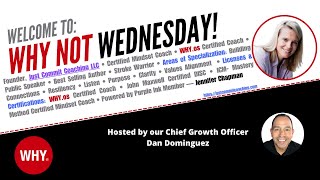
Transcript of a WHY NOT Wednesday YouTube interview (host Dan) with Jennifer Chapman, founder of Just Commit Coaching. Jennifer recounts her transition from a 16–17 year sales career to life-and-mindset coaching after a life-changing stroke at age 34, explains her signature work (overcoming victim mentality and embracing an "inner warrior"), and describes using the YOS (Why) framework to help clients gain clarity, build trust, and make impact. The conversation also covers her fundraising/advocacy with the American Heart Association, co-authorship of Solology Chronicles, and personal sources of resilience.
Chapters
Two years have made us question everything.
Our relationships.
Our jobs.
What constitutes an office.
And who we are.
In a.
World filled with chaos, confusion and uncertainty. It's time for some clarity. It's time to start understanding what another.
It'S time to start understanding ourselves.
We envision a world where everyone knows their why. But even more, we envision a world where everyone knows their why. O s, their why, their how and their what. The operating system that drives you, that lets the world know where you stand.
What your unique gift is, and most importantly, who you are.
Yos.
Are you ready?
And I'm wishing they stop trying to turn me on I want it on.
And I'm walking on wire Trying to go higher Feels like I'm surrounded by clowns and liars Even when I give it all away I want it all.
Hey, that's new. That is a cool song. Jennifer Chapman. Welcome everyone to why not Wednesday. I'm so glad you, you, you had a walk up song today, Jennifer, so that I could introduce you to that. So before we go any further, I want to hear about that song and, and why you chose that. But before we go any further, let's introduce you or reintroduce you because you've been on why Not Wednesday before. But for those of you who didn't hear that first interview, Jennifer is an indie native and the founder of Just Commit coaching. She's a certified life and mindset coach who helps her clients go from just surviving to physically, mentally and emotionally thriving by embracing their inner warrior. And I said in the pre show that should be all caps inner warrior. She loves to speak to audiences and share her story of turning her own pain into purpose to show others they can too. Her incredible transformation from sales executive, chasing after the awards, the trips, the trophies and the cash, and into our true calling to serve others that are trying to do it all and feeling the pain, stress, agony and emptiness. So welcome Jennifer. How are you?
I'm doing great, Dan. Thanks for having me back. I'm excited about this.
Well, I'm excited because you and I have now known each other, I think a little over a year. We've been talking, we had you on the show and we got to tell your story, which is pretty amazing. Why don't you tell us, you know, in, in a, in a, in a short package, what's your story? What, what made you leave chasing the trophies, the awards and the money to do what you do today?
Yeah, so you know, my background is a career in sales. I spent 16, 17 years in a couple different Industries of being a sales professional and a key account manager and selling different products and services and felt, you know, I was representing a couple of just really great companies and great cultures, great leadership and that's where I was coming off the best year of my career in 2016. So I was, I was chasing it again in 2017, trying to, trying to do it again and life, you know, intervened if you will and I suffered a life changing stroke at 34. So that was six and a half years ago and that's really where my life took, you know, a different direction that I've been kind of walking along this path now for about six and a half years. So.
Yeah, and, and, and we, we got a chance to meet through the People Forward Network, Nikki Llewellyn and her group and I met so many great people through that. Just commit coaching. Tell me about, you know, I love in the intro we talked about the people you help because there's so many people out there who are trying to do it all and they're feeling pain, stress, agony and emptiness. And so. And you help people by helping them embrace their inner warrior. What is it? What is that? What does that mean?
Yeah, I think when I initially came up with, when I became, when I started to explore speaking as an, as an avenue of my coaching business and coming up with that signature topic, that signature topic for me is how to overcome victim mentality and embrace your inner warrior, your warrior mentality. So what is, what is victim mentality? Look like, feel like, sound like and more importantly, where does it come from? And that's where people get a little uncomfortable because you have to be able to self reflect, you know. And when I'm speaking to groups, I ask them to be engaged and think of a time where you've played the victim role. And why that's personal to me is that I've been called a stroke victim multiple times by people that it's not intentional. They don't know that I'm a stroke survivor, stroke thriver, stroke warrior, victim. You know, being a stroke victim, that would only mean that it took my life. That is how I, that's a trigger word for me. However, I've seen lots of folks play become, you know, victims of having a stroke versus being able to take control over that and kind of empower yourself on how to live with something like having a stroke. I had to do my own self reflection and question, well, have I played the victim role? And the answer was yes. You know, when I was in corporate sales chasing another president's club why did I not trust the process that got me there the first time? Why did I start chasing the numbers, chasing the results, blaming things outside of my control, Right? Which was the buyer's decision or indecision or another rep that had a bigger territory or selling bigger accounts than myself. So that's the message I share with folks all over the country now. Because I think over these last three years, I hear from leaders all the time, like, we've got people that are playing that right now. Help us kind of support them and empower them to flip their way of thinking.
I love what you said. You went, you know, people use the word stroke victim. You're a stroke survivor, stroke thriver, right? And I think we can do, we can apply that to so many different things. And as you're talking to sales leaders who have those people, because we. I've been there, right? I led sales teams and I was on, I was part of sales teams. And it's so easy to say, well, they have a bigger territory, they have more open accounts, right? They had, they had more X. You can make kinds of excuses for why someone else is getting more, having more success than you are. And you take that and say, okay, well, what is it that you can control? What is it you can impact? And I love what you said. You talked about impact versus chasing the dollars, the accolades, the awards. That's all good and fine, but that just happens when you make an impact. Would you agree?
I do agree with that. What I like and what I would share to add to that and why becoming a wise certified coach was so important to me was when I was in corporate sales. What I loved so much about my sales leader at the time was that he would go around to our team every few months and ask us, why do you get out of bed every day? And Dan, I couldn't put an answer to that. And I knew that I didn't want it to be external. Right. I didn't want to say, well, I want to make as much money as I can. I want to be the best on our team. I want to be the best in our region. That's. That, that's not enough. And saying, you know, that my dog, who is my favorite being on this planet, that's probably not appropriate either. And yes, I love my husband, but he's not why I get out of bed. And I would watch others kind of have an answer to that question. And really, obviously, having a life changing experience myself in 2017 has really allowed me to know my calling now and why this happened for me. And why. I think that the WHY Institute is so valuable in people understanding their own why.
You know, I was going to get to that because a lot of times. And you are now a YOS certified coach, Jennifer. So you're working with this system. And when we talk to people and we say, so what's your why? And they'll show us a picture of their, of their dog or their husband or their kids or their just commit coaching banner and say, hey, my business is my why. And what I've learned is that those are great temporary motivators, but they change, right? Your business could fail someone. You know, Elon Musk could come and say he wants to buy, just commit coaching for a billion dollars. And I have a feeling you might just say yes.
Yeah, right.
But then what's your yeah, but what's your why then? Right? When your kids grow up and leave, what's your why then? If your marriage breaks up, what's your why then? And so we discovered your why. So let's go over that, because I think that's important. And you and I have had conversations about this and it's so true of you because your why is to contribute to the success of others, make a difference, make an impact. And we've already talked about the importance for you of making an impact. Your how, however, adding to that is clarify. So for you, it's about providing clarity, helping your clients get clear and understand where they're going, how they're going to do it. You thrive helping people get clarity. And you like to be clear yourself. And then your what is to build trust with people that you work with, with the clients you work with, with your, with your family, your friends. For you, trust is very important. So given that, how, how did that give you the clarity that you were looking for?
Yeah, it was, it was being able to put words and language to why I do what I do. Right. It was very affirming to me. It became very clear to me that, yes, this is exactly who I am, why I do what I do, what others can expect from me, which is, which has been really great too, as I continue to have conversations with leaders and decision makers that are looking to implement something like this for themselves and their teams too. So that's been really great.
So. So as you. Look, Jennifer, if we, as we look at your why of contribute and tell me about the, the defining moments that really changed everything for you.
I can, I mean, one that I can think of was, you know, when I, I went back to corporate sales four Months after my stroke. And I stayed there for another year and a half. That next year and a half was extremely challenging for me from a mental and emotional standpoint because I was still recovering from a stroke. My brain was still healing, my brain was still rewiring. My emotional capacity was immense. It was overwhelming at times. And through that next year and a half, it was like, okay, I'm no longer fulfilled selling X, Y and Z, which are, you know, it was a fantastic organization and I appreciated everything about it, but I was just no longer fulfilled doing it. It was giving me no energy, no fulfillment. I knew I was made to do something more. So honestly, at the time, I thought, well, I've had success in sales. I was being recruited to go to pharma and med device companies. And at. I thought, well, at least I'll be able to make an impact there because I'll be able to sell something to someone that's going to make them feel better. That was where my head was at.
So many interviews that I went on over the next few months. So that was kind of a moment where I knew I wanted to make an impact. But what does that look like? Where does that look like, all those questions? And found a home health company that I said yes to before. That was in 2019. So I worked with them until 18 months ago or so. So I was still making an impact to a certain point for others, helping others receive care, but there was still something internally inside me that knew it's bigger than this.
And, you know, one of the things we know, and you probably know this about yourself intimately, if you don't feel like you're making a difference, it's really hard to get up in the morning. It's really hard to go do that thing if you're not feeling that it's making an impact, a positive difference in the lives of others. And for you, you had to find that something else. So I love your story because there's. There's such a sense of overcoming adversity. Right. I love that you talk about the fact that you're not a stroke victim, you're a stroke survivor, a stroke thriver. I like that, you know, you've. You've overcome something that a lot of people.
Still, you know, and I'm sure you still feel the effects sometimes. And so you're still overcoming that every day, but you're not. You're not the same person that you were before you had the stroke. And. But it's a good thing because would you have made the decisions you made with regards to your professional career, had you not gone through that event.
I.
Would still like to think that I was either still at the company that I was with thriving or I probably would have gone into pharma or med device honestly.
And then you went into home health because that, I like the thought of that because as you know, I've been in sales my entire career also and always been fortunate to work in companies that made a difference. But you, it almost for us who have the why of contribute, you have to almost feel it directly. Right. You know, you have to see the difference as a coach at just commit coaching. You work with individuals, you work with teams. Is it a different feeling when you help somebody overcome, get clarity and they have a clear plan of action and you're able to help them get to that next step? What's the difference between that and that ultimate feeling of winning president's club and being on stage as the number one in the company? Tell us the difference.
It's so different.
You know, when you, when I was in corporate it was, it wasn't as personal. You know, when I would walk into accounts or sell accounts and they would say yes and we knew we were making a difference for them and making their place a better place with the products and services that we sold. And if they said no, you just move on. You know, I just moved on to the next account and I just kept going where it's so, it's so personal when a. I'm my own business owner, you know, and I support clients from an individual and group perspective to witness them have their aha moments.
I feel that and that's, that's affirmation that I am meant to be doing what I'm doing where you know, working at Cintas, it was like I would of course check in from a customer service standpoint, make sure they liked the products and services they, they were using. But I didn't feel it, you know, like you feel these intimate one to one and group conversations that you have and witness probably, you know, some unexpected emotion come up potentially where they, they, you know, had had that moment of clarity for themselves. It's, it's so powerful. It's such powerful work.
Jennifer, we've, we've talked a little bit about your, your, the impact this has had personally, personally on you. So tell us about for you the transformation from being that, that, that leader, that person that, that was the, the number one in the company and now you're, you and your husband have had these probably tough conversations as my wife and I have had, hey, so what are we going to do next? Right? How are we going to build this. This business? So all the struggles that you're helping people with, you. You know, what's great about this is you've probably gone through them, right? You're. You, you understand what it's. What it's like to feel the pain the.
Of building a business and then trying to make it work. What's. What's the biggest or what's been the most impactful thing you've been able to do personally to help you strive, continue to strive forward?
I'm very blessed with the people that I surround myself with. Not just an incredible spouse who supports me and stays patient with me and knows that the work I'm doing is what I'm meant to be doing. And my family is incredible and my friends. And then the women that I've surrounded myself with these last couple of years, who you've, you know, a few of them. But I have an incredible support system here in Indianapolis that it fills my cup up so much that they give me their time and when we go grab a coffee or grab lunch. And I love knowing that not only are they a step or two ahead of me, and that's incredibly inspiring, is that they are. They just reaffirm that I am also meant to be doing what I'm doing and that I'm meant to serve and meant to. That I'm going to create massive impact and difference by continuing to share my story in such a vulnerable way. And I know that you just brought.
Up two things, and I want to talk about this because I remember when I made the decision that I no longer wanted to climb that corporate ladder. One of the things that impacted me is as I looked up, everybody above me had been married multiple times and had messy divorces, had bad relationships with their kids. You know, they would talk about the fact, well, you know, I've been so busy that I'm not. I don't really talk to my kids anymore. And I knew that that wasn't where I wanted to go. And so now, in a different world, the people, like you said, those people that are 1, 2, 3 steps ahead of you, they're aspirational. You want to be there. You. And the way. And the way that they've done it. So do you. Did you see that, that kind of a difference as you, as you look at your. At the people that you would have been aspiring to be had you stayed in the role you were in, versus the people you aspire to follow in whose footsteps you want to follow. Now, is there a. What's the biggest difference?
That's such a great question. There's definitely a difference. It. The company, you know, the company I was with, it. It wasn't toxic in that regard. The expectations were different. I would hear, like, how much time they were spending at work versus home. Not necessarily, you know, messy divorces and things like that. I mean, there were. There was all of that. I didn't hear about all of that. But just, you know, when you're in a corporate environment and you're hustling and, you know, trying to achieve and strive again, you kind of forget, like, what's. What's really important here. Not. And tie it to your worth.
A lot of overachievers and overly competitive. And I am a overly competitive person, and I call myself a former overachiever because being able to reflect back, I tied a lot of my worth into. Into those results and accomplishments and defining success differently than what success looks like for me now.
Yeah, no, that's. It's. For me, it's been such a difference. The other thing is, when you're in a corporate environment, I don't know if you saw this. You're limited as to who the people you surround yourself with are because you are spending a lot of time with that group.
Right.
In this world, you get to choose.
Right.
You get to choose who your top five are, who the people are that you're gonna spend. You know, as Jim Rohn says, you are the average of the five people you spend the most time with. A lot of times the people I'm spending time with, I'm reading their books, too. And so that now not only am I getting to know them personally, but I'm reading their books and understanding their stories and getting to know them on a. On a very personal level. So. And you're one of those people, Jennifer. You know, we've had. We've had some. Some great conversations, and I just appreciate having you in my sphere. I know we're going to get a chance to see each other at the Y conference soon, and I can't wait to share your story with the rest of the coaches around us. Tell us about your biggest why not moment, a time when you were at. At a low point and. And you said why not to something. And you told me a great story about this. So I can't wait to hear this answer.
Yeah, I mean, when you asked me that, it's still the same one that, that shows up for me. And I share this for so many reasons, because it was at a time when I was still, like I said, at this mental and emotional low in my life, still trying to achieve at a high level, yet really felt like I was suffering every day. And it was when I said yes to my first coach in 2018 and met with her. And I'm emotional as I'll get out, sitting there at the table with her. And she, she just looked at me and said, you know, do you ask yourself, why me? And I don't think that I did. You know, I was surrounded by people that would certainly say that, but I don't think that I did. And she just looked at me straight up and said, that's because you need to ask yourself, why not me? And that, that has taken several months to fully, like, accept and embrace. She was right. That's right. This happened for a reason. Having a life changing stroke at 34, at the same age that my mom was when she passed away, by the way, at 34, when I was 11, my entire life came full circle in that moment. And it was really time for me to accept that, find a way to embrace it, and move forward with a completely new and different perspective.
So it went from a why me? To a why not me? So when you say, why not me? What? How do you answer that?
Why not have the opportunity to.
Embrace the fact that I'm a stroke survivor? You know, I remember a year, a year or so ago, meeting someone at an event, it was actually for the American Heart association, and I was sharing my, I shared my story with the group and then was meeting with folks one to one after, and this lady came up and she was like, I shared it and she said, that's so unfortunate for you. I don't see it that way. Thank you. And I choose to see it completely differently than you. And that's. And I share that. And I'll tell you another thing that inspires me is because I'm such a sports fan and I learned so many things from watching incredible athletes. And the ones that I learned the most from are the ones that have faced the most adversity and have hopefully said, you know, why not me? And look what they've been able to do after life changing traumatic events and hardships and challenges. That's. Those stories inspire me.
You know, it's interesting you bring up athletes because we can learn so much from them. I read somewhere that Michael Phelps told himself that he was going to work out seven days a week when he was building himself because he figured that most athletes would at least take Sunday off. And if he could work two more hours every week, that would be 104 more hours a year that he was ahead of the competition, putting in the work. And, you know, when we think of Michael Phelps, we only see the amazing success.
Right.
We don't see all the times that he didn't win, all the reasons that he had for possibly giving up. Right. And we see that constantly with those people. And I love that you brought up the sports analogy because you, you played sports yourself. What was your sport?
Tennis was my sport of choice growing up, and it was certainly an outlet for me when I was kind of going through my own grieving process, if you can only imagine, as a teenager. But these last 15 years or so, golf is my. Golf is my sport, and it's. It's therapy for me to be able to play. I'm so thankful that my body allows me to play.
It brings me joy. It's therapeutic. And outside of that, I'm a huge football fan. So any Saturday and Sunday in the fall months, that's what, what I'll be. That's what I'm doing.
So who. Who. Let's. Let's figure this out. Who. Who's. You're in Indianapolis. Are you a big Colts fan?
Next level Colts fan? Yeah.
Next level Colts fan. What does that mean?
So Sunday they won in overtime and I did not. I couldn't sit down for the last half hour of the game.
Love that you. You're.
You're seeing around my house, you're going.
To meet Nikki from our team, and she's a next level bucks.
She flies. We live in Albuquerque, New Mexico, and she flies out to two or three games a year to go see her team play.
I love that.
You know, we're not lucky in Albuquerque to have, you know, major league teams, so all of us have to fly somewhere to watch our teams play. Just. It's okay because then we get to do that.
Exactly.
You talked about your work at the American Heart Association. You were named an Impact Woman of the Year finalist. What. What did, what did that mean? What is. What were the criteria for that? And was that based on the work that you did for them?
Yeah, I was chosen through, you know, meeting. Meeting women that worked for the American Heart Association. So there were five of us that all had personal stories tied to heart disease or stroke, and we had for, I think it was nine weeks. We had to raise as much money as we could, and I don't, I don't think I knew what that entailed. Until I was in it and then, you know, right after it. And again, Dan, I must say, I'm an extremely competitive person, which most the time plays to a strength of mine. And it still did. I. So I did not. I came in second. And our goal was to raise $5,000. I raised 10, and the girl that won raised 11. And I. So I didn't know what she was raising behind the scenes. Right. And she didn't know where I was. So to find that out, like, was really. It was hard for me internally, truthfully, honestly. But also. Let's, let's step back, Jennifer. Right. I had to bring it back to perspective and be like, I raised $10,000 that it's going to an amazing local chapter to help support women that are. Have gone through something like heart disease or stroke.
Yeah, those. And, and the contributed. You probably loved it because, hey, you helped, you know, who knows how many countless women were helped by the fundraising that you did, and there were five of you trying to raise $5,000. So minimum, there was. You're going to raise $25,000, but just between you and the winner, you raised $21,000.
Right.
So, I mean, there's. And there's that 8020 rule, right? The top 20%.
Right.
Get a grab. 80% of the. Of the production. That's fantastic. You're also a co author of a book called the Solology Chronicles, and in. In the description of that, it talks about stories of women who have persevered and have turned their mess into their message. And I just absolutely love that phrase. So tell me about your mess and.
Your message.
Writing that chapter. So that I wrote that in 20. In 2021. And it was, it. I had. It was my first time doing something like this, so I, I didn't know what to expect. And, and like, I shared with my, you know, a little bit of my story a little bit ago. There's a lot there. I can speak it and say it, but to write it was different. And so when I, when I, when I first wrote out my first draft, if you will, the publisher came back to me and she said, okay, I hear you, but I don't feel it. Then I'm like, oh, she's like, we have to tap into your emotion, emotional piece of your story. And that. That's a whole nother level, you know, because that's where you have to get, you know, get even more specific and more clear with the details of, you know, losing my mom. So suddenly and tragically when I was 11, I had to Go back there, and I hadn't gone back there in a long time. And it's. It's therapeutic for me to still. I share it all the time. It's. It's prolific for me. It's. It's. Again, it's one of those I've had to say, even more so than my stroke. Dan is like, why not me? Why not be the woman who lost her mom 30 years ago and thrives on knowing she's with me every single step of the way with everything that I do?
That's a great, great mindset. You know, I. I lost my mom only a couple of years ago, and that was tough. I can't imagine at 11 years old because my daughter now is 11 years old. I can't imagine dealing with that because the. The work's not done yet. Right. Our moms are supposed to be there to help us become adults. And here you were at 11, several years away from becoming an adult and having to deal with all of that on your own. I'm sure there's a lot of that that goes into what makes you who you are. So let's. Let's ask one. One last question, because we're almost at our time, but I want to be. I want to be respectful of our listeners and for you, too. But you're now a y coach. How are you implementing? How is the yos helping you in your business? What are you seeing able to implement that's helping you help people overcome their challenges?
Yeah, it's been really great so far. It's only been a, you know, a couple, three months for me that I've become wide certified, and I have planted so many seeds and have been able to show already quite a few leaders and decision makers that are interested in something like this that when I do their why debrief with them, they have their own moments of clarity and affirmation of like, yeah, this is so spot on for how I work and why I do what I do. And I see the power of knowing why my people do what they do and how that can not only bring more clarity to the team and also break down some communication barriers. So it's been really great.
I love that it comes back to your how of clarity. And you can see, you know, it's so, so amazing. One of the things I love about knowing people's yos is they light up when they're talking about their why, their how you light up when you talk about contributing and helping these leaders. And then you lit up when you said, hey, when I get when we give them clarity. Right. And then you're building trust. So, Jennifer, thank you so much for being on the show. This has been a fun, fun conversation. We're so glad to have you as part of Wine Nation. And what do you say we end the show on that note?
I say why not? Dan.
Thank you so much, Jennifer. Guys, we'll see you here next Wednesday for another episode of why not Wednesday. Thank you, Jennifer Chapman. Just commit coaching for being our guest this week. And we look forward to seeing you in Albuquerque soon.
Looking forward to it. Thanks so much.
Have a great rest of your week.
You, too.
Bye, everyone.
More from Dr.




Women In Leadership: A Need For A Greater Systemic Change With Belinda Clemmensen






