WHY NOT Wednesday With Jennifer Chapman
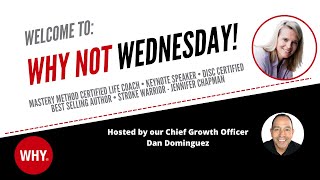
A recorded live YouTube interview (Why Not Wednesday) in which host Dan Dominguez interviews Jennifer Chapman about her transition from a 17-year sales career (including 10 years in beer/wine/spirits and a role at Cintas) to becoming a certified life and mindset coach and founder of Just Commit Coaching. Central events: a life-changing stroke at age 34, months of physical and longer-term mental/emotional recovery, using life coaching in her own recovery, COVID-era reflection and certification, and a decision (on her five-year stroke anniversary, March 30) to leave steady employment and become a full-time coach and speaker. Core themes: contributing to others, clarifying purpose, building trust, circle-of-control/self-mastery, and the "why not me/why not" framing as catalyst for purpose-driven change.
Chapters
There's a certain kind of coach who believes what we believe.
Who leads people to greatness, who gets people unstuck, who unlocks all of your passion.
A coach who helps people discover what drives them to tap into their superpowers.
Then knowing your why is the first step.
To untap potential.
To focus.
To breakthroughs.
A coach who's looking for a better way.
Are you that coach?
Hello, everyone, and welcome to why Not Wednesday. I am Dan Dominguez, your host today, and I am here to talk to you, to talk to Jennifer Chapman, who is our guest today. You know, we were scheduled a few weeks back. We had a little bit of a setback. Thankfully, Jennifer's feeling better and she's here, so we're excited to talk to her. Let me tell you a little bit about Jennifer. She's an indie native. She's the founder of Just Commit Coaching, in case you couldn't read that banner behind her. She is a certified life and mindset coach who helps her clients go from just surviving to physically, mentally, and emotionally thriving by embracing their inner warrior and man, you know, as a veteran, I love that inner warrior stuff, so I want to hear about that. She loves to speak to audiences and share her story of turning her own pain into purpose to show others how they can too. So welcome to the show, Jennifer. How are you today, Dan?
I'm doing great. I've been looking forward to this conversation for quite some time now.
I've been looking forward to this conversation myself, especially since we couldn't get it. Get it done at the original date. So we've got a few people that are saying, saying hello to us. So I always like to acknowledge people. Dan. Danica Treble says hi, Dan. And Jennifer Bella's on and she's saying hello and Watson is saying hello. So, you know, you kind of had the double intro because Jill o', Boyle, by the way, if Jill o' Boyle is listening, we want to thank her because she filled in last minute. And what was really cool about that, Jennifer, is she has your exact same Y operating system. So it wasn't like a big change, but we had, we had a different face. And you know, before in the pre show, I'm going to, I'm going to give. I'm going to make you blush, Jennifer. But I was, I was scrolling through, through Jennifer's LinkedIn and I was making a comment that she had a picture up from her and, and a colleague at a presentation she did, and it looked like a professional, like one of those stock pictures, because Jennifer and her friend look so good. So kudos to you for having a very photogenic face.
Thanks, Dan. That's very kind of you.
Not, not that, you know, not that we can, you know, it's like my good friend, like, he has a face for radio. And you know what? The thing, the thing is this. We are who we are. You know, I, I always used to get mad at people that said, that said, you know, I don't like the way that picture came out. I'd say, hey, that's you. That's a picture of you. And so you got to just like it. Embrace, Embrace who you are. And I know you embrace who you are, Jennifer. So tell us a little bit about Jennifer Chapman. You know what? One of the things I'd love to start with, we're going to do it differently. We always start with yos. But here's what I'd like to do. Tell us your story. Why are you today a coach versus what you were doing sometime back?
Yes, that's a, that's a huge loaded question. But the shorter version of that is, you know, I spent my, my whole career in sales. I mean, 17 years of sales, 10 of those years in the beer, wine and spirits industry. And then up leveled myself and went into a corporate organization called Centos. Shout out to Centos. And that was my first leap out of my comfort zone, you know, going from what I knew for 10 years to something that was completely brand new as far as cold calling and door to door sales and all of that. And that first year there in 2015-16, I, I, my, I hit Presidents Club and it was huge. And I thought, well, this is, this is the pinnacle of sales. Let's do this again. And also within 48 hours of knowing I hit that, I turned to 34. And that was a moment for me. That was my first moment of realizing my mom was 34 when I lost her. And so what a huge epiphany for me to realize. Not only did I know I lost my mom at 11 years old and that was traumatic. But to then be 34 and feel so young still, right? So I had that moment and then I started to do the hustle and grind in year two at Cintas. And as I was switching positions with them.
At 34, I suffered a life changing stroke.
Wow.
It was, it was surreal. Sometimes it still is. To say the word stroke is a scary word at 34.
Yeah, I mean that you, you, you, you hear about that, but not at 34 years old. So what did that do for you. So now you're 34 years old, you make that realization. And I talked about it in my post introducing you. What, what happens when you have a stroke at 34? You're at the pinnacle of your sales career. You're building your. You're. You're getting ready for some big things.
100%.
Yeah. The first few weeks and months it was. I was in the hospital and then acute rehab, relearning how to do some basic things. Right. And then I go to outpatient therapy. So I was out of work for about four months, physically recovering, and then I thought, well, I'm well enough. Let's go back to what I know. Let's go back to normal, whatever that means, and let's go back to sales. So Cintas, you know, graciously welcomed me back and from their standpoint, they couldn't have been a better supporter of what I was going through and where I was and.
Right.
So I, so I stayed there another year and a half, but really throughout that next 18 months, I was there. It was no longer about physical recovery for me. It was the mental and emotional aspect of, Of a huge traumatic event was, was that was harder for me to deal with in the physical.
Wow. And so, so, so you come back.
You'Re. You're at Centaz, and you had a realization. Tell. Tell us about that.
The. The realization of knowing that I was no longer fulfilled.
Yeah.
That was, it was hard because I didn't know what exactly I was meant to do, but I just knew this is not what I was meant to do. It was nothing against what this company had done for me, but it was like I knew I wanted to make more of a difference in what I was selling. So I started to interview at pharma and med device companies, thinking, well, at least I'm going to sell something that's going to make someone feel better. And so I did tons of those interviews and finally said yes to a home health company here, locally, here in Indy. And that was a perfect fit for me at the time. So that was in 2019.
And so, so now you're working at home health company. How long were you there?
Honestly, I was there for two and a half years. And so I was doing well there in 2019. And then when the world shut down in 2020. Yeah, it was what an opportunity for me to do some deep dive into my own personal growth and development. Because I do want to share that what helped me through a really low point in my recovery was hiring a life coach.
Yeah.
And she was a game changer for me.
So you will definitely have to dig into that. But I want to. So a couple of more people have come on. I saw Jerry Fletcher all the way from the northwest usa. Vicki Knuth. Welcome. Glad, glad you're here. Danielle Dobson is our new coach in Australia, believe it or not. So she's called, she's tuning in from the future. I know it's, I think it's Thursday morning.
I was going to say it's probably 5:30 in the morning.
Yeah. So Danielle, thank you for joining us. We got Lynn Everard and Watson. Jordan. You know John Watson says sometime life intervenes. Yeah, life just happens. Right. And so, you know, sometimes we're just going along and something happens and we have to react. So let's, let's talk about that sign behind you because I'm sure it's related to your story. What it, what do you mean by just commit coaching?
Yeah. Thank you for asking. I, I'm very proud of my, the name of my company and I received lots of compliments on it. And so about six months after my stroke when I, I knew I wanted to do something physically, I just knew my body wasn't going to be able to do the type of workout that I used to be able to do, which was, which was like physical boot camp style workouts.
Right.
And so I found a studio here in Indianapolis called Just Breathe. Pilates.
Yeah.
And it was, it was referred to by a friend and so I was like, well, I'll try it. And so then as I started to create my name, come up with it and I knew I wanted to use my initials but Just Breathe. So I was in class this morning even, and periodically throughout class, you know, she'll say, okay, we're just gonna hold or just pulse or just lift. And it's like we're in the most uncomfortable position you can imagine. And she makes it sound like it's so simple. We're just gonna do it, we're just gonna hold. Okay. So we're gonna be in this plank, right? And we're gonna hold it for two minutes. We're just gonna hold. And so it made me think like, yeah, I'm asking you to just commit to yourself. Right. But there's so much more that goes into just committing to yourself.
Right.
That's how I came up with it.
I love that. You know one of the things we've been talking about at YA Institute when we talk about our messaging because when you're a Y coach, everybody says, okay, so what is that. And so we've come up with that story, and part of that story is just getting to that first step because people come to you. People come to a life coach or an executive coach or a consultant because they're often overwhelmed with everything that's going on. And they're looking, they're trying to figure out who they are.
Right?
They're looking for that self awareness. And so when they're, when they're looking for that, they get overwhelmed because there's so many choices out there. When they're really, all they need is somebody to help with that first step. Just get me to that first step. And we believe that that first step is discovering your why. So let's talk about that because you have the best why out there. And I'm just a little biased because it's my why. So your why is to contribute, to make a difference in the lives of others, to have an impact. Your how is clarify. So how you do that is by helping people gain clarity and understanding about what it is that they're sometimes overwhelmed by. And then ultimately what you bring is trust. You're someone that can be counted on to do what you say you're going to do. So, Jennifer, how did it feel to you? I know it's been a few months. When we discovered your why and you.
Went through that process.
It was reaffirming to me like, it was like, yep, this, this, this assessment nailed who, who I am. I mean, to contribute is, is. Is my why. I mean, it's why I became a coach. It is to, to do something that's ultimately going to make a difference that's bigger than myself.
Right.
By simply sharing my message and in my wisdom and my experience and hope that it resonates with others and that it, it will. Yeah, it's contributing to something bigger than me. And you guys nailed it.
And that, and that's, you know, that's absolutely part of the definition. What about the clarity part? So what we said, what we like to say about the how is, it's how you bring your why to life. So you, you contribute to others by giving them clarity. Is that a big part of your coaching, helping people get clarity?
Oh, yeah. I mean, it's. It. My. One of my responsibilities as a coach is to ask those what we call empowering questions to help them tap into their own wisdom. I'm not here to give you any answers.
Right.
The answers are already within you. You just have to be open and willing to want to tap into what they are. And that was that Was for me in becoming a coach and going through my own certification was, was getting really clear on what type of coach I wanted to be.
Yeah, so. So you're that coach that people come to when they're looking for somebody to help them, looking for somebody to give them clarity and looking for somebody they can count on to do what they say they're going to do because it's not necessarily everybody who does that. Right. And I don't want to, you know, I'm going to throw myself under the bus. But, you know, there's another assessment there. There's an assessment out there called the Colby and it assesses you on your, on your fact finding, on your, on your follow through, on your energy for, for quick start new projects and then on, on implementation. And I'm a two on follow through. So it's it on a scale of 1 to 10. So if I tell you I'm going to do something and I don't write it down and I don't put it in my calendar, it's probably not going to happen. And if I'm dealing with Jennifer Chapman who does what she says she's going to do, we're not going to get along. If I do that a couple of times to Jennifer.
Right, Right. Yeah. That, that I would probably rank pretty low on that as well, aside from my coaching role, but just me as a human being, sometimes some follow through on my list of things that I want to accomplish. I like to start a lot of things, but then it's like it's part of, part of this my why system. Right. It's. I think you can, I can over commit because I want to say yes to all the things and make a difference in a lot of different ways. But then that gets, that's a little overwhelming.
Right. And so how have you seen it now that you know your why and you've had a, now you've had an extra few weeks to think about it, what's it been like when you look back at your life? Where, where does that contribute? What places in your life did you see that living in, in the past or even in the stuff you're involved in now?
I think always being a sales professional, I was contributing, you know, and it wasn't always necessarily about the product per se that I was selling, but it was so much more about the company I was representing.
Right.
And that I believed in.
I've worked for some, like, really amazing companies and so I, I just had full faith and trust in them that we can, we can try on a product, if it doesn't work, we're going to try on a different one. I'm going to make sure that it makes the most sense for you as a customer that we provide you with what you're looking for. And so I feel like, yeah, my 17 being in 17 years in sales, I was always contributing and clarifying, right. And asking those questions to these decision makers and these buyers, what's going to be best? And ultimately, as a salesperson, it's building trust. I mean, they have to trust me before they're going to trust anything that I was going to sell them. And even so now, as a coach, I want, I want my potential clients and my audiences to, to build that trust in me as best they can to then potentially say yes and seeing, like, yeah, she's going to help me take, take me to where I want to go.
Right. And I love that you, you just brought it all together. You know, I talked, I talked to someone yesterday who's one of the most successful sales people I know. He, he's a multiple, has run some car businesses and, and they're amazingly successful. And he said he's got three rules for his salespeople. He says the first one is a spoil the heck out of your customers. You know, spoil your clients. If you spoil your clients, they're going to talk well about you. His second, his second rule, his second rule is make a lot of money. If you're a salesperson and you're making a lot of money, you're doing your job, right? And his third rule is have fun. And so, and I said, really, is it that simple? Three rules. And his, his car dealerships break records every year. And they're luxury brands, you know, Audi, Mercedes, Porsche. So in an economy like we have right now, they're breaking sales records by spoiling the heck out of their customers, making a lot of money, and making sure that their clients are getting a great deal because they're spoiling them. And then the final one is having fun. So I think I like that that is as a simple, easy way to sell. But I heard a little bit of that in what you're talking about. That clarity is so important. Right? And I'm going to give a shout out to our good friend Larry Levine, the author of Selling from the Heart, because his how is clarify. Like you, I think he may have the exact same why I always clarify, contribute, clarify, trust. Because one of the things he talks that we know about people with the why of clarify is you do ask a lot of questions. But in a sales environment, that makes you so valuable because your clients probably felt like, she really cares about what I need. Right. So you were asking the questions that other salespeople probably didn't come in and ask.
I, I would like to think so, because it's building that trust. I'm not gonna just, I wasn't just gonna walk in that door and automatically try and sell you something without getting to know you and getting, without getting to know your wants and needs here just because I needed, needed the sale. I mean, that was never the way I went about whether I was selling beer, floor mats, or home health.
Yeah, love that. I love that. Mark Hunter. I spoke, we, we spoke on LinkedIn earlier. He says, you know, it's not about closing the sale, it's about opening the relationship. When you close the sale, you're opening the relationship. So don't even talk about closing the sale. It's. Hey, when we, when we, when we come together to work together, we're opening the relationship because we just. You're going to start buying from me, right? When somebody comes to just commit coaching, when you close them, quote, close them and they become a client, that's the opening of the relationship. I love that, that metaphor. So, Mark, if you're listening, that's a shout out to you. So tell me the defining moment that changed everything for you.
The defining moment for me was when I was working with my life coach.
Yeah.
And she, and I was emotionally unstable. Right. I am, I am living with a lot of fear and anxiety and scared and grieving and all of it. And she said, have you ever asked yourself, why me? And I said, I, I haven't done that. But of course, all my friends and family around me have said that. Why, why is this happening? Jennifer?
Right.
And, and my coach, Des Garcia, if Des is on here, shout out to Des. She, as a matter of fact, just looked me in the face and said, you need to ask yourself, why not me?
Right.
And that hit me with everything, you know, And I, and it took me several months to really process like, she's, she's right. This happened for me for a reason. Everything has in my life. And that, that is when it, I finally felt like, okay, I want to figure out what this reason is and how to move forward with it. Yeah.
Love, love, love that. So you posted something, I think it was today. I don't know when it was, but it says, self control is strength, calmness is mastery. You have to get to a point where your mood doesn't shift based on the Insignificant actions of someone else. Don't allow others to control the direction of your life. Don't allow your emotions to overpower your intelligence.
That's huge.
Yeah, it is.
So what, what, what drives you to post something like that? How does, how does that play out for you? Self control, calmness. I see that in you, even just talking to you. But how do you do it? What's the secret? And then how do you coach to it?
Such a great question. I think I learned first in corporate when I was with Cintas. My sales leader would always say, control your controllables.
Right.
And so from a professional standpoint, it was, what can I control here in the situation? Can I control the buyer's response or reaction? No, I cannot. So it was always being, trying to become more aware of what I could control. And then now with this personal life changing experience.
Right.
There's Melanie.
What could I control in the situation? Right. I couldn't control the fact that I had the stroke, but I could certainly control how I responded to the stroke. And so it's, that's been a huge life lesson for me in every day moving forward. And now as a coach in helping my clients become becoming aware of your circle of control, literally writing down what's in your circle of control, what's outside of it, and where do you see your emotions take over of something that's outside of your control?
Yeah. So Melanie wants to know, was your sales leader, Jeff Hancher?
No.
No, it wasn't. Right. But. But you know what I love? I love that you talk about that, you know, often here. And the percentages are different, different speakers use a different number. But life is 10% what happens to you and 90% how you react to it. What percentages do you give it believe that it sounds like you do. Just based on what you said.
Yeah. I would say that's pretty accurate. I mean, we're all going to have life changing experiences. I mean, grief is universal here. And so are you gonna allow that event, that situation, that challenge to control you and to take power over you, or are you gonna have the will and the courage and the resilience to take your power back and take control over. Over the situation? Is it easy to do? No, it's not. But it's worth it. It's worth understanding how to do that. Yeah.
Yeah. And so your transformation from a sales executive who is chasing after the awards, the trips, the trophies and the cash, and then your true calling to serve others that are trying to do it all and feeling the pain, the Stress, the agony and the emptiness that sometimes comes from that. You know, we, I think we, you know, you and I share similar stories. You're. You're doing great. You're getting paid a lot of money and you're winning the trips and your teams are succeeding, but it just doesn't feel like you're making a difference. Right. So what was the catalyst for that final step? Because just commit. Coaching just started only a couple of years ago. So what made you take that final step? And we're going to give a big shout out to Des Garcia already, but I want to hear the internal story, Jen.
So.
I started creating this during COVID Is that so? When I was working with Des, she. She looked at me, it was one of our last meetings, and she said, you're gonna be a coach. It's just a matter of when you're ready to be a coach. And I was scared then. I was like, oh, not ready for that yet. But really, when we were locked in our homes, yeah, it really kind of I thought, could I do this? And started to create my name. I just commit and sharing with people and doing podcasts and putting my story out there and getting response from it because there's lots of elements to my story that resonate with, with, with a lot of people.
Right.
So I started to do some networking and kind of creating some clients and went through my coaching certification last year, which was the most transformational experience of, of my life up to this point. I think as far as learning the tools and resources that I can offer my clients, I had to do on myself first, which was transformational. And so it was getting harder and harder to try and, you know, honor my, my commitment to my job, to my company, who was so good to me and understood that I have this side project, this passion project, and knew that it was going to eventually it was getting too hard to balance both.
To balance the two. Right. And so you had to make that. You had to make that choice and you did that. Right. During COVID How fun. Right?
It was, Dan. It was profound. The day I chose to leave Select Home Health because it was on my five year stroke anniversary.
Wow.
It was meant to be that day. Yeah. Everything happens the way it's supposed to happen. I mean, and so for it to be on that day, March 30th of this year was my 5 year anniversary and I walked away and have become a full time coach and speaker since. Yeah.
So tell me about your biggest why not moment. That's our signature question. So time in your life when you said why not to something, and it led to what? Something positive.
I think it was pulling, pulling the trigger and saying, why not walk away and why not fully step into my calling that I've created? Right. Like I, you know, I tell people, like, I left my training wheels in March, Right. I had that the steady, the steady income was happening. And, yeah, I had tried to work on building my brand and my audience and my clients these this last year and a half or so, but it's still ebb and flow. It's still fully trusting myself, this process, staying patient, having an amazing supporting spouse and family to say, why not? Now's the time.
And you know what I love about your story that you said earlier, because it's the name of the show. And again, Des Garcia, we're going to give you credit for this because you said you were asking yourself, why me? And she said, have you ever asked yourself, why not me? And I have heard that phrase from a few very inspirational people in my life, and I'll add you to that list. There was a gentleman once when I was still working in corporate, and I had one of my direct reports, her husband had a traumatic brain injury, and he was paralyzed from the neck down. And probably had the best attitude I've ever seen on someone who was told he'd only had a few months to live because just the way his body was shutting down. And we went to visit him that me and the whole sales team went to visit and try to uplift his spirits. And he uplifted our spirits.
Yeah.
Because he said, why not me? He said, you know, this is the best time ever to have a brain injury like I had. Because guess what? If it wasn't today, in the old days, they would have put me in a back room and waited for me to die. But look at this great wheelchair I have. They drive me around, they take me out. And he was looking at all the positives that came because of when he had his brain injury in 20, 2017, I believe, and not about the fact that he was feeling sorry for himself. So he was one of the first people I've heard that was going through a really tough time that said, why not me?
Yeah.
And he inspired people with that. So, Jennifer, we're getting close to the end of our time together, but I definitely want to ask this question. How has discovering your why and your why operating system impacted you?
It just reaffirms what who I am and why I do what I do. But it's as simple as that. I mean, it Just really makes sense. I mean every assessment I've taken over the last, probably even before a year or two ago. But I've done a lot over the last year or two in all of them reaffirm.
Right.
Who I am internally and how that shows up as a coach, whether it's contributor or teacher or coach or whatever assessment it may be. So, so this was certainly. Yeah, just. I don't like the word validate necessarily. I'm not looking for any external validation. I certainly used to, but it was, it was affirmation for me.
Oh, I like that word, affirmation. So I'm gonna, I'm gonna, I'm gonna leave on that note because that's such a great note guys. I hope you enjoyed meeting Jennifer. I've enjoyed talking to you. I want to say Danielle, thank you. She said she, I think she finally. Danielle Dobson. It's Thursday 7:30 down in Australia. So she, she's you know, calling us from the future and then I know, I think we said hi to Lynn Everard from South Florida and, and Lynn, we hope you, you are safe from Hurricane Nicole there. And, and, and Melanie, thanks for joining us everybody who joined and chimed in. Jennifer, anything you want to say to our audience before we go? I know that one of the things you're doing is you're really stepping into your speaking role. So who is the audience you want to speak to? I've got about two minutes left so I definitely want to put that out there.
So thank you for letting me share that. I love to speak to groups of people that it doesn't matter the role that you play. I've spoken to groups of HR professionals to C level, to managers, to supervisors. And I'm not here to speak to you about sales and leadership. There are coaches and plenty of resources for that. But I, I am here to support you. I just think now more than ever mental and emotional wellness are so important to have that support at work. Some people maybe don't know how to have access. You have access to that outside of work. And so if you as an employer can support them.
Under the surface, as I say, or under the hood so they can then show up as their. As you want them to show up as their best professional self. I mean supporting that, I think that that will, this is just the start of what's to come as far as coaches being an, a value added resource to their people.
Love that. Thank you so much Jennifer. Have a great rest of the week. We've loved having you on why not Wednesday and if you didn't catch the live interview. It's going, it's going to be. Use that same link and the recording goes live as soon as we go off the air. So, Jennifer, I look forward to talking to you again soon. Everybody have a great rest of your week and we'll see you next Wednesday.
Thanks, Dan.
More from Dr.




Women In Leadership: A Need For A Greater Systemic Change With Belinda Clemmensen






