WHY Not Wednesday with Jennifer Mallory
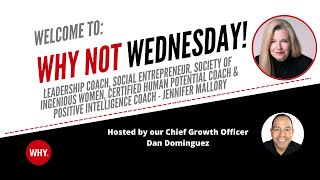
A recorded interview (WHY Not Wednesday) with Jennifer Mallory, an ICF-certified human potential and mental fitness coach who runs Ingenious Coaching & Consulting and founded the Society of Ingenious Women. The conversation centers on Mallory's "why" (to find a better way), her how (challenge the status quo), and her what (simplify), illustrated with personal anecdotes (biohacking, wedding/planning examples, real-estate scripts) and practical work (weekly live discussions, membership via societyofingeniouswomen.com and LinkedIn). The episode also explains the Society's purpose (peer learning, skills for a rapidly changing world), membership structure (small, curated network with weekly live conversations and a Facebook group), and ends with Mallory's "why not" moment—choosing the dot-com path over Columbia Business School.
Chapters
These last few years have made us question everything.
Our relationships.
Our jobs.
What constitutes an office.
And who we are.
In a.
World filled with chaos, confusion and uncertainty.
Certainty.
It's time for some clarity. It's time to start understanding one another.
It's time to start understanding ourselves.
We envision a world where everyone knows their why. But even more, we envision a world where everyone knows their why. O s their why, their their how and their what. The operating system that drives you, that lets the world know where you stand.
What your unique gift is, and most importantly, who you are.
Yos.
Are you ready?
Hello and welcome to why Not Wednesday. I am so excited to talk to Jen Mallory today. Guys, if you have been watching my LinkedIn feed, I gave you a couple of hints as to who we were going to be talking to today, but I just cannot wait to introduce you to Jen. So let me tell you a little bit about Jennifer. She is an ICF certified Human Potential coach, Certified mental fitness coach. She combines techniques of traditional productivity coaching with the latest discoveries in human potential research to help entrepreneurs create profitable businesses that are aligned with core values. I know you guys would resonate with that. She coaches to the person behind the numbers, working to create a business that is a privilege, not a chore. And who doesn't want that, right? Her clients describe her as a provocative question asker who encourages implementation of fresh ideas. And they choose her because she delivers something different than traditional coaching. So the name of her company is Ingenius Coaching and Consulting and that reflects her intent to get to the heart of the creativity and originality in her clients. So in addition to her private coaching practice, she's also the founder and leader and you guys are going to love this. The Society of Ingenious Women, an UN networking group for women in support of developing innovative skills to thrive in an emergent business landscape. So a little personal stuff. She's a food and craft cocktail enthusiast and lover of the unconventional. And she lives with her husband and four kids in a house that's rumored to have been in an exhibit. Been an exhibit in the 1964. 1964 World's Fair. Did I get all that right, Jennifer?
You did indeed, Dan. Thank you.
That is for that intro. Oh, that is so impressive, Jennifer. And you know, even more impressive was the way we met. You and I were just talking in the pre show. I do some marketing as the chief growth officer at Y Institute. One of the things I have to do is to reach out to people that I've never met before sometimes. Right. And I Reached out to Jennifer through LinkedIn and she sent me a message back that was very professional and very nice that just kind of said, hey, Dan, I may not be your ideal client. Based on your message, I can see what you're looking for. However, I do like connecting with people authentically. So if you're interested, I'd love to have a connection call. And we had a 15 minute connection call and that's led to multiple conversations and to you being our guest today. So thanks for doing that, Jen.
It's my pleasure. And I remember our first conversation. We just didn't stop talking the entire time. It was so fun to connect. We really did.
You know, I think that we were talking in the pre show too, about authentic connections and how important that is and how a lot of us in today's post pandemic world, but even after the pandemic, we've continued to do business through Zoom and connecting with people through Zoom. And then we get an opportunity to meet those Zoom friends in person. And what a great connection that is because we feel like we've known each other for a long time by the time we meet in person, right?
Yes, absolutely. And you know, as we were talking about, I think that nothing will ever replace personal connections. There's just something so special about being with people and really sharing a physical environment. And I also, I don't think we've tapped the power of connecting online and what it means, I hear a lot of Zoom fatigue and I totally get it. I mean, who wants to spend eight hours a day in front of a computer? You can feel really unattached to the people on the other side. And I think there's a huge opportunity to use technology to, to be second best to physical connection. You know, and I, I noticed during the pandemic, my network exploded across the, across the globe. You know, now we have connections in Australia and Ireland and Germany and Russia and, you know, is. Yeah. And in ways that I never would have been able to do without technology.
Well, it's so interesting you mentioned that, because the Y Institute grew during the pandemic and we grew globally because we couldn't really do business locally. Everything was shut down. You couldn't go and, and give a, give a presentation to a Rotary Club. Everything was on Zoom. So we just made a conscious eff to get active on social media like LinkedIn and connect with coaches from all over the world. And just like you, we have coaches in Australia, we have coaches in Germany, Canada. We have people all over the world that have joined the why Institute because of that. Now, one of the things that I love to do, Jennifer, when we get started, is to go over your why operating system, which those of you that a lot of our coaches are listening in and they're making comments so they know what that is, but I like to define it. So, Jennifer, your why is to find a better way and share it with others. So you believe that there's always a better way. You're an ultimate innovator. You constantly seek better ways to do everything and you contribute to the world by creating better processes and better systems. That's your why. Your how is to challenge the status quo and think differently. So what that means is that you're always looking outside the box or the conventional way of doing things to find solutions that are different and unique. You don't typically follow the rules or color inside the lines. And you create or innovate unique ways of doing things that others may not be, might, may not have thought of. So you like to find processes that are fun, exciting and different. And you often rebel against the classic way of doing things. You have an uncanny ability to see things that the rest of us don't notice. And then you bring answers or solutions that push the envelope. So that's your how. That's how you find those better ways. And your what is to simplify. So what that means is that ultimately what you bring or what you deliver in any situation are simple ways to move forward, simple solutions. Your solutions are useful and understandable and typically easy to implement. So you have a unique gift for reducing the number of steps required for just about any task because you're always looking to simplify. And for you, life is better when it's simple and uncluttered. So you like things direct and to the point and you don't understand why anyone would want it differently. That's the full version. I like to give the full version.
How does that resonate with you, Jennifer?
Well, it's so funny because the intro that you read was written before I took the assessment and I was laughing when I got it back, especially the how, because in my bio it says I skate where the puck is going. And that's been in my, that's been there for years. And I was, it just made me laugh because it was so on point, the assessment. And it just really pointed out that, yeah, that is how I, that is how I am.
And I love that you, you have the why of better way. So, you know, by the way, I don't know if, if we saw this, but Jennifer Nielsen is one of our newest coaches. So I want to say hi to her because she's on. You know, when you have the why of better way, you will do things differently if they're better. Right? When you have the why of challenge, you'll do things differently just to be different. And you have both. So your why is to find a better way, and your how is to challenge. So you're almost like a really great filter for yourself. The challenge part of you is that says, hey, let's try it that way. Let's do something different. And then the better way part of you filters it out. It says, okay, that's different, but how is it better? If it's better, then you'll implement it. Have you found yourself doing that?
I love that, and thank you for pointing that out. Yes, that is very much the way that I like to work, and I like to find people who I know are better than I am at developing processes and let them go. So when I planned my wedding, I hired a band, and I said, they said, what do you want to play? And I said, well, here's 10 songs that we. My husband and I would like. And then the rest of the music, I'd like you to play whatever you jam to. What do you guys love playing in practice? And that's what they did, and it was amazing. And I did the same thing with a florist. Here are my colors. I don't care what you do. It just has to be these colors. And I had the less stress because I hired someone who was way better than I was at doing that. But to your point about simplifying, it made my life so much easier because I could just trust the people that I hired to do their job.
You know, it's interesting that you. You mentioned. So you have two of Gary's. Why's our founder and CEO Gary. His why is to find a better way. His how is clarify, and his what is simplify. And you. We just really see that in everything Gary does and everything we do at my institute, we're always looking for a better way. We're always looking for ways to make it clear and ways to make it simple. And I think you saw that in when you did the why discovery. You know, you. You go through all of it. It's a better way to get to know someone really quickly. It's clear. You get very clear results and that they resonate. And it's simple. It takes. I think it. The longest I've had somebody take is 10 minutes. Eight to 10 minutes is what I. What I tell people. You answer 38 questions. But the beauty of it, and it's probably a little bit of what you do, is you can take something that's really complex and just simplify it and make it simple so that others can understand it. The Y Discovery, for example, has 4,000 possible questions for the YOS and 2,000 possible questions for the why. To get that down to eight to 10 minutes took a lot of simplifying, but it was having that kind of thinking, right? And you probably do the same thing. How do we make this simple and easy to understand? Can you give us an example of a. Here's a great question. A time you found a better way to do something by challenging the status quo and ultimately delivering something simple and easy to use?
Oh, my gosh. I can think of some. I can think of a lot of different examples.
That are sort of funny. My husband is a scientist, and.
So I often do things that really sort of aggravate him because I come up with a process that's really simple. So I can think of an example. I'm just thinking of things off the top of my head because they make me laugh. One time we. We cooked something on a cookie sheet that floated, and he went to put. He was saying, well, we've got to soak this before we can really do anything with it. And so he was trying to figure out what he could put on it to soak it. And I just looked at him and said, well, why don't you turn it over.
Right?
So I have this. So I have this process, and we now call them moves. Master of the obvious. Because I do have this ability to look at something and to just see, okay, here's how we could do it much easier. You know, there were certainly processes at work where I can think of, especially because my background is in real estate, in terms of connecting with people and how to make things simpler to connect with people. So developing scripts that were asking connection questions rather than having, you know, a long intro or a system that had.
You know, a system of connection that allows the relationship to develop as you and I were talking about, instead of, you know, constantly just asking people for business. So most of the examples I can think of off the top of my head are these fun sort of personal examples, but it shows up all over the place.
Gary's listening. He said, master the obvious. Love it.
That's a simplified thing, right? It's just like, look, how about we do this? You know, when we were. We did work with a lot of our Initial coaches, when we were coming up with the definitions as we were improving the website and we wanted to say, okay, how do we define simplify? And, and, and one of the definitions was to make make things simple and easy to understand. And then another simplified person says, how about just to make things simple? And then someone said, how about just simplify? Simplify means to simplify, you don't need another definition. It is that word versus mastery. Right. The almost the opposite. Mastery is all about digging deep and learning and understanding things at a very deep level. That definition was a lot when we went to that group of people. Okay, so how do we define mastery? Well, it's understanding things at a deep level. Somebody who loves learning and it's a lifelong learner. So it's interesting how the different wise did different things. The Better way group kept coming up with a better way to define the why of better way. And they just kept, they couldn't stop because they said, well, there could be a better way. And you just mentioned something that's another trend that we see in better way People. You're always looking for experts.
Yes.
For people that know what they're doing to learn from them. Right. Or you hire them.
Absolutely. And I think one of the hallmarks of better way, and I think this comes up in the, in the description is that if I don't agree or don't trust somebody, even if they're an expert, I'm going to do my own research and find out. What do I think about that? How does that resonate with me? Is there something that I'm missing? Is there something new here? One of the things that I do in my spare time, my hobbies is biohacking. And that's ultimately how I ended up being a coach, was really to figure out what it is that I can do for healthy lifespan and longevity. I'm getting older every single day and I don't have to be trapped by the aging process, but I do have to learn how to manage it. So I started biohacking as a way because I found a lack of that in our, in our healthcare system right now. So my better way was to go and figure out techniques that work for me.
And so that sounds a lot like, you know, in, in your, in your bio we talk about the fact that you're a forward thinker and you have an ability to skate where the puck is going so that you've got flexibility, but then you find things and then you go, you go work on them and you make them better. Have you found that You've always been an innovator that takes things that exists and finds a way to make them better.
I guess I would say yes to that. Although I didn't really realize that that's what I was doing until I got much older. I have always been an unconventional thinker, but it is something that when I was younger, I sort of didn't talk about as much because I noticed that it was different.
Yeah.
So yes, I've always been an unconventional thinker and it showed up in all over the place, but it's only now that I'm owning it.
Exactly. That's what I was going to say. We hear a lot from better way and challenge people. Especially because you as an unconventional thinker, as an out of the box thinker, you always kind of feel like, oh, nobody thought of that. Why did I think of that? And then you have people who appreciate it and it's not until you're appreciated for those out of the box solutions. You see the world differently than other people do. And you have to understand that that's a strength. But if you don't know that about yourself, you kind of think, oh, well, why can't I be? Why can't I fit in right? Why do I always come up with something that's completely different than what everybody else is thinking? It's not until you realize that that's a strength, that's something that other people wish they had and they're looking for and that's why they would hire you if they want ingenuity from the ingenious coaching and consulting. Right. If you're looking for ingenuity, you want to look for Jen. If you're not looking for ingenuity, then that's maybe if you want somebody to come in and tell you, hey, what you're doing is great, just keep on doing it. Let me reinforce that. Probably not looking for Jen to help you find a better way by challenges challenging you and helping you simplify it. If you want to do the status quo, you don't want to hire Jen as your coach. Tell us about that. Tell us about ingenious coaching and consulting. How does that apply to that?
All right, so ingenious is a word that I love and I love it even more than I like the word genius. Because I think we hear a lot about working in your zone of genius and finding your genius. For me, genius are people that I feel I can't touch. They're the Nikola Tesla's and the Steve Jobs people who just really are so far above the way that I think. But ingenious means creative, resourceful and original. And that definition is every single human being. So I believe that everybody has a quality about them that is special and unique and that uncovering it and helping people to express that in the world is what is going to make our world sing and make our world better and really help us get out of some of the problems that we've created for ourselves by all having to be the same.
Genius.
No, I. And I love that because. Tell us about. So, so there's ingenious. There's ingenious coaching and consulting. What is the Society of Ingenious Women? What is that all about?
Well, so back in the 1720s, Benjamin Franklin found himself in a situation where he was not able to afford to go to school and he needed an education in order. In order further his goals where he wanted to be. So he decided what he was going to do was invite 13 of the smartest men that he knew to a pub every Friday night. And he would buy them beer and they would in return, exchange their ideas, their ingenuity with him. And he called this group the society, his Society of Ingenious Men. And it is what allowed him to become the Ben Franklin that we know and love today. I thought, that is genius. Yes, pardon the pun. What.
A fantastic way to learn. There was only one problem that he was missing, about 50% of the population. And I thought, wouldn't it be awesome to have a group of women that did the same thing? And that's why I founded Society of Ingenious Women. And it was originally meant to be a local group of small business owners, women who were small business owners, to come together to share their wisdom and resources to supporting each other in business growth. That was my Society of Ingenious Women. And enter the pandemic. It went online and it became something that I never imagined.
So how big is it?
Well, it's not that big because. So when I was deciding what do I want this to be, I came across a number of 150 people. And I think it was Seth Godin who said that, you know, there's all of these studies that show that you can really only have 100 people in a network in order to know people well. So I thought, all right, I'm going to have 150 people and I'm going to keep culling through them to find the right people. So as people come in and out, what I realized probably about two years into the process is that's not valid. I mean, it's not valid for me because.
I can be a connector of people of multiple groups. So it doesn't have to be one group of 150 people. It could be 150 groups of 150 different people, all with conversations that relate to what ingenuity means and shows up for in their lives. So I'm on a mission now to really connect people who are ingenious, who are really looking for ways to explore what that means and support for showing up that way in the world.
Love that. And so how does. If somebody is interested in joining the Society of Ingenious Women, where should they go?
So. Societyofingeniuswomen.com and what we do is there is an, excuse me, an online group and it is on Facebook. It's not the meat. And the heart of it. The heart of it goes on in live conversations where we get together once a week and we talk about skills that your parents didn't teach you for a world they couldn't imagine. Because one of the things I'm very aware of is that technology is changing rapidly and so rapidly that we're all having a hard time keeping up with it. What hasn't changed is our biology that makes us human. So when I look at my kids, for example, I need to prepare them for a world that I don't even know have any idea what that's going to be like. What I do know is that people aren't likely to change. And so the better skills that I can give them to, to be able to connect with people, work with people and be ingenious with people, then I have given them the best tool that they can have to create whatever ever life they want and whatever the world looks like.
So you said something that was really cool. You said we teach skills that our parents didn't teach us for a world they couldn't imagine. And we're really all doing that right. And, and the world is changing at an ever increasing speed. You know, when you look at the evolution of cars, for example, or just any in technology, you know what we're able to do today with computers that when computers didn't exist 60 years ago, it's, it's amazing how quickly things are changing. I, I really love that. So you, you get together and you talk about, live once a week with, with the Society of Ingenious Women. So you're including that second half of the population that wasn't included in, in Ben Franklin's original group. I love that. So how, how did. Go ahead.
Yeah, there's A topic every month. So this month we're talking about what it means to be connected. And we run it through what it. There are three topics. One of them is about what it means to be connected, self in relationship with others, and then the larger society sort of along the lines of emotional intelligence. And how Dan Goldman out outlined it, what it means, because as I said, although our technology is really increasing very rapidly, our biology is not what makes us human, is not evolving as fast as our technology. And so what we need are tools to manage our human selves so that we can connect. Because look around you in the room. Is there anything in that room that did not come to you through a relationship with another person?
Not a lot. So you may have a rock on your desk, right? But to get to the beach where you found that rock, you needed a car, right?
So we are interconnected in ways that we don't even recognize. And we need to be able to communicate on a level that's far more intricate than, than we are now and far more intimate and far more authentic. And that's, that's what I'm looking to explore and foster with people.
So you keep saying authentic connections. And you know, when, when I think about what I. That's that I just love that phrase because I think it's one of my gifts to connect authentically with people. If, if, if people said, you know, Dan, what's the one thing you do really well? And, and I asked my friends, he said, you know, you're really good at connecting with people, Dan. And so thank you for, for bringing that up. It makes me feel good that you're bringing it up. But Jennifer, how has your. This is a question I wanted to make sure and ask. How is your why operating system reflected in the work you do for the society of ingenious women? How do you, how do you find better ways? How do you challenge the status quo and how do you simplify things in that work?
So the conversations that we have are all about challenging the status quo. And if you can imagine, I mean, we're.
In this country right now, we are facing some.
Some situations and some, some legislation that really affects the lives of women. And our conversations are, are, are all about that and what it means to.
Really challenge a system that doesn't necessarily believe what we believe. And within the society of ingenious women, I have a rule is that you can say whatever it is that's on your mind and you don't have to agree with anybody, but you do have to respect the opinions of Everybody. And we don't attack people. We discuss, we have discussions about opinions, but we never attack the person behind the opinion. So we have some pretty heated discussions that go on in society of ingenious women. And everyone, every woman who leaves says, I learned so much from this conversation. And at the end of the conversation, we all share with each other, what are you taking away from this conversation that you're going to take into the world that's going to make a difference for you and for others?
Love that.
Yeah, we, we, we question everything. I have a whole list of topics here and we question all of them. So the better way in order to.
Find a better way, right?
Correct. And it's not necessarily my better way because I hear a lot from other women and I think, oh my God, that's so brilliant. I have a whole notebook of quotes from, from the women in the group that have helped me to become a more effective, a more effective person.
Love that. So tell me, you know the name of the show. We're going to close with this. Believe it or not, our half hour is almost over, but we always close with this question. What is your biggest why not moment? A time when you said why not to an opportunity, a circumstance or a choice and it made a positive impact for you?
Well, I, back in the day, I was accepted to Columbia Business School School at a moment where it was in the middle of the dot com boom. I was working for a very hot dot com, learning a ton and really being in a space where there, there weren't people I could learn from. We were all learning together. And for me, the moment of choice was do I go do something that's as traditional as going to business school at Columbia, which, how amazing is that? Or do I ride this new wave on the dot com that nobody can really predict and we don't know where it's going. And I chose that.
I chose, I chose to go on in the dot com world. And I don't believe I ever would be where I am now without having made that decision. I think I would have lived a much more traditional kind of life with a traditional business school. Not that some days I don't think, man, I should have done that. I should have gone to Columbia. Why didn't I do that? But then I have conversations with someone like you and get reminded of what my why was and why I'm doing what I'm doing. And I see, man, I don't know if I could have done it any other way.
Yeah, you would have been. You weren't made to fit in a box.
Yeah.
And so sometimes I think, well, those Columbia business skills might have come in handy, you know, being an entrepreneur. But hey, such as it is, I don't know that I ever would have become a human potential coach if that, if, if my course had been more traditional than it turned out to be.
You know, one of, one of the things we, we talk about with the nine whys, one, one of the most common whys contributed to make a difference in the lives of others. And a lot of people say, well, I want to do that and I want that to be my why. And that didn't come up in your top three. However, one of the things I always remind people is when your why is to find a better way, that is how you contribute. You find better ways to do things and then you share them with the world. You challenge the status quo because others won't don't have the courage to do it. You are driven to do that. And so we need people like you to challenge the status quo to do things differently. Because, you know, all of the great inventions came from people who were willing to challenge the status quo and do something different. Steve Jobs, as you mentioned, he challenged Ben Franklin. Ben Franklin, yes. So all of the great inventors, my daughter, my 10 year old says all the time, she says, you know, dad, somebody had to be the first person to say, I wonder how that stuff coming out of the cow tastes, right? Somebody had to challenge, yes, the calves like it. Why don't we try it? And it's delicious and it's good. And there's, you know, everything that's breakthrough came from someone who said, you know what, let's, let's challenge that. Let's not do it the way everybody else has been doing it.
Who decided to eat oysters, right?
Or snails, and you dig them up out of the ground with your feet, right? Or clams. Clams come from the ground, right? Oh, gosh, yeah. So, I mean, Jen, this has been so much fun. I'm so glad we had a chance to connect.
Me too.
And I want to thank you for your approach. And I recommend that to everyone because we all get, even those of us who are in the business of reaching out to others, we all get those messages once in a while that we say, I wonder if I should answer that. And you took a chance and you said, you know what, I'm going to talk to Dan and let's have a 15 minute meeting. And it turns into a great. I think we ended up using the full half hour that we scheduled. We had a great conversation and we're still talking. I want to. I want to let everybody know so you can get a hold of Jen. She's on LinkedIn. What. What's the best way to get a hold of you? If somebody's interested in learning more about Ingenious Coaching and Consulting or the Ingenious Women's Society?
Definitely LinkedIn. So, you know, you can reach out. It's easy. Send me. Send me a message or, you know, you put up the URL Society of Ingenious Women. And that's a great way to reach me as well. So thank you.
Perfect. Thank you for being on Jen.
Well, thank you for continuing the. The Connection and I'm looking forward to seeing, you know, where we go from here. I really love what it is that you're doing and what you're bringing to the world, and I thank you.
Thank you so much, Jen. Have a great rest of the week and we'll see all of you next Wednesday. Hope to see you too, Jen.
Yes. Take care, Dan.
Bye. Bye.
More from Dr.




Women In Leadership: A Need For A Greater Systemic Change With Belinda Clemmensen






