WHY Not Wednesday with Jim Packard and George Campbell
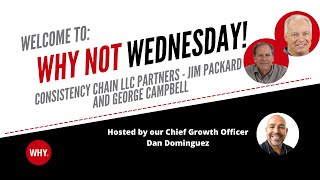
A recorded interview (Why Not Wednesday, Mar 10, 2022) in which Dan Dominguez interviews George Campbell and Jim Packard about their book and program on consistency (Consistency Chain / Don't Break the Chain). They contrast two personality types (roughly the 20% vs 80% Pareto split), explain the "don't break the chain" practice (build short chains of daily wins that compound), summarize supporting research (marshmallow study, brain-difference framing), and offer practical steps for leaders and individuals to increase consistent action.
Questions this video answers
March 10, 2022.
About 1,400 consecutive days of reaching out to two people each day (as stated in the interview).
531 straight workout days (as stated in the interview).
$800 million (cited in the interview as Jerry Seinfeld's syndication payout).
Approximately 300 five-year-olds (as stated in the interview).
Chapters
Foreign.
Welcome to why Not Wednesday. We are so excited to have our guest today. George Campbell and Jim Packard. You know, they, they have led illustrious careers as entrepreneurs, as network marketers. One of them is a Hall of Fame speaker. However, when I asked them how they wanted to be introduced, they simply said, hey, Dan just introduces as Jim and George, our partners as consistent Consistency Chain llc. So welcome to the show, Jim and George. How are you guys doing?
We're great. Thank you so much.
Yeah. Unbelievable. It's a beautiful day here in Arizona.
I know you guys are both in Arizona and I hear you. Now, Jim, I think you've got an introduction for George.
No, George is in Minnesota.
Minnesota, wow. So that's a big difference.
Huge difference.
George.
Yeah, sure. I'm, I mean, first time I, I met George was down in Tucson.
Yeah.
My sons and I were building a network marketing team and my son Jeff called me and says, dad, I have a speaker coming in to talk to our team. I think you might enjoy him. Why don't you come on down to Tucson? So Sherry and I jumped in the car and we drove to Tucson. And I'm sitting there and in. And Jeff had introduced George as Joe Malarkey, America's worst motivational speaker.
Right.
And I'm going, what is this all about? Well, you know, I sat there and I listened to him and I mean, little did I, I mean, I laughed my head off. I mean, he's hilarious and Right. And little did I know that I, I later found out that he was a stand up comic for 10 years with Jerry Seinfeld and that whole group of comics that came up. And then for 25 years he toured the country as Joe Malarkey, America's worst motivational speaker. Which by the way, landed him in the speaker's hall of Fame, which is less than 1 1/2% of all speakers. Later found out that he was on 60 Minutes. He's been on To Tell the Truth cover article of the LA Times. And I'm just sitting there going, boy, don't I wish, don't I wish George was on my team? I mean, all the contacts he would have and the charisma that he had. I later found out that was probably a blessing in disguise that he wasn't on my team. But we'll talk about that later.
Hey, George, you want to introduce Jim? I'd love that.
I mean, we'll get into the reasons why, but I realized I needed. When I first began this consistency chain research and journey, I came to the understanding that I needed a Partner who was very, very different than me and Jim qualified on every level there. When I met Jim, he said we were in a network marketing company and we were semi. Jim was on stage as he had been distributor of the year and one of his sons was distributor of the year. The other one, runner up, distributed the year. He's with top 10 money earners. And I was firmly seated in the back of the room holding down that part of the audience. And we're going to talk about consistency. And that's what Jim.
Seemingly had an effortless capacity for. I mean whether it was, whether it was being the top paper boy in Miami, Florida or building taking 500 investment and turning it into a 17 million dollar a year traditional company and selling it out to Fortune 500.
Yeah.
Being working with an inventor and appearing on. I'm always, I always get this wrong. Was it qvc? Yeah, you got it right. Oh my God, I got it right.
There's three letters. George, you got it.
Yeah, that's. I always get wrong. But 25 appearances on that and sold over a million units of, of widgets, whatever it was.
Yeah, he saw stuff, right? That's, that's what you're supposed to do. Yeah, yeah, that's awesome.
So anyway, that, that the difference, which we'll talk about a little bit, the difference between he and I was the reason why we did. We decided to do this because there's two very, very different type of people that are trying to attain success and the roads for them are going to be very, very different.
That's absolutely what drew me. So Jim and I met through, through LinkedIn and we had a fantastic conversation. He was so good. He sent me a copy of the book which if you saw the picture that I put up earlier, it looks like it was George Campbell that wrote it. But I know that you guys co authored in it and for those of you that are listening, this is a fun and easy read. You guys did a great job of playing off of each other. Jim, you know, presents some, some, some, some topics and then George will jump in with some great anecdotes. You know, and it's interesting that you began the research. George, the guy who was Joe Malarkey was the guy that was actually into the research and that. And the guy who seems to be the more consistent, structured guy was the one, the guy that you brought in to help you get that done. But you're, you know, we're going to get into your why operating systems too, which we had a chance to talk about a few, few Weeks ago. And I want to hear a little bit about that, but let's. Well, you know what? Let's do that first. So let's. So we're talking in our audience's language. I'm going to introduce them to your individual Y operating systems. And when you hear this, guys, you're going to really understand why Jim and George are such a good fit for each other. So Jim's why operating system begins with trust. His wise trust. His how is to find a better way, and his what is to simplify. So, Jim, what that means is that you believe success happens when relationships are based on trust. For you, trust is very important. Now, how you build trust is by finding better ways of doing things and then sharing them with others. And ultimately what you bring are simple solutions. And you and I had a good conversation around that. How does that feel? That sounds.
It was so dead on that it was scary.
Yeah.
And I've utilized that in some of my sales presentations. And, and it's.
It's.
You have a good thing going here, Dan.
Oh, thank you, Jim.
We.
We think so too. And. And you guys have a good thing going, and that's why it's so great that we're together. So, George, your Y operating system is challenge mastery and better way. So your why is challenge, your how is mastery and your what is better way. So the way we interpret that is it means that you believe that success begins when we think outside the box. Now, how you challenge is by seeking depth, breadth, details, and mastering your craft. And we see some of that in the work you've done. And then ultimately what you bring is a better way to move forward. And we had a chance to debrief on that, too. How does that feel to you?
It seems exactly right.
Yeah.
And to go to your question about why I started the research and not Jim, Jim didn't need to.
Right.
Jim had it. I mean, he was here. He was effortlessly consistent. For me, it was a question of why can't I keep the promises to myself? Why? I. And I wanted to get a better understanding of that. And that was the genesis of the research in the book and everything and.
You guys have done. There's a lot of research that you do. So here's. Let's. Break it. Well, let's get. We're going to get into the research, but one of the things that I noticed is you both share the why of better way in your why operating system. So for. For. For George, it's. It's your what? And for Jim, it's It's. It's your. It's your how. So since it is in there, I think obviously you found a better way to help all of us improve our consistency, and of course, you're sharing it with the world. So that's what the book's all about. That's what consistency's chain is all about. So tell us how that. How that partnership came together.
Well, I mean, I initially began the research, and then I would talk, and I had an opportunity to speak to some companies and the people that could identify with me, because I'm definitely in the 80%. The people would come up and it was all just hugs and handshakes from those folks. But the leaders.
Top executives of companies and stuff, they would look at me like I had seven. It's seven heads. They're like, you cannot possibly make your way through life thinking that way. And I'm like, totally do. Yeah, right.
Be yourself, right?
Yep. Yeah. Flaws and all, and. But I realized I needed someone who could relate to that or someone more importantly that they could relate to, someone who was more in line with their experience, who could speak to the leadership challenge. Because this is the big leadership challenge is there is a definite hardwired difference in people. And if you don't understand that as a leader, you are always going to be frustrated, why can't these people simply do what I do or what I've done?
We had Paul Allen on our podcast, and he talked about, you know, we always. Gary always asks, what's the one piece of advice, best advice you've gotten? And he said, you know, never take advice from people who don't think like you do. And I think you guys have hit on that. Right. You 20 percenters aren't going to be great at giving advice to 80 percenters, and 80 percenters aren't going to be great. They're not going to understand each other because of the way they do. So since we brought it up, this is the Pareto principle, so.
Right.
You guys have kind of turned the Pareto principle on.
I want to add one thing to that.
Yeah, go ahead, Jim.
The first time that we did a talk together.
Yeah.
I. I couldn't believe how many people went up to George after the talk, hugged him, kissed him. I mean, it was like. And then about 20% of the room kind of gathered around me and we had handshakes.
Right.
And it dawned on me at that point that we were missing 80% of the audience. As far as the leader goes, we were missing the potential that the 80 percenters had and so obviously it was the message that the leaders needed to hear as well.
Yeah. So. So what I'm going to ask you to do just for, for anybody in the audience that doesn't know what, what's the paret. Tell us. Just quick overview of the Pareto principle and then how it goes, how it works in what you guys do.
Well, quickly, the. Was discovered by a social scientist in the late 1800s named Vilfredo Paredo, who I think we can all agree everybody's name sounds better in Italian.
Yes.
Because if he was American, he would have been Willie Parrot. Who's going to listen to that? Sofredo Pareto, when he was, when he was researching the income distribution in Italy, found that 80% of the people owned 20% of the wealth. 20% of the people owned 80%. And as he began to look at this ratio, it was, it was shocking how often it occurred. We, I mean, we've talked to real estate companies. 80% of the listings will come from 20% of the brokers. You talk to financial services people. 80% of insurance will be written by 20%. It's just over and over and over again, this 8020 thing came up. And so the thing that intrigued me about it was it's people. You know, how can we be so extraordinarily different and yet we fall so easily into one of these two categories.
Right.
And so I started looking at all the things that I wanted to eliminate, all the things we had in common. Both groups intelligence, equally present. Both groups education, training is going to be the same. And organizationally wide, talent, skills, abilities, even ambition. You find those in both groups. So what is the, what is the differentiating factor? For us, it came down to this. This is the key distinction. The 20% do what needs to be done when it needs to be done on a relentlessly consistent basis. The 80% know what needs to be done, but they don't do it and they don't do it consistently. And as we, and as we talk about this 8020 thing, just. I just want to be really clear here. We're not talking down to anybody. We're not trying to shame anybody. If you feel like you probably fall into the 80% category, well, thank you for joining me because that's where I live. And.
There'S no shame, there's no blame. There's nothing wrong with you. You're not broken. We just have to understand there is a significant hardwired difference in our brains that causes us to make the decisions that we do. And so what we want to do is we want to find a way to appeal to that decision making part of our brain in such a way that allows us to, to achieve short term victories in the pursuit of a long term goal.
And, and that is so key, right? Because when Jim, you sent me, you sent me the book and you signed it and one of the things you put in the note was dbtc. And I said, well, I guess I'm going to figure out what that means. And now I know that that means don't break the chain. Right? And it's, and it's not a. You have to do something 100 times. I think what you guys have said is go do it three times. If you can do it three times, then you just got to repeat the third day. Right? So tell me about that, that concept. That's a great concept.
So this comes from Seinfeld. And I saw an interview with Jerry Seinfeld and he had a kid ask him, how do I become Jerry Seinfeld? And the first thing Seinfeld said is, listen, the Seinfeld you see today is not what I was shooting for, right? He said I wanted to become. My whole goal was to become a better comic. And we talk about this a lot. The idea of better, the idea of the er, goal. Any words that ended er.
Right.
And because what he did, he, he didn't. That's, that's the so far away from a traditional goal setting thing, which is specific and measurable and time based on better comic. When's the end point of that? Right. But that was his goal. And he said. And so he decided he was going to do one thing every day, the same thing every day that would take him the furthest in that direction on a regular basis. And so he wrote jokes. And so he wrote jokes the first day and he congratulated himself because he did what he said he was going to do. And that's exciting. He won the day. He went to his calendar, made an X on the calendar. Next day he wrote jokes, put another X on the calendar. Now the genius of Jerry Seinfeld, the reason why he got paid $800 million.
For the syndication rights. There you go. Jerry got paid $800 million for the syndication rights for his sitcom.
Right.
Was because of day three. And day three was he looked at that calendar and he did not see two X's on the calendar. He saw two links on a chain. Day three. And every day after that was don't break the chain. Yeah, don't break the chain. And that's what that's what the fruits of all of his efforts, that was the beginning of him starting to compound, develop compound interest on consistency.
Yes.
And over time it's, I mean, it's the eighth wonder of the world.
Yeah. Well, let me acknowledge. So we got some comments. So TJ Davidson says, make it a lifestyle. Don't break the chain. Make it a lifestyle. Love that Lynn Everard says. Love that Maria Cruz said. You know what, Grazzi, for breaking down the Pareto principle. It's always good to make sure we, everybody, we get everybody on the same page because it's not a difficult concept. But if you've never heard of it, you're going to sit there and was like, what are they talking about? And Lynn Everard from Florida says hello. So thank you guys for, for joining and for, and for your comments. So I, I love this. From your, from your book or from your, from your webpage, you say fact important tasks that get done consistently can lead to massive success. That's what Jerry Seinfeld did. That's the power of consistency. Conversely, lack of consistency is probably one of the single biggest reasons for the failure of millions of human endeavors. That's huge.
Oh, absolutely. I saw, I saw a statistic the other day, I mean, within the last week that said by the year 2030, fully 1/2 of the United States will be obese and a third of that will be morbidly obese. Yeah. And you think about that. Well, this is not a knowledge problem. Everybody knows how to get healthy study and exercise. This is a consistency problem. And you know, a great many people, this is, this is the stumbling block. We know what we want to do, we know how to get there. We just don't take consistent daily action.
You know what's fascinating to me, George, and maybe when you took the Y test, the first part is challenge. And maybe that has more to do with the challenge you have working with me. Right.
But I, I, I never could understand why you could be a 20 percenter in a lot of areas or most areas and an 80 percenter in other areas.
Yeah.
Years and years and years, I'd wonder why can't I apply the same techniques, you know, that work in all these other areas? And it's, and it's literally because like George Luke, our bright, our brains are wired differently.
Right, Right. I mean, the greatest example of that that we talk about is Oprah Winfrey. I mean, as a businesswoman, of course, she's a 20 percenter. She's a.002 percenter.
Right.
So far up There. But when it comes to managing her health and her weight and, and her diet, she's in the, she's in the battle just like the rest of us. And you think about it, she, she has every advantage in the world. She could have a personal trainer and a private chef. She could hire somebody to just do nothing but follow her around all day long, pay him a thousand bucks a day just to slap food out of her mouth. Right. And she still struggles with this. That shows the extent to which this, this is a, I mean it's a hardwired issue. And that's, that's one of the things we talk about in the book.
Absolutely. And Jim, you know, you were very honest in the book. You talked about how you could be a 20 percenter in just about everything. But exercise was your struggle, right? Being fit.
Absolutely. And, and it was eye opening for me to realize that. I don't think the same way when it comes to exercising as I do with prospecting. I mean, even today, I mean, the first thing I do, I get up in the morning, I reach out to two people.
Yeah.
I mean that's done by 6 o' clock in the morning. And I pat myself on the back, but to get myself to go outside and put on my sneakers and walk around the block, oh my God, I'd rather cold call, you know.
Yeah. And that's what, what you do, what you do well. Right?
Yes.
Oh yeah. I've got a chain of almost 1400 consecutive days of reaching out to two people in a row.
Yeah.
And eventually those, you know, you reach out to that many people, they start.
Calling you back after a while. They, they have to. Right?
You would think so, right? Yeah.
That's awesome.
Enough times, Dan, you know.
Well, you, you and I have had some great conversations. So I want to tell you the, the impact your, your, your book has had on me because I'm looking at my journal and I said, okay, what are the five things? And I know you guys recommend, you know, one thing at a time. Right. So the one thing at a time is the networking. So that is, you know, I put that that's going to be doing done every day. But if I can do that one thing, then I'm reaching out to 15 people and connecting and really genuinely connecting. Because you know, when we talk about when we go through our self discovery, when I learned my why was to contribute to the success of others and how I do it is a lot like George, by challenging the status quo. And ultimately what I do is help people make sense of Things I know that my gift is connecting with people. So why not do that on a consistent basis? And it kind of helps that I'm the chief Growth Officer at the Y Institute, that I do that well. Right. So that we can make connections with people, amazing people like yourselves.
But that comes real easy for you. You're a 20 percenter in that.
Yes, I would say that. Yeah. But consistently doing it right, because you, because it comes so easy, George, you know this. It comes so easy. You're like, I'll get to it later. But if you make it a goal and you set it and you cross that X every day, then you're getting to that consistent level of performance that we're getting and we're seeing the results of it. It's amazing. So I want to thank you for that very simple piece of advice and how I've incorporated it. So I, I try to do five things every day. I don't get to all of them, but I have the one. There's got to be the one. So you can make the X every day. And, and that's how, and that I think that's how you start it. So guys, what can people expect? I mean, we've talked about it a little bit. If they're, if they get the book, what, what's, what's your biggest takeaway? That people come back and tell you, this is what I learned.
Well, I mean the thing is, I mean we give you all the, the research as to why the things that we say are going to work for you. I think the thing that people is unexpected to people is this isn't a, a nine month plan or a 60 day plan. This, you win immediately, which is the whole point, right? You win today. And today's the only day we care about. You know, I, I put together a string of 531 straight workout days. And I will tell you, I never in that entire string worked out tomorrow ever. And I didn't worry about it. I just won today. And because I would win that day, I could look myself and look at myself in the mirror and be proud of myself. I wasn't waiting for some long off goal to be realized before I could feel good. No, I felt good today. And because I'm driven by instant gratification, which is one of the things we talk about in the book, then my instant gratification was satiated, right? And now I'm actually using what was used to be my biggest stumbling block to actually power me towards long term goals that I would never have been able to achieve before marshmallow story.
Yeah, tell us about the marshmallow study, because you mention it in the book, it's prominent and that's an amazing, great piece of work.
So this, this was done by a researcher at Stanford in the late 1960s, early 1970s, and he took 300 five year olds, which right there, he should have got a Nobel prize for that because. Come on. And so he would take them one at a time into a room, set them on a table, and on the table would be a marshmallow. And he would say to them, listen, that marshmallow is yours to eat. I'm going to leave, I'm going to be gone about 15 minutes. If I come back and that marshmallow is still there, however, you are going to get a second marshmallow, little marshmallow, double nothing. Want to guess the percentage of kids that ate the marshmallow?
80%.
80%.
I'm telling you, this is just deadly accurate. So the cool thing was that they had the names of all these kids and they did a follow up study when they're mid teens and they found that the 20% non marshmallow eating kids had higher SAT scores, higher GPAs, were just to be more socially advanced. They checked in with them again at midlife. They found that the 20% had more educational attainment, more professional advancement, a lower divorce rate and a lower body mass index. So they were actually healthier. And then the key thing that this is the thing that people, I've heard this story before, I've heard people talk about, but they miss this. We get to 2011, right? And now they can bring them back. And now we can actually look at these, these test subjects in a different way. We can put them in a functional MRI machine.
Right.
And a technician, based on the brain activity of one or two areas of the brain could look at that scan and tell you with 100 accuracy whether or not that test subject did or did not eat the eat the marshmallow 45 years prior.
He's got the marshmallows.
Yeah, that's how deep this is.
So you and I, George, we'd have the one, right?
Oh my God. Yeah, I would have, I would have eaten the marshmallow before the guy got done explaining the experiment.
You walk in and see there's a marshmallow.
Hey, marshmallow. Wait, wait, wait.
Yeah, I gotta explain something.
Ready? Fire.
Right, so this is a really important. When we say it's hardwired, what we mean is decisions in parts of our lives are made in different parts of the brain, right? Prefrontal cortex, executive functioning. The part of the brain that's great at looking down the road and making a decision. Ventral striatum is a part of the brain that we. That was developed very, very early. And the criteria that it makes a decision on is. We call it the ESP filter. Is it easy? Is it safe? Is it pleasurable? This is where diets go to die. Because if you're thinking in this part of the brain and confronted with the donut, I can tell you what your decision is going to be. And we say that we. If you can tell. If you can tell me what part of the brain your decisions are being made, I can tell you what your decision is going to be.
Yeah.
Jim tends to make his decisions. Prefrontal cortex. The reason why he was able to take action on a daily basis and develop businesses and relationships and his life. Me, I was driven by instant gratification. So my decision is going to be completely. We could be looking at the same exact set set of facts, the same situation with the same hopes and dreams, and make completely different decisions.
That's why if they announce a contest, like a trip to Maui or something, I look at it and go, I wonder if I can win two trips, right? And. And. And George looks at it and says.
I'm like, I wonder if Jim will send me a postcard.
Because, well, you know, we talk about the gap and the gain, right? One of our partners at Y Institute, Jerry, talks about that if you. If you've got a great goal, that's way up there, the gap is so big for the 80 percenters, they're like, forget it. I'm not even going to try. There's no way I can do that. If you make it simple and measurable and easy to get one little step at a time, all of a sudden, the 80 percenters get involved. And I think for. For leaders that are listening, for coaches, you know, we all want our 80 percenters to behave more like the 20 percenters, right? Because then we'll get better, better results. And our 20 percenters, you kind of don't have to worry about them. They're going to go do their thing. How do we leave them alone?
They'll get it done.
They'll get it done, right? So once you figure that out, and then. So. So how do we get those 80 percenters? Because just even a little nudge forward is going to improve your performance significantly because you got 80% of your people that are producing at a lower level. So if we can get them perform a little bit higher. And that's what you guys have done. I think you, you've made it easier for the 80 percenters to behave like 20%. Is that oversimplifying it?
No, you're just giving them a different way to measure success.
Right. I think we've just provided a path, a doable path that you can believe that you can do. And because you believe you can do it, you're going to start taking the first few steps.
I saw a quote the other day that said, you know, the key to believe in yourself is creating evidence. Yeah, man, if you're taking action every day, that's evidence. Now I can believe in myself. You know, it might just be possible for me to do that because look at my little backstory here, day after day after day.
Yeah. I like to, I like to use the analogy, Dan, where if you, you take a penny and you double it every day, we all know that the end of 30 days, you're going to have a little over $5 million accumulated just by taking that penny and doubling it every other day.
Right.
But if you take that same penny and double it every other day at the end of 30 days, you don't have $5 million. You have a hundred and sixty three dollars. So there's the power of consistency compounded on a daily basis.
Yeah.
It's almost enough for a tank of gas.
Yeah. That's all. Well, that's exponential versus linear growth. Right. Lynn Everard says, how does knowing their why help the 80 percenters? So that, that's probably. We're gonna have to have a second show to talk about that with you guys because now you know your wise. I know you. I went over the nine wise. And then Watson, Jordan says, evidence for the win. And he, he did that on another show. He said, ftw. I said, what's ftw? Oh, for the win. There we go. Well, guys, we're getting to the end of the show and I, I always like to ask this question because the name of the show. Tell me about a time that you said why not to something and it worked out and, and, and you're so glad you said why not instead of not doing something. So I'll start with you, Jim. Tell us about your why not moment.
I had a good friend of mine that I was working with and he says, I'd love to introduce you to my kid sister. And I go, why not? We've been married 52 years this summer. Congratulations.
That's, that's a big why not? Congratulations, Jim. How about you, George? What's your biggest why not moment it.
I probably saw an article in a, in a little paper about.
Open mic night at a comedy club.
Yeah.
And I thought, I think I could do that. And I went up and did 12 minutes the very first night, which I had no idea. That's way more than anybody should ever tackle on their first time. Yeah. But I walked off the stage and at the back of the room the club owner says, I've got work for you. You. Awesome. And it was just immediate validation and encouragement. And that's, I mean, that's all I've been doing for the last 35 years.
Yeah. No, and you're really good at it. Like I said, you guys do a great job of writing together. So the consistency chain for network marketing. Now you're going to come out with a new version of this. What's it going to be called?
We're still debating. I think it's going to be called Don't Break the Chain. And it's going to be more of a mainstream version of the book.
Yeah. Because in my, in my publishing publicizing before, before our show today, I said, look, it's called for, for network market. It should be don't break the consistency change for life chain for life.
Yeah.
Because it really is, it's, it's a great, great tool. I highly, highly recommend it and I'm so glad to have you guys on. I'm glad LinkedIn brought us together. You know, I love this virtual world where we connect with people based on similar interests. And Jim, you and I have got to have some follow up conversations. George, I know you're just getting over being under the weather and so we appreciate you hopping on today and you sound great, look great. And guys, thank you so much. Thank you for doing why not Wednesday with us.
You bet. Thank you.
More from Dr.




Women In Leadership: A Need For A Greater Systemic Change With Belinda Clemmensen






