WHY NOT Wednesday with Joanne Black
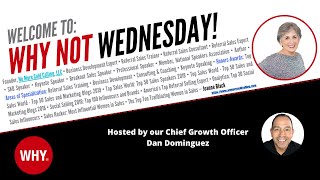
Joanne Black, founder of No More Cold Calling LLC, explains why referrals beat cold outreach. She built her entire business on referrals, starting with her first client, and argues that trust transfers through introductions. Her core advice: get specific about who you want to meet, commit to the strategy, and always ask for referrals in person or by phone.
Questions this video answers
joanne@nomorecoldcalling.com
6.5 on a 7-point scale
Never cold call (cold outreach of any kind); never ask for a referral in any digital format (e.g., LinkedIn message or email).
Chapters
These last few years have made us question everything.
Our relationships.
Our jobs.
What constitutes an office.
And who we are.
In a.
World filled with chaos, confusion, and uncertainty. It's time for some clarity. It's time to start understanding one another.
It's time to start understanding ourselves.
We envision a world where everyone knows their why, but even more where we envision a world where everyone knows their why os, their why, their how, and their what. The operating system that drives you, that lets the world know where you stand.
What your unique gift is, and most importantly, who you are.
Yoshi.
Are you ready?
Hello, everyone, and welcome to why Not Wednesday. Today we have a very special guest. I am talking to Joanne Black, who is. Let me tell you a little bit about Joanne. She is America's leading authority on referral selling, the only business development strategy proven to convert prospects into clients more than 50% of the time. As the founder of no More Cold Calling llc, Joanne helps salespeople, sales teams, and business owners build their referral networks so they can quickly attract more business, decrease operating costs, and ace out the competition every time. Welcome to the show, Joanne.
Thank you, Dan. I mean, it's always a treat to talk to you, but especially today.
Well, it is always a treat to talk to you. I have yet to have a conversation with Joanne Black that I didn't learn. Something new, something important, something that could help us here at Y Institute grow our business, something that can help us be more effective, and something that could help us connect with people better. I was just talking to Stu Hynek a few weeks ago, and he wrote a book that was called how to get a Meeting with anyone. And I said, you know, between Stu Hynek and Joanne, no one should ever have to cold call again. Joanne, that's a big part. That's the name of your company. No More Cold Calling llc. What does it mean that you should have no more cold calling?
You know, I debated with the name. I remember. So it's the work we do is the opposite, which, you know, it's all about referrals. But no, I debated no more cold calls or no more cold calling. And I was being videoed for something or other. I don't know, it was like 27 years ago. And I said, what's better? And she said, oh, no more cold calling rolls off the tongue better. So that's how that happened. You know, it's. A lot of things happen. It's just serendipitous.
Well, I love. I love the name because when, you know, I work with a lot of coaches at YA Institute. A lot of people that we work with are amazing, amazing coaches. They're amazing speakers. They can get on a stage and own the stage. They can coach somebody to tremendous success, to make hundreds of thousands and even millions of dollars. But they all hate cold calling. And there's a reason we hate it, right? It's, it's very, it's a lot of work and it's a very low return on investment. But you've got a system that allows you to succeed without having to do cold calling. So what brought that on, Joanne? What made you one day say, you know what, this is not good. And then what made you decide to make a business out of.
Was 1996, Dan. And I was working for my second consulting firm and my colleague said to me, joanne, you know, you should start your own business. The economy is great. Which it was then. And I thought, okay, I'll do it. When I think back about it, my first client was a referral. In fact, my first job out of college was a referral. It was all over our lives. At any rate, referrals weren't even on my radar. What I wanted to do, I thought, was work with small companies to create a sales plan within their business plan. Because back then you couldn't find sales with a magnifying glass any place. It happened, and this is serendipitous, as I just said that at the same time, they were doing a customer Satisfaction survey of 50 of their best clients. It was several rounds. And I added this question on the last round. Would you be willing to be a referral to this client? It was a seven point scale, seven high. My question came back 6.5. So my next management meeting, I said, 50 of your best clients are saying they'd be glad to refer you. Are you asking?
You can guess the answer. It was no. It was no in 1996, and it's pretty much no today. But any rate, turning the clock back, I reflected on my years of sales and sales management experience and knew my best business had come from referrals. But I needed to do what I call my feet on the street research. And I asked sales execs and salespeople I know, do you like to get referrals? And they gave me this long list. Oh, we know all of that. You know, we've been doing. We know referrals are great. And then I said, that's terrific. Do you have a referral methodology, a process, a framework with a strategy, metrics, skills, and accountability for results?
The answer was no. In 1996. And it's no today. But that's what started me. That's what I call my feet on the street research, because for me, that's the most important. What are people saying? What do they believe? What are they hearing? And that's how it started.
You know, it's not what you say about yourself, it's what your clients are saying about you. Right, right. I think, you know, in, in, in both of your books, you've got. Your first book was this one. Right.
Now that's the second.
That's the second book. So let's talk about the first one, because that's the name of. That's the name of your company. It's no more cold calling, but Cold calling. Yeah. So we're talking about something, you know, fairly simple here. Don't. Don't reach out to people. You mentioned something in the intro before we got on how many phone calls and emails, unsolicited emails you have of people talking about themselves. So again, it's not what you say about yourself, it's what others are saying about you. Tell me what you do with those emails and what, what we can expect happens to those emails that companies are sending out by the hundreds to people that don't know who they are.
Yeah, I, I must get minimum 50 a day. And I put them in junk. And I look at some of them because I want to find out what in the heck are they saying. And they all start with, hope you're doing well. This is the dumbest way to start. I mean, really, it's a filler, right? And then they start talking about themselves and telling me why they know about my business and I should talk to them, which is absurd. Therefore they go in junk. But, you know, I still get them from different people, different companies. And today they're all automated. We know that. So the same email goes. I don't know how many people. Thousands, probably. And they're just a waste of time, whether it's a phone call, whether it's email or social media. Because on LinkedIn, how many invitations do you get that people just click a button, say, please join my network on LinkedIn or whatever it says, you know, that's not connecting with people. And then sometimes when I connect, then they pitch me.
Maybe not right away, but maybe later. I said, what? This person sending me a sales pitch. So I go to their profile and I remove them from me. Not interested. It's just a waste of time. I think they're working the numbers. They must figure if they send A thousand of these, they'll get X number of people engaged, right? But that's not engaged. People do business with people, period. I know we can talk about AI and all that stuff, but bottom line is when we sell services.
Our product is us, but we sell services.
People relate to us first. And unless we have that relationship and that trust, business is not going to happen.
Well, Joanne, we were introduced to one of my favorite people, Larry Levine and Jackie Joy and Darryl, who are part of the selling from the heart, I like to call them a movement. And they, they, they talk about the importance of relationships and trust. How can you build trust by just cold reaching out? And even when you make that, that great connection, right, where somebody accepts your connection like you did, but then you move on to a pitch that is a cut and paste obvious, you lose someone. And what's the cost of having somebody like Joanne Black or any client really block you and then report you, which is what happens, right? You get blocked enough times, eventually the social media services don't allow you to send out messages. That's a big cost. I can't imagine that anybody would want to do business that way. I'm so glad you're out there spreading the message of the importance of connections and building trust.
It is. And you know, when you talked about Larry, so Larry Levine selling from the heart, it said.
Relationships drive referrals, and I say referrals drive revenue. So it's all attached.
Business is about people, you know, always has been. Now we're not selling widgets, we're selling our services to way more complex. And to your point, Dan, about trust, unless people trust us, they're never going to do business. So if, if Dan, I introduce you to someone you want to meet, the trust that person has for me transfers to you. So you arrived totally differently. The person wants to talk to you. You know, it's amazing you don't get doors shut in your face.
That is such, such great advice. So, Joanne, one of the things I like to do on why not Wednesday? And you know, we're going, we're going, we started a little differently just because I love the topic and I love what you do, but I want to make sure we cover one thing because our audience tunes in and this is about why. So let's go over. I want to go over your why operating system and then talk about how you apply it to your business, right? So Joanne's why is to challenge the status quo. That means she likes doing things out of the box and indifferent. Now how she does that how she challenges this task quo is by simplifying things, making things simple and easy to implement and to use. And ultimately what she does is contribute to the success of others to her clients. She believes in making a difference in the lives of others. And I've already heard that in our conversation today how you challenge the status quo. You said, hey, that the way you're doing it is not the way everyone should be doing. And I've got a different way. Let me show you a different way to do it. And then you talk about making it simple. There's some simple rules to follow so that you contribute to the success of others. But you and I met, gosh, it's been, it's been probably a couple of months we went through this with you. How did it feel to you to find out your yos and how did the language fit for. For you?
It did. So the, the first thing my, my profile showed came out challenge. And that has a very different application than many people think, but challenging the status quo. So I'll give you an example here. This goes way, way, way, way back. When I graduated from college, my first job was at a women's retail store, which was just for women. Joseph Magdan. I don't know if anybody remembers that, but at any rate.
I worked with them for quite a while.
And I was 22, right? And then all these older people, they were probably 45 at that point, you know, were on the floor with me, and I got to know all of them. Well, at one point, I wanted to change a display. And I went to them and I said, I want to change this display. What do you think? And they said, oh, go talk to Carolyn. She was our floor manager. So I went to Carolyn, I told her what I wanted to do, and I told her these people said it had never been done before without missing a beat. She said, that's the best reason I know for doing it.
And that's the challenge to the status quo and to do like everybody else does. And here, the, here's the thing. We know that if we do what everybody else does, we're going to look like everybody else. But that's not how we do business. We need to differentiate ourselves, right? And the number one way we do that is to get that referral introduction. And it's also our biggest competitive differentiator, because when you think about it, you get in early, right? You get in, you have conversations, and it's all based on trust, like you said, Dan. So I am just so against doing things like everybody else. Does it makes no sense to me.
I've never heard a business owner or a client say, I want to do business. I love doing business with them. They. They do. They do everything. They do everything the way everyone else does it. People hire us because we're unique. They hire us because we're different. They hire what's different and better. Right? Not what's like everybody else. So I love that you bring. Bring that to mind your how of simplify is really important because we talked about it in the pre call you. You talked about, you know, it's simple, but it's not easy. And you've developed a program and an entire. You wrote a book and then you've developed a program to help companies build their referral system. So give us get. Without giving away the book or the whole story, what are some simple things we can do that aren't easy but that we should be doing to increase the sales that we get from referrals?
Well, the first thing I would say is you need to commit. I really put a stake in the ground and saying this is how I'm going to build my business.
Because then once you do that, you're going to follow that. That's your commitment. And unless we have that commitment, it's not going to happen.
I will also say that we need to be really, really specific about the person we want to meet. And here's what I hear a lot. If you know anyone.
Who could benefit from my services, please let them know that there's nothing. First of all, I don't know a person named anyone.
Right.
We need to help our referral source think of a person that you want to meet.
And the narrower you are in your description of, the easier it is for that person to think of someone. You need to make it easy, just like we need to make it easy for our clients to buy. And so it's not anyone. You need to describe in detail exactly who you want to meet.
And I want you to think of it this way.
I don't know if any of us gone to a museum recently because of the pandemic, but remember when we went to museums and picture this, you looked at a Jackson Pollock and you looked at a Rembrandt. Well, I have nothing against Jackson Pollock. I really don't. I think his stuff is cool, but I have no clue what it means. Now you look at a Rembrandt and you see color and lines. You. You can really see what's happening in the painting in addition to knowing kind of what century it is. So the painting tells you a lot about it. And that's what we need to do when we ask is detail. Because with that detail, you're getting your referral source to picture exactly who you want to meet. And that's the translation your words get in the minds of the person you're asking. Does that make sense, Dan?
That makes a lot of sense. So it. So we want to train people to be looking for our ideal clients. Right?
Right. And people want to help. You know, during the pandemic, there was a lot that we did like that. How can I help you? We did things we never charged. I mean, all of that. And I'm seeing that we're moving away from that now with all this, you know, the spam that we get.
But we need to help that person think of people with our description. So I'll give you an example.
I could say, you know, I want to meet.
I want to meet a sales leader or business owner. And, you know, they need to get better at what they do.
And I can work with them, you know, to get more revenue. Well, that doesn't say anything. But if I said, and these are people, by the way, who want to help, I find everybody with whom we have a relationship really wants to help. They just don't know what to do. So that's our job, is to help them understand what would be a good referral for us.
So if I said to you, Dan.
Clients I work with who are in sales, whether they admit it or not.
You'Ll be. This is what you'll be hearing. People say, I don't have enough leads, or I don't have enough qualified leads. If it's a sales team, they're missing quota. They're not getting meetings with the right people, and revenue is down. It's a sales complaint like that. Again, it's the first part of the selling process. How do I get the meeting?
And that's. So you need to explain what this for me. I need to listen to what people are saying to say, oh, you need to meet Dan, or you need to meet Joe, or you need to meet Sue. And I do that all the time. We love putting good people together as human beings. We really do. And people want to put good people together. And so that's the thing about asking. It's the specificity. And I want to remind you. And you can have somebody.
Say to you, whatever. So what if anybody hears any of you saying, do you know anyone?
No.
Because you need to say. You'll say. The person will say, no, I Don't.
Know who is anyone.
Nobody has that name, right?
No. I love what you say in your vision. So when we look at your vision, we talk about helping. You got to leverage the power of referrals so you get meetings at the level that counts, at the decision maker level. Because if you're, you can get all the meetings in the world, you can spend all your time in lots of meetings, but if you're not speaking with decision makers, you're not going to hit your numbers. And I love that you say that you hit your numbers without hitting the phones because when you, and you talked about it earlier, and I love, you know, it's so amazing how your yos really fits in here because we hadn't talked about contribute, which is your what. But I heard the word help come out of your mouth in the last three or four minutes at least six or seven times because you're talking about helping people get the right connections, help people hit their numbers, help people get meetings at the right level so that they can get to the decision makers so that, that what have contributes to what you ultimately bring is a passion to help people succeed. You move people forward, help people have the success that they, they've been looking for. And so you talked about sales complaints and look, I was, I was a national sales leader for a major medical device company. I've heard them all. The leads are no good. We're not getting the leads. Our market is slow there or our competition's getting in ahead of us. You mentioned, Excuse me, you mentioned something in one of our previous. Excuse me, hold on a second.
You mentioned something in one of our previous conversations about the importance of talk, talking to the right, talking to the right people and then the importance of referrals in terms of getting you in front of the right clients so that you're not wasting time, which is what we hear a lot from sales teams complaining we're just not talking to the right people or they're getting in. In front of us. And that's a really key point. Right. Because when you get a referral, you get in early. And if you get in early, even if the competition shows up, you get to set the standard. Tell us more about that because you talk about that in your course.
Yes. So it's.
Think about it, you get in early, everybody else is typing away. You're, you're building relationships. And if you think back on your business, you found out a lot. They, they trust you already. So you hear things that other people don't hear. Believe me, I've been told things I really didn't need to hear. But it's okay. I mean, it stays with me. They know that. But you're going to have the inside track.
And that's what is key. So somebody else comes knocking on the door, they may or may not get in, but even if they do, you're in and you've got competitive information.
And if they have to do a request for proposal.
You better have a hand in writing it, otherwise your competitor will. So that's the big thing there.
Yeah. I used to work in the medical device field when I was leading sales teams and we used to talk about creating the proposal that has your unique advantages in the proposal so that no one else can really match them. Because if you have a chance to help your clients client create the RFP and you put what separates you from the competition as part of the criteria, then they've got a far lesser chance of meeting meeting the criteria unless they can get in. And if you're already in there, that is. That is genius, Joanne. I really, really love that. So let's ask you the. A couple of the questions that I know I have to get to because we're running short on time. Tell me about some absolutes in selling. What are some of the things you should absolutely not do?
Never, never. Cold call. That means cold outreach of any kind, right? That's one. Second, never, ever, ever, ever. I could discontinue the evers. Ask for a referral in any digital format. That means through on LinkedIn or an email. Probably other ways too, but those are the first two. Why?
Well, first of all, when you ask for a referral, you have the opportunity then to ask that person when they say, oh, you need to meet Tim. How do you know Tim? Tell me about him. What's important to Tim? What's going on in the business? Why do you think he'd want to talk to me? So you're putting, putting all these color and lines in this picture, but a referral source, because they know that person is going to tell you that, you know, on LinkedIn, we only know what people choose to put on LinkedIn. Right. And so it's having the conversation that you must have and then helping them in a way to make the introduction because you need to be introduced. Getting a name is not a referral.
Right?
In my definition, absolutely.
Well, and I spoke to someone recently who said, you know, I don't want to be compensated for my referrals. I want to refer people to you because I want them to benefit from what you do. And I want them to, if they ask me, well, what do you get out of it? I want to be able to say, I get to see you succeed. I'm not getting any monetary recompense for bringing your name to them. So I really like that comment. Joanne, we're short on time and I want to ask about your biggest why not moment. So tell us about a time in your life, because the name of the show is why Not Wednesday. Tell us about a time in your life that you said why not to something, somebody. It was a proposal, an idea.
Something.
That was different and you had to think about, but you said why not and went ahead and did it and you're glad you did.
Well, this is more personal, Dan. So I remember this goes back quite a few years when.
A group of us going on a hike and it was up cliffs and stuff. And then we get to this place, place where there is a split between one cliff and the next and everybody's jumping over it and I'm scared to death. I really got angry because they should have told us that.
And then I did say why not? But I, you know, it was still very, very hard for me because I was scared. And the thing is, I'll still be scared.
Doing it today, but that doesn't mean I don't need to do it.
Well, there's that challenge. Why? Right. You know why. Why not do it? Where. How high up were you? Give me. Now, now I'm interested. How high up were you? How many people were in the group?
I think there were four or five of us. And I have no clue how I. It wasn't like some huge mountain, right? But it was these big rocks sticking up that were flat on the top and then there was this crevice.
That was it.
And isn't that a metaphor or a great metaphor for life? I think you, you've said why not to leaving your. Your job. I mean, can you believe it's been 20, 26 years now you've been teaching people how to build referral systems and it's amazing. Now, are you the only per. Can you be the only person out there that is, that is banging this gong and saying, hey, referral selling is. Is the way to go? Because you said it a couple of times in the introduction. Even today, people, companies still don't have a referral selling plan. So how can people get ahold of you, Joanne? If somebody says, hey, I like what Joanne is saying and I want to get, I want my team to start using referrals More effectively.
My email is Joanne J O A N N E nomore cold calling dot com. And the reason I'm giving you my email is.
I have two phones, I have a cell phone and yes, I still have a landline and I give the landline out.
I have that number on LinkedIn because I always get cold calls on that. So. But if you email me and I email you back, you will find my cell phone. So that's what's key there. The other thing I'd love for you to do, invite me to connect with you on LinkedIn and reference.
This conversation. Why Wednesday?
You see, when people just send a standard invitation, most of the time I just delete it.
They haven't given me any reason to connect with them. If I have a little time, I might look at their profile, say, yeah, yeah, yeah, and I might write to them and say something. But I've also said what questions you have about referral selling, and I hear nothing. And after two weeks I just ignore the invitation. We just have so much time in the day and we need to spend it wisely doing the work we want to do and we love to do that nurtures us.
Thank you so much, Joanne. And let me tell if you're listening, if you email Joanne, she will email you back, of course you got a reference that you heard her here on why Not Wednesday? And you will get her phone number, because I do have you recently real phone number that I that you can get a hold of her on and she will have a conversation with you if you take the time to reference. And I cannot give you enough, I cannot recommend working with Joanne enough. She has been a godsend and I cannot wait to continue going through your course. That's part of your curriculum. It's on LinkedIn. Look Joanne up on LinkedIn. Connect with her on LinkedIn. Reference that you heard her on why Not Wednesday? Thank you so much for being on the show, Joanne. We look forward to continuing to work with you and all of you. Don't forget to join us next week on why Not Wednesday. Thank you for being our guest this week, Joanne, and have a great rest.
Of your week, everybody. Thank you.
More from Dr.




Women In Leadership: A Need For A Greater Systemic Change With Belinda Clemmensen






