WHY Not Wednesday with Judy Cirullo
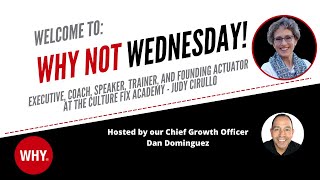
Judy Cirullo, a physical therapist and coach, shares her 'why operating system' that helps healthcare leaders and teams communicate better. She uses three questions—Why: Make Sense, How: Clarify, What: Contribute—to reduce judgment, improve acknowledgements, and develop new leaders through monthly workshops and coaching.
Chapters
These last few years have made us question everything.
Our relationships.
Our jobs.
What constitutes an office.
And who we are.
In a.
World filled with chaos, confusion, and uncertainty. It's time for some clarity.
It's time.
Time to start understanding one another.
It's time to start understanding ourselves.
We envision a world where everyone knows their why. But even more, we envision a world where everyone knows their why. O s, their why, their how, and their what. The operating system that drives you, that lets the world know where you stand.
What your unique gift is, and most importantly, who you are.
Yos.
Are you ready?
Hello and welcome to why Not Wednesday. Happy Wednesday, everybody. It's the middle of the week. We're halfway through the work week and a couple more days, and we're going to be enjoying the weekend. I'm excited to introduce you guys to our guest today, Judy Cerulo. She is a physical therapist and ICF certified coach. She's certified in conversational intelligence. Most importantly, she's a Y certified coach, and she has certifications in team advantage. And she's also the founding actuator at the Culture Fix Academy. So this is someone that has been with my institute for a little bit. So she's been with us through some changes. We're so excited to have you on. Judy, welcome.
Thank you. It's a pleasure to be here and I'm looking forward to it, man, I.
Look forward to these conversations. And you and I were talking in the pre show about, you know, when we first met and the process you went through to discern the decision of whether or not you were going to be a wise certified coach and what a difference it's made for you and your practice. So we're going to get into some of that. But I like to start, do start every show the way I do every other show is let's talk about your why operating system. Because for those of you that are watching for the first time, you're probably wondering what is a y operating system or what's a why, right? So I always like to talk about the why operating system of our guests. And Judy has an amazing why Os. Her why is make sense. Her how is clarify and her what is contribute. So, man, that. That, you know, you and I connected because we share two of our top three, right? I'm a contribute makes contribute challenge makes sense. Our hows are very different in that you're clarifying, I'm challenged. But tell us about your own personal y operating system. Making sense of things, clarifying things, and contributing to the success of others.
You know, this was so fascinating when I found it out. And for my entire life I've always asked people, does this make sense to you? And for, I was always asking that. And then I would go on to ensure that it was clarified and ultimately what people would share with me, which I didn't realize, is that I was contributing to their success by utilizing my why and how and then the what and, and it just, it was just like a light bulb went on and you know, decades older. And I remember asking everyone, does this make sense? I still do that. In my emails with my clients, I noticed this.
So that's my what. And I notice I do it all the time with our team. I'll say, well, does this make sense? So I'll, I'll explain something and say, does it make sense? Because we, we want, we want things to make sense to us and we want it to make sense to the people we're talking to. So let me say hi to a few people. I think Danica Treble is on. She, she and Jackie Joy are having a little love fest on, on, on the chat. And of course our good friend Watson, he says, judy, great to see you. Now I don't know if you, you and Watson, I think you were on his podcast, right?
Yep, you bet.
Fantastic. Yes, he's a great interviewer. I really enjoyed my time with Watson. He does a fantastic job on his show. So, so I love that you, you've crafted your own message too and it's different. So you know, of course people, people with the why of make sense, if it makes sense to them, they, they, they, they can help others make sense of it. I, I'd love for you to talk to me about how you changed it, your changed your message because I see it on your LinkedIn page and it's wonderful. It says con. So how you craft your messages, contributing to the transformation of CEOs, leaders and their teams by navigating through the complex and developing clarity driven action with intentional purpose. Man, that is strong. So let's, let's break that down. Where's the contribute, where's the make sense and where is the clarify?
Well, you know, one of the things that happens so much with all the team leaders and everyone currently is there's a lot of chaos, there's a lot of things happening, a lot of distraction and leaders and their teams get all caught up in the minutiae of this and have a difficult time figuring out where they, where they want to go and how they want to get there. So I actually help Them make sense out of where they want to go by helping them simplify, clarify their goals. And by that, I'm contributing to them really understanding what they need, what they want and how they want to get there. So that's. That's kind of what's kind of wrapped into that message.
You know, I love that you said that because yesterday we had a call. I think we had like 11 of our new coaches so that have signed up in the night on the last couple of months. And we were going through just a branding workshop. Okay. How do you communicate your Y O s? And, you know, in its most basic form, we have that simple yos that you have on that you. When you discover your yos, whether you do it with a coach or you do it on your own, you get that simple. My why? I believe that success happens when we make sense of the complex and challenging. How I do that is by making things clear and understandable. And ultimately what I bring is a way to contribute to others and add value. So that's the simple. But you've taken it and you put it into a really elegant sentence and kept it simple. So kudos to you for that because I don't know if you struggled with this, but I remember when Gary took me through the process, I created this, the longest run on sentence in the world about my why, how, and what. And I kept sending it to Gary and he'd say, nope, simpler. It was one word answer. Simpler, simpler, simpler. And I kept struggling through it. Did you go through that?
Oh, man, I did. And I kept moving the words around and trying to. I think what I wanted to be able to do is make sure it made here we go again.
Made sense to other people.
Right.
And that they could look at these words and say, yes, I understand where this will take me and where this will help me. And so it really. And I wanted them to be able to know that it was about them having an action plan so they knew where they could go with it.
And, you know, we've got Jackie Joy is on here. So I was. I was fortunate to be on the trust challenge earlier today with Darrell, Amy and Larry Levine. And Jackie works with them Now. Larry's how is clarify also. So we had a good laugh about. Because Jackie and Darrell were like, hey, guys, we need the yos in our practice. We're going to use it with our clients. And Larry had questions. As a clarifier, he had questions, right? And I remember sitting in that meeting and Larry was like, I know what's going to Happen here. Jackie and Daryl are going to say let's, let's move forward. And I still have questions. What I remember most about that interaction is I knew what questions he had and I knew that he needed that clarity. And so for me it was like I need to give him time to. And I get, I need to answer his questions otherwise he's going to be hesitant client. And we don't want that. We want somebody that's all in. And what I know about clarify people like yourself, Judy, is once you, you're clear, you move forward fast.
Oh yeah, yeah. And I think, you know, that was what's so is interesting when, when we were collaborating before I signed.
Yeah.
You, you recognized. So I did my yos initially.
Right.
But then you recognized that I needed the space to put some things in order in my own brain in order to do that. So you didn't let it go and not come back, but you gave me the space and then you tolerated all my other questions.
Well, because we, you know, it's predictable. Jerry, Jerry Lujan always says, look, it's predictable. So if it's predictable, let's just make sure we give people time. Right?
Yeah.
If you're challenged, you're going to ask all the questions that say, well, why do you have to do it that way? Why do we have to follow that process? Why. Why is it this way? We know that's coming, so let's, let's prepare for it. Right. And. And the same thing goes with, with clarify, with simplified, you know that simplified. Just give, give me the bottom line, Dan. What, what is it? We're trying, what you're trying to do here. So we, you know, we prepare in bullets for them. Right. So great, great stuff. I really appreciate that. So what is, you know, let's, let's get. Hey, for once I'm going to get to this question early. I always wait till almost to the end and I, I want to make sure I get to it early. Tell us about the name of the show is why not Wednesday. And that comes because I like to ask people. Tell me about a time, Judy, that you said why not to something that maybe you wouldn't have regularly, but it turned out well for you personally, professionally. And I know you said you have a new answer for us.
I have two. But the one I really was thinking of is as a kid in high school, I was asked to participate or audition for an all in our all state band. In the state I was in. I play alto sax. Me too.
Isn't that great? And So I auditioned. But what really was why not came when I was asked to audition for the Universal Academy for Music in Princeton, New Jersey, in high school. And I was, I said, really? I'm never, I'm not that good. And in talking with my parents, they said, they said, why not? What do you have to lose?
Right.
And so I did. And I got selected as first chair and played concerts throughout Europe representing the Universal Academy under the direction of Carmen Dragon. Wow. And I. That. What did that do for me? So what did you learn? You know, so you say, why not? I took, I took that risk and I. It opened my eyes to other cultures.
Right.
Other parts of the world, not just a small little place that I lived and was raised. And it changed my perspective on things going forward. And so I think that was a huge learn of why not? What do you have to lose? What's the worst case scenario? And so I think that was really important. You know, I have my practices and the things I did with, with that and why not open the practice. Practice during a bad time. You never know. So. But that was a big changing event for me in my life. And I think it proved as a young person, it's okay to say, why not.
How old were you?
Seventeen.
Wow. And you got to tour all over Europe. How long was the tour?
It was six, four weeks. And we played concerts in all different countries and we auditioned and in each country we had to audition for each piece we did. It was not an easy thing working under Carmen Dragon, but it was very rewarding.
What about, what about your parents? Did they go with you or did you get to go as a 17 year old, you got to go to Europe by yourself?
I went by myself with, with the band, sure, of course, yeah. But that was.
17 is so close to being an adult. But I would still have been hesitant as a parent to send my daughter to Europe for six weeks.
Well, you know, that's like 50 years ago almost.
Oh, sure.
So things are different.
Yeah. That's fantastic. And I love that you, you know, and, and so how does it. How did, how do you use that experience today, Judy? How does that experience come back to you saying, why not?
Yep. Yeah, it's a great question. That experience comes back to me every time I say.
What else could happen? What. What else could happen and what can happen? If you look at it that way. But, but the motto I always tell everyone is, you never know till you try.
Exactly.
And those are things we have. We live in a society where people are so fearful of failing.
Right.
That they don't take risks. Everything. It's almost like the, the mastery. Why you. You analysis to paralysis.
Right, right.
And so that's, to me, it's, it's really just stepping out and looking at all those opportunities that are there and saying, if I fail, it's not a failure. I just learned what I need to learn.
Exactly. Well, you know, and, you know, we talk. We talked about it in the pre show, the why of Better way. Gary's a better way. And, and, you know, one of the great things about Better Way people is they'll let you try anything because they'll make it better. You know, let's just try it because at least you have something to fix, right? You don't have any. If you don't try it, you have nothing to work on. You don't have a first draft. And, and those Better way people love those first drafts because they can make it better. Hey, I, I want to, I want to recognize Bruce Captain Kirk. I have not met Bruce Kirk, but he's commenting, he's saying, beam me up. And he knows a couple of our people. He knows Jackie, and he knows Danica. So, Bruce, welcome. If you have any questions for Judy, please let us know. We'd love to have you join us. And so tell me, Judy, how did you find out about Y Institute? How did, how did you know I should remember this, but it's been so long. How did I reach out to you? Did someone recommend us?
You reached out to me.
Yeah.
You reached out to me and contacted me on LinkedIn, and I was curious.
Yeah, I remember that. You know, we were just talking about what, what a, what a transformation we've had in our business. You know, we have over 150 coaches across the world now. We just had another coach sign in Australia. I'm working with two coaches in Malaysia right now. And we, we are in Ireland, soon to be. So we, you know, we've got countries in Europe, in the Southern hemisphere. Those Southern hemisphere calls are tough, I got to tell you, because 9am Their time is 7pm My time. And the same goes the other way. Right. 9:00am My time is 7:00pm or 11:00pm Their time. So it's, it is a hard time transition, but well worth it to get. Get into the Southern hemisphere. So I remember talking about how there was a process that you went through. Right. When we, when we first started talking, you learned about it and then you make. It made sense to you, but you needed more clarity.
Yes.
And then, and then you figured out a way that you could use it to contribute to your clients. So thank you for sharing that. First of all, thank you for joining when you did because you were one of our early adopters and we've enjoyed the relationship we have with you. I know you've worked with some, with Dino Watt. You guys are in the, in the medical space, so I'm going to ask you about that. You posted recently that good leaders develop great ideas, great leaders develop people, but the best leaders develop new leaders. So as you're working with those medical practices, how does that come into play?
Yeah, boy. You know the thing that. Let me just give a little tidbit about healthcare and medical in general who aren't, aren't always on board with learning more about themselves. And, and here's why. We, as healthcare professionals and business people, we are trained to think independently and we're not trained to have other help. We have to, we have to think quickly on our feet. We don't need a lot of help. So what happens is when we get, we get in our own way in health care, whether it's dental, wellness, whatever it is, we get in our own way because we have to make all the decisions and we have to do all the things and we have to work quickly. And so what happens is people get stuck, they start to get burned out. And what happens is as we step into helping them, it's important for them to just realize who they are, right? And why are they doing what they're doing? Why did they go into it? So now I'm wrapping it right back around to the yos so that it can be about them and they can start to then recognize and in a non threatening way. It's not like I'm telling them what to do. They then start to recognize, this is really who I am.
These are my qualities. How can I best take these qualities and maximize the impact? I'm not trying to copy all the words, but that's exactly what it is. So that they can step back and say, wait a minute, these are my values. This is what who I am now what do I do with it, with my team, with myself. And so that's where it all has to start is you know, how we all like to find out these little juicy things about ourselves. That's why the yos is so powerful, because it's all about me at first, right?
Oh, you know what you bring. That is such a great point, Judy. Because you know, at the end of the day, we all care about ourselves. Hey, let me say hello to Clavette Michael she, she's on, she's, she's. Get the Fat Albert. Hello. Hey, hey, hey, how you doing, Clevette? Welcome. And, but I love that you said that because, you know, at the end of the day, we all want to know, hey, is this good for me with them? Right. What's in it for me? So when you start with the leaders, yos, their why, their how and what, it's about them. And I love how you make it non threatening because, hey, look, we're just finding out about you. Here's, here's why you do what you do, here's how you do it, here's what you bring. How important is it for you to know that about that client before you start working with the team?
Well, if you haven't had an initial discussion or conversation or interaction with them or any kind of history, it's important because what it does is open the doors for talking, for discussion and conversation that may be otherwise difficult to have. And so, you know, the team that I did it with, and I'm really reflecting on as I developed the model now that I use.
Is I had a great relationship with them ahead of time. So I, I introduced this and you and I talked about this after the fact, and they still got a ton out of it. And I did, I introduced it to the, to the leaders first. And that was before the app even was there. I had to do it by paper.
Right. That's how long Judy's been around. Right.
And then I started saying, you know, we really want to. With all the change and chaos in these teams, I said, I want to get your team back engaged because that's really what they needed.
Right.
And so I proposed the team Yoshi, and we have done it that way. And I don't know if you want me to elaborate on that, but it definitely has worked.
I love that. So Watson says, hey, at first about me and then, wow, the platinum rule, the benefit. Right, the benefit. Talking to people in their language. And I'm sure there's a benefit to understanding their why, their how and what and how you talk to them and then you present how you present the plan going forward. So I'd love to hear what's the benefit of, for, for the team when they learn the yos of their leader and what's the benefit for the leader to know the yos of their team.
Yeah, you know, it's interesting. So that way that we've done it, and again, this is still all developing, you know, because this is the, the. There were three. There are three owners in this business. So we did it. I did it with the first two.
And then this didn't happen until.
Six months later that we went to the team. So I went to the in and we. And I meet with them monthly for virtual meetings, and I go on site, and I go on site quarterly. So one of the things that came up last year, and people ask about this all the time, and I know there's other coaches that are thinking the same thing is, okay, so now everybody gets their yos. What do we. What do we do with it? How do we use it? How do we really build upon the information that. Because there's so much valuable information in all of these whys. So we just. We took it. I had everyone do their yos. And I won't go into the details because of time, but then what I said is, we need to take a deep dive into the whys, the house, and the what's. So every. I made a worksheet, and every month we have attacked the why. The next month we do the how, and then we're going to do. We're finishing up with the what, and then I'm going to wrap in all their core purpose, their core values.
Right.
And how to have essential conversations. How do I link those whys into conversations? What. What really happens is that these people, the value of them, everybody loves to know, again, what. What's in it for me. But the value is that they start to really open up and communicate with each other. And they eng. They joke with each other. They share. Yes. And they are. And they. They understand now why certain people are really hardcore.
Right.
And everything is the right way.
Right.
And so they. And they rag on that person in a nice way. But she now has been able to say, okay, well, my way isn't always right, you know, and so there. It really allows them to see inside themselves, be and in. Be transparent, be vulnerable in a safe way and discuss it. So the next phase of this with this team is, all right, then how do you craft your crucial conversations around this?
Oh, very good. Tell me about that.
So it really. For me, being conversational intelligence certified, and there's three levels of conversation. I. I really have them. They bring scenarios to the meetings. They bring conversations that they want to have, whether it's personal or work or whatever. And I coach them around how to have an impactful conversation. However, they have to bring how they might have a conversation based on the yos of the person they want to talk to.
Oh, man, that is genius. I love that. So Much. Judy, you're doing exact and, and you're addressing two things that often come up because, you know, at the end of the day, the Y, O S and the Y are a tool. They're a tool to help you understand your clients, to help your clients understand themselves better. But it's, it doesn't work by itself. You need a skilled and talented coach like Judy that's got years of experience working an organization, has multiple other certifications, and you bring that to the forefront and you've created as, as Watson said, nice monthly engagement for, for better cognition and retention. So you, you're coming back in and then you bring in those other talents that you have, those other skills that you have for all your, you from all your years as a healthcare practitioner and as a health healthcare practitioner manager. Right. You manage practices. So you know all that, you bring all that in and then it allows them to live into it. You mentioned laughing. You know, the, you know, I read something and I've been saying this to everyone that'll listen to it, Judy, but the difference between challenge and right way, a right way person, if it is not specifically outlined that you can do it, it's forbidden, right? Exactly. If it doesn't say you can do it, I'm not doing it. A challenge person that says, if it doesn't say I can't do it, then it's allowed. Right. And they think so differently. And if you don't know that about each other, what are you going to do? You're just going to butt heads. But if you know it, you, you get what you meant described. You're laughing about it. Oh, there you are. It's not in the book. So you're not doing it. Right. And so you, you can joke about it and, and what, what else? What, what's, what's one of the biggest breakthroughs you've seen with a group?
You know, I think, I think for me is their ability to step back and, and release their judgment on each other.
And actually start a conversation. And I'm saying I have another group in, in New Mexico not far from you, that one of the individuals, when I first did this, one of them is the right Way. He's ex military, he's right Way. And the person he was butting heads with is mastery.
Oh yeah.
And, and so they were butting heads because a lot of that is similar. It's got to be this and this and this. Right.
They both had their way of doing it.
Absolutely. So get bringing them together in a conversation to, to look at not only the characteristics, but as I told you, I have this worksheet, and they take their challenges. They take the top challenge. That resonates with them.
Yes.
And then they bring the solution and they discuss it openly. And I do that in the teams as well. And it is all about getting people to really dig deep. I call it the deep dive into it, because what does this mean to them and how can they relate it to their current situation? Home, work, community, you know, that kind of thing. But you have to do it on a regular basis or people lose the meaning of these concepts.
So our coaches, I know, are eating this up because they like this. This re engagement, and you use what you bring to the table. I want to recognize our super leader. Raymond Camp, former command master chief of the Navy is on. He says speaking each other's language is important to de escalating microaggressions and communicating from a level of authenticity. And we talked about that today in the earlier show I was doing. Authentic connection happens when you understand who you are. Yeah. And the other one that he talked about is self correction is another superpower that is gifted to those who have the knowledge of their y operating system. What do you think of both of those?
Well, you know, it's so good is what that just brings to me is as human beings, we are hardwired to connect. So our neurons. If you look at the functional MRIs of the brain, you can see that the neurons mirror each other. So you and I are really get along nicely, Dan. So neurons are mirroring each other, but if you're having conflict with someone, they're. They're off. And it's fascinating. And that's really what brings that up. But we have to have a connection. That's what human beings need, want, desire.
Right.
And so how do we do that so that it's impactful for everyone?
Well, Darren Hardy talks about the importance that everybody wants to be seen, heard, and understood.
Yeah.
And when you know someone's yos and you acknowledge it. Right. It's something so simple. Gary does this with us. Our Christmas cards always talk to us in our yos. And so, I mean, I save them because they're so good. Dan, I love how you contributed to our team this year. I love how you gave us so many new ideas addressing my challenge. And I love how you solve this problem. So it's amazing how much how good it feels when somebody recognized, hey, those are the things I love doing. And you're recognizing things I did that I love and that contributed. Right. Because that's what, that's what's important to me. Well, you know, we're running out of time.
I know we are. And I was just going to say, you bring up a really good point that leaders who have the YOs in their team could, could really utilize to continue the engagement is to do the acknowledgement and the recognition based on the, on the yos to their team members once they have it. That'll keep the discussion going. That's a great idea.
There you go. Take it, take it forward. Judy, I definitely, I know you will because look, this is, this is about idea sharing and sharing with each other. That's why we're so excited to have you in Albuquerque at the end of the month. Can you believe it? It's only a couple of weeks away. We're going to get to see you. We're going to see Watson. We're going to see a lot of the team is going to be in town from all over the U.S. i don't think we have anyone coming internationally this year, but we're looking for that next year. We're going to put out the dates early enough that people can make those plans. Well, let me ask you this. You know, you went through your, your discernment to, to make a decision to become a YOS certified coach and have this as a tool that you're using with your clients today. What would you say to Clevette, who is, I know she's going through that discernment process. We've had some great conversations. Great lady. And what would you say to Clevette if she's thinking about adding this to her coaching?
Well, you know what's interesting for me, as it makes sense, clarify. I would, I would really have to say if you feel like you are stuck or not sure where you want to go, obviously get your yos, but make sure that you embody the concepts of, of the yos so that as you jump on board, you can carry it and develop it. The sky's the limit with this. And so I, that's really what I would say is everybody has their own tools and expertise to use this. And if you really can't, you really can't go wrong, honestly, by not, but by making a choice to do it well.
And Judy, you've been such a great example for us. I've been trying to get you on the show. You are so busy. But, and as you guys are, if you're listening, you see Judy, Judy doesn't have a lot of clients, but she's very high touch high connection with her clients. So it's easy to get really busy when you're working with a few clients that you're doing this kind of depth of work with. So we're just proud to have you on the team. We're glad you're here. And I am going to say, is it okay if we end on that note, Judy?
Why not?
Thank you so much, Judy. Have a great rest of the week. I can't wait to see you at the end of the month.
I can't either. It's been an honor being here. I really enjoyed it. Thank you.
Thank you so much, Judy. Have a great week. And I'll talk to you soon.
You all, too. Bye. Bye.
More from Dr.




Women In Leadership: A Need For A Greater Systemic Change With Belinda Clemmensen






