WHY Not Wednesday with Kevin Martin
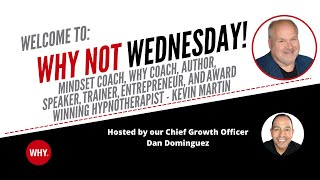
This is a transcript of a YouTube interview (WHY Not Wednesday) where host Dan Dominguez interviews mindset coach Kevin Martin. Kevin describes his personal and professional identity: his why is to challenge the status quo, his how is to find a better way and share it, and his what is to contribute. He is an experienced coach, hypnotherapist and NLP practitioner (noted as over 15 years), entrepreneur and trainer. Kevin shares a formative personal story: he and his wife adopted three children; their oldest had severe behavioral/mental-health issues and, after three five-hour NLP sessions when the son was 17, the problems resolved — this experience motivated Kevin to train and practice clinically. The interview covers NLP principles (presuppositions, "the most flexible has the most influence"), practical rapport-building techniques (matching physiology, tonality, limited role of words), Kevin's "why not" moments (leaving corporate to start businesses), and upcoming offerings (a Boston SCORE rapport workshop and a five-day "Awaken the Why Within" challenge in the week of May 23). The tone is conversational, personal, and promotional/educational.
Chapters
There's a certain kind of coach who believes what we believe.
Who leads people to greatness, who gets people unstuck, who unlocks all of your passion. A coach who helps people discover what drives them to tap into their superpowers. Then knowing your why is the first step to untap potential.
To focus.
To breakthroughs.
A coach who's looking for a better way.
Are you that coach?
Foreign.
Hey, Kevin. Welcome to why Not Wednesday. How are you?
I am doing fantastic, Dan. Thank you very much for having me. How are you doing?
I'm doing fantastic. I'm so excited to have you on. You know, you're one of our. You're. You're now one of our veteran coaches, and I'm so excited to have you on why Not Wednesday because you've got one of my favorite whys. Your why is to challenge the status quo and think differently. Your how is to find a better way and share it with others. And your what is to contribute. So let's, you know, I always start with that. Kevin, what. What does that mean to you? What has it meant to you since you've discovered your why operating system?
Hey. Hey, Lisa. How you doing? Oh, you know what? I just. Before I go into that, that video I got the first time, it was fantastic. It was absolutely fantastic. And it was right on point. You know, it's a really great way to start with clients and for clients to start, you know, start their transformation is to discover their why. Lisa and I, Lisa Schermerhoe and I, we. We use it with every single client. Yeah, we. And that's how we start with them. Excuse me, less. It's got to be a why. So he's talking about challenge. You know, one of the things as I was thinking about being on here today and I was posting some things about why Not Wednesday, Right. I realized. I realized that, you know, why not is the. One of the biggest statements for me as challenge. Right. Because I want to do so. I want to do things differently. I want to find different things, and when I find them, I say, why not? Why not? Try this. Why not do it this way. I think why not is a. Is a motto for challenge. Yeah.
You know, if Stephanie, If Stephanie was. Was listening, she. She'd give you a big thumbs up because that's. That's her. That's her motto. Everything she posts, she talks about why not. It's very important to her. So, you know, we got right into your why, how, and what. But, you know, let's talk a little bit about you, because when I introduce you to our audience, right? You're a mindset coach. You're a why coach. You're an author, speaker, trainer, entrepreneur, and then an award winning hypnotherapist.
So you've been training, You've.
Yeah, you've been training people all over the world for over 30 years, and you help people get past their barriers and excel for over 15 years. So you understand how people think, how people learn. And most importantly, and I think this is, this is key how people change.
Yes, that. That is key. And, you know, everything that you just talked about me is a lot of it, or mostly all of it represents me as challenge. Because you know what, when being a hypnotherapist, I mean, who wants to be that? You know, not many people. It was such a different thing. And I said, yeah, this is where I want to go. This is how I want to go. Granted, something else brought me there, but when I realized it, I said, this is. This is me. This is. That was my out of the box thinking. And I say, yes, yes, indeed. A lot of the things I do as an author, as everything else, as an entrepreneur, because I, Because I've started three or four companies. One of the things as a challenger is, you know, I got, I worked in corporate for many years. Right. And that wasn't me. First of all, I had a hard time because I didn't like. I like to play outside of the outside, draw outside of the lines.
Right, right, right.
So conforming was really difficult for me. Right. And I realized that really early on. And so getting into my own business, doing something that only, you know, 1 or 2% of the people in the world do. Right. I wanted to be that different person. I wanted to be that person. And, and I love it. I love doing what I do. And it's because I love being. I love being. Doing it my way. How's that doing my way?
So you're, you're following the Frank Sinatra mantra, right? Do it my way.
Exactly, exactly.
I like that.
I was gonna say watching Jordan says, be true to yourself for the win. And, and Gary. Gary Sanchez is agreeing. Watson, Jordan. Yes.
For.
For the win, for sure. You know, I think that's very important. You know, one of the things that, when, when I talked with Lisa when she and I first met, because Lisa.
Brought you on board, but she did.
I remember one of the things she said is, was about finally having a language to describe who she is. Right. And then I think that's what you're talking about is, you know, and I Talked about it today with, you know, one of, one of the people I follow on LinkedIn is Monique Gibson, and she posted about, you know, just being yourself and just, you know, when you're, when you find out who you really are.
Then it's a matter of now that you know who you really are, then let's, let's just be true to ourselves. Let's talk about our strengths. Let's represent ourselves as who we are. So Kevin is somebody who loves to challenge the status quo and think differently. And he also is someone who is always looking for a better way to do.
Oh, absolutely. Sometimes that better way gets in my way of completing things because I'm always looking for that better way. Each of the whys, as we know, have challenges, right? Each of them have challenges. And so, yeah, but it's wonderful. One of the things about why, and we don't talk about it too much is why is what drives you throughout your lifetime. When, when I discovered the why and I started looking back, I started seeing things that I used to do as a kid, as a child, where, and by the way, Lisa and I have a different childhood and respect that she was different, you know, and she did things differently, but she got chastised for it. Me, I celebrated it. I just said, okay, this is me, you know, let me in. When I, when I had my first day of high school, which was a parochial Catholic high school, and we had a dress code, my way around a dress code was you had to wear a button down shirt while I had this army khaki green shirt that said army across. And I said, this is my favorite shirt. You, all you said was, I had a button down shirt. That's what I wore with a tie.
Right.
There were so many incidents from my childhood where me being challenged was, was there. And I, and I loved being different. You know, I, you know, I was a bit of a geek and I think a lot of geeks, when they grow up, I think a lot of them probably are challenges. They love to be different. They want to be different. Right.
And I think there's a difference, right. Sometimes you don't, you don't necessarily want to be different and you are, but then there, when you embrace it, then you want to be different.
Then I want to be different. And you know, and you know, it's been fun for me, not necessarily for my family when I do things that are really goofy or just because I want to do them right and embarrass them. Actually, I, I was told one time that our job is to embarrass our children. So being in a kid challenge makes it so easy for me. Yeah. But also one of the things, looking back when my wife and I first got married, you know, we'd do things like I'd wake up on a Saturday morning, early on Saturday morning, I said, you want to go to breakfast? And she says, sure. In two and a half hours later we were in New York just because it came to me and I wanted something different. I wanted to do something different.
So many times.
So Kevin, you bring something great up. Have you had your, your wife go through the, the yos discovery? Do you know her why, how and what I do.
And her why is contribute, I believe. Okay. I don't call the how and what right off him, but we, we did go through, go through all that. And we're not opposing. We're not opposing. And since that's high for me. Yeah, contribute is high, very high for me. And there's been times in my life, I, I swear that for periods of time, that was probably number one where I had the. I was the person who couldn't say no. Right. I was, I wanted so much to help each and every one of them. You get to a point, and that's the challenge of a. Right. Right. You get to a point where you can't help anyone because you've over committed. And so, yeah, it's, it, it's funny. Yes, we know. We know what each other is. And when she discovered that of me, she said, oh yeah, of course.
Yeah. It's almost like getting an owner's manual for your spouse. Right. Because Lisa, Lisa just said something. Let's make sure we recognize that owning my why gave me freedom. No longer feeling broken or that there was something wrong with me. I now see being a challenge as my greatest gift. I love that. Right. Because you, you now own it and that's you. But you know, I, I love when you said, you know, my wife said, let's go get breakfast and you said, ha. Let let you know, next thing you know, you're in New York. I can tell you in, in my family, that would have been an issue because my wife is clarify right way. Trust there. There's not a lot of spontaneity gonna happen there. Right. You know, you got to be clear as to where we're to make sure we have a plan before we go. And, and, and we, we also have to make sure that we're dependable. Right. If we didn't tell anybody that we were going. So you imagine when, when I do stuff like that. It doesn't go over near as well in our house, but it sounds like you and your wife are, are able to, she's able to flex to you.
She got used to it. Rest of the family did too. There I, I, I'm known for something in the family is going on mystery rides. And mystery rides means not even I know go. All I know is I want to go someplace different. And sometimes it takes me, it takes me a long time to figure out where this is going to go. I'll say, well, I've been here, we've been there, we've been there. Where can we go? That is a, the challenge of being challenged, right Is you can't make a decision. But everybody in my family knows me as the person who takes people on mystery rides and they know that even I don't know where we're going to go because I'm going to figure it out the, the different place to go as I'm driving.
And, and I'll. And that is, that is so fun for someone with your. Why. Right. That's that, that is. Hey, let's figure, let's see where the road takes us. And you can see where that would drive someone with that wants to be more planful would probably drive them a little bit more crazy. Right. William Summers, Bill Summers says the one who has the most flexibility has the most influence.
So what do you think of that, Kevin? That is a tenant of nlp, Neuro Linguistic Programming. The person with the most flexibility has the most influence in the, in the, in the group, in the community and everything else. So I, I live by that. Thank you very much. Thank you very much, William. That is awesome.
So tell us what that means since this is a tenet of nlp, which you're a practitioner of.
Yeah, I've been, I've been practicing Neuro linguistic programming for over 15 years. Actually a little longer because it was part of my sales training business as well.
NLP has something called presuppositions. That's a, a nice syntactical word. It means principal or tenant. So and, and there's, there's several of them. And, and one of them actually really states that, you know, the, the person or the thing because they originally stated it as part being part of a system.
Right.
With the. Who is the most flexible. Who is the most flexible is the one who can control or at least influence the system. So being flexible, of course, we know in business if you're not flexible, you're not going to be here. Especially These last two decades with so much change.
Right.
And so if you're not flexible, you're not going to be here in five or 10 years.
Well, what about the last couple of years, Kevin? I mean, you and I and Lisa got to meet before the pandemic, and then soon after, it was like, okay, we're, we're, we're done. We're shutting it down and we're going zoom. Everything's going on zoom. So, Kevin, I mean, you've got a very diverse background and a very rich background. How did you get started in coaching? What, what made you say, you know what? This is, this is how I want to make my mark?
Well, actually, it was, it was a. I, I adopted three children. Okay. My wife and I, should I say I want to be correct about that. We adopted three children and our oldest was five and a half years old when we adopted him. But he had lived in seven homes before then. Wow. So he came with a lot of, a lot of issues from abuse and all sorts of things. And as he grew, it didn't get better, it got worse. No matter what we had for doctors and medications and whatever it is. And when he was getting, when he got to 10, we actually had to have him moved out of the house into a residential run by the Department of Mental Health. Right. And because he was too dangerous for his siblings. And, you know, from 10 to 17, he grew worse and worse. And I was looking for an answer and I. One of my companies I was running use neuro linguistic programming for language skills for sales. But I also had looked it up and they have to do with clinical. So I went on my search and my journey and I found, I found the answer finally. It took a while and I hired somebody. And my son was 17 at the time, and in three five hour sessions in less than one week, everything disappeared. Wow. I know that's. That's hard to believe, but in that moment I said, this is what I want to do. I want to help people get over these issues, over these kinds of issues. I want to help people get a. Get the life they deserve. And so from that moment on, I went and finished my own training and I started seeing people. I saw people for many, many years part time. And, you know, it was either individual, you know, limiting sessions or it was longer coaching sessions. And I still did, I still did the sales business type coaching. Right. And it wasn't until three years ago, actually, it was just before you and I met. Right. It was like six, eight months before Lisa and I decided, let's let's have ourselves a coaching business.
Yeah. Yeah.
Because we both were doing the same thing, and we wanted to up our game and. And level up there and. And we've been doing it ever since, so we've been enjoying this ever since because there's so much. There's so much place for people with. With our skills to be able to help people make differences. And that's what we do, and that's what we do. And it's been wonderful adding why to our. Our skill set. It really has.
So I was getting some feedback, so I'm putting on my headphones. Can you still hear me, Kevin?
I can. Great.
Great. I think there was a little bit of an echo, so I put the headphones.
I like Bella's comment, and she said, figure it out on the fly sometimes. That's what I'm doing. Yeah, that's because I like to be different. I like to. I like to do that. It's just so much fun.
So, you know, what's interesting about you too, Kevin, is you've got challenge and better way. So one of the ways in coaching that.
That.
That we talk about the two. Why's the why of challenge? The why A better way is challenge. People will do things differently just to do it differently.
Better way.
People will do it differently if it's better. So you own both of those. You've got your. How is to find better ways and share them. So you kind of become your own filter for. Yeah, that's different. But this is better. And so.
Yes.
How do you. How do you deal with that?
There's. There's. There's definitely overlap between the two. Well, sometimes when you. Sometimes when you're looking for a better way and you get stuck, you don't know that. You just got to try things differently. Just do it differently. Yeah, just do it differently. And, you know, for being someone who does things differently, what is it Einstein said you. You know, people who are doing the same thing over and over again, expecting different results. That's the definition of crazy. Right. See, I don't do the same things over and over again. And I know that when I. When I. If you want a better way, it means you want to change from the. From the status quo. Right, Right. That's where I come from.
That's where you start.
I. Then, you know, that's where I start. And then I can measure. Is this better or is this not right? I'm liking it. At an optometrist, you know, better or worse. Right. That's how we are, as a challenge, we. We do things differently, but we don't want to do things worse. Right. But we love, but we love. The testing is like living a litmus test. All right. I'm going to do it differently, and we're going to figure out if it's better. You got. You all say something about men, you know, looking at menus. I do. I do take a long time making a choice in a menu. Right. And because I'm looking for something different, and I don't always get the better thing, but I get. But in my mind, I get a. I get an experience and I get a learning, and I know I'm not going to try it again. Yeah. And someone who's always trying new things and different things, I need to know which ones I don't want to try again.
And you're. And you're constantly learning.
Right.
Bella had a comment. I'm sure you'll appreciate this. She said, challenges have the ability to figure it out on the fly and not panic and have fun with it. A lot of others will not handle that very well. Right. So for others, that, that's a, That's a very stressful situation. So I'm sure you've seen a lot of that.
I'm glad you. Bella, thank you for bringing it up. And you had just, we had just talked about a little while ago, and I have this uncanny way of not panicking. And in desperate situations, I do have this uncanny way, and people look at me and say, why. Why aren't you. Why aren't you all anxious and stuff? And, you know, I never realized it's. It's from, it's from the being the person who loves to put themselves in different situations all the time. I have to be able to do that. Yeah. So that's, It's a great revelation for me. Yeah.
You know, so. So I'm gonna, I'm gonna switch the conversation a little bit, Kevin, because I want to talk about something you and Lisa did recently. You talked to. You did a workshop for Boston Score on how to build rapport with anyone in seconds. So I know our listeners. We've got a lot of people listening. If there's any questions you have, put them in the chat and let us know and we'll ask the question, but what. What's the secret? If you know without giving away any, any, any secrets, but you did this for free. And, and there was registration, and, and you have probably had a lot of people show up. So what's the secret to building rapport? With anyone in seconds.
Sure it's based on neuro linguistic programming, but the idea of building rapport is having something common in common with someone else, right. Once you notice someone else has something in common with you or they notice that you have something common with them, they feel more comfortable. You can't always guess what it is you're going to have in common. You can't even use what it is around their office sometimes they left stuff there that they don't like, but it's just there anyway. Are the way in which we communicate is through physiology, through tonality, how, how our voice sounds and through words. Believe it or not, words is the least amount of our communication, only 7%. The physiology is 55 and the tonality is 38. So if you're in front of somebody, be it in zoom or especially in person, you mirror or match their, their physiology as much as possible. If they're kind of leaning and stuff like that, you don't want to be stiff and rigid. You don't want to be the opposite. You want to get towards where they are and something happens really deep underneath. And it says wow, this, this person is, this person's similar to me. Right? And we're attracted to people who are similar to us, not to opposites. If we were to, if we're attracted to opposites. If opposites attract, should I say and people were totally opposite, they probably never even have the chance to meet because it wouldn't be in the same places in anything else. And I'll bring this to why Lisa and I click really well. We're both challenge wise, we both like doing things differently, thinking outside the box. So we were attracted to each other and we, we were able to have this, you know, partnership that works very well. Now obviously in a business partnership you want to have some little differences and we do, we do. My, I'm my. What is contributing her. I think she's clarified Lisa Claire.
I think it's made sense.
What's that makes sense?
That's what it is her what is make sense?
That's so that's a little different. And if you're business partners, if you're working in a business, you don't want everybody to be the same because you want a good mix, right? You want a good mix. But the fact that we're both have the same wise really attracted us to work with each other and we like to and, and therefore we like to work with people who are, you know, who love to be different or try different things and think outside the box. We love those clients because we can really. That's their rapport that you build. Right. So then your original question was if you do that kind of work, if you mirror their tonality and their physiology and even word phrases once in a while, it's amazing how you'll get real comfortable. They'll get real comfortable with you and it takes only a matter of seconds. And it's just amazing how that works. Thank you for asking.
Yeah, no, I think I saw the post. I wanted to ask about it. You also have an upcoming event, a five day challenge. Tell us about your five day challenge that you and Lisa are doing.
Five day challenge. Awaken the why within. Yes, very nice. Yes. And I am doing that. And it's the week of. I'll get the dates here. We're. It's a May, the week of May 12th, I believe. Okay.
Yeah. Oh, no. May 23rd. Sorry. The week of May 23rd. And what we're going to do is one hour a day through five days, we're going to walk people through, you know, understanding what why is. Understanding the importance of why. Understanding how knowing your why, what and how can actually leverage your, your own messaging.
Okay.
And how it's important not only in, it's important in family as well as in business, it's important in personal things. So we're gonna go through all of that in, in the five days and we're looking forward to it because this gives us a finally a chance. We're going to de and we're gonna really take advantage of being y coaches and going out there and helping as many people as we can.
So if somebody wants to sign up, should they just follow you on LinkedIn? Have you guys started publishing your registration?
We're gonna have our registration out in another couple weeks. Definitely follow us on LinkedIn. We're gonna start talking about it as early as this week, but we're going to have our registration out in a couple weeks and, and all the play all the pages up there for them to sign up. We're going to have a master class early on. It's just a one hour overview of, of the importance and things like that. Oh, and during the five day challenge, I believe we're going to have an incredible speaker come in.
Dominguez.
We don't have him locked down and booked. He's a tough guy guy to get. But.
Well, I'm looking forward to it and I can't and I can't wait to be a part of it. I know you guys will put together a great program and I encourage people to follow you or Lisa to get that information. That's going to be coming out in a couple of weeks. So let's get to the, you know, the question. The, the name of the show is why not Wednesday? And so one of the questions I love to ask is what's been your biggest why not moment, Kevin, A time when you said why not to an opportunity, a circumstance or a choice, and it made a significant positive impact for you.
Okay, well, first of all, speaking about why not is I realize as I'm thinking about this, why not is kind of like the motto of challenge because we're always doing something different. So we say to ourselves and we say to all the people, hey, why not? Why not do this? Why not do that? My biggest thing that changed my life is when I decided what is when I decided to leave corporate and get out on my own. It was a, it was a time in my life, in our life that we probably shouldn't have done that. The very first day I started my sales training franchise, the very first day was my second son was moving into our house, our second adopted son. And but I said, you know, I, why not, why not just take the plunge, do this? I know it's going to be great. Right? As it turned out, that business didn't work out, but I was at the same time I actually had my foot in the door from my software company as a contractor. And five years later I had a business making over a million dollars a year. So me getting, leaving and getting into my own business was. And saying, why not? Why not just do this now? It doesn't, there's always never going to be a great time.
Right.
To take the plunge. Right. And, and I said not. And it changed my life. And by the way, that sale, as I mentioned before, the sales training business that I got into, that was my introduction to nlp and NLP ended up saving my son's life. Yes. Ended up getting me doing what I'm doing today. Oh, I didn't wrap up that story of my son, you know, that was, that was 17 years ago. He's 32 years old now and adopting a seven year old of his own. So yeah. So that it basically getting into, you know, taking that plunge, saying why not do this now? Is what brought up, brought me to where I am today. It's what, you know, brought me my children and my future grandson. So it's just amazing.
Fantastic. Well, what a great example. You said for him that he's actually doing it himself now and and how old is the. The. The. The child that he's adopting?
Seven years old now. And he's been. He's been taking care of him as foster and legal guardian for four years. And as soon as it's all cool, cleared with grandparents.
He'Ll be the adoptive father and we're the adoptive grandparents. It's just wonderful. It's a nice circle, but it's amazing the way things work and things work, unexpected things, things that are adversities end up being in alignment for where you're meant to be. That's what I truly believe.
I love that. You know, Bella commented. Challenges. People with the why of challenge must have to have a plethora of why not moments. Lol. So was it hard for you to figure out this. This one? Because this was a pretty significant one. It sounds like it was not just a why not moment for you, it was a why not moment for your family.
Oh, absolutely. Absolutely. And, you know, being. Being a challenge, and when you have a family involved and they're not all lined up as challenges, it gets difficult. As we were speaking before. So when you have these why not moments, and I love why not moments, as I said before, because, hey, it. Let's do this. Why not? Right? And so we've done that many, many times. And, and most of the time, they work out really well for, for me and the rest of the family. So not always, but most of the time. So I, I love these. The idea and the significance of why not as from it's being a challenge.
So that's. You know, you earlier talked about these no destination drives that you go to where nothing is planned. What did you. What did you call them?
Mystery rights? I didn't call them that. My family called them that because they knew if they got in the car with me and it was. And there was nothing planned, which I really don't like. I don't know if that's challenged, that don't like planning. I, I never like to fully plan something out. Right, Right. I want to have spontaneity. So they call them mystery rides. And you never knew when we got in the car where we end up in the. And the big thing about it was most of the time I didn't know either.
I love it. I love it. All right, Kevin, one last question. So we've got some. You know, a lot of our coaches listen to the show, but a lot of potential coaches are listening. What would you say to a coach who's thinking about adding the why discovery and becoming certified? What would you say to them if they're on the fence?
Well, what I say to them is it's going to be one of the best decisions you could ever make as a coach for both you and your clients. Because for our clients, I mean, their discovery sometimes is life changing and business changing right from the start. So I think it's one of the best decisions you can make. And even just discovering your why and then knowing what to do with it once you discover your yos, your why, how and what, and knowing what to do with it, the messaging and the kinds of people you really operate really well with and things like that, it's just, it's a, it's a godsend. I love it. I've loved what we've been doing and we finally come to a point. We use it with all of our clients, but we're actually going to start using it in a much larger way now.
Fantastic. Well, thank you so much. Kevin really has. Can you believe our half hour is over? And I knew this was going to be a fast and fun and furious conversation. So thank you for sharing so much. I know you shared a lot of personal things, your why not moments, your son's story, which was amazing. And hey, we're putting your LinkedIn up on the, in the chat so people can find you. And you also, you know, you can find Kevin and Lisa because they follow me, so they're connected to me. But yeah, go to Kevin and follow him so you can take part in that five day challenge if you're so inclined.
Absolutely. And if you have any unanswered questions that you want to, just hit me up on LinkedIn and I'll be glad to have a conversation and just simply answer your questions.
Thank you so much, Kevin. Have a great rest of your week and we'll talk to you soon.
Thank you. Thank you very much, Dan. Thank you all for being here. Take care.
More from Dr.




Women In Leadership: A Need For A Greater Systemic Change With Belinda Clemmensen






