WHY Not Wednesday with Kit Cassingham
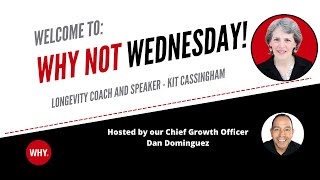
YouTube interview (WHY Not Wednesday) featuring host Dan Dominguez and guest Kit Cassingham, a longevity coach. They discuss Kit's WHY operating system (contribute / challenge / mastery), the importance of a longevity mindset (age as attitude), practical health habits (diet, sleep, hydration, joy), and her experiential coaching methods that include month-long pilgrimage walks (e.g., Camino de Santiago) and a 12-session 'Life University' program. Kit also describes discovering and recommending the WHY Institute for deeper practitioner learning.
Chapters
Sam.
These last few years have made us question everything.
Our relationships.
Our jobs.
What constitutes an office.
Who we are.
In a world.
Filled with chaos, confusion and uncertainty. It's time for some clarity. It's time to start understanding one another.
It's time to start understanding ourselves.
We envision a world where everyone knows their why. But even more, we envision a world where everyone knows their why. O s their why, their how and their what. The operating system that drives you, that lets the world know where you stand.
What your unique gift is, and most importantly, who you are.
Yoshi, are you ready?
Hello everyone and welcome to why Not Wednesday. It is the first Wednesday in August and you know, we're back to talking to one of our coaches today. Kit Castingham has been with us for quite a while. She's one of our. I'm going to call you a veteran coach, Kit. She's a longevity coach who helps people get the most time, health and success possible out of their lives. She starts by improving your mindset. Few people have a true longevity mindset and most have no idea how to get there. Kit not only does she knows how to teach people how to get there and the way she does that is by starting with their with her own what or how which is to challenge them to base their create their lives based on their why. Operating system, which she brings into her coaching. Kit also leads clients either through destination coaching sessions or lengthy walks, knowing that we can grow the most when we are outside of our comfort zone. So I love that introduction. Thank you, Kit. Man, did I capture everything?
No, but we don't have time to capture everything. Dan.
There.
I have a feeling there's a. There's a lot to kid casting him. So I'm so excited to have you on board because we're going to talk about a topic that we don't talk about a lot. Right. Longevity. You know, I posted something about before, before our interview about the fact that most of us are going to live 30 years more than than our parents and just a couple of generations ago. So you know, used to be 65 was kind of the, the retirement age and you didn't have a lot of. Now people are living far into their 90s and, and living vibrant lives and you help people transition into those lives.
Yeah.
And you know, Dan, I. When people tell me they're old and they're younger than I am, I just grimace. It's like how can you be old? I'm not old.
Right. So. So you talk about that Age is a mindset. Tell me about that, what does that mean?
It is.
We make our lives with our attitudes and mindset and attitude are kind of the same thing, right? So if you think you're old at 50, guess what you are, right? If you think you're young at 100, bingo, you win. You are. Betty White and George Burns are two beautiful examples of old people who are very young. Young at heart, healthy, vibrant. They were engaged in their lives.
Yeah, I remember hearing George Burns tell he was, I think it was on the Tonight show back when Johnny Carson was still hosting and Johnny, Johnny asked him about signing a contract with one of the major hotels in Vegas. And he said, but I didn't sign it. And Johnny said, well, why didn't you? Well, they wanted me to sign a 10 year contract, said George Burns. And Johnny said, well, well, what's wrong with that? He says, look, I don't know if they're going to be around in 10 years. He wasn't worried about himself, he was worried about them. So you're right. He, he took on life and took on his longevity and lived it. Let's start with the thing that I like to start with every guest kit and then let's go over your why operating system, which for you, for those of you that, that are new, that are watching for the first time, we always start with the nine whys and we'd like to know what the top three are for kids. So kids, why is contribute. What that tells me, kid, is that you love to contribute to the success of others, make a positive impact and be part of causes that are greater than yourself. How you do that, how you go about that, your how is by challenging the status quo, helping people think differently. And wow, how, how appropriate, right? You help people think differently about being old. And then what you bring, what people can count on from you is mastery that you're gonna, you're gonna study things at a deep level and understand so that what you bring to your clients is well studied and researched. How well did, did I capture that?
Beautifully, perfectly.
Feels like I'm fishing for compliments. I realize I've asked you twice, how well did I do that?
Let me, let me add to the contribute that I, in addition to helping contribute to people's success, I also want to contribute to their joy and their vibrancy, their satisfaction in life, not just career.
Sure. And, and, and so what, what does that mean for, you know, so we just talked about. So if you feel old at 50, you are, you are old. You know, there was a great speaker once said, you know, you are who you think you are all day long, right?
Yeah.
So, so, you know, if somebody's feeling old at 50, what, what, what, what can they do? What is it that, that you, you would help them do to get out of that mindset or understand that there's more to, to them than what they've done over the past 50 years and they've still got some, some way to go.
Well, hopefully they do. I mean, I, I hope that they hope they do.
Right.
People often don't understand what their pain points are or.
As just the way it is. So I kind of challenge people to find where their pain points are. What does longevity mean? Well, it means health span. It means lifespan. So are you healthy for the entire length of your life and how long is that life? And I've added one and that's part of the formula. I, I have added one more component to the longevity mindset, to longevity. And that is joy without joy. Who cares how healthy you are or how long you live? Fact without joy. You want to keep it the lifespan low. Not having fun. So I dig and find the pain points.
I love that. So, so we've got Bill Subber says I feel young at 76. And Bill often joins the show. So Bill, you might need connect with Kit and we're, we're trying to make sure Kit comes down to the conference. She's, you're, you're in Denver, right?
No, I'm on, I'm on the other side of the state. I'm, I'm in Youray county. Four, five hours west of Denver.
Five hours west of Denver. So she's just our neighbor to the north. So those of you that are going to be at the, at the, at the Y conference in September, you're going to get a chance to see kid if she comes down from Colorado. I love that comment. Bill, My goal is to die young at the oldest possible age. What do you think of that?
I think that's great. Now I'm going to see what William thinks. Does you go by William or Bill.
But I think he goes by Bill.
Okay. So Bill, I used, when I met my husband, I said I was going to live to 120. And I got to that very scientifically. My parents had outlived their parents who'd outlived their parents. And I'm going, so I'll live out live my parents, my parents died in their 90s. Of course I came up with this before they died. But so when I said 120, all of a sudden that felt Like I was limiting myself. Yeah. So I upped it to 150 and my husband said, you can't tell people that. They'll think you're crazy. Well, they need to know ahead of time that I'm crazy. So, Bill, you want to live with me that long? Not with me, but we could be coffee mates or something.
Yeah. Well, you're going to die young at the oldest possible age. I love it. Bill confirmed. He goes by Bill. So T.J. davidson said, hey, hey, Dan and Kit Lindsey Pollack says Bill Summers, you, you are young. So of course, you know, he's got a couple of fans that are joining us. So tell me about these travel and long walks that you do. That, that's interesting. So tell me about, how do you go about it? How does if, if I'm working with kid, you know, I'm, I'm over 50 and so maybe I'm feeling old and I come work with you. They're going to take me on a travel trip. How does that work?
Well, the first thing I'm going to offer you, Dan, is to walk a pilgrimage with me. And to me a pilgrimage is about a month long.
Okay.
Anywhere from 350 to 500 miles or longer if we want. Yeah, I walked the Camino de Santiago, a short 800 kilometer, 500 mile walk. And I make fun of that because people go, you walked that far? Yes, it took a month, but just step at a time. And I discovered that the first two weeks you're kind of adjusting to the trials and tribulations of carrying everything on your back and walking and getting over tired feet and knees and, and the cultural challenges of being in a different country with different language and money and food. But after that two weeks, you start really taking it all in. And when you get done, you may think never doing that again. And then you're going to find, you know, I changed that, that was valuable. I want to do more of that now. If you can't take a month and a lot of people can't, or if walking really isn't your thing, then we can decide on some place to go and I'll try and get you to go for at least two weeks and I'll come up with a schedule of travel and sightseeing and food and, and we'll coach along the way. And it's fascinating how it all works out. An example of resistance that people feel. I took a woman, a couple people to the, the area called, that I fondly call Sky Ireland. You call it Scotland, Northern Ireland. And Ireland, but that's too many syllables. So it's now Sky Scarland. Got it. And in Belfast, where the Titanic was built, I said, we're going to the Titanic museum. And one of the people said, I'm a history major. That has no interest for me. I didn't know anybody on the Tan Titanic, didn't know anybody who built it. I don't even think I have any Irish blood in me. I said, well, I bought your ticket, so you can go or not. She went, right. She loved it. That may have been the best part of the trip for her. So, you know, and so I challenged her.
Yeah, you did. So you challenged her. You gave her something that, you gave her a different perspective. How, how does that help people grow? How do you, how do you see that helping people grow? Being part of these travel journeys?
You're outside your comfort zone. When you're not at your home, your town, you are forced to get outside the rut. And we all get into ruts. Even if we stir the ruts up a little bit, you are exposed to things you wouldn't expose yourselves to, to different attitudes, people, styles, cultures, religions. All of that helps us grow and be better. We understand what's going on in the world when we've been out in the world and we understand ourselves better when we survive these challenges of. Oops. The airplane didn't go when it was supposed to. How will I handle that?
Right? Hey, I want, I want to share Lindsay, because I think Lindsay thought we might forget, but she says she's going to stick with Kit and Bill. So you got. We may start our 150 Club here with you guys. That's a fantastic.
Excellent.
So. So Kit, tell us. Yeah, go ahead.
I was gonna say. So I'm walking the Way of St Francis in Italy next year. So Bill and Lindsay, if you want to come.
So how far is that?
Some shoes. Oh, that's a short 350 mile walk. But it does take a month because it's, it's evidently hillier the way I.
Haven'T done it yet in Italy. And when are you doing that? Now I'm getting notes for myself that I've been. I wanted to go to Italy. How, how does, how long does it take? It takes a month. And then when are you planning on doing it?
I'm going to do it in April and I'm doing it backwards from how the guidebooks suggest you do it. I'm starting in Rome because I figure it's going to be warmer in Rome in April and It'll be hot in Rome if I do it the other way around. So in early April is cooler. And then I'm going to walk through the city of Assisi, which was kind of St. Francis's real home.
Right.
And then I'll walk on to Florence, which is hillier. So you kind of get used to walking before you hit the harder part. It's going up the ramp rather than.
Well, Bill and Lindsay with, with the how of challenge. Can you imagine that Kit's doing it backwards from, from the way the guides suggest. Right. And Lindsay wants to know where can she find the details. So if somebody wanted to sign up to do that walk with you.
Well.
You'Ll have to email me. I don't have it on my website yet, but that's a reminder. I'll make a note. Add way of St. Francis.
Well, and you guys can, can always get. Hey, look at that. Kit, Your email is kit castinghammail.com so there it is for anybody that wants to reach out to you. And you can also find kit on LinkedIn. Kit castingham, very easy to find. She's connected to me. Perfect. See, we've got that nice banner so we know, we know how to get, get a hold of kids. So you never know. You might have that the 150 Club in, in. In Italy doing the, the trail of. The trail of a together.
That'd be cool.
That would be fantastic. Somebody says Italy is amazing and don't miss. And I wish I had a name on that. So the LinkedIn user. We'd love to have your name, put your name in your comments so we know who you are.
And I want to know what we shouldn't miss because I think there's a lot we'll just by virtue have to. If time was not an issue, there's so many additional places I'd go, like the island of Sardinia. But anyway, that's another thing, another time.
Well, we'll have to have. You know, we. Last week I had Larry Levine on and we had such a great conversation. We said we're going to have to do a second trip. Right. Love life in focused energy. L I F E life. Tell us about that. That's. That's on your website. It's on your LinkedIn profile. What. What does that mean? And that was awesome. If we could hear more about living in focused energy.
When I was changing careers several years ago, I didn't know what to call the new program, the new business.
Right.
And the universe said, and I wanted an acronym.
And the acronym of Life was given to me. I go, all right, thanks. What does it mean? And so I just kind of kept pacing my office and the meaning of live in focused energy is what I decided it meant. And initially my subtitle was Empowering yourself through.
Mindful balance. And I kept tweaking it, but it really is still about mindfulness and balance. And that, that's how we live a long time, is balancing all the elements of our lives.
So where should we focus our energy? So I, you know, on that journey to 150, I'm, I'm, I'm, I've got a long ways to go. Right? So if, if someone who's, who's, who's thinking, hey, in, in a long term way, what are, what are some of the tips and tricks that you would say? What's the first thing you need to do to prepare yourself for that long life?
Well, the elements are eating a good healthy diet, right? Getting your sleep, hydrating.
Having an optimistic, positive mindset. And I don't mean.
The frilly.
Optimistic of it's okay, yes, I'm in the middle of a volcano that's exploding. That's okay. Not that kind of optimism. The kind of optimism of, huh, my car just broke and I'm in a tunnel. How can I safely get the car out? I'll figure out a way, right? So that's the kind of optimism I'm talking about.
Keeping joy in your life is important. Reducing your stress, those are the important elements. And you can take each one and make it bigger and really expand on it. But to keep it simple, which is one of my mantras.
Do that. And you can't. It's hard to be joyful when you're stressed.
So diet, optimism, hydrating. Oh, just healthy lifestyle, sleep, healthy lifestyle.
Yeah, yeah, fantastic. It's not a difficult thing to do. It's just, just live, be engaged in your life.
And long term, yes, I can have this banana split for breakfast. Is that good for me in the long term?
99% of the time I'll say no, but once in a while ago, yes, it is good for me.
So, so when, when is it good for you? When is it good to have that banana split for breakfast?
I said, yeah, you know, once in a while we need to treat ourselves. Yeah. And they say dairy's bad for you and sugar is bad for you. Well, bananas are good for you. And my diet is the color diet. I subscribe to eat red foods, yellow foods, green foods, brown foods, and chocolates in the brown food group along with coffee and steak.
All right.
Raspberries and beets and strawberry ice cream are in the red food group. Oh, and wine's in the red food group, right?
It can be. Right. We have white wine too.
Yeah. Yes, that would be in the white group with milk and white grapes.
Love, love, love that you need.
You need to once in a while treat yourself to something fun. That's my belief.
All right, we got a couple of comments. I wanna, I wanna make sure we. So, Jake, JT is Jackie Richie says Italy is amazing and don't miss. So, Jackie, you gotta tell us what, what is it that we can't miss when we go to Italy for our 3,300mile walk? Linda Kirkpatrick says she loved the life and focused energy. I love this quote from Bill St. Francis basis. He said, if you're walking, is it, you're preaching. No point in walking anywhere to preach. So you preach as you.
Thank you, Bill. Yes, yes. Well, and you are your lecture, you're preaching.
Yes. Linda Kirkpatrick says eat pie before your dinner. What do you think?
Well, I call it dessert in general. And then if there's room, have the rest. Because what if they don't have good pie? What if they have better brownies or cake or ice cream?
There you go. So explore, explore all the options, right?
All the options, yes.
So, Kit, as we go back, you know, you, you, you've obviously studied all this stuff. What is, how does your, your what of mastery play? What is it that you do that. That you've learned at a deep level? Obviously there's. You're the first longevity coach I've spoken to on the show. So what is it that you dig into that you're passionate about that your clients can count on from you in terms of. That you're going to know what you're talking about?
Well, you're asking somebody with ADD what their passion is. My passion is all over the place. And I use my curiosity and my mastery anytime I need to learn something new. For example, when my dad, dad got prostate cancer, I researched prostate cancer so I could better understand what he was going to face. My Toastmasters group didn't like hearing about that. But anyway, when I walked the Camino, I researched.
Everything I felt I needed to make it a successful journey. And a successful journey meant I got to the end alive in one piece with a smile on my face.
Good goal.
Right?
And with a smile and with a. So I researched all kinds of things. Places to stay, where I could get water, what kinds of shoes was I going to wear? And this will surprise you, Dan. I don't recommend boots. I recommend shoes. And I particularly am fond of the zero shoe brand. It's lightweight. I've walked a Camino twice and I've not gotten a blister yet. So.
So there's.
So I challenge everything I do.
Yeah, you certainly do. And, and you know, one of the things that we know about people with the how challenge, you're gonna make it fun. Right. It's gonna be fun to do this kid. So you're gonna put people through a 300 mile walk. You better have some fun along the way.
Absolutely. And you've started asking about my. My what if mastery.
Yes.
So like I'm learning Spanish or Italian and duolingo right now, and I'm not going to master it. I'm going to learn it well enough to know what's on the menu, what the.
Options for, where to stay, which path do we want to take? Will my Italian be able to be good enough that I know we want to take the left fork rather than the right fork.
Yeah.
So I don't go into mastery so much that I know everything about everything. I know a lot of things about a lot of things.
Right.
That's my approach to mastery.
Well, I think that's what happens when you combine mastery with challenge. Right. And you. But you do it all from a place of. You want to contribute to. To the success of others. And I think that's so important. Right.
And the joy. I contribute to the joy.
To the joy. To the joy. I love it. You know, I think joy and success are intertwined. I think I can be successful and joyful. Can we both?
Yes, yes. It's people who are successful and not joyful that I worry about.
Yeah. That there. And there's. There's a lot of people out there.
Yeah.
Doing that. So what style of coaching do you do? How would you describe your coaching and how do you use the yos with your clients? Because you talked a little bit about it. I put a little bit of that on my social posts. But how do you.
How does it come into play? Well, my coaching program, I call Life University. Life is the acronym for my business name and it applies to what we're learning. And I do take a university approach so that I have 20 topics. For our 12 sessions, I'm choosing five or six of the topics we'll go through based on the conversation we had. I see you need this stuff and you get to choose the rest.
Okay.
So then we have. I give a little bit of a Lecture, discussion about that topic. Then we Q A. I'll ask you questions. You answer. I may move on to another question, and I may challenge you about your answer. And then I send you homework, and you get to dig deeper. So, yeah, you go through 12 sessions. When you continue with me, there are another 20 topics, and you get to select from all 40 topics. Can't see my hands. They're way out here.
Here, not here. Love that. Brian Smith says prosperity is tied to joy. I want to make sure we comment on that, but let's, let's. Let's keep going where you are.
Yeah, yeah. So. So it is the helping you master yourself. I start with your values, and then I move into your why. Why Os.
So you start with values.
Yeah, because I think we've been living. Most of us have lived by other people's values. We learned our parents values, our minister, whatever values, our teachers, principals, our bosses. All these people have taught us, but now we're on our own. And I'm expecting people coming into my program to be ready to redefine their lives, to approach things differently. So they need to figure out what their values are so that they can move forward on their terms, and then we can go into their yos. I keep wanting to add an I in there for some reason. It's not. There's no I in there, Dan.
There's no But. But a few people do that. They call it the Y,Os. So I get.
They must be Macintosh people.
They are Mac people, guaranteed. So. So Brian said prosperity is tied to joy. Want to acknowledge that? Con comment? I think that's very true. I think you can. You can be joyful without being prosperous, but I think it's. You can also be prosperous and joyful. So I think that. That, yes, that's great. And JT Says, great explanation of mastery. That's one of hers too. And it was interesting to discover, but it makes a lot of sense. And. And I know JT personally, and I know that it does make sense for. For what she does. What's your biggest why not moment, kid? Let's talk about your biggest why not moment.
Moment.
What's time you said why not to something.
The biggest one was when I got my invitation to walk the Camino de Santiago. When my girlfriend had talked about what she and her husband were going to do, I thought, who would want to walk across Spain would want to walk that far by the time they did a little bit of it. And then when she invited me to go with her, I said, why not? I've never done that before. And I got to test myself in all kinds of ways. And when people would say to me, you can't carry 2 liters of water that's too heavy, I say, oh, not for long. I'll drink and it'll go away. So I kind of flip it. You can't wear those shoes. You got to wear boots so people can challenge me. And I, I have figured out what's good for me. So it was a great way to get to know myself, to test drive each one of the rules you have. You can't carry more than 10% of your body weight. What can I get into 12 or 13 pounds? I'd have to leave my vitamins. Not going to do it. And I backpacked with £45. So I'm thinking £13 is nothing.
Right.
I did £18 before my water. And I was right. It didn't stay on my back very long.
Right. You're drinking that as you go along. So now it's a cornerstone of your program, these long walks.
Yeah.
You said, why not?
And look at how it changed. When I got to Santiago, I'd walked for three days with pneumonia.
Wow.
And I'm going, I don't need to do this again. I have. No, no. And I got back May of 2018. In October of 2019, I walked the Portuguese Camino. And it was half as long and it took half as long. So I clearly was willing to go back.
You know what, what, what I'm getting from, from just listening to you, Kit, how much fun it would be to be your, your coaching client. Because I think, I think, I mean, we all need a coach, right? We, we know, we talk about this. Everybody needs a coach. People who are world class athletes need a coach. So we know that us as regular people need coaches. But I, I just can imagine that it's a fun experience to be one of kids clients as, as a coach. So thank you for sharing all of that. Tell me about this. You know, how did you learn about Y institute? You know, you've been with us for a while. What was your first exposure to us?
My first exposure to the why Institute was from a fellow masterminder in a different group. You may know the name of Jerry Luhan.
Oh yeah, I kind of know that guy.
Yeah.
Okay. Well, he was in this other mastermind with me and he allowed us to take the test. Now interestingly, when I took that test, it only told me what my why was. Well, I called it service, you call it contribute.
The new program. And I figured out what my.
How and what were.
Right.
And later on, and I came up with a different what, which is interesting, right? And. And it's my husband and I had the same three, but they're backwards. So we both have a how of challenge. Can you imagine how much fun it is to be with us sometimes?
Oh, I can imagine that. That's just loads of fun. Hey, listen, I have a how of challenge. So we're kindred spirits here. We have the same why and how, except my what is make sense. So we're just a little different at the end of our top three.
My. My what initially I thought was make sense.
Right.
But when I retook the test and came up with mastery, I go, I see that they're related. But if Dan wants to tell me it's mastery, I'll go with it.
So, you know what's really cool is you mentioned Jerry Lujan. You know, he. He's a. He's a partner at Y Institute, and he's an amazing member of the team. And I'm so glad you brought his name up, because I was wondering, okay, how did Kit. How did we run into Kit? Because it was probably before I was here. So let me ask you this question. What would you say to someone every day? So I talk to people all the time. Brian Smith is a recent person I talked to that asked me, okay, what would you say to someone who's considering becoming a member of Wise Society, getting certified, and being able to provide this for their clients? What advice would you have to someone who's thinking about.
Is my firm belief that people should get involved with the why Institute Society? Because it's one thing to learn your own Huawei os and you can help your clients with theirs. But as you interact with the other members and listen to more of the conversations, your understanding and knowledge go deeper and broader, which means you can help your clients better. And you know what? You get better, too. And that's. That's a great bonus. And I discovered the why concept through Simon Sinek.
Right.
And I'd been struggling along for a while, and, yeah, it took me hours to figure out what I thought my why was. Right. You've made it so much easier that I'm really tickled. And I don't know if I would have been as intrigued with Jerry's introduction if I hadn't already danced with Simon.
Right.
So, yeah, no offense to Hawaiian Stu that I knew dance with Simon first, but, you know.
Well, that's okay. We. We're just glad you're dancing with us now. You know what? What do you say we end the show on that note, Kit?
Why not?
More from Dr.




Women In Leadership: A Need For A Greater Systemic Change With Belinda Clemmensen






