WHY NOT Wednesday with Langley Downs
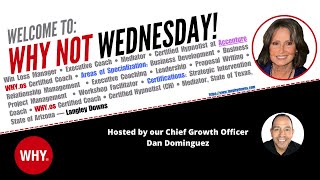
Coach Langley Downs talks about her YOS framework (Why, How, What), her 2014 stage 2B breast cancer diagnosis and how she used healing frequencies and meditation alongside treatment, and the coaching work she does now.
Questions this video answers
Stage 2B breast cancer (diagnosed in 2014).
432 Hz and 528 Hz.
131 days after diagnosis.
langleydowns.com
Chapters
These last few years have made us question everything.
Our relationships.
Our jobs.
What constitutes an office.
And who we are.
In a.
World filled with chaos, confusion and uncertainty. It's time for some clarity. It's time to start understanding one another.
It's time to start understanding ourselves.
We envision a world where everyone knows their why. But even more, we envision a world where everyone knows their why. O s, their why, their how and their what. The operating system that drives you, that lets the world know where you stand.
What your unique gift is, and most importantly, who you are.
Yos.
Are you ready?
All right, Langley, we are here with you today. That's your song walking on the sun. And you know, I'm so glad that you took me up on the opportunity to play a little bit of your walk up song. Why? Hey, let's, let's, let's introduce Langley Downs first. So first of all, welcome everyone to why not Wednesday. This is going to be such a great episode. I'm here with my. One of my favorite new coaches at Y Institute who is just a blast to be around Her Yos is challenge, simplify and mastery. But let me tell you a little bit about her. Langley is her why is challenge. Her how is simplify and her what is mastery? She's a firm believer in client driven strategy. She's a lifelong learner. She gathers and shares insights from win loss reviews for a 700,000 plus employee corporate employer. She earned her undergraduate and graduate degrees in coach, mediator and hypnotist certifications while working full time. She takes a holistic approach to coaching where she encourages being in the moment and embracing stillness and peace. She says if she were her 20 year old self starting out today, she would major in quantum physics to learn more about energy, vibration and fun frequency. So that's who we're talking to today. Hello Langley.
Hello Dan. It's great to see you.
Great to see you. You're coming. You know when, when your walk up song is walking on the sun and you live in Arizona, we all. I can almost see that where that comes from. But where did that walk up song come from? Langley?
Well, I've always loved the way it makes me want to move. It makes me feel. And, and the words are good too. But honestly it's all about the movement and the energy, you know.
So, so tell us. Go ahead.
It's just fun.
It's a fun song, right? And what, what more would you expect it from someone whose why is challenge? I love that you just said it. You know, when people with the why of challenge. Love to challenge the status quo, do things differently and make things fun. One of the things we know we're going to get from somebody with the y of challenges, they're going to find a way to make everything fun. And you just said it. So let's start with that. You know, your yos just to challenge the status quo so we know what we can expect from your out of the box thinking different things. Your how is simplify, which is a great pair with the why of challenge. Because you simplify things. You look for. You look to boil things down to their. Their simplest and their essence. And then your what is mastery. So what. What people can count on from you are. Is depth and breadth and that you're going to do your. Your homework and your research and your solutions are going to have depth and breadth. So Langley, how do you feel? How did that feel to you when you first found out your. Your yos?
Absolutely wonderful. And I haven't I. Everyone that I've done the yos for feels the same way. It is the fastest way to connect with your authentic self.
It's absolutely. That's right moment.
Yeah. That's so fun. Right when we. When. When we meet. That's probably one of the funnest things about working with the why discovery and the yos discovery is getting. Giving people that aha moment where they say, hey, that's me. That's how I do things. That. That is why I wake up every morning. So. So, Langley, you have the why of challenge. How early in your life did you start challenging the status quo and doing things differently?
I don't. Probably don't even remember the first time, but the first time that I do remember. I never told anyone this story, including my parents.
And it dawned on me a couple of weeks ago. I thought, oh my gosh, this all fits in. Now. I was. It was before kindergarten, and this was back in the days we lived out in the country. We were up a hill from a lake and a house removed from the lake. But I decided to wander out on my own, probably 4 years old. I went out on some rocks on the lake, and I remember noticing how slippery they were. And I remember a sudden moment of, oh my gosh, I could fall in. And then I slowly backed up and I thought, how am I going to find my way home? Because it was through another empty lot. And then I thought, I'll follow the dog path. It's really strange how knowing my yos took me back to this moment. And it was. It was the first Time that I really put everything together, got resourceful, you know, Find the simplest path back home. Follow the dog path. And I never told my mother that I was gone.
How, I mean, as a, as a four year old, Langley, how far away were you from home?
Oh my gosh. Well, it was Honey Lake in Barrington, Illinois and probably, I mean, oh, you know, the equivalent of when you think about lots. Everybody had like two to five acres, so probably two lots away, you know, and, but I made it home.
That's a lot. That's a long way from home for a little four year old, Sarah. It was.
Yeah. And I do remember the fear. But what took over right away was solve it, you know.
Yeah. Let's find the simplest way home. Follow the dog path. Right. The dog knows where he's going.
Oh yeah.
Oh my gosh, we're there now. Are you, are your parents still alive, Langley?
No, no. I wish they were. I would tell them the story now.
You, that's what you might have told them once you were an adult. Right. But I can tell you right now, if, if my, if my 4 year old went that far away, I would be really scared. I have, I had the pleasure of having my two grandkids in town this week and one's two and the other one's three months. And that little two year old can wander off really fast.
Oh yes.
And you know, it wasn't, we weren't quite as vigilant back then as, as we are now.
Yeah, well, we weren't afraid of everything then. Right. There's a lot of stuff that happens that we can, that we can be, be afraid of. So tell me about the, the that you mentioned. I mentioned in the intro that you'd say you, you said if you were 20 years old today, you'd major in quantum physics to learn more about energy, vibration and frequency. Tell me more about that, that interest that you have now.
Yeah, there's just so much being discovered today. But it really began in 2014. I was diagnosed with stage 2B breast cancer. And this was exactly 12 months and one day after my previous mammogram. So the insurance would pay for it. Right. And I immediately went into fear and then, you know, all the feelings, anger and all that stuff. And then I went into curiosity.
But my was, I was so fortunate. My brother in law was alive at the time and he was a neuropathologist. So he actually sat for the second opinion. I sent the, we sent the sample to his, the hospital where he was. So I knew that it was true. I Did have it. And on one of our conversations, he said, you know, you might think about listening to healing frequencies. They're free on YouTube. And I said, well, tell me more. And it was 432 and 528 hertz were the frequencies that I listened to for four months every day. And I still listen to them every day because he said, the brain is a very powerful organ. Then I started going down the wormhole. You know, the Internet and Tesla. Everything is energy, vibration, frequency. It made sense to me, the cancer cells, vibrational frequency. You know, why not? It's not going to hurt me. Listen to healing frequencies. So I did that. And 131 days after diagnosis, I had where I had had lit up lymph nodes. So I figured I'll keep my body parts because it's already spread. I had no lit up lymph nodes anywhere and I had no tumor to remove. Now that's just one of the many things that I did differently. It's a wake up call. And you change your life, you know, it. To me it was a message to change, to be more mindful, to meditate every day and really just take a whole different approach to my life, you know. Don't sweat the small stuff.
Hey, I'm so glad you said that. One of our. I was interacting with it in a LinkedIn post this week from. I'm trying to remember. Oh, gosh, I want, I want to say it was Ashley, but I can't. I can't remember. But she, she posted about losing an earring and you know, one of her favorite earrings and it was very tiny and how she was so mad about losing it. And finally when she gave up on it, you know, like a couple of weeks later in the laundry, it fell out of a piece of clothing. And so she had her pair of earrings back. And one of the things that. One of the quotes, I think it's. I think it was Les Brown. It's Les Brown or another motivational speaker. Don't sweat the small stuff. And it's all small, small stuff.
Yeah, yeah, I totally, yeah. What's really important. And so just, you know, that was, that was an aha moment. And it really showed me my yos was in action because I went immediately, the definition of insanity is to keep doing what, what's been done over and over and do I expect different results? So I immediately went in to say what countries have the lowest rates? What do they eat? What is their culture like? Do they, you know, what are their practices? And so that's when meditation and turmeric and all the healthy herbs, you know, came into my life and on a daily basis, it's a life changing event and, you know, I went right into the quickest path to the desired result.
I love that. And one of the things I know about you now. Did you know we're coming up on our one year anniversary for meeting? I know we met at the ICF Arizona conference. At the conference in Arizona. At the ICF Arizona last year. I think it was in December or November.
Was it October? November. So anyway, yeah, towards the end of.
The year and you were one of the attendees and we had an opportunity to meet and one of the things I love about Langley is her energy. And you have tremendous energy. You know, there are people who act their age and there are people who act 50 years younger than their age and. And Langley, you're one of those people. You just have such a great energy about you. You have a passion about finding different ways, finding that path, the best path to value, and then continuously learning. So. And you don't shy away from it. Right? And I think that's, that's, you know, there's a great quote out there that says, hey, you got to be yourself because everyone is already taken. And you really do live your why, who you are. And you work at a company where your employer requires everyone to take the Clifton Gallup strengths. So your strengths are strategic, maximizer, learner, input, and futuristic. So when you paired those up with your Yoshi, tell me how those paired up for you.
This was the only time they really made sense. Dan. I don't remember what they are. You know, it's. I can remember my why, but can I remember my top five strengths? No, but they make us put it in the email signature. So, you know, there it is. Now what do they do with it after they have everybody take it? And when you're, when you join the company, you take the strengths assessment. So everybody takes it, but what do they do with it is the thing. And the why made it so much more clear. Strategic. Oh, okay. That fits in with challenge and think outside the box, you know, so clearly and of course, learner. You know, I just. Mastery. You know, it all came together. So. But. And you know, my how is simplify, right? So what do I want to do? First thing, I want to sell y inside the company because, oh my God, wouldn't it be much simpler? Simpler? Their purpose, to me it just makes sense, you know, And I was talking to Jeff Pottinger, a fellow YOS coach. He was Very generous with his time because he, and he told me there are one, there are 34 strengths. So that makes one in 33 million chance that my top five in the same order is someone else's. So that's, that's like, you know, but with the nine Y's and 441 combinations, to me that's a much simpler approach to the world. And to me, and they're still valid. They map to your strengths.
Yeah. And one, you know, it's great that you brought that up and that you've been talking to Jeff because one of the things Jeff brought up and it was in a conference call we were doing, I think he was talking to our coaches, he said that your how is where your strengths really come in. So in your how of simplify is a lot of how you're going to do things. You is using those strengths that you have. Right. How you're going to bring your why to life using those five strengths that we talked about earlier. Do you agree with that?
Oh, yeah, absolutely.
I want to, to make it easy when, if you're going to put in place a change or a process, especially in a huge corporation, you have to make it easy for people to make that change.
They won't do it otherwise. You know, if, if you tell everybody to jump through a hoop, you got to make it easy or a lot of people are just going to say, not me, you know, I'm not going to do it.
Yeah. Oh, I love that. You know, for the, for those, those of you out there, coaches and, and consultants and entrepreneurs, that is a golden lesson. You know, make it easy for your client to do business with you. You, whatever it is that you do, the easier it is that if they can do it with one click, the better. Right. The easier we can make it. That's such great, great advice. Hey, you know, there, there you give credit to your neuropathologist brother in law to pique your interest in quantum physics. So. And then your curiosity, you say your curiosity took over after that. What was it that he said to you?
It honestly was the fact that everything is energy, vibration and frequency. And your brain is an extremely powerful organ. Because ironically, my father was a psychiatrist. So he saw illness come from stress. He knew when he went to medical school he didn't think he was going to be a psychiatrist, might have been a surgeon, something else. But then he realized that so much disease comes from dis ease and he wanted to try to help with that. And so my brother in law being a neuropathologist he's taken the scientific, you know, he did the, the autopsies and the analysis of tissue and stuff. And he very often would have, he'd be consulting on court cases and, you know, things like that. He would understand the backstory and, you know, he could see where all the stress showed up in the body.
So he had a different perspective. But it was very beneficial to me to have somebody with that kind of. He kept up with the brain. You know, what have we learned about the brain and how it helps us be well? And so that was, it meant a lot. I think it was a life saving moment. I told him I thought it was and I told him that before he died, but he.
He didn't believe it, but I do.
Yeah. Well, we talked a little bit earlier about how, but some of the events that the. Why helped you make sense of. So we've talked about getting lost as a four year old. But one I gotta talk about this is. Tell me about private school headmaster. That's all I have in my notes. But were you a private school headmaster, Langley?
No, I was not. My parents.
All right, tell us about it.
Yeah, I, at my request, I always wanted to be.
A linguist, you know, a translator. I wanted to work at the UN and translate, be fluent in a lot of multiple languages. So I studied French, Spanish, Russian, Italian and German. And my junior year of high school, my parents sent me to the American school in Switzerland, which is in Lugano, Switzerland. The Italian speaking part. Well, you know, the assumption was here you are in this beautiful country and isn't there going to be some, you know, field trips or traveling and not just stuck in a box, you know, learning stuff? And it turned out no, we were pretty much right there for the whole stuff, except for a session that was a ski, ski season, I think it was four weeks.
And one of the people in the school had scheduled. She got to leave early for Thanksgiving vacation. And so somebody, we had this, you know, the group meeting and stuff. And one of the students asked the headmaster, so how do you, how do you get to leave early for vacation? And I spoke up because I knew how she did it. I said, you schedule a dental appointment the day before?
Well, he didn't like that. I, I thought that's the way you do it, you know, that's the way you get special permission to leave early and to maybe travel a little bit more. And he called me into his office and oh, no, we don't, we don't speak up like that. I said, but it's true, you know, Anyway, I survived that too. And, and it's just one of those moments where.
It was very clear to me that that's how you would do it. There's no other way to get out early to travel. It was just schedule a dental appointment.
And you were just sharing. You were just being helpful, right? It was true.
I thought so. Yeah. But you know, a lot of environments don't like you to kind of step outside the zone. You know, it's just like at the end of this, I am so, so tempted not to say what you want me to say. But I will because I like you.
Oh, I think, I think I thank you for that lately. Well, tell me about, tell me about. And let's talk about that part of, of you language. It's a big part of your personality. It's a big part of your makeup and that is the fact that you like to challenge the status quo. You know, people, what we have found is people who like to challenge the status quo are either wildly successful or terribly unsuccessful if they, if that has been beaten out of them. Right. Or, or just if they've been kept down, put in a and told, hey, that's wrong. We don't do that. You've obviously been very successful and now you're successfully coaching other people and you're able to use your talents and think outside the box, even within a large corporation. What are some, what's some advice you would give somebody who's a, a 20 year old person who is constantly being told, hey, we don't do that. We, that's not what we do.
What would you say to somebody?
Get away. I honestly don't think that generation will let you get away with that. They're not going to listen to you. Don't do that. You don't do it that way. It's just, it's a whole different world now. But what would I tell them if they were that way? I would say, learn your yos early and be true to it because that is your authentic self. And there are so many successful people who are successful because they're authentic. And Joe Rogan comes to mind. I can think of no one more authentic. And Chris, Anthony, Oliver Anthony, he comes to mind. He is the most authentic person out there right now. I've seen some of his interviews. It's just incredible. Jordan Peterson, it would not surprise me if all three of those our challenges. But you know, I'm open to whatever it is. I just know they're authentic and they are living their why.
You know, and I think you bring Something really important of authenticity. You know, it's being who you are, being true to yourself, discovering. So what have you done differently since you've discovered your. Why? What are some things that you've changed about what you do or how you approach your coaching, your work since you discovered that you're that person that likes to think outside the box, or you've always probably known that now that you have the language to express it.
I didn't really know it the way I know it now. So it truly, truly helped me be a lot more comfortable in my own skin, you know. Oh, that's why I'm like that. That's why sometimes I say something I shouldn't say, you know? But.
In all honesty, what happened when we met in. Well, I think it was October, whenever the conference was, and I saw that wonderful shirt that Gary had on, and I asked him, I said, what is why? He said, well, you're about to find out. I thought, oh, my gosh, I want one of these shirts. This is the shirt that makes people come up and talk to you. And it was fabulous. One of the best presentations.
Of course, I couldn't wait to learn my yos. And then when I did take the training and everything, I thought, why not get my hypnotist certification? Because I am a firm believer in meditation, and guided meditations are just one step away from tapping into your subconscious. They say 95% of what we do and who we are is run by our subconscious. So if you can tap into that too and have a guided meditation, think of the progress people can make so much faster again, simpler, easier. So that was why I added that to it. I also have a software. It's a voice code software where you. It's about 20 seconds, you record certain syllables, and it comes back with a.
Tones that you listen to. They're about 30 minutes of tones, but it's. It analyzes over a billion bits of information and comes back with a recording that you listen to. And it. It.
Releases the hidden stress that sabotages you from your human potential. So it's one of the things that I'm incorporating this year in my private practice. You know, I. If you can make it simple for people to get to where they're meant to be, why not?
Why not? It's a little different and out of the box, right. Langley, we would. We wouldn't expect anything else. So tell. Tell us. You know, we. We always ask this question because that's. That is the name of the show. So what is your biggest why not moment that you want to share with our with Y nation today?
Well, again, I think my biggest why not was why not try something different for my cancer, you know, and it really was the biggest because it moved me so fast from fear into curiosity and into doing something good about it and reading about the positive outcomes that people had had. And it was remarkably difficult to find books and studies about positive outcomes. What had these people done differently? I incorporated all those different things, you know, eating organic food, truly being mindful just so much I can't even go into it. And.
It was a call to action and I took it very seriously. But I was happier. I had a focus, I had a purpose. And I'm alive today and no active cancer. So, you know, it's.
Yeah. Focus on. On what else we know, what else is there? You know, I. My father was a medical doctor, but I'm sure he would be absolutely appalled at how much restriction there is on knowledge today. You know, other types of knowledge.
It's interesting you say that because we have access to all the knowledge. You know, we have chat, GPT, we have AI, we have the Internet. We can find out almost every. Anything. Tell me what.
Not every sensor.
Yeah. Why you feel like we're not. We're not. We don't have access to all that.
Because there's so much censorship. I was really fortunate in 2014. It was when there was still an open Internet and they had not passed the laws that said they could decide what was okay for me to know, you know, instead of letting me decide what resonated with me. So it's a very different world today. And many of the links I sit saved on research etc are gone. But. And Some of the TED talks have now been flagged by YouTube as. There is no evidence, scientific evidence, that this works. Right. Well, when you read a couple of the studies that have been done, clinical trials that have been negated, you realize why there is no evidence. Sometimes they don't want the clinical trial study to be completed and there, there are clever ways to sort of suppress knowledge that then when you just. We need to be aware of the language we're reading and why somebody would say it's not. Say there is no evidence versus it's not true. You know, you have to think outside the box, Dan.
And there, there's that thinking outside the box again. Langley, what would you say to someone you.
You.
You've now been using VYOS discovery in your almost a year. What would you say to someone who's considering joining the Y Institute and learning more about this specific discovery and using it in their practice.
Well, for me, it was. It was life changing, personally. And I, everyone that I have introduced it to, maybe it didn't change their lives, but it did enhance them. You know, it's. It brings a different perspective of your authentic self and sort of the purpose in your daily activities. I find myself smiling a lot more.
And I know that because I don't know I'm smiling, but I'll be grocery shopping and I'll look up and somebody looks up and they smile back. And I was smiling, right? Because the quickest connection between two human beings is a smile.
Well, that's a great answer. And Langley, you know, I think that's a great place to end our interview today. What do you say we end on that note?
Why not?
Thank you so much, Langley, for being on why Not Wednesday. I have really enjoyed our quick half hour conversation. I've enjoyed every conversation I've had with you over the past year and I'm looking forward to continuing to work with you. I know you've got a lot of big plans. You've got a lot of great things going on. Before we go, how can someone get ahold of you if they want to work with you?
Well, my website is langley downs.com and everything's there. I'm on LinkedIn and you can reach me.
We will make sure we have that. I see your LinkedIn profile and your web address on the banner. So if you want to get a hold of Langley, you want to work with her. Thank you so much for being on why Not Wednesday? Langley, I look forward to seeing you again soon, all of you. See you next Wednesday. Talk soon.
Thanks, Dan.
More from Dr.




Women In Leadership: A Need For A Greater Systemic Change With Belinda Clemmensen






