WHY NOT Wednesday with Linda Perry
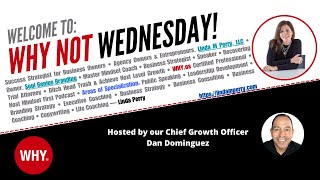
Linda Perry, a former federal criminal defense attorney turned mindset coach, explains how her YOS tool helps agency owners and teams uncover limiting beliefs. She uses the 'Better Way' why to diagnose blocks and design mindset-first coaching that works in business and family life.
Chapters
These last few years have made us question everything.
Our relationships.
Our jobs.
What constitutes an office.
And who we are.
In a.
World filled with chaos, confusion, and uncertainty. It's time for some clarity. It's time to start understanding one another.
It's time to start understanding ourselves.
We envision a world where everyone knows their why. But even more, we envision a world where everyone knows their why. O s their why, their how, and their what.
The operating system that drives you, that lets the world know where you stand.
What your unique gift is, and most importantly, who you are.
Yos.
Are you ready?
Hello, everyone, and welcome to why Not Wednesday. We are bringing you a very special guest today, all the way from Lisbon, Portugal. Our guest today is Linda Perry. How are you, Linda?
I am great. I'm so happy to be here.
I'm so happy that you are here. Let me tell you guys a little bit about Linda and why we're excited to have her on the show today to introduce her to Wine Nation and have all of you guys get to know a little bit more about her. Linda is a master mindset coach, a business strategist, a speaker, and also a recovering attorney who has helped hundreds of people around the world transform their mindset, implement key strategies, and bust through the blocks that held them back so they can build momentum and reach their own higher ground, whether that is 10xing their business or simply finding more freedom. And I got to tell you, all of that is true, because every time I spend even a few minutes with Linda, I come back energized and ready to bust through some more goals and plateaus. Linda, so great to have you on. You know, you recently moved to Lisbon, Portugal. So how is it going in your new city?
Man, it's great. We really love being here. We've been here for almost six months, so we feel like we're finally settling in. I'm learning little bits of the language and really just finding my new home.
That is so cool. And you're planning on staying there for a little while. You've got family coming to visit soon. Your kids are coming, and I know we're going to miss you in October because we have a big meeting in October that we would love to have you at, but you've got your kids visiting, so your priorities are certainly right.
Yeah, absolutely. I mean, it's a balance, right? Like, I get to balance a little bit of work life, work a little differently, work a little later. But it's all good. It's been. It's been a really fun change.
So one of the things that's speaking of change. Right. So, by the way, let's. Let's get to know Linda the way we like to get to know people through their yos. So Linda's why operating system starts with better ways. So her why is to find a better way and share it with others, which I think YOS is one of those things. Her how is to challenge the status quo, think differently. So that's how she finds better ways, by challenging, asking questions that others might not think about and looking at things from a different perspective. In her, what is trust? She's big on. Trust is important to her, doing what she says she's going to do, being dependable, and she expects the same from others. So that's who Linda is. Linda, now that we've, you know, introduced you using your yos, how does that resonate with you and how does it describe you?
Yeah, I think it's pretty accurate, I think, for sure. I am somebody who's always, always looking for a better way. I'm not the kind of person who's going to. Well, and I do create things from scratch, but I'm so much better at looking at something and saying, oh, this can be done better. And it really is. And I've never been somebody who likes to be in a box. So, yeah, I mean, how I do it is really think differently and challenge the status quo. And I mean, really, my whole life really has been about challenging the status quo. So it's been great.
And we're going to talk about that for sure. And it's so funny. You talk about taking things and making them better. Linda did that with our certification course. She went through it and said, you know, here's some things you can do. So all of you coaches who are going through certification now and you're having a better experience, you. You've got Linda to thank for that. She went through and gave us some tremendous feedback, and that's one of your new ventures, too. So maybe we'll get a chance to talk about that a little bit. Linda, but you talked about getting used to the change. Change is not a big thing for you. You've done that your whole life. You actually spent 17 years as a federal criminal defense attorney, which we have to let people know you loved in Chicago, but you decided to pursue coaching and business strategy after witnessing how much it changed your life and helped you find greater success. Take us through that decision process.
Yeah, you know, I did love being older. I loved learning new things. There was always, you know, a better way. I Mean, the truth was, is federal government had a 96% win rate, so I had to think outside the box at all times. But, you know, spending 17 years going, hanging out in prisons, it got a little depressing. And so I started to really see that I had become a kind of person that I didn't really like. And so I ended up studying the work of Debbie Ford and I became a coach. And then marketing and business came along with it because coaches, you know, traditionally have had a hard time generating business. And I think that's. And again, it's one of the reasons why I love this tool so much because it does change the game for everyone. But the truth is, is that it was, it was a change and I just kind of ripped the band aid off. After 17 years, I decided I'm done. And I'd done everything I could and I became really an entrepreneur.
And what's the, what's the, you know, you mentioned, you know, you, you go from winning 96% of the time and you go into business where nothing's guaranteed, right? Not that, not, not that.
Actually, I was losing 96% of the time. If you, if I went up in trial, it was negotiation that I had to do. I was the defense. So right over was winning. Yeah.
Excellent, excellent. Well, so now, but now you're in a different, in a completely different environment and you're working with service based business owners, agency owners and entrepreneurs and you help them using mindset business strategies so they can build greater success. So you use a mindset first approach. It's tell me what that means.
So what that means is so many of us think that it's our strategies that come first. Right? It is the implementation, the doing all of those courses that we take that we hope are going to help us grow, be visible and make sure that our messaging hits. But what mindset first asks is where am I going to get stuck? How do I show up? Who am I being? And it's really an opportunity to look at the ways that we are going to get stuck. Our habits, our patterns, those pieces of ourselves that we really have to get to know so that we can prepare for whatever life throws at us. I mean, the truth is business ownership or, you know, life itself is always throwing something at us and it's going to have challenges. And it's usually in the challenges when, where our head trash has the opportunity to show up. So mindset first says, okay, let me map this out. Let me think differently about how I'm going to approach every life challenge, business.
Challenge, I love that you, you even, even as, as your answer, you said let's, let's think differently. Right. Which is a tenet of challenging the status quo for you. Where did that start, Linda? Do you, do you remember, you know, maybe as a teenager when did you know that you were somebody that the way you were do things was by challenging the status quo? Do you remember an experience? Was it in high school, was it in middle school?
No, I mean, early. First of all, I had a mother who challenged the status quo at all times. She was a physician. Pretty early on, there weren't a lot of women in who were doctors and she didn't mind standing up to people. Said a really great example of somebody who shook the world up always. But I remember being six years old and my dad, you know, telling me how things were going to be and just the anger I had at the thought of like just having to live in sort of this box or being told what to do or any of those things. I just recognized early that I was not going to do things the traditional way. I never enjoyed looking at things traditionally. And you know, I also was a first generation kid. As an immigrant, immigrant with immigrant parents, you recognize automatically that you're different. So I think I really took that on and enjoyed it. And so I knew I was always looking for those. And I can literally remember being like 6 years old.
You said something really important there. I want to get into that a little bit. Because you embraced it, I think when Gary talks about it all the time. Gary Sanchez, our founder and CEO of Wine Institute, he says people with the why of challenge are either really successful, are really unsuccessful because you either embrace it and say, hey, I'm different and I'm gonna, I'm gonna embrace that and do that in everything that I do, or I'm different and I'm, I don't belong and I, I don't, I shouldn't be there. You embrace that. You remember that as a six year old, you mentioned being a, first of all a mother who was a physician back when there weren't a lot of women physicians. So she, she kind of set the, the standard for you. But also being the child of immigrant parents, what was that like? And where did you grow up?
So I, I grew up in Chicago. I mean mostly downtown Chicago and a little to rural parts of area of Chicago, but I grew up in downtown Chicago mostly. And I, you know, I'm half Serbian, half Croatian, which is an interesting mix, but like I grew up in some of those communities, but also my parents Were super cognizant about, you know, fitting in and figuring this thing out. But, yeah, I loved. I loved. I'm a city kid who has lived in the mountains. I now live in Portugal. So I. I really miss Chicago in a lot of ways, except just not the weather.
So, you know, we talked about that beforehand. I love everything about Chicago except winter. I. I could not. Could not live there. I lived in the Midwest. I lived in Bloomington, Illinois, for. For a few years. And that winter was so tough. So let's talk about your vision. Vision is to help people move beyond the plateaus of business and personal growth so they can reach their own personal higher ground. Where's this vision come from, Linda?
You know, I had this sort of visual about this, that there's this entrepreneurial or business owner ceiling, right, That a bunch of people are hanging out at. It's like I almost like they're sort of glued to the top and they can't really bust through. And the idea is we have things that keep us there. We get stuck. Now imagine you're, you know, climbing. I mean, that's really what it is. We're all trying to get to our goals, and we're climbing and we get stuck on the plateau, or we roll back down to the plateau, or we keep rolling back down. And the idea is, what I do is I help people get unstuck. It is those times where you say to yourself, I'm stuck. I don't have clarity, or I'm not really sure what to do next, or how do I grow this team? And all of those kinds of things get in the way. It can be our head, trash the stories we tell ourselves. And so what I do is really unpack that. Find obviously, the better way to reach the higher ground without it being so hard. One of the things I always say is, you're closer than you think. It may look like that peak is so far away, but the reality is once we start to identify the blocks, move through them, we can actually start to move and create right action as opposed to spinning our wheels, staying busy, feeling frustrated. And that's pretty much what I do.
You. You know, we started. We started the conversation. We started with. You talked about the importance of mindset. And I don't want this to be an advertisement the whole time, but you mentioned how important it is to know who you are and what a. What a great tool YOS has been for you. Tell us a little bit about how you've implemented it, because when we talked the first time, you kind of said, to me, hey, look, I kind of have everything I need. I've got a pretty rich tool belt, Dan, so how is this going to be different? But you decided to give it a try and now it's a vital part of everything you do. So tell us about that and how it helps you with working on Mindset because that's so important to your practice.
Yeah, here's the thing. The first time I heard, I had a conversation with another wise certified coach and she started to tell me a little bit about the whys. And I heard better way. And I went, oh, I bet I'm that. And you know, because I knew myself well enough. But one of the things that I think the tool has done is by understanding Better Way, I can see the ways even I get stuck. So when I remember I had a conversation with Gary and I was like, I'm not indecisive, but how's Better way indecisive? And the truth is, is I'm not. Except when there are two different better ways. Like it can be really hard to choose which one to go. Right. Or if there are multiple things to do, like you can get stuck and I can move more quickly through those pieces. And so it really tells me where I'm going to get blocked. It also tells me how I'm motivated and why I shouldn't be doing certain things in my business. And so the way I've implemented this is that I will go into a business. Perhaps there's a challenge with growth. Maybe the team isn't communicating effectively. Maybe somebody needs to develop some leadership skills or they really just want to get to the next level and really start to communicate and be more effective. And I like working with agencies, particularly because I'm familiar with marketing copywriting, the struggles that agency owners have. And what I've been doing is really working individually with their higher managing directors, also even bringing workshops to their junior level teams. But I've been using it to help people really understand who they are, how they communicate with each other. How do they really communicate their messaging too, around this with their clients? It's a little bit of a side benefit. And I think the greatest part of this is that it really is validating. I have found that for so many people who go through this, they finally go, oh yeah, that makes sense. Finally I get why I'm doing what I'm doing and how they're motivated and really what they offer. And so it unlocks to the doors to those pieces, but it also creates a pathway to move through the blocks which it speeds it up, quite frankly. Right. If I have somebody with a why of trust, I'm going to know where they're going to get stuck. They tend to be people pleasers, you know, they tend to have some perfectionism going on. So we know exactly what to work on. And so it really streamlines the coaching experience. And people really feel like, oh, great, I have a path for growth. And I think that's the hardest thing with mindset is, is there a path for growth? And that's really what I've used YOS for myself, for business owners, for agency owners. And it's been really fun.
And you mentioned the part about it kind of gives you a roadmap. Right. And you know how to talk to people using their yos. And as you mentioned, if they've got trust, you understand what challenges they may have. What's been the most surprising thing that you've noticed when using this tool?
I think the most surprising is, you know, at face value, like I have tools like the Enneagram or Colby, and I understand all of those things. And on the surface it looks simple, right? Oh, yeah. Why a better way. But what's been most surprising is how well it allows me to translate the rest of the tools that I have. And I think that's been really kind of the neat part and how I can always anchor people back into their why. So that it does start to change habits, it does start to change the patterns, it does start to create a sense of identity, which is really what I believe.
Is necessary for people to change or for people to grow. It's the thing that gets people off the plateau. And I think that's really been the most surprising piece and people love it. It's been really fun working with teams and helping them see that whole picture. And I think the other piece that's been super surprising is when you look at teams, there's patterns that are really fun to see. So.
I really enjoyed that piece too.
Yeah. You mentioned a client where you saw a pattern recently. I'd love you. Without sharing the information about the client specifically, you noticed a pattern in the group. There was about seven people, right?
Yeah. Yeah. There was a really neat pattern that. And they all. I think the through line was how important relationships were for this team. Everybody had either the, you know, a why or how or what of trust or contribute. And to me, those are really relationship based whys. They're really mission other based kind of whys. And it was really neat through thread to see how this was something they could actually convey. I think most of them had trust in there. And so it was something they could really convey to clients, something that really helped them understand their own strengths. And it's really kind of neat.
One of the things I talk about with a lot of our coaches is especially if you're really intentional about putting out your message. So with Linda, for you, it's, hey, if you work with me, you're going to find, you're going to work with a coach who's going to help you find a better way. You're going to work with the coach who's going to challenge you to think differently, and you're going to go work with a coach who can trust. So if you're consistent in that messaging, you start attracting people who are looking for that. And so you're, you know, somebody mentioned it on a podcast sometime back, your vibe attracts your tribe. And so as I look at my results and then probably as you start looking at the results of the people you're working with, you're going to see a lot of better ways, a lot of challenge and a lot of trust in there. And then their pattern when you start working with their events is going to be whatever their why, how and what is and they'll, they'll always have, it's great that you found trust and contribute. Now. I have a feeling this, this company had no problem with relationships, but if they didn't have a lot of better way or make sense or right way people to get stuff done, that's probably where some of their challenges were.
Yeah, I think what's, what shows up is challenges in systems, right when you have some of those kind of heavy.
Trust components or whatnot, and you know, there may be some make sense in there, but the truth is, is that if you're lacking some of those pieces, there's definitely some systems that need to actually shore those people up. So actually they can stay in their lane and really be in what's called their zone of genius and do the work that they are best designed to do. And I think that's the key around Y oss is once you understand that you can actually put in the, the systems, you don't have to guess at what's going to take you to the next level. And I think that's the kind of coolest part is even for me with my business, if with better way, challenge and trust, I'm like, well, I need somebody who's going to hold my feet to the fire. I need somebody who's going to implement those systems because I'm not. And so knowing all that creates actual solutions.
Love that. So what's you. You mentioned in, in the pre show, we talked a little bit about this. How has your business changed in just a few months just because you're starting to use why?
You know, it, it. I didn't, I wasn't even sure exactly how I was going to. And you know, I actually thought at first I'm like, oh, what a great sales tool. But what has happened is, is it's actually the top of every service that I offer. Now if, if it's a workshop, it's first thing we do. If it is coaching, it's the first thing I do. And so my business has changed in that it's really if you're going to work with me, it's the first place that we go. We start off using the why and we do a why session because from that we can really create a pathway for greater learning, greater change. And so it's really become that. That doorway for every service that I offer. And it's really neat because any team that I work with, I do insist on, on understanding the.
Full yos because as you mentioned, I have a venture with my daughter, for example, and knowing her why and mine allows us to figure out who are the people that we need to grow. Same with another team that I work with. And so it really allows us to communicate better. Communicate Y to Y as Gary likes to say, and really be a heck of a lot more effective.
And you mentioned you led to my next question. Thank you so much. That's really a good explanation. I know people will find value in that. But you lead me to my next question because you mentioned you did the yos for your daughter. So how has this impacted your personal life? You've done it for your husband, your son, your daughter. How are you guys using it at home?
Yeah, I mean, it's hilarious. There's no question that everybody has challenged. My son has a why I've challenged my daughter and I both have the how of challenge. It's, you know, we are definitely. It's like a whole rock the boat kind of conversation. And my, my husband who married into this family is more of a makes sense kind of guy and so.
Has allowed a little bit of patience for everyone. Right. There's a little bit of greater understanding on how to communicate. I know with my daughter, her why is actually make sense as well. But I have to slow down and have the solution be the primary focus as opposed to finding the better way. She will get lost with my better way, she'll get frustrated. My husband needs to ask a thousand questions because his how is to clarify. And so it has allowed me a little bit of patience, allowed me to communicate toward what they need versus what I need. And you know, and, and have like, my son is challenge everything. And he truly is a challenge absolutely everything in this world. And so it just allows me to really have some ability to show up how I want to show up, as opposed to being reactionary or emotional or being like, not this again. Right. Like we all are.
And I think recognizing those patterns is so important and talking to people in their language. And I love that you guys are doing that and recognize that in each other. And are you the coach for the family? Are you kind of always saying, hold.
On a second, no, nobody wants me as the coach for the family? Heck no. No one wants that. But, you know, like, it is my role to just take a deep breath as every mom. I think so, yeah.
Well, I want to talk about your secret weapon. We put, put this note in here and Sunil did a great job of highlighting it for me. Your secret weapon is you say mantras, affirmations and self care are nice, but they won't help you change. So you work with people to dig deep and uncover the beliefs that hold you back from being the rock star you deserve to be. What are some of those beliefs that you uncover and how do you work through? Because I'm sure you've had some challenging clients and helping them work through that. Give us an example of that.
Well, as I mentioned, I studied under Debbie Ford, and Debbie Ford was a shadow coach. And shadow work is based on Carl Jung's theory that most of our limiting beliefs were formed before the age of 10. And they're really hidden in the subconscious part of our brain. And so most of the beliefs are, you know, we all carry them. We all carry stories about who we are and whether we're not enough, not smart enough, not good enough, not verbal enough, whatever it is, there's the stories that hold us back. And so my job is to really find your core limiting beliefs, and they really can be about yourself, the world, or people around you. Things like, I'm not safe, people can't be trusted. Right. And so often as we talk about people with the why of trust have a really core limiting belief that others can't be trusted and they've been wounded somewhere. And so my job is really to shift, uncover, not put a pretty little mantra saying the world's to be trusted because that doesn't work. Your, your subconscious brain can't be tricked. But really create new beliefs around that action around that and really rewire your brain so that you can take action. This is about not sitting on the plateau, but really moving forward. And so we all carry beliefs. I mean, I had an I'm stupid belief for, you know, decades, and here I was doing all these great things and nobody would have ever known. But we overcompensate. We do all of these things that sabotage. And so my job is to really excavate those, help them shift it and create the momentum somebody is dying to, to create so they can actually have their goal, not be this someday thing. Someday I will have, you know, peace. Someday I will whatever. And, you know, I try to be an example of that. It's why I now live and work in Lisbon and live this really happy life, traveling quite a bit.
So, yeah, I absolutely love that. And so let's talk about that, Linda, because you've obviously, with being a better way person, you're always looking for a better way and you've obviously found some better ways and taken advantage and done those things. And you also challenged the status quo. So tell us about, let's talk about the name of the show is why Not Wednesday? And we like to ask the question, tell us about a time that you said why not? Not to an opportunity, a chance, a career change, something that made that you said, you know, why not? And you went for it. And it's turned out and you're so glad you did it.
I mean, I've had so many. I was like laughing with you. I'm like, how do I, how do I pick one? I mean, leaving a career in law after 17 years was definitely a big, big, big why not moment. And it's one for others. That's scary because people believe that, right? Like, I invested all this stuff and, and never did I leave anything behind. Never am I sad that I left the lobby hand. I loved it. I still love. And talking to my law friends about, you know, especially like, whatever's happening in the news, I, I'll talk about all of that stuff. And it was worth every moment because I could be me finally I could truly follow a passion that I fully believed in. And you know, the second biggest is selling my house, selling all my things. I own a storage locker in the United States with one coffee table and nothing else. And we picked up and we came here with an apartment for one month and we figured it out. So those are my two biggest wine out moments. And so Far they've both been great.
You left the safety and comfort of Denver in their very mild winters to move to Lisbon, Portugal, right?
Yeah. Yeah. It was even safer. Like mountains. I was in the mountains where it was pretty and you know. Yeah, it was gorgeous and so, yeah, so it's been great.
So, Linda, of the things that you're doing now, what's the thing that gets you up in the morning? You're a better way person. What's that better way thing that gets you up every morning?
Honestly, it is about creating change right now for where business owners with teams and agencies. I really have been having a blast walking them through the pathways that allow them to actually go, yeah, I'm going to get there. I want to 10x my business. I want to change my income. I want to grow to bigger clients and giving them the internal tools because change happens inside out. So it's not so much just pitching those clients, but I wake up going like I'm going to help them see the permanent change inside out and I. And really giving them that motivation for, oh, yeah, this is who I am. It's pretty cool.
And finding out who they are and then living into who they are, which I see you embrace who you are really well. We didn't talk about trust a lot, but trust is important to you. So talk a little bit about the. Where that fits into. Into your. Your yos.
Yeah. Ultimately, what I think trust for me is I really do create the trust trusting spaces and I really am. I do believe that confidentiality is important. I do believe that delivering what I promise is important. And I do follow up on my word. And particularly when I'm actually interacting with somebody with a why of trust. I actually am so cognizant of how important trust is that I actually go over the top in the sense of let me make sure that I've dotted this I and cross this T so they feel that they're in a safe environment. And for me, that's super important. And as a coach, I mean, it's the biggest thing I can offer is a safe, reliable, confidential environment so that people have the space to grow sometimes. I get this comment all the time. I can't believe I'm disclosing all this to you. I get that all the time. And that to me is that means I've done something to create a space that they feel they can be seen and heard and that's huge.
Linda, that's a great answer and thank you so much for being on today. I'm going to leave on that high note. So what do you say we end the show on that note?
Absolutely. Why not?
Thank you so much for being on today, Linda. We're putting your Instagram profile, we're going to put your LinkedIn profile. If you like what you heard from Linda, you want to work with someone like Linda, you can get a hold of her through LinkedIn. That's how we met. We met through a common. A common colleague. But you can find Linda on her website. And I am just so glad that you came into why Society. We're so glad to have you, Linda. I look forward to continuing to work with you. Have a great rest of your week and enjoy. Beautiful, Lisbon.
Thank you.
More from Dr.




Women In Leadership: A Need For A Greater Systemic Change With Belinda Clemmensen






