WHY Not Wednesday with Lisa Schermerhorn - Peak Performance Mindset Coaching
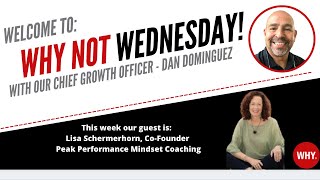
Transcript of a live "WHY Not Wednesday" YouTube interview (Dec 2021 upload) featuring Dan Dominguez and Lisa Schermerhorn. Lisa describes her background as a transformational leader and mindset coach, her experience helping athletes (notably golfers) with mental performance, how discovering her WHY changed her personal and business messaging, and a personal transformational anecdote about firewalking that helped her end a long marriage and step into courage. The conversation also covers marketing, client fit, and endorsements of the Y (Why) certification.
Chapters
Welcome to why Not Wednesday. Lisa Schermerhorn. How are you?
I'm awesome. How are you?
I am so excited to talk to you. I was just thinking about the fact that just about a year ago we were talking about whether or not Lisa Schermerhorn wanted to become a Y certified coach and we went back and forth. But then once you made up your mind, you were so into it that you brought your partner along and next thing I know, both of you were getting certified and there's a lot to tell. So we're gonna, we're live right now. This is kind of just the warm up because LinkedIn requires us to go on for a minute, a minute early, but everybody will start seeing us in about one minute and then we'll, we'll get into the real conversation. So thanks for being on.
Well, thank you. It's always such an honor and pleasure to talk to you. I always have fun talking to you anyway.
Yes, it was a great connection that. You know, it's interesting how.
When I first met Lisa and we met through LinkedIn, we started talking about the why and you have such a varied background. I should go over your background, Lisa. You've got over 20 years experience as a, as a transformational leader. You're a speaker, you're. This is really cool. You're an expert in human behavior, leadership and personal development. So you've worked with Bob Reese. He was the former head trainer for the New York Jets. And we've got to definitely talk about this. You once you helped a professional golfer win golfer of the Year. As you know, both Gary and I are golfers. So we're going to hear about that. You were VP for a business development for a company that use virtual reality to help clients with pain reduction, memory loss and stress reduction. So that's innovative and different. And then you're also a certified hypnotherapist and master practitioner of nlp. So you help entrepreneurs and high performance. And I love this, I put this in my post this morning to get from where they are to where they want to be much faster than conventional coaches. And of course, the highlight of all this is you're trained as a why coach, so you help people discover their why. Not only do you help them discover their why, but you also help people discover the why of their business and how to use it in their branding. So, I mean, there's a lot to unpack there. And you're, you're just so, so accomplished and we're so glad to have you part as part of the why society? So, Lisa, welcome to the show, and I can't wait to see what we talk about today.
Thank you so much. So, I know. I know you mentioned golf, so we can talk about golf if you want.
I'd love to start there because we haven't talked. You know, as much as I love golf and I play golf, we haven't had a guest talk about. So how did you help a golfer win Golfer of the Year?
Well, what I found was so fascinating was, and this is a funny story, I want to say, 15 years ago, I think, played golf for the first time. My ex husband and I were on a trip with someone, and they were at the men's tee, and they said, you know, we'll go over to the women's tee with you afterwards. Because I'd never really played golf other than going to the range and the first time. And I said, well, I'm kind of coordinating. And I tried from here. And the first shot I hit off the tee landed on the green, across water.
Oh, my gosh. Over the water, onto the green, over.
The water, onto the green. And they looked at me and they go, you're gonna make par. And I said, is that a good thing? And they just laughed at me. But one of the things that I discovered about golf was that golf is really a game of perfection. And it. And. And so with that, it. It mimics life. So when I see a golfer and the way that they behave on the golf course, I can tell a lot about what's going on in their life. If they've got anger issues, if they're feeling insecure, all of those things. So I really work with the mental game and. And is in all parts of life, whatever you focus on, that's what you get. So when a golfer focuses on, I don't want to. I don't want to hook it, or I don't want it to go into the, you know, anywhere you don't want it to go get. That's where it goes, because you're focusing on it. So I work with people, really, to learn to become present and let go of the old behaviors and the old belief systems. Because when you're pressured, when you feel a lot of pressure, all of a sudden, all your old belief systems start to come in, and it takes you away from your focus. And golf is all about being fully present. You have to be fully present and relaxed and get out of that stress. So there's a lot of different techniques that I teach about getting. Getting grounded, getting relaxed, and focusing on what you want and you. You think that's easy, but not necessarily. And this one professional golfer had. Had been trying to become golfer of the year for many years, and he'd always come in second or third. And he just had this little belief system that was just aggravating him about not feeling good enough, not being enough. And once we got rid of that, his confidence level soared. I had another golf pro that I worked with in his twenties. He had gone down to a tournament and he didn't play his best, and his putting was actually the best part of his game. And after he finished the tournament, someone walked up to him and said, gee, it's really too bad that you can't putt because you'd be a phenomenal golf pro. And for 20 years, he couldn't putt because he took it in as a belief system. We spent about 90 minutes together, released that belief system that he couldn't putt, and he went out and played the best game he played in years. So we hold on to these belief systems and they carry with us from our childhood throughout our lifetime. Money mindset is another one. People don't realize that even successful people, people who make a lot of money, have scarcity issues.
And they drive themselves into the ground because it's never enough.
Right.
And so it's really important to really have a sense of that. And so that's a lot of the foundation of where I've come from and delivering the why and the why. Coaching has really added so much to what I do and helping people get aligned with who they are.
So let's talk about that real quick, because you're one of my more interesting discoveries. I want to say your why is to challenge the status quo and think differently. Your how is to find a better way to do things and share it with others. And your what is to make sense of the complex. All great qualities to have as a coach. But I remember when we, we went through your yos the first time for you, it was almost like an emotional experience. You said, that's it. So tell me about how that has affected the way you coach and the way you approach.
The approach that you take with your clients.
It was a game changer for me. And this is the thing that I found interesting. And I don't know if any of the other why coaches have found this too, but oftentimes people have a lot of shame around their why. And what I mean about this is being a challenge Challenged people are about seeing, being visionaries, thinking outside the box, being different than everyone. Else. And when you're different, especially as a kid, you can get bullied and it's always like, why can't you be like so and so? Why do you always have to be different? But that was such a huge part of who I was. I never wouldn't even dawn on me to be like someone else. I just never wanted to. I would dress differently, I would change my hair up all the time. I was always just being different and unique. But it came with a lot of difficulties. And when I got that challenge as my why, it was validation that I'd never had in my entire life. It was like, okay, that's your superpower. It's, it's safe and it's okay. And that's what makes you different and what makes you special. Instead of feeling shame around being different and not fitting in. And my partner Kevin, ironically had the same one. So we both have the same why as challenge and we both have the same how is better way and we finish each other's sentences. It's really funny because we almost, we have very similar thoughts. I don't think we've had one argument since we've been in business together. It's been a fun ride. And not that you always want to work with people who have the same why. Right? It's just good to know what their why is. Because you really do want to have complementary why in, in your organization. But for us, it just happens to work really well.
I love, I love that you brought that up because I remember when you brought Kevin on, I had no idea what his yos was going to be. So we went through it with him and we figured out you guys are mirror images. Your why and your how are the same. And you're, you're make sense and he's contribute. So that's the one difference in the end. But you did something really cool. You said you guys had been working on your advertising and your website for about a year and you couldn't quite get it right. But then when you found out your yos, things kind of came together. Tell me about that.
We were struggling so much with our website. We're like, who are we marketing to? Who are we speaking to? And we, we realized that once we both were challenged, we were speaking to people who thought outside the box. We wanted to think, we wanted to work with entrepreneurs, people. So our language was geared to that because someone who tends to be more of a right way person, who may be.
An executive that's very traditional and likes things done a certain way, most likely doesn't want to work with me and that's okay because there are people for them. But I love that, you know, I'm working as in the entrepreneurial space for me, working that innovative startup company. Yes. It was really fascinating. You have to think outside the box. You don't have a choice. And the combination of better way of always looking for something that's unique and better, the combination is really perfect for me. It might drive someone else nuts.
I just saw a comment from Raymond Kemp. So he was on a couple of weeks ago and Raymond was his why is better way challenge contribute. So he's more, more like Kevin but he shares your top two. And you guys are friends, you know each other. Actually you referred Raymond to us and he's joined the group. But he just said Lisa is amazing. Have you found that when you, when you share, you mentioned you and Kevin get along so great. Do you filter according to wise when, when you're working with clients, do you say to someone, you know what, this might not be a great fit or are you open to working with someone who's right way, who maybe wants to get out of the box a little?
I'm always open to it. I've yet to have a right way person as a client.
So how does that come about? You have them take the why and then you once they know is that, is that how you make the decision or do you just talk to them and then figure out that that's not a fit?
I haven't had anyone come to me to take the Y test who was a right way person. It just has worked out that way.
Yeah.
It's really funny.
I love that you said that because I think it has to with your messaging. Right. You're attracting people that are looking for someone who's going to challenge the status quo, find a better way and make sense of the complex.
And that was everything for me because for marketing it's huge. Not only are you figuring out what your own personal why is, it also impacts your business why and how you navigate either within a company or your own business if you're an entrepreneur. And it also impacts your marketing because who are you speaking to and who do you know best? People like you.
Right.
Like with, with nlp, Neuro Linguistic programming. It's the, it's the study of excellence and it's the study of people who are experts in their field and learning to mimic that, learning from that. And so. So like attracts like. We just happen to to because we understand each other better.
Yes. Well, you mentioned something I think it was about a week ago you posted you, by the way, if you have not seen Lisa's profile on LinkedIn, some of the most amazing pictures. And these are all pictures that she's taken herself and then she pairs them with great quotes that are either from her or from other people. But the one you posted a couple of weeks ago, I said we've got to talk about this. You talked about being in the arena and putting it all out there and taking that chance. Well, tell us about that quote. I can't remember it exactly. You probably remember it better. What does it mean? It's such a challenge quote. I love it.
I don't have the quote in front of me. I should have had it in front of me. But what it really means for me is facing your fears. Because I was paralyzed for many years about really facing my fears. I always thought, I never thought I was very smart. I had learning disabilities growing up that were undiagnosed and I just gave my power away to so many people because I thought that they all knew more than I did. And I was afraid to speak up. And as I got older and started to become more confident and realizing that it was the fear of the fear that was far greater than actually accomplishing my goal because once I did it, it was like that was no big deal. But some of these fears can paralyze us and. And it's about having the courage to really stand up. Because when you're in alignment with who you are. Because we're always. Yes. It's not the critic who counts. I love that that it becomes that whole. When you're in alignment and when you are you, it should be easy and effortless.
Right.
It's work to be someone other than yourself. And the fear of being yourself and being judged is, is, is. It haunted me for a long time. And then once I was able to have the confidence and really stepped into my fear and. And one of the greatest things that I did was. Was nearing the end of my marriage. That was my biggest why not we had talked about but right. I was.
I was terrified to be alone. After 29 year marriage. I married very young, raised two children, had an incredible life and we had just gone in two different directions. But the idea of suddenly being alone and being on my own at my age and figuring life out was terrifying. And I was also terrified of Walking Fire. So I decided to try walking fire first.
I love that you're getting to my next question. Before I get to it, tell us about walking fire. I mean that is. A lot of people talk about it, but you did it and you walked on glass and you broke arrows on your. On your throat.
Right, right here. And 10 foot piece of rebar from here.
So what that. So that was part of your, your biggest why not moment. Right?
Yeah. And it's. It's the challenge in me that had to do something different to get my life on track. I knew I needed to do something big to take me out and put myself out of my comfort zone. And woman that I had been training with on some other things said, I'm doing a firewalk facilitation course. Would you like to learn how to teach firewalking? And I thought, why not? I don't know if I'll ever teach firewalking, but I think this will be good for me. And every night we walked 7 to 10ft of red hot coals. During the day, we would practice using arrows. The arrow would be at the base, the soft part of your. Your neck and your throat right here. And we would. Someone would hold a board. And it's all about energy and putting all of your energy and believing there cannot be any doubt at all. And so every night we were doing these different walking. And then it came time and I walked glass. And I actually love walking glass.
Do you still do it?
I have glass in my basement in a bin. And I've done it. It retreats at my home. It's the most grounded you will ever be in your life because you have to feel everything. You have to go really slow. You can move the glass around a bit so that you don't get any sharp edges, but you have to be fully present. And I loved. It was very empowering for me. But with the firewalk, that terrified me. And they told us in the beginning, in order to graduate, we had to walk 40ft.
Yes.
And I felt really sorry for the people who were in my class because I went into victim mode. I went into whiny crying. I'm going to die. I'm going to have my feet amputated. How is this possible? And right before it was time for me to go, one of the people in my class said to me, lisa, how much fire have you walked this week? And I said, well, we've walked at least 7 to 10ft a night, so at least 50ft. And he looked at me and he said, you have already walked over 40ft. Go. And I just went. And it was the easiest walk of the entire week. I don't. I didn't burn my feet. I had Nothing. And I couldn't believe it because I got to the other side and I still had my feet intact.
And I went home, and the next day I had a conversation with my ex husband about ending our marriage.
Yeah.
And it was. It was one of the most painful, but also inspired, inspiring moments of my life because I got the courage to step forward and allow him to move forward as well.
So you were, you, you had to challenge yourself to do that so you could get the courage to do. And I'm sure that's so helpful for you as a coach. You know, I just saw a comment by Lynn Everard. It's not the critic who counts, because you, you, you talked about that, that golfer who heard somebody say if you were a good putter. You know, I, I remember. I'll tell you a quick story. Gary and I were playing, and we were on the 17th hole, and there's a bunker in front of the hole. And I said to Gary right before I hit the shot, well, I just got to hit it anywhere but the bunker, and I'll be great. Guess where I hit it?
Right in the bunker.
You're the coach.
Always happens.
Focus on. So I was focusing on that, and you're so right. And Gary looked at me and he's like, dad, come on. Gary's an excellent golfer. He. He challenged us the other day. Who is the best athlete, you know, besides myself? Because I don't know if, you know, he's a world class racquetball player and he's had some amazing. And he's a great golfer, too, so I thought I'd share that. What would, what would you say to Dan to improve? Because Gary and I are our handicaps. He's almost a scratch golfer. I'm about a 10. So how do I catch up to him?
Well, we want to talk about your mindset and what you're focusing on first.
Yeah, he would tell you, I need to focus. Just plain focus.
Yeah, no, we, we would have to go into. Go into really where your thoughts are. Where. Where, you know, why. Why? It's, it's going into the why, because that's where the emotions lie. What are the things that are causing you to, to focus on not what you want? It's. It's a fascinating process, also about getting fully grounded and released. And I teach something called the emotional release method, and it's also known as the Sedona method, where you go through and you can literally slow everything down and become really focused by just saying, should I let it go? Yes. Could I Let it go. Yes. When? Now. And you literally start to feel yourself getting into that relaxed mode. And one of my favorite sayings is, what you think of me is none of my business.
I love that. I remember when you posted that, I found the quote that I wanted to ask you about. You said, I want to be in the arena. I want to be brave with my life. And when we make the choice to dare greatly, we sign up to get our asses kicked. We can choose courage or we can choose comfort, but you can't have both. Not at the same time.
Not at the same time. And that was the whole thing with my firewalk, was I had to get out of my comfort zone and go into the place of discomfort. And I always say pain is one of the greatest gifts you can experience in all lives. Emotional pain, physical pain, mental pain, whatever that is. Because once you have that experience, you're like, I want to move out of this, because if everything were sunshine and daisies, we would never have an opportunity to grow. So the best part of this is when I'm working with clients, because people will say, isn't that so hard? Isn't that so hard to see people in pain? I'm like, no, because that means they're about to get out of it.
Yes.
That means they're about to have an amazing transformation because they don't want to stay like this anymore.
Yeah, we used to say that when I was in the army going through Ranger school. Pain is weakness leaving your body. That was something we talked about, because you've got to go through that in order to come out on the other side. So you're an expert on that. And there's Steph McPhee. She says that is one of my favorites. It was so freeing when I heard that quote. It's none of my business. Someone else with contribute challenge. So you got a little challenge reunion happening here. People with the how or why or what of challenge are joining the conversation. I saw Bella's quote about her mom, and she uses that quote all the time. What people think of me is none of my business. And I think that frees you to go ahead and be yourself, right?
Yes. Yes. But if you're insecure or you don't like yourself or you don't feel comfortable with who you are, that's painful. It's terrifying. It's amazing how many of us. And I always like it to, you know, that I don't offend anyone, but I always have that. That image from when I was younger with the ads for the Used car salesman with the perfect smile and the perfect hair. But it always felt very two dimensional. And the problem with that is when you have no depth because you're pretending and you're putting so much energy into being something that you're not. And there was an exercise that I had to go through when I was doing some training where they handed a couple of us a grapefruit and we had to hide this grapefruit in a room of 20 people. And so these people walked back in, had no idea, and we had these grave. A couple of us had these grapefruits. And every time someone walked behind us, I had to constantly be aware and shift my thoughts. And. And my instructor said to us, how much of your energy and thoughts went into paying attention to the conversation you had with someone versus hiding your grapefruit? And I was like, oh, my God, 90% went to hiding their grape. My grapefruit. And they said, that's what it's like when you're not yourself.
Yes.
And I thought that was so profound. It was a. It was a huge lesson for me.
I had a conversation this week. I want to run this by Elisa, because you're such a good mindset coach. We were talking about, you mentioned used car salesman. So I have been in sales my entire life, other than the time I spent in the military.
And.
And I've always said, you know what, the key to being successful in sales is believing in what you're selling. And I've always made, for me, as a professional, as someone whose vocation is to sell, I've always said, as long as I believe in what it is that I'm selling, it's not a problem for me to really share it with someone and see if it's right for them. And so as long as you have that, then sincerity is not hard. You know, we. It's not hard to be sincere when you truly believe. You know, I spent almost 25 years in the healthcare setting working with drugs and medical devices that help save people's lives. So it was easy to believe in that. And that's the way I feel about the work we do at Y Institute. It saves people's lives. It changes people's lives in a positive way. And when I see a coach go from I think I get it to where it really comes alive, and they say, I know exactly how I'm going to use this with my clients, it is life changing. Would you agree?
Absolutely. It's also a door opener if you're a coach. It was interesting because I Was talking about this earlier. I do a lot of speaking, and I love to get on podcasts. And I was just speaking to someone two days ago about getting on their podcast, and they were like, well, mindset thing. It might not be up my alley, but the why. Because now that's something I'd love to talk to you about. It really helps you get in the door because people get it. Discovering your why is really important because then, you know, you're in alignment with who you are. And I've also worked with people in transition, people who are looking for jobs. And there was a woman who had three job opportunities, and one was for a big corporate job in New York City. It was what she thought was her dream job, but she realized that it was her ego that wanted that job, not her heart and her soul and her passion for it. So when we went through her why, she realized that moving to New York City would have been a huge mistake for her and that she decided to take something for a little less money but had much more opportunity for growth. And she was so grateful for that because, you know, moving, especially moving to New York, is not an inexpensive thing and can really put your life on hold for a while if you realize that you've made a mistake.
Yes. No. And I think you. You. You shared that story with me before, but what. What a big difference you made for her because you probably saved her five years of heartache. Who knows how long it takes? How many people get into a career or a job that they do because it pays the bills, because it's got the title, it's got the prestige. And then you look back and you say, wait, what have I been doing all of this time? Right. I'm sure you see that all the time.
I see it all the time. Especially when people go, well, I reached a certain level, I make a certain amount of money, and now I'm stuck because I can't change my career because I have a mortgage, I have kids going to college, I have all these expenses, and I can't afford to leave. And what happens is there's this part of them that starts to die inside. I mean, it really. It really is crippling. And people start to get physical issues because you're. You know, your thoughts create manifest things in your body. Your body speaks your mind, and it's very important you know it. And it takes a lot of risk. It takes a lot to take the. To have the courage to leave an industry. But when you're in alignment, everything literally just starts to show up. It just does.
I love that because here's the question I want to ask you. Lisa, you're about a year into being a wise certified coach. We're going into our end of year push. A lot of coaches are using this slow time to get those additional certifications. What would you say to someone that's talking to Dan and is saying, I'm not sure if I want to do that? What would you say to someone who is considering adding the YOS certification to their toolkit but has a couple of questions?
Run, don't walk.
I have to say.
Was a game changer for me because here was something else.
I had a hard time explaining to people what I did because it was different. And so trying to explain as a mindset coach why someone would want to work with me.
Was hard. But when I got my why, my how, and my what, it made explaining it easier, simplified everything for me. It made my relationships with my clients better. I have a client whose why was simplify. And he was struggling with the fact that he worked with engineers and very complex information, and he could reply with four bullet points. But what happened for him was he didn't know how to charge. Once I explained to him that this was his superpower, that he had this ability to bring it down to layman's terms so it could go to market, he realized his value and doubled what he was charging and made more money. So by having the why you make your clients into superheroes, you know, you better them as well as. And when you make them better, you're better.
That is great.
Yeah. I have just loved it. It's helped me.
Get into areas and work with people who wouldn't, not necessarily have initially worked with me, and it helped them better understand.
What it is I do and how to impact their life.
Well, you're a mindset coach. You're an NLP practitioner. You walked on glass. One of the things we talk about a lot during training and so you went through the training is the difference between talking to that limbic brain versus talking to that neocortex. When you're talking why, we're talking to the limbic brain, where people make decisions. Right. So have you seen that really come alive for you where I think when you're talking from your why, you're really connecting at that limbic level.
The why is the purchaser. The why part of your brain is the emotional part that makes the decision. It's the person that goes into a store, no intention of buying anything, and they say this beautiful sweater that's way out of their price range and walk home with it and they go, I don't even know why I just bought this or the car. When you walk in and you've already researched the model and then someone suddenly the salesperson puts you into the next model up and you're like, oh, this feels really good. It's that why? Because might bring you to a memory. It may bring evoke emotion. So. So when people are talking about their how well, there's a million other coaches that know how to do what I do. Right. But why I do it is different. And what differentiates me when you're marketing yourself and you all, you talk about the details of how you do it, there's no interest. But when you talk about the emotion and get people excited, excited, that's where the sales come and this is truly life changing. I know. It made such a difference for me and I have brought in quite a few other coaches into the Y and I always say it's not competition because we all have something to offer. There's abundance for everyone and everyone can benefit from this. It just makes everyone's work better.
We're all going to do it differently. Right? You're gonna somebody. Yeah. And. And I know because I get a chance to talk to those people that you send our way. Raymond Kemp's one of them. We know Michelle McGlade just joined us. I'm talking to Trisha Sticka soon. So you sent a lot of people our way. James Madison, I believe, right?
No, I don't think James was. But Monique de Mayo.
Monique de Mayo. She's actually just getting started on training because I was checking in on her. You were checking in on her and she says, I got to get started on this. So thank you so much, Lisa, for being such a great friend of Y Institute, for being such a great supporter and for really getting the message out. You've done. You and Kevin have done such a great job. It's incorporated into everything you do and we love seeing that success. So thank you very much. We're at the end of our time, so I'm going to wish you happy holidays. I hope I talk to you before the end of the year, but have a great rest of your day and. And next week. Who do we have on next week? I know I mentioned. I want to mention it before we hang up. We've got Erica Groschler, so she is going to be on with us next week. Tune in. She is an amazing coach from north of the border that we're going to get a chance to talk to so very close to you in Europe and northern U.S. but she's up in Canada and we're going to get a chance to talk to her. Thank you. Have a great day, Lisa, and we'll see you guys next week.
Thank you.
More from Dr.




Women In Leadership: A Need For A Greater Systemic Change With Belinda Clemmensen






