WHY NOT Wednesday! with Marva Bailer
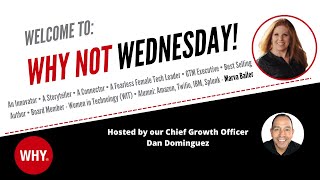
Marva Bailer, a tech leader and coach, talks about her whyOs: contribute, simplify, challenge. She shares lessons from Amazon, Twilio, IBM, and Splunk, practical advice for virtual meetings, and why asking hard questions and curiosity matter in servant leadership.
Chapters
A certain kind of coach who believes.
What we believe.
Who leads people to.
Greatness, who gets people unstuck, who unlocks all of your passion.
A coach who helps people discover what drives them to tap into their superpowers. Then knowing your why is the first step to untap potential.
To focus.
To breakthroughs.
A coach who's looking for a better way.
Are you that coach?
Hello, everybody and welcome to why Not Wednesday. I am so excited to kick off with Women's History Month with a killer guest, Marva Baylor. Baylor is our guest today and she is an innovator, a storyteller. She's a connector. She's a fearless female tech leader. We're definitely going to talk about that. Who is never afraid to disrupt the status quo. So you guys can guess a little bit about her yos based on what I'm saying. She's a purpose driven executive with over 20 years of leading billion dollar teams for global businesses. She's a cert. She embodies servant leadership and a growth mindset through mentorship, experimentation and the intersection of purpose and passion. Can you guys tell why she's a great guest for why Not Wednesday and for why Institute? She's a former breast cancer survivor. She's a mom, she's a successful tech executive. And you know what I love about this introduction is she uses her personal career experiences to inspire and educate others. So I know she's going to inspire and educate us today. So let's welcome Marva Baylor. Welcome to the show. Marva.
Welcome, Dan. And welcome everybody.
We are so glad to have you on. We've got a few people that are already saying hello. Dave Tegmeyer from sunny Indianapolis, Bruce, Captain Kirk is here from Philadelphia. And Pam Ferguson is on. She's from Louisville, Kentucky, a place where I spent eight years of my life. So Pamela, welcome everybody who's listening and those of you that are going to be listening to the recording. We're in for some fun today. Hey, Liz Wendling is in from.
Denver. Liz is in Denver, Colorado. Liz, thanks so much for joining us today. You know Liz, Liz sent me a message earlier today. She said, hey, Dan, I'm gonna be on but I'm only going to be on for half an hour. I'm like, hey, that's all that we're on. Anyway, Rob Swimer's on on here. So we're going to recognize everybody here. Rob. Yes, for sure. Rob, I can't wait to reconnect. I know you and you had some travel. You just got back from Vegas and so it's going to be fun to reconnect with you and talk about what, what's next with you and your team. So, Marva, you know, let's start with the first thing we always do and that is to just go over your why Os because, you know, the why not Wednesday is all about why not. A time when you said why not or as you said, a time when you said yes to something. Right. So your yos and I like this yos combination is contribute, simplify and challenge. So in everything you do, you want to make a difference, make a positive impact. And then how you do that is by making things simple and easy to understand. And then ultimately what you deliver are solutions that are outside the box and different. How does that feel to you?
It feels really natural. What really struck me is when we had a discussion though, about the simplify part, because that's where I get the most friction, because I ask a lot of questions, but I want to get the net net and just really figure out what is it people are trying to accomplish. And sometimes that's perceived that I don't care about all the work or the history. I'm really just trying to again, make things super simple. So that one, I think you had shared with me, that that's a real unusual one. There's not many people that have that attribute.
Yeah, so. So when we look at the nine, why simplify is number nine in terms of what's most common to the least common. And I think Liz Wendling, who's on here is also has simplify in her yos. And what we know about you is like you said, hey, just give me the bottom line. Let's, let's figure out what is the, what is the least thing that we need to do, what is the most important thing that we need to do and let's do that. And so the other thing, the other talent and gift that I see in people with your, why is your able to take stuff that's probably complicated for a lot of people and you make it easily digestible. Right. Easy to understand, make it simple so that everybody gets it. So you make great communicators. And as I've connected with people that are in your network, you know, one of the things they talk about, one first things they say is you're a super connector. I posted about that this morning. You're just a master connector. You connect people with others. But the other thing is how simple you make it. You know, just keep it simple and not don't make it crazy. Right. Dave, Tegmeyer is a simplifier too. He calls it laser language. Just get to the bottom line. Something I'm not doing real, real good right now because I'm talking so much. But I'm so excited about having you on. So tell me about this. You know, you've written a book and it's an amazing book called Be Unexpected. And so people have said a lot of things about Be Unexpected. What is someone going to get if they, if they, if they read Be Unexpected?
Well, I know we have a lot of coaches on this call, so you're very familiar with the work of Ken Blanchard, but especially Dale Carnegie. You know, everyone's very familiar with Dale Carnegie and that was in the 1920s. And when I explained it's like Dale Carnegie in, you know, this, this generation is very interesting because most people do not know who any of those people are. So it's bringing new information in a new light. But it's, it's basically the golden rule. How to smile, how to show, know the, the basics of a human value and connection. But sometimes people don't understand all these other teachings. So it's, it's really just putting it into context so people can understand it in a, a fun and consumable way. Yeah.
And again, consumable. Right. Simple.
Simple. And I, it's interesting because I'm doing some nonprofit work with First School. And one, One of my superpowers is really decoding jargon. So I'm in the tech space and you know, I don't have a technical degree. And that actually is a value in meetings because everyone tries to be the smartest person in the room, especially when you're dealing with. I've dealt with the federal government scientists, so they have their own codes and I know you're in the ex military as well, acronyms, all these things. And so people talking all this jargon and if you can just simplify or ask the question, what do those three initials mean? Because those three initials might mean something to you and it different context than they might mean to Liz in another context. So really simplifying and asking the questions that no one else is asking.
Yeah. And I love that you're, you're, you, you talk about how that you know. Because one of the questions I always ask is how's your why played a part in your life? Your why of. Of contribute, your how simplifying, your what of challenge. But you just really answered it right now. The other thing that I've heard people say that on. About your, about you is that you Bring out of the box stuff you're not afraid to challenge the status quo. And that's your what? By the way, Liz just bought your book. So let's give Liz a thumbs up for doing that. Liz is an amazing author herself, so that's a big compliment. So tell me what, how do you bring those out of the box solutions? What you know, because a lot of, you know, being unexpected is about doing things differently.
Yeah. So everyone sees I have red hair. This is my only natural thing I got going on. So I don't dye my hair. I've always been a redhead. So when you're a redhead, there's no place to hide. I also have a pretty memorable name, Marva. So that's a pretty. Marva, like marvelous. So it's a, a pretty memorable name. And the, it's, it's interesting because I just got part of, it's called World Changers and it's by Scarlett Abbott and they're a great, great consulting company out of the uk And I worked with Lindsey and her, her team and Kate and her team there. And what's so interesting is they have this whole movement around being a rebel. But if you look up the word rebel, rebel means change. And it also means curious. And if you look at any job description or any company values of all the different innovative companies, no matter what space you're in, they're always going to say they want you to be curious and they want you to ask questions.
But they tell you that's what they want. But then when you're in the real world, and I work for some very formal companies, but I also work for some companies that you would think would be fun, but actually they really don't want you to, to ask those questions. Or maybe they want you to ask those questions after the meeting or when certain people aren't around. So it really takes courage where you really need to ask the question. But I think what makes the big difference, Dan, though, is you're asking the question. Not for you. You don't have to be the smartest person in the room. And it's not about your ego. You're asking the question for two things. One, on behalf of your customer. So the best companies that innovate, they really listen to the customer. So you can have this great product or service, but people aren't really knowing what the customer is actually using it or how they're using it. So when you can advocate for your customer, that's great. And then the second thing is advocating for those that aren't going to ask those questions because they are afraid of the political backlash or whatever. So I would say those two areas is how it shows up.
I love that. And you're absolutely right. You know, when you're the person that asks the questions that nobody else will ask, guess what? You're not representing just you. You're representing all those people that have that question that either aren't in the room or if they are in the room, they don't have the courage, as you said, to ask that question. And you've worked, I mean, when I look at the, you're an alumni of Amazon, Twilio, IBM, Splunk. So you've done so much with so many of those big companies and now you're bringing that to your expertise, to the companies you work with today. One of the things I know people like you do is you take those lessons from one place that you learned and you bring them to, to your next ones. What's the, what's the most important lesson you've learned with all those companies that you use to this day?
Oh, that's a, for all those companies, I would say innovation. So it really has been innovation and just learning. It's interesting because, you know, I'm looking for my next opportunity right now. And one thing that my husband keeps reminding me, he's like, when you first worked at Splunk, you didn't know anything about data and when I first worked at IBM, I didn't know anything about security. And so it's, it's like you think you don't know about an area and now everyone's talking about AI and whatever and I'm on the board for a startup around AI, so you think you don't know about a topic. But actually back to being curious and asking great questions, you can do whatever you think you can do and you can be a great asset to any organization by asking the right questions and really just being curious.
I love that. And you know what, what is, what I know now about Marva is as you, as you're looking for that, that next opportunity, one of the things I know makes such a big difference is being, being, being able to define who you are. Right? So I tell people all the time, if you happen to know your yos, when you go into that next opportunity, you're talking to that hiring individual, whether it's, it's a, it's a consultancy or if you're working as a, as a full time role and let them know what you're going to bring Marva, let them Know, hey, what you're going to get from me is an undying commitment to your success, because I love to contribute to the success of others. You're going to get no one that cares more about your success than I will, because that's what I do. That's what drives me. And how I'm going to do that is by simplifying things. If you've got messy stuff, if you want stuff simplified, give it to me. I'll make it simple and easy to understand. And you've taken advantage of that in those tech roles, right? Because a lot of people. You're absolutely right. You get into those tech type conversations. I came from the world of medical sales, so you get around doctors all the time and you want to talk medical jargon, but sometimes it's the people that can just break it down to an understandable form to have the most success. And you got to ask the questions, hey, how do we say this to the layperson, right? So that they can get value out of it. And then what else they can expect from Marva is out of the box. They're gonna. She's gonna be different. She's gonna challenge the status quo. You want some creativity? Bring Marva onto the team. How does that. How does that sound in terms of a. Hey, this is who I am. 30 seconds.
Yeah, you could be my agent, Dan. Sounds wonderful.
You know, I'll go. I'll go around and introduce you. You know, we always talk about the power of having an introduction, so having someone else introduce you is always much more powerful. So let me ask you about. About Rebel World Game Changer. What. What is a Rebel World Game Changer sounds like something. Somebody with that. What a challenge would be a part of.
Yeah. So that's what I was sharing. That's with the Scarlet Abbott. So Lindsay is a behavior psychiatry psychologist, PhD. And they survey companies all around the world and, and, and people. And you can look at their study again. It's called Scarlet Abbott. And I am a world. I got nominated to be one of the 10 that they have for the year. And so it's bringing new voices and ideas to the world. And that, to me is so powerful. And I love how you're so communicative in a Sincere way on LinkedIn. And I love LinkedIn, by the way. I joined LinkedIn in 2006. There was 30,000 members at that time. Now there's over 8 million. And I joined. It was actually one of my MBOs. When I worked at IBM, I ran media and telecom, and it was an MBO. We had to join LinkedIn and Twitter. We actually had to learn about it. But I love LinkedIn because, you know, and now LinkedIn's bought multiple companies. Obviously they're owned by Microsoft. But what's really great and I don't think people appreciate it Enough is so LinkedIn originally was a job platform and also people do give, agree to give their data and it's also one of the only global platforms where people are agreeing to give their personal data and opt in. But now with the content and the creation, it's a great way to learn. I mean the videos, the, you know, the LinkedIn lives like we're doing now, but really this communication and connection around with people around the world of like minded or people that maybe aren't like you. So you can really understand people's perspectives. That's why I, I really just love it. And, and that's how I got connected with Lindsay. Someone introduced, you know, like two people said, oh, Marv would be the greatest person to meet Lindsay. And then I met her and then obviously we've had calls and videos and it's been great to, to get involved with that group.
You know, it's amazing what you talk about there and you know, we've had to learn, right? So when Y Institute, when I, when I started helping Gary get the word out about Y Institute, it was October, December 2019. So the world was our oyster and we were going to teach everybody about yos and, and how to discover your why and use it with your messaging, use it with your companies. And we had this plan. We're going to take over, you know, we're in Albuquerque, New Mexico, so we're going to take over the Southwest and then we're going to go nationwide and then we're going to go to the world. Well, In March of 2020, our plans got derailed, right? All of a sudden it was like, wait, what's your growth plan? And everybody we were working with, all those great businesses that wanted to discover the why of themselves and of their, of their clients said hey, we don't know what we're going to do next. And we're on Zoom, right? So we had to get familiar with Zoom. We had to get really active on LinkedIn and we had to reach out to the world. But it's the best thing that happened to us because now we have coaches all over the world instead of just starting in the Southwest and then the US and then the world. So we're actually adding someone in South Africa here soon and Someone in Ireland, our first coach in Ireland. So that never would have happened had the pandemic not happened. And. And I see that in you, Marva. It's like you take something that might not be a great thing that happens, and you're like, hey, I'm going to take that and turn it into a positive. So let me. Tell me about the US India Summit. What is that about?
Oh, that. That's a fun one. So the. The whole. I had this whole thing say yes, and a lot of women are actually told say no all the time because you're asked to do so many different things. So I actually switch that around. So I always say, say yes. And if you cannot do. So I have two. Two, I guess, learnings. If you can't do something, you pass it on to someone else. You don't say no, you say no, Dan. I'm not able to do that, but I know Rob Swimer would be a great person to do this podcast or to do this meeting. And so you always pass it on. And also that goes for. If you get invited to a dinner, if you get invited to these great speaking events. And you need to really reach down into your network of your high potentials is really who you need to think about. And so don't get so wrapped up in your internal titles and what they do. Look at the people that are personalities. So. So I took my own advice and I needed a speaker. Her name is Dr. Sweta. She's a PhD. She runs health informatics for Kennesaw State University. And she was hosting all these people from India to a health innovation summit with Georgia Tech and which is the university in Atlanta, and with Kennesaw State University at the Medical College of Georgia. And she's hosting people from all around the world and needed a healthcare expert from the company I worked with at the time named Splunk, and is a really great big data company, public company, and everyone was actually at a industry event. And then they asked the president. She couldn't do it. Nobody could do it. I was like, you know what? I'm going to do this talk. So I didn't. Again, I'm speaking back to the thing about doctors. I mean, from all around the world. So it wasn't really even tech people. It was more doctors, chief medical officers, a lot of the big consulting companies and so on. My panel was cdc, the head of Blockchain, the head of the Georgia Bias Biospheric something or other, and the head of Tata Communications, global healthcare practice. I think he managed maybe 50,000 people, some. Something like that. So big, big people. And then me. And at the time, I was a sales leader for, you know, Splunk. And it was fine. Yeah. But what I did was, so I worked hard, worked hard trying to make my presentation and I finally just gave up and said, you know what? I'm not going toe to toe with chief medical officers, whatever. I showed a video of Gatwick Airport and UAE airport, around how we had instrumented the golden bathroom and the whole experience of people traveling throughout the airport. And then I said, imagine this. This is the health hospital of the future. What would that look like to you? And people thought it was the greatest thing because they had all traveled through that airport, through UAE airport and Air Em to get to Atlanta. And it. So the idea was instead of going toe to toe, strike up a conversation because I will tell you, every single corporate video everyone was playing them, they all look the same. And I just did something different that was relatable and it just struck conversation. So. And that is definitely growth mindset. So the whole idea of being comfortable, being uncomfortable, that was a moment for.
That, you know, and you just, you just shared something that's really important for those of us with the why of contribute. And I posted about this recently, those of us with the why of contribute have a really hard time saying no. So I love that you embraced your contribute inner contributor. You said, you know what, I'm just going to say yes. And if I can't say yes, I'm going to connect people to the right person that can do what they're asking me to do, that I don't have the bandwidth or the talent or the skills or the will to do. Right. And so I love that you've done that. But one of the things that, that we struggle with is saying no. Sometimes we say yes because we feel guilty. Right. You don't do that. Right.
You say yes because someone has given you the opportunity to own that action and now you own it so you can make the decision. And that's why I think people kind of misses feel guilty rather than, oh, I have a gift and I can't accept the gift. Because you would never throw out a gift. Why would you do that? So if I have a gift, who should I give that gift to? Or. Or guess what? Maybe that person has, has. Can pass on that gift. So you need to look, you just need to look at it totally differently.
Yeah. And I think the other party is, you know, I think it's Andrea Butcher, someone I met recently says, look if it's not a hell yes, it's a no.
Right?
If you can't say hell yes, I want to do that. I can't wait to start working on that. And I'm, I'm going to allocate the time to get it done and I'm going to make sure that it's done really well. Then say no. Right. The other heart. And I'd love to get your thoughts on this. The other thing I've learned recently is no is a complete sentence. You don't need to make an excuse. You can say just right. Not gonna, not gonna do that.
Right. And then, and also, I mean back, I guess, you know, to counter, counterpoint my own point.
Right.
A lot of times you're asked to do things that aren't gonna make a difference and they are a time waster. And that is when you do need to be very decisive and you need to not apologize. You just need to say no and say it. A little smile. Not a big smile, just a little smile.
Right? Because there's nothing worse than saying yes. And then as you walk out of the room kicking yourself, right? Because you're like, why did I say yes to that? It's not something I want to do. Hey, great, great quote here from you. Making the art. Marva Baylor makes the art of storytelling as approachable, as engaging as she is A cre. Delivering creative collection Real World tested specific strategies for. For the virtual meeting world. So what tips do you have? We, I mean, we're all doing. I'm so glad that we're finally doing in person meetings. I'm trying to get as many of those as possible. So. Jerry Fletcher, Rob Swimer, TJ Davidson. TJ I've actually had a chance to meet in person already. Watson, Jordan, I met in person. But those of you that are on that I haven't met in person, I'm going to make it a goal to meet as many of our clients this year in person as possible before they come to Albuquerque for our conference. But we what tips do you have in our virtual meeting world for people to really connect?
So not being so polite and formal. So the time that you're being given on a virtual meeting is not really the time. So if you have a meeting scheduled for an hour, people's attention span is about 10 minutes. So you really, really have to think about how you're going to structure the meeting. So if you spend 10 or 15 minutes doing introductions, you, you've just wasted time and you wasted energy. So if you are going to do introductions. You need to put in the research like you just did, Dan. I mean, you've done so much research. I know you do for me and for your other guests, because I watched four or five other episodes and you're putting in the research and you're asking great questions and you're also prompting and saying, I saw that I saw. You said that I saw you have interest in this topic that is making a connection. But in the real world, I will tell you that it doesn't work like that. People have great intentions, they have great scripts and marketing people, but they put things in front of the, the script or the time. So it could be written where it's this. I mean, I talked to marketing people from tons of industries, big companies, and they're like, why isn't my message landing? It's because their sales teams are putting in front of them. Hi, Dan, I'd like to introduce yourself. Martha Baylor, your account manager. Hope you'll take this message. It's like, no, the person didn't tell you to put the. Where. Not in the faq anywhere. It wasn't in the training. So people add their own little spice to it. That's not spice. It just is just, you know, pours out the flame and, and the same thing happens in person. If we get on this call and you're ready to go, you research, you're ready, ready. You're like, whoa.
And introduce ourselves and everyone goes around and they're not even paying attention. And then you didn't learn anything and there's no energy. So that's one of many, many ideas that I have. But the whole idea is you got to keep this. Every second matters and you got to keep this energy flowing.
I know Jerry Fletcher. He's a master marketing, multi, multi talented marketer, and he was our guest last week. I know he's like eating that up because he says, hey, you've got about 10 seconds to get someone's attention when they visit your website, when they're watching your video. And then after that, maybe three seconds. It's either three or 10 seconds. You don't have a lot of time. So especially in a virtual meeting, you've got to capture that attention and keep it. And I know Liz Wendling, who's watching, is probably saying, absolutely, you've got to personalize that message to every person. You know, we're, we're, we're, we're blessed and, and, and, you know, we want to grow and a company. But one of the things that I love about is being Being in the early stages of our growth is I get to know every single coach that joins the Y Institute. I get to meet them, I get to spend time with them. And I know at some point it's going to get so big that I won't get to meet everyone. But as a contributor, I love that part of it. Getting to know people and then knowing something about all of them is a lot of fun. Hey, tell me about the walk up songs. We, we're running out of time. I want to make sure I learn about because I noticed in your Amazon reviews you had walk up songs next to every person that put a review. So tell me about that.
So I have many prompts that you can do to do introductions and one of them I came up with was, what's your walk up song? And everyone I say this to, I literally just watched something yesterday. It was Keith Parker. He's the CEO of Goodwill Industries and he was talking about, I didn't even ask him. He was talking about music and what he likes. And if you even just watch him in this video, his, he's engaged, he's smiling, his shoulders are back. He's. He's like vibing. And anytime you ask anyone and, and it crosses generations across his industries, we're going to tell you something personable and memorable and you can connect with it also. And I know probably 80% of the people on this call are coaches. I already have had it really go bad twice. But if, if you were in the room, you would have been like, this is great. I, I have someone that I can help because it also can, can spot out the, the vulnerability and psychological safety that a lot of leaders say they have. I'm vulnerable, I'm empathetic, right? Then you ask them to do it and then they won't do it. And then even if you give them like, oh, it's fine, Dan, you know, we'll get back to you at the end. You know, that's fine. If you don't know, you know, you don't put it pressure people. You say whatever. You can go third or fourth and then you come back to the leader and they say, no, I'm not going to share. You're like.
So I know all your coaches probably are like, wow. You probably have all kinds of ideas about that. But it is very telling about the trust and it really shows. But people, it just, it just gets that energy and spark and it's kind of relaxing and it's fun and it's something personal.
You know what I'm Going to add this to the question. I'm going to start having a walk up song for our guests. What's your walk up song, Marva?
Mine is Anything by Heart. Barracuda is and then also right now by Van Halen. And then actually in my book I have it's called the B sides because my book's called Be Unexpected. So it's like a little record. I have all the songs mentioned in the book, so I have everyone's walk up songs but I also mention a lot of music because as you know, music is, definitely connects with a point in time, in a moment in our life and so it can motivate you, can make you sad, it can make you happy, but it can ground you. And so I have, you know, different references to my life moments and songs that, that I remember. So hopefully you all hear and I'd love to hear in, in your, in the chat your walk up songs or something that connects to your, your life, that brings you energy and joy.
So those of you that are still, that are still on, I definitely want you guys to put, put your, put in the chat, put your, put your walk up songs. And, and you know, I think that's so much fun because we watch you know, when we go to baseball game all the, all the players, that's, that's where I first saw walk up songs. Every player has a walk up song that goes with them and that's so much fun. And then when I was, when I was leading sales teams at my corporate job, I got a chance to have my walk up song when I'd get introduced and that was so much fun. And you're right, it does give you a certain energy when, when you get up on stage. It's that introduction, it's that energy. We know something about that leader or that person that's coming on stage just based on their, on their walk up song. I love that. I love, I'm glad I asked that question. So let's do. Oh, Frank Forte says Happy. I think I love. I, I know, I love that song. It's a great song. Thanks for joining Frank. I think he and I are going to talk later today. So it's so good that he joined but I love that, that concept and I'm so glad I asked that question. So let me ask you about the. This is going to be, I think it's going to be. What are we at? Yeah, we've got about 58. We got about two more minutes. Let's talk about servant leadership. Tell me what that means. Let me, let me ask you about that. What does it mean to you?
So servant leadership is when you have a true purpose and you lead from your heart, but you also are leading to really bring large social impact combined with, with work and profit. And so I am a big proponent of servant leadership. I actually had the opportunity to work with the Greenleaf center, which is where it was created when I worked at IBM and really got to learn how to not just give your time at a local car wash or soup kitchen. I know that feels really good. But to really find a way to use your corporate resources and really make it part of, of your team and your community where you're bringing things at scale. So I really, I won't work for a company that doesn't care about really, truly committing to the people and the communities that we serve and live in. That's really, really important. And servant leadership is where it's at. And you have to be a servant leader. Otherwise, you know, I know we've talked about having a God in marriage and that's what it's all about. I mean that, that's what we're all working for.
You know, it's great because you and I got introduced and we talked about being on the show and one of the questions I asked, I said, so, Marbo, why do you want to be on the show? And you were so nice. You said, dan, I love that on your show you have your wedding picture in the back behind you, right? So there's my wedding pictures, there's some military awards and stuff, you know, and that's just, that's just my background. I think if you, if you talk to me, you see my selling from the hard card. That's one of our, our partners that we work with. You kind of get a little story. You can, you can know a little bit about Dan, just like the walk up songs give you a little bit. What can we know about you by looking at your background?
Marva, you can know that I'm going to make you smile.
Yeah, I love that. What do you say we end on that note, Barbara?
Why not? Dan?
I love it. Thank you so much for being on Marva. Thank you for kicking off Women's History Month with a just amazing, energetic interview. And guys, next week we've got Tina Corner Staltz, who is the founder of Alex Counsel. So she's our why Not Wednesday guest next week. You know, just keeping up that tradition of the amazing women in our lives and introducing them to Y Nation. Thank you for being on Marva and We will talk to you soon. Have a great rest of your week.
You as well. Cheers, everyone.
More from Dr.




Women In Leadership: A Need For A Greater Systemic Change With Belinda Clemmensen






