WHY NOT Wednesday! with Matthew Brackett
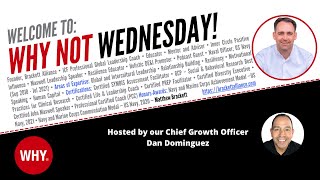
This content was created by Dr. Gary Sanchez. This content was uploaded by Dr. Gary Sanchez. This is a YouTube video titled "WHY NOT Wednesday! with Matthew Brackett" created on June 22, 2023. It features a conversation between Dan Dominguez and Matthew Brackett, a global leadership coach, discussing topics such as leadership, personal growth, and diversity, equity, and inclusion (DEI). The discussion covers Matthew's diverse background, including his experience in the military and ministry, and his approach to coaching and leadership.
Chapters
These last few years have made us question everything.
Our relationships.
Our jobs.
What constitutes an office.
And who we are.
In a.
World filled with chaos, confusion and uncertainty. It's time for some clarity.
Clarity.
It's time to start understanding one another.
It's time to start understanding ourselves.
We envision a world where everyone knows their why. But even more, we envision a world where everyone knows their why. O s, their why, their how and their what.
The operating system that drives you, that lets the world know where you stand.
What your unique gift is, and most importantly, who you are.
Yos.
Are you ready?
Hey.
Good afternoon, everyone, and welcome to why Not Wednesday. Today our guest is Matthew Brackett, a global leadership coach. He is passionate about positive leadership and influence. Matthew's dream is to use his gifts, experience and knowledge to touch and transform lives through leadership. He has over 30 years experience in leadership positions and leadership development in six different countries, across different languages and multiple cultures. He's also served as a special special staff officer and chaplain in the United States Navy alongside both sailors and Marines. He's a professional certified coach through the ICF and a certified speaker of the John Maxwell Leadership Team. He completed specialized graduate degrees in spiritual theology and human development from universities in Rome, Italy, specialized studies in counseling, family and education at Los Angis University in Chile, and a master's degree in Psychology of leadership, which he just completed at Pennsylvania State University. So let's welcome to the show our guest today, Matthew Brackett. How are you, Matthew?
Very well, Dan. Very well. Thank you for having me here on this, this very famous show.
Well, I don't know about famous, but maybe having you on is going to make us famous. It's so cool to have you on. You know, one of the cool things about the work that I do as the chief Growth Officer at my institute is get to meet amazing people like you with. You have such a diverse background, Matthew. I mean, as I was reading through that, you've got like three careers worth of experience in your back pocket, whereas one person might, might have that, that, that, that work that you've done in, in spiritual, in the spirit, on the spiritual side. That could be a whole career. And then the work you've done on leadership is just another career. And you're also a veteran. So this is a really cool opportunity for, for us to get a chance to talk. And I couldn't wait to share you with, with Y nation. And I see the comments already coming in. So let's see Jerry Fletcher, who, you know, I think I was telling you about Jerry. He's he's who I we did that program with on Monday with him and his, his network. So he's greeting us from Portland, Oregon and then all over the world, all the way across the world, way far. In Dublin, Ireland, Des Ryan says hello Dublin.
I lived in Dublin for five years. Hello Desert.
Des is here and of course, Watson, Jordan. He's always, he's always Johnny on the spot. So thank you, Watson, for being on. So, so.
Let'S talk a little bit about you. What a, what a change you have. You're now the CEO and founder of Bracket Alliance. But as I said, you know, you've, you've had a long and winding path and first thing I like to do, Matthew, is talk about your Yoshi. And I think this is, this really helps explain at least to those of us who are familiar with the why discovery where, where you come from. So your why is to challenge the status quo, think differently and do things outside the box. Your how is to make sense of the complex and challenging. So you like to solve problems, help people get unstuck. And I see that a lot in some of the work you've done. And your what is to contribute to make a difference. And you know, when we asked you about that earlier so you resonate with all three of those wor.
Tell me what what that felt like to you when you, when you realized when we we went through your results.
It I think I saw it as confirming in many ways I've had because of a lot of my story and a lot of personal work I've done. So I've done assessments all over the place and a journey of knowledge of myself and growth. And so this, this helped me. I supposed to put it to simplify it in a certain way.
Right.
And and to really in a foundational way I was to simplify it but in a foundational way and to, to frame it in a way that made sense. So it was affirming. It was, it wasn't. It was things that I knew about myself, but maybe not in that way, not framed that way. So it was very, it was clarifying and affirming.
Exactly. So, so, you know, challenge is a fun why, Matthew. Because you know that, that we love, we love when people have the why of challenge. And, and, and, and we can talk.
About you growing up. When did, when did you become the person that, that likes to do thing? When's the first time you can remember saying, you know what, why do we have to do it that way?
I I don't know. That's A good. I was. I need to think about that because I was a young. When I was a kid, I was. I think I was a quiet kid and not very assertive.
So I remember the first thing that comes to mind is when we. I. I was. I'm pretty competitive and so when there was a thing to sell tickets for on a play that the school was putting on, I was in the play and, you know, whoever won the most, whoever sold the most tickets would win, you know, a prize and blah, blah, blah. And I went all in and I went out there and I got other people to sell tickets for me and I, I suppose I did it differently, but I did. I won the prize.
Right. Everybody was doing it one to one.
You.
You would enlisted the help of people and you multiplied your.
That's right. So that wasn't, I guess, the normal way of doing it. So that's what. That's the one thing that comes to mind. But I suppose I did some things differently growing up. Just as my. My own journey. Right. I went to, you know, I went to a high school, boarding school for a year to try out something new, you know, which. It's not a big tradition in the States to do that.
Right.
I did a volunteer year after high school. Right. And then I. Then I went to seminary as you know, from my own personal story.
Right.
So it was kind of going against the status quo in many ways. And. But I really. What. One of the words from the. From the why that resonates is also contribute. Because I think that was very much part of my.
That's your what? Yeah, it's what people can count on.
From the way I was brought up is always contribute. And that's why that led me to so many. That's why it led me to seminary. I think it led me to be the way I am in many ways. And it was. I think I'm very helpful. I think I'm a good person almost. But in today's society where, you know, it's hard to. It's hard to trust people. People like second guess why I'm doing things. I was. I'm just. I just try to be a good guy. There's no, there's no hidden intention.
There's no hidden agenda. Have you know, I. My why is contribute. So you and I have the same top three I'm contribute challenge makes sense. So we're very similar in the way we go about things. Have you ever been in a situation where you're trying to help someone and you're almost overwhelmed Them, they're like, they don't trust you because they're like, no, this can't be true. You can't be that generous.
Right? Yes. Yeah. They don't know what to do with it. And I, I find that sad. I wish our world was a better place for people where they wouldn't find that strange.
I love, I love the way you challenge that. And, and you know that that's very common. I wanted to recognize Leslie, who's. Why is challenge. And she, she said, hey, I think she's just giving you a hashtag challenge. And then who else was on here? I love it. You know, this is a LinkedIn user. LinkedIn user. You're going to have to put it, put your name so we know who you are, but says, I love it. Challenge the status quo. So you've done that. I think, you know, like, like you said you started in boarding school, which not a lot of kids do.
It.
Was that something that you chose to do or did you misbehave and get sent to boarding school?
I didn't know. Something I chose. Yeah. It wasn't like a correctional school. Yes, there's something that I, I chose to do and it was a great experience. Made a lot of friends that I still have today. Till today.
So is this high school?
Yes, my 11th grade in high school.
Wow. So 11th and 12th grade of high school was at boarding school. Then you went off to college?
No, no, then I did a volunteer year.
Wow.
To clarify kind of what I wanted to do because I didn't know what I wanted to do.
Right.
And, and then maybe that's. I don't know, maybe that's part of the people that challenges we have a. Might be challenging for us to find where we fit in. And then I went to seminary. So, yes, my. All my college studies were. Were part of seminar. You know, we study philosophy, classical humanities, philosophy, theology, all that. So as you know, I studied to become a Catholic priest in a religious order. When we say religious order, we're saying, you know, Franciscans, Dominicans, Jesuits. Those are all the names that people would recognize. So an organization like that, a global.
Organization, in which order were you?
I was with the. An order called the Legionaries of Christ.
Okay, fantastic. Hey, Matt. Magda had. Did the. Had an experience similar to you boarding school? Friends or sisters.
There we go.
I don't know if you guys were at the same boarding school, but I, you know, I think the experience is probably the same. That's really cool. Thanks for sharing, Magda. So. So, Matthew, what About makes sense. So make sense tells us you like to solve problems. You're somebody who can take in a lot of information. Solve. Solve the. Take that information, process it and, and come up with solutions fairly quickly. And that's a talent and a curse sometimes. Right. Talent in that it's great that you can solve problems in a curse because people sometimes can't keep up with you. Have you experienced that?
I've experienced that. Yeah. I like. I'm a good listener. And then I think I'm able to focus really into what the essence is of a situation.
Right.
And you know, I listen to everybody and then I sort of try to draw everything into what's the essence of, you know, what's the root here? And I think that's probably why what people find useful in working with me over the years is, is that to that ability to, I guess, to simplify the problem or a situation into what's the root here. And if we go there rather than staying on the branches, then things will. Things will get better.
You know, one of the things, Matthew, that, that I like to. I want to make sure I commend you for is you. You're. You're. You're a veteran and you have a couple of awards that, that are mentioned and I want to recognize you. Number one, thank you for your service as a fellow veteran. I appreciate that you did what you did for as long as you did. But tell us about your service. How, how was what. What, what stands out. What. In what in that background do you use today in your coaching.
When I was saying coaching and also in speaking. Because it's.
Yeah.
People love to hear stories about the military.
Right.
And also life about. In ministry. You know, in, in the military. I was a chaplain, and so it's a very unique space that, that I sat in and was invited into people's lives. So there's so many. I mean, I, as a chaplain, you deal with. I dealt with extreme situations every day and.
Right.
Because it's a large mass of humanity that I, that I took care of, you know, about 5,000 marines and sailors and, and because of the situations, the, the circumstances and then just also the age group, it's just, and the amount of people. It's just natural that there's going to be a lot of extreme situations going on every day.
That's. I mean, there's so much more we could talk about here. But the one image that comes a lot, you know, working with the Marines and sailors, I would really. It's about taking care of our Humanity. Right. When we serve our humanity, well, then we serve our loved ones, we serve our country better. And so that's, that's one element that, that always comes to mind and an image that I use with them with when we. And it's natural, it applies to everyone. But I take it from that, that that experience of work is as human beings, when we go through pain, when we have difficulties and challenges or things happen to us in our past or present, we want to put them away.
Because they're uncomfortable or there's pain involved, there's discomfort, whatever it is. And so there's some things that when we put them in darkness, yeah, there's the smaller things that they kind of disappear or they're, they're quiet, but there's a lot of other things that they grow in darkness. And that's, you know, like what I do, bringing things out into the light in conversations, in my case with the chaplain, it's a way that we start to give less, let things have less power over us and they stop growing. And what, I mean, what. They grow, they grow and then they begin to invade other areas of our life. They begin to stench. There's a stench. They begin to stink. They begin to really just sort of take over.
Right.
And so that image has helped a lot of people.
I like that a lot. And, and you know, you're so right. That is such a challenging time for a lot of people. You take a bunch of 18 to 30 year olds and you throw them in an environment that they've never been in before, put them through some of the most difficult training they could ever go through and then you. Life is still going on back home. I'm sure you dealt with a lot of those issues and, and then having to, to guide them out of that darkness and putting, bringing stuff into the light. I really like that example. How do you use that in your coaching today?
Well, I did not. The process of coaching. First, let me clarify. In coaching, as you know, I understand coaching as the ability to, of attentive listening, creative and powerful questioning with the conviction that the person has the answers inside of them. So it's facilitating a process and that's what makes it so powerful. So as human beings, we.
We need to talk to someone else right now. Coaching, therapy or other settings, those are sort of confidential places where we can talk about stuff and we need that, we need that confidentiality. We need the safety right to deal with certain things that we're going through so we can really lean into it.
So what coaching does was first of all, it forces us to slow down and pay attention. Pay attention to what's going on around us and to pay attention to what's going on within us. So that's one of the. That's the first thing. And then the second thing is by transforming thoughts or emotions or experiences, by transforming them into. Into words, we take more ownership of them. They become more real.
And that's why when. When I hear. You know, when people hear themselves say something, they almost sometimes are surprised, wow, what I just said. Or they begin, or they get emotional or they laugh, or. Because that's what. When all of a sudden it's. It's made into words and I hear myself say, becomes more real. And only then can we really deal with it.
Exactly.
So when. But we need someone there to mirror it back to us as human beings. We discover ourselves through the eyes of the other. That's one way that we get to know ourselves. But it's a. It's a very important way that we get to know ourselves. And it's through communication, whether it be writing, but also through speaking. And oftentimes we can have a jumble of confusion right in our mind. But when we begin to talk about it and make sense of it, sort of like a jumble of threads that are all confused and.
Right.
All up together, all tangled up. Then by speaking about it, we begin to make sense of those things. But we need someone else that's there to be able to listen, to show interest, to ask questions and to mirror things back to us. And that's.
Help us make sense of it.
That's right. That's one of the. There you go. That's one of the powerful things about the coaching relationship.
Love that. Love that. So why did you step into the DEI space? And. And more importantly, why holistic dei? Tell us about that.
Right, thank you. The. Well, I suppose because I like to challenge things, right. And so I. When I went through a lot of the DNI training, I have, people sort of looked at me like, what are you doing here? Right. Because I didn't fit the mold. I am a white, heterosexual male. Right. Cisgender. And so I just. That's not the general mold that goes into DNI space. So I suppose because I like the challenge, but more. More importantly, because of my international intercultural experience, Right. Because my love of the beautiful complexity of the human person.
And all of their expressions, I think through my education, but also through ministry, I fell in love with the dignity and beauty of the person and the challenges that we go through. And, and so that's, that's why, and for, for me, dni, a holistic approach. Dni, which means not an ideological approach and not a political approach. That's what it speaks about. It speaks about the beauty of the human person and all the expressions and how can we, in, in the end, every, all of us, we all want to be seen, we all want to be valued, we all want to be recognized, we all want to be acknowledged. And part of that is, that's what part of what De and I is about. It's about more than that. But, but that's part of it is that we all want to be seen for who we are.
How hard is that question though, when somebody says, hey, what, what are you doing here? You're, you're, you're a white male cisgender heterosexual. Why are you here?
What, what about my background? Yeah, I think that they, they begin to grasp a little bit.
But those, that question or the sort of like turning the heads, it makes you think about, we all experience bias and that's how bias shows up also in that space.
Yeah.
So, but it was then when I, when I said that I was in Ministries for 20 years as a Catholic priest, that also kind of turned some people off because they immediately assume that I have certain prejudices or judgments.
Right.
Which is not true, but that's sort of the conclusions that they draw.
So you help people see themselves through your eyes or help them see themselves just listening. I, you know, I really like that one of the things you say you're passionate about is leadership. And so leadership, not just leadership, but holistic leadership. And then when we talk about holistic leadership and global leadership, what, what is that? What does that mean?
Yes, so leadership. I'm passionate about leadership because it's part of it has been and always will be part of the human experience. Right.
Secondly, because healthy, wholesome and healthy and wholesome leadership and functional leadership is so life giving to people, whether it happens. And in one's, you know, in leadership of our own selves, when it happens in the family, when it happens in other circles and professional circles, good leadership is so life giving. Poor leadership, unhealthy leadership, toxic, dysfunctional leadership is so destructive. And because I think because I'm so passionate about the human person, I'm therefore passionate about the, about leadership. And I've seen it all. I mean, I, not at all, we, none of us have seen it all, but I've seen a lot of wonderful leadership and the results that, that does. And, and leadership, I've Seen a lot of this. I was part of a very dysfunctional and toxic organization for a long time, you know, and so I saw the destruction that that, that does in people. So there's, there's that aspect. But leadership holistic. Because my approach in, in my coaching and my professional services or within my speaking, it's about first of all, meeting people where they're at and meeting them at the intersection, meeting people in leadership roles at that intersection between the personal and professional. You know, I, I would say I'm more than an executive coach because yes, we're going to deal with your professional life, but we're also going to deal with your personal life. So if, if you want to work with me, you have to be someone who's willing to also challenge the status quo in your personal life and, and someone who wants to grow, wants to lead yourself better so that you positively influence yourself, you positively influence those around you and you positively influence your priorities.
Right.
And then that you, then you can lead better, you know, in your inner circles and lead better in the professional space. So that's why, that's why I call it holistic, for lack of a better word, global. Because it's a big deal nowadays is international, intercultural, cross boundary leading leadership.
Right.
Whether it be hybrid or whether that be just leading across cultures if you're not. And I think because of, I've been very fortunate having worked with people from so many different countries and led people from so many different countries and cultures of all kinds. Been very educational for me. And so the global element, a lot of people, they're stepping out of, they're stepping sort of into the deep end when they go into that setting as a leader and they might assume they're going to be good at it, but there's so many nuances. And so being able to coach people and also be sort of advise and be a consultant for people in those roles on how to lead better and cross boundary, cross cultural environments. I think it's very important.
We've lived in Italy, Colombia, Ireland, England, Chile and Mexico. So what languages do you speak?
English, Spanish and Italian.
English, Spanish and Italian. So a couple of romance languages thrown in there. How hard is it to distinguishing between English and Italian? Sometimes you listen to Italian, almost sounds like you're listening to Spanish.
It is, they're very, yeah, they're similar. But if I was a native Spanish speaker, I noticed that native Spanish speakers mix them more often more easily because they are very similar. I didn't have that much of that problem. But my Italian Is a bit. It's a bit rusty now because when you don't practice something, you start to lose it.
So. Great. No, this is, this is so fun. So tell me, why would corporate or any other sector want to hire somebody with your background? What is it that your background brings to the table when. If they're hiring you as a speaker or as a leadership coach for their team?
Right. And believe me, Dan, that. That has worked so much against me because people like, if you don't have corporate background, you're not gonna. I. But I have been part of some of the largest and more most complex global organizations. You know, because people think about ministry and like, oh, you're, you know, you're. You're praying all day and reading the Bible. Right. What are you going to know about organizations and leadership? No, because that's. I've been in those roles for the last 30 years.
Right.
First of all, of understanding the human person in. And the complexity of the human person in so many expressions and, and the interpersonal relationships. Right, right, That's. And then there's the. Was it. And then just the complexities of organizations. Right, right. I was part of, you know, I like to say that I was part of the largest, long, longest ending. Largest global organization that's ever existed in the history of the world.
Right.
The Catholic Church. Right. Yeah. And there's a lot of dysfunction there, but it's. And then being in the military, so I've been part of very bureaucratical, highly structured organizations. And so I know how to navigate them very well and then how to work with people and how to navigate that and, you know, the interpersonal relationships and all the dynamics. So that's. And I think my knowledge of the person, my knowledge of complex organizations and people don't usually, they don't equate that to someone who was in ministry, at least my type of. The type of ministry that I did. And so I would, you know, we gotta. I just want to clear that up because that's, you know, and I do have work with a lot of people in big corporations and, and it's amazing the, the impact because. Yeah, don't ask me about business. That's not my. That's not my. But how to deal with the human element.
Right.
That's my sweet spot.
Well, in businesses, humans. Right. Just like I. People ask me a lot about, you know, sales is all about connecting with people and understanding people and being able to help people. And so that. So that experience, I'm sure, is very helpful for you. So tell me about your biggest why not moment as we're getting towards the end of the show here, a time when you said why not? And you're so glad you did. Got a couple of things here in the pre show notes, but I want to let you answer the question.
The, I mean the very sort of fun one is the bungee jumping. It was something that was always on my list. It's something I want to do. I got to the top, you know, where I had to jump and I tried to jump three times and I couldn't. But I was like, I don't want to live with the regret that I did. I was already, you know, I made it and I didn't do it, so why not? So I did it. Now, deeper things in my life was, for example, joining the Navy. Why not? And why not join the Navy? And it was, it was an itch on that I had on me. And so, and it's, I sat with that for a number of years, you know, because that's something that I wanted to do a diverse type of ministry. I wanted to serve people in that, in that environment. And so that was another one. And then, you know, going back even more is, you know, why not join the seminary? There was a lot of duty and obligation behind that decision to do it, but we won't get into that. But it was definitely. It was a leap and yeah. And why not do it? And so I just, it was a decision I made. And within three weeks I was, was, I was there, I was in the seminary. I was wearing the uniform. Right. So it was, I just, I dove. And. But then the biggest, I suppose probably the most challenging one is when I had to step away.
Huge decision. Again, that's, that's a whole story. But still leaving, you know, leaving formal ministry, leaving ministry as a Catholic priest and all the institutional and cultural things that are around that. Right. And. And then just personal things. Right. On many levels, on the theological, on the philosophical, on the, on the emotional, on the social, on the spiritual and so many levels. And now that I. That didn't happen just a few days, that was a few years.
Sure.
Got to the moment where why not, why not leave and embark on a, on a new journey of. To continue to serving people, but in a new way.
And, and you've, you've stepped into, you know, kind of like what you did, you said when you went into the seminary, you just dove in head first and you became a coach. And I mean you've got so many certifications. Icf. John Maxwell, you've learned so much. So somebody that comes to Matthew is going to get somebody who's done their homework and has learned a lot of different things.
What, what drives you to seek all those certifications and, and learn so much. Has that always been a drive for you?
You know, growing up, I was never much of an academic, actually did very poorly in school. Right. And even in seminary in the mind, you know, in the bachelor's when you're doing the philosophy and theology. But when I more specialize my degrees got the better I got. And you know, part of it is, I think it's the curiosity. I think I want to always learn more so that I can serve better.
Yeah.
But part of it I think was also a sort of insecurity. I. All of these titles or certifications might give me the security in the end. They don't.
Right.
But also credibility is also an important thing. I want to have credibility in the marketplace. I think I bring a pretty complete package to, to those who would be a right fit for, for work either in. On the speaking or education to your organizations or on the individual. On the individual side.
So who would benefit the most from working with Matthew?
Well, first it has to be someone who's willing to work on themselves.
That they. They're kind of like, no, I want to be honest, I want to grow. I want to challenge the status quo. My own personal life first. I want to step into vulnerability. And I mean that in the most positive way so that I can. So that I can lead better, love better and live better. So someone who wants to do that and, and I say love as well, because someone for, you know that that is important to them.
So it's for someone who's sort of has. That wants to do deeper work on themselves and that wants someone that's just not gonna kind of go with the flow and, and just kind of just say, hey, yeah, everything's good, all's good.
So when we look at your yos, and this is something I've just, I've just been doing recently, Matthew, tell me how it resonates with you. You're looking for someone who is looking for someone who will challenge them to do things differently. You're looking for someone who is looking for someone who can help them make sense of what they're going through. And you're looking for someone who is looking for someone who is going to help them make a, make an impact in the world and make a difference and contribute. Does that resonate?
It does, yes. So thank you for phrasing it like that. It does, it does. And again, I'm not, I'm not. I will never step into that role to tell you how to live your life.
Right.
No, I will facilitate a process where you will discover that. But I also, you know, I'll offer this. There's educational aspects that I'll offer. I just because of my background and education, all that and experience, I think I bring a lot to the table to add light, to shed light on a lot of areas.
Yeah. You know what's interesting about that is, you know, when you look at that, you also, if someone comes to you and they say, hey, Matthew, I want to work with you, but man, I want to. I don't want to do anything differently. I want to keep doing what I'm doing and I don't really have any problems. I don't need any help solving any problems and I don't really care about making a difference. How much fun is that client going to be for you?
Right. Well, I will say, well, then why do you want to work with anyone? If you're happy with the way your life is, why would you want to work with anyone?
And then if they still say no, I really want to, I said, well, well, we can try, but we might not be a good fit.
Might not be a great fit, right? No. So this is so, so good. Well, guess what, we're at the end of our time together, believe it or not. We've gone through half an hour. This has been really fun. Matthew, I really appreciate you being on the show and sharing your wisdom and. And like I said, I was excited about when we scheduled you and it's been a while since we scheduled you. Glad we got around to getting you on the air and getting you in front of Y Nation. And where can people reach you if they want to work with Matthew Brackett?
They can find me@bracket alliance.com also on Instagram @Matthew Bracket, official Facebook, same and LinkedIn. Here on LinkedIn, Matthew Brackett.
Fantastic. Matthew, thank you so much for being on why Not Wednesday. We look forward to working with you and we'll see you in the future. Take care. Have a great rest of your day. And everyone else, we'll see you guys next Wednesday on why Not Wednesday. Have a great week.
More from Dr.




Women In Leadership: A Need For A Greater Systemic Change With Belinda Clemmensen






