WHY NOT Wednesday with Megan Fuciarelli
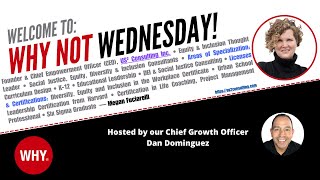
Megan Fuciarelli, a retired superintendent turned consultant, built US Squared Consulting around a Y operating system: why contribute, how make sense, what trust. She moved from education into corporate work, including with a major automaker, and is scaling her DEI-focused business while writing a book.
Chapters
Last few years have made us question everything.
Our relationships.
Our jobs.
What constitutes an office.
And who we are.
In a.
World filled with chaos, confusion and uncertainty. It's time for some clarity. It's time to start understanding one another.
It's time to start understanding ourselves.
We envision a world where everyone knows their why. But even more, we envision a world where everyone knows their why Os, their why, their how, and their what. The operating system that drives you, that lets the world know where you stand.
What your unique gift is, and most importantly, who you are.
Yos.
Are you ready?
Hey.
Hello everyone, and welcome to why Not Wednesday. We've got a very special guest today, Megan Fucciarelli of US Square Consulting. Let me tell you a little bit about Megan. Megan is the Chief Empowerment Officer at Usquare Consulting. She's the founder and she serves as their Chief Empowerment Officer. She's retired school superintendent. She's dedicated her entire professional career to navigating social justice issues and supporting teams and people in being inclusive. She is passionate in the areas of education and equitable opportunities for all children. She holds a B.S. in Elementary Education, a Master's in Reading and Master's in Education and Educational Administration, and an ESL endorsement. She's also got a certificate from Harvard for Urban School Leadership. In addition to schooling, she is also a certified life coach and a project Management professional and a Six Sigma graduate. I gotta admit, Megan, you're one of the most well qualified people we've had on this show. You've got so many certifications and you've done so much. I love your passion and the things that you do. Welcome to why Not Wednesday.
Thank you so much, Dan. So excited to be here with you today.
I'm so glad to have you here and I'm so glad our paths crossed. I knew just from our initial conversation that I wanted to share Megan with why Nation and the people that, that are out here that believe in the power of understanding your why, your how, and your what.
Excuse me, we'll have to edit that out. So I love the. The. The saying behind you be the change you wish to see in the world by Gandhi. It's important to you because it's there, right?
Yes.
What. What does that mean to you?
It's really all about taking action and it's about not just watching everything happen around you, but being a part of the solution. Because I feel like, especially in our society today being so polarized that, that we have a lot of people who are being bystanders and instead of that, we need People who will actually stand up, speak out, and be part of the change that all of us want to see in the world.
Love that.
And.
And you come to it honestly, Megan, you know, again, I. I get to meet people like yourself through the work that I do in business development for Y Institute, looking for the next YOS certified coach. And so I got to know you from the. From the perspective of your yos. Your why is to contribute to the success of others, make a difference. Your how is to make sense of the complex and challenging in order to contribute. And then your what is trust? To build trust. So what you bring or is a relationship where people can count on you to do what you say you're going to do. How did that resonate with you?
Oh, my gosh. I almost get emotional when I just think about it because I feel like I had those pieces within me as part of who I am as a person. I knew that that was a part of what I believed in and what I valued. But to have an outside.
Assessment or an outside questionnaire, be able to really pinpoint it in the way that it did, it just really made sense and it brought it home for not only myself, but for my team. So. So that we understood why, as the founder of US Squared, we knew what we were adding to the clients we worked with. We knew that our whole goal was to contribute and add value to their organization. And we did that by taking those large concepts and breaking it into smaller concepts so they can make sense. And then we delivered on what we said we were going to do. That trust component is critical. And.
Really, when we break down those three pieces, I couldn't. If you would have given me the list of all nine components, I don't know that I would have been able to put them in the order that came out and have it make any more sense than what this does.
That's. I. I love hearing that. And thank you for sharing the experience. I definitely want to follow up. There's so much in there. How did your team react when you shared with them your Y operating system?
Because you.
You guys do a lot of this very important work in de and I. What. What was the reaction?
It was. Well, yeah, that's what you say all the time. Right. But I think what helped the team was to have the additional pieces, the one pagers that didn't just say what it was and why it was important to me or why it was how I operate or what I do, but what that looks like on a tactical level just really helped the team and it also allowed us to figure out why our values with the company align so well to who we are and what we do as a company. Because as the founder, I mean, I created the values and I created the core principles, and I've been very fortunate to bring team members on who have also adopted those pieces and many of them have taken them on as their own. But it's really important to know that those values are rooted in something beyond just what we think. Sounds good. Because. Because I think especially in the world of dei, there's a lot of lip service and a lot of things of, well, this sounds good. So we're going to say it instead of not only does this sound good, but this is truly who we are. This is what we do, why we do it, and how we do it. And having that to back up what we say so we can truly move beyond just talking about it has been critical for US Squared.
That sounds so good. And you know, as I was reading through your, your introduction, there's so much in there know for a fact, there's no doubt that your why is contribute. You want to make a difference. And when we look at, you know, as I look at your, at your bio, you're, you're all about, you're passionate about providing equitable opportunities for all children. Why is that so important to you?
I mean, I started as you shared. I'm a retired school superintendent. I was in the school systems for a long time. And I realize that if we can truly help, every student in our school systems have that sense of belonging which means that they are seen, heard, welcomed and valued. If we can make sure that our children have that at an early age, they will become adults who are valued, seen, heard, and welcomed. And right now, in our society, one of our beliefs is that the reason why there's so much polarization is because people are not feeling seen, heard, welcomed, and valued. They're so closed to the identity idea of wanting to be right or trying to prove the other person wrong that we're not listening to different perspectives. And the best way to contribute to the world is to help each other understand one another. And you know, when you talk about the why and all of those pieces of understanding yourself, that's where US Squared comes in. US Squared stands for Understand Self, Unite Society. Until we understand ourselves, we can't do the work of uniting those around us because we are still trying to figure ourselves out. So our main goal is to understand ourselves so that we can understand others, so that we can get to that point where we're the change that we want to see in the world.
There's the, there's a quote by Audre Lorde that says it is not our differences.
That separate us, it's our inability to recognize acceptance, celebrate those differences. That, that sounds like something you might say, Megan.
Yeah, absolutely. We believe that, number one, we all have biases because those biases are rooted at a very early age. It's based on your experiences where you went to school, your education, background, your family, your culture, all of those pieces. Right. We all have those and we all have differences and we all have similarities. And intersectionality of identity is inherent in all of us. And what we want to do is to help people recognize not only what their own identities are, but to also appreciate and honor the intersectionality of other people's identities. Because just like all of us are unique with how we present to the world, all of us are unique in how we provide information and lead conversations and the diversity of thought that can really help organizations move through to be more profitable, productive, and impactful.
You gave us the definition of us squared. It's, there's, there's two parts to it. So tell, tell us that again because I want to capture that.
Yeah. So us squared us a little bit of a math, math person. But it's understand self unite society. So us, us, us, us.
Understand self unite society. That is such a great name and I love the way it comes together.
One of the challenges that we know of people with our why, by the way, I share the why of contribute with you is the tendency to spread ourselves too, too thin. Megan. To say yes to a lot as an educator. You, you, you, you're all. Educators are such giving people already. How do you, how have you been able. Because you, you've got a, a tremendous resume, you're running a successful consulting company. How do you find the strength to say no to those things that, that aren't productive so that you can concentrate on the things that do make a difference? That's something people with the yf contribute, struggle with. I'd love to hear your answer.
Yeah. Honestly, I think when you look at my house, which is the trust, I think it helps balance each other out because I will follow up on what I say I'm going to do. So if I say I'm going to do something, then I make sure I'm going to do that. I don't let people down and I'm very strong on. I'm going to deliver what I say I'm going to deliver. So I think that Helps me balance out with the contribute because I don't over promise because I know that I have to be realistic with what I can deliver on.
Now, all of that being said, do I still contribute or offer more than I probably.
I don't like to use the word should, so I won't. But do I contribute a little bit more than maybe other people would like me to contribute sometimes or offer to contribute? Probably. At the same time, I love every single minute of what I do. I don't feel like I'm working a day in my life. And if you look at my clocking hours, because we do clock all of our hours for clients and things, I'm probably spending. There's weeks where I'm spending 70, 80 hours a week and then there's weeks where I'm spending 30 hours a week. Right. So it all averages out. But I love every minute of what I do. So it never feels like I'm working. But I think that aspect of trust helps me balance out to not over promise. Something I say to my team all the time and we like to do within our organization is don't over promise. And under deliver. We prefer to over deliver.
Correct. That's a great. That's a great model to live by. So your, your why is contribute and your what is trust. And in between your how of makes sense. So you're really good at solving problems. I can also see why, because you're the first person that has ever combined contribute or said this. You combine contribute and trust. The trust doesn't allow you to over commit because you don't want to commit to something you don't deliver. And that, that's. That makes a lot of sense with your how of make sense. How does. And, and that's how you, you contribute by making sense of things. Have you always been a problem solver?
I think it became. That's an interesting question. I think that became more evident when I got into administration and leadership within the school setting. I was a principal before I was a superintendent. And as a school principal, you really are that central hub of making sure that things happen well and that things get executed and that everyone is safe and that everything is moving appropriately. So I think I started to really figure out how to be a problem solver at that point. But what I've always done is I've always noticed what needs to be improved. And I think for me, when I'm noticing what needs to be improved or when I notice that people are confused by something, or if something seems so large and insurmountable I like to break it down to make it possible because I believe that everything is possible if we put our mind to it. I believe that everything is possible if we can't do it, to find someone else who can come in to help us get something done. So with that contribute, it's not just about me personally contributing, it's about bringing others in that can contribute to make it make sense and deliver what we promise on. So for me, the make sense has blossomed since having my company, but it started when I was in that leadership role.
That makes a lot of sense, Megan. So you included in your bio, you mentioned.
A human, a wonderful human named. Is it Reese?
Yes, Reese.
And that you're very close to your parents. So in addition to your professional background, that's a big part of your life. How do you balance running Us Squared and making sure you have time? Because I, I know a lot of us. I've got older parents and I've got a 12 year old that just turned 12 Monday. So dealing with taking care of children plus older parents, how do you balance all of that and. And continue to run Us Squared so actively and, and professionally?
Yeah, I think, I mean I am similar to you very much in that sandwich generation of taking care of my parents and my children because I have. Reese is 13 and my parents are both not the healthiest. I actually moved back to Michigan to be closer to them because of their health. And I think for me it's about making sure that I have time dedicated to being with them even if we don't have plans. So that's something for me that I have found to be really helpful is I live by my calendar. So I own my calendar. I put what's in there in what I want. But when it gets to be that two week time frame, my calendar owns me. Right. So a year out, I own my calendar, I decide what goes on there. A month out, I own my calendar, I decide what goes on there. But then two weeks out, my calendar owns me. It tells me what to do, when to do it, how to do it, and I will put things in my calendar like dinner with the family or head to my parents or doctor's appointment or whatever it might be. I just started, I signed up to coach my son's football league this year. That's not really my thing, but it's something that's important to my son so I'm going to make sure it happens. So is it busy? Yes. But I put it in my calendar and people will say you have to put time in your calendar for family. And I say, that's not saying that I have to do it to be able to spend time. But what it does is it allows me to block that time off in my schedule so that I know how much I need to grind out before that so that I can be fully present in the moment when I'm with family. That's another thing I really try hard to do, is be fully present in whatever I'm doing. So we started a rule probably about a year and a half ago that when it's family time, my phone gets put away. I don't check emails. I don't do that. If I'm on vacation, instead of saying, oh, I won't do it, and then I sneak off to the bathroom or sneak somewhere to do it, I tell my family, hey, every day I'm gonna need to be on my computer for an hour and I'll set a timer and I will set the timer for an hour and that's what I do. Or every two days I'll be on for an hour or two hours. But I let them know ahead of time what to expect. And because I love what I do, it doesn't feel like I'm taking time away from something else. I also think it helps that my son Reese, loves what I do as well. I mean, he has full intentions of taking over the company when he gets older and he's already talking about all the ideas and suggestions he has. So sometimes we'll brainstorm together if I know I need to do some vision work for us Squared. Sometimes I'll include Reece with that because it's ultimately his vision in the future as well.
That's fantastic. There's some great hacks there. So one I heard the calendar is so important, putting every.
You.
I do the same thing and I think it's. I think you probably do it at a much more masterful level because you're talking about you block time for those things and then that time becomes sacred. One of the things I heard you say is two weeks in, you know, you can't just change stuff. You know, you're committed to what's in that calendar. That probably has a lot to do with that trust, right? Yeah. Told somebody you're going to meet with them on Friday at 3 o' clock and something else comes up. You're gonna do everything you can to make that 3 o' clock meeting because you told them you were going to be there at 3 o' clock and they're prepping for that meeting at 3 o' clock with you. So not showing up or changing it at the last minute is not going to bode well. And it doesn't probably sit really well with you as a. As a person who delivers trust. Right.
Right.
So let's talk. I want to thank you for sharing because that's so important. I want to say thank you for that. So your mission is to navigate social justice issues and support people and teams and being inclusive. Is that Us Us Squared's mission and is that your personal mission too?
It's both. I mean, I believe that Us Squared was my first child. Right. It's my everything that I want to see in the world, the change that I want to see in the world, I tried to put through a Squared. So US Squared is all about navigating social justice issues and supporting people and teams. My personal mission that support supports that mission of Us Squared is really to release the guilt and shame so that we can reveal the inner change maker. So I believe that especially within social justice work, we talked about the polarization that's happened in society, but I believe a lot of that polarization is because of guilt and shame and blame that has been just perpetuated over the years. So my personal mission as I continue to spread the message of what we do is, is to release that guilt and shame so that everyone's inner change maker can be revealed.
That's really some deep work that people have to do in order to get there. So when you're working with organizations, who are the types of organizations that you're working with?
Yeah, so we are very agnostic with our organizations. But our two main avatars or the two people that really benefit the most from our services are obviously the education realm. Being a former educator, I can speak the education language. And also I understand how important it is to navigate the community voices with your staff voices and your students. Best interest at mind, at heart. So education is a large piece of who we work with. And then we also start working with corporate. Actually, about five years ago, we started working with corporate and that has increased tremendously. And that's actually been a really kind of strong story to speak of when we talk about those why not moments. Right here we are recording why Not Wednesday. And one of my why not moments actually revolves around the corporate work that we do.
Tell me about that why not moment.
Yeah. So I started this. I think I've shared this, not necessarily in this piece, but in our conversations that I started this as my personal mission. I thought I would own my job. I Had no intention of owning a company, owning a business. I was going to own my job, be an independent consultant, and do things as I wanted to so that I could take care of my parents. And within my first year of committing my time, 100% to this, I had seven people on my team and I was doing a lot more work than I ever thought I was going to. And in that first year of doing work, I thought I was only going to work with education groups. And someone in the audience, a teacher, came up to me afterwards and said, do you ever work with corporate? And I said, well, we haven't. I mean, my background's education, but why not? Right? So. And that kind of started that movement. Our first corporate client was a big three automaker, right? I mean, it was a large corporate client, and that was our very first one. And since then, we now have almost 70% of our client base is in the corporate arena. Most of our clients are in either pharmaceuticals, automotive, or the insurance industry, financial industry. But we've worked with lots of industries in the corporate realm. But if I wouldn't have said, why not? In that moment, I would have stayed with education, and I still would have been impactful and we still would have been doing great work. But I don't know that well, I know for a fact I wouldn't be where I am now, because at that moment I said, why not?
And that's a big. That's a big change. Probably one of the first things you noticed, Megan, going from educational institutions to corporate is the pay is a lot better, right? Bigger budgets. Less. Less, probably less red tapes. There's still some. Because you're working. When you're talking a big three automaker, I'm sure there's some approvals that have to happen to get you in there to do the work that you're going to do. But the. But the budget's there, you know, that versus in a school district. We're talking about bonds. And where is the funding coming from? Does it match? Specifically, we have a group of coaches within Wise Society, which is what we call our coaching community, that work in the education sector and that would like to make that shift to work with some corporate clients because their love is in education. Your passion is helping children get equitable.
Opportunities. But it helps to have those profitable corporate clients that help pay the bills so that you can do more of that work, which maybe is not as high a ticket. What advice would you give to a coach who's in the education sector? Is very comfortable. Retired principal, retired superintendent, very Similar to you. And they love working with staffs of district staff or school staffs. How did you how what you said? A client just came up to you from the audience and said, hey, do you do work with corporate? What advice would you give somebody who wants to make that shift?
Well, the first thing I would say is, yes, corporate provides more money and all of those things. I'd like to add something to that. My passion is still working with our youth and our children. And I feel like corporate allows me to do that just in a different way. So instead of working with educators, I'm working with the parents and grandparents and aunts and uncles of our youth. So that for me was a huge piece that I had to allow into my heart. I had to allow my head to hear it right, to say that I'm not going against what I believe. My belief system is still very strong on making sure that we're being the change we want to see in the world for our future generations. I say all the time that I do this work for my son and for my unborn grandchildren. And I think that working with corporate allows me to do that just as much as it does in education. But specifically with your question about how can we help coaches who are currently working in the education realm about how to move into corporate, for me it was about asking yourself why not? And getting out of the imposter syndrome. Because for me at least there was some of that imposter syndrome of I'm an educator. I don't know if corporate going to want to hear what I have to say. I don't know if they're going to value my experience. There were a lot of questions in my own head and I had to just add that extra word. So instead of saying why would they do this? Why would they trust me? Why would they believe in me? Why would they see value in what I do? Why would I make sense for this company? It's why wouldn't they trust me? Why wouldn't I be able to contribute? Like, I knew that I could contribute, I knew that our company could contribute. And I just had to add that extra word and to share shift my viewpoint and my vision. Because for me, especially in the education realm, starting in education, moving into corporate education prepares you with so many skills and there's so many things I learned in the education world that have helped me tremendously in corporate. So I think it's really more of a belief and a mindset shift than a skill shift. It's really just saying why not? And allowing yourself to get out of that imposter syndrome that at least I know I faced in the very beginning.
And that's so big, right? And to just have the confidence, why wouldn't they trust you? Right. These. And no matter where you go, corporate CEO of a big three automaker, guess what? He entrusts his, his or her children to the education system. Right? And you came from there. So you are trustworthy. You do bring tremendous value. I love the, the framing of just ask why wouldn't they instead of why would they. Great, Great reframing. We kind of talked a little bit about your big. Your why not moment. Is there a big why not moment that you remember a time when you said, okay, why not? And you went for it and you're so glad you did?
I mean, I think a lot of my why not specifically with the business I shared, the one with going into corporate, but just starting A Squared in the first place, right? Like As I shared us, Squared was a DBA and an LLC for years. I've been doing this work for 26 years now I've been doing this work and I was doing it as an educator and just really speaking for free with different people to try and impact the education and impact the curriculum system. And when I came back to Michigan, I spent most of my adult career in Chicago. When I came back to Michigan to be closer to my parents, I said, well, I don't really have to go back to a full time job. I was vested. I had my retirement in Illinois. Why not take some time to follow my passion, right? And my parents for the first couple years told everyone I was unemployed. They didn't understand. I mean, I don't have any entrepreneurs in my circle. I was the first entrepreneur in my family. No one knew what that even meant. So for many people it was, I was unemployed and I was okay with it because I knew that I was doing what I loved and whatever they wanted to say. At the same time, I was taking family vacations and paying for the family to go on trips, right? So I knew that I was making an impact and I was bringing money in to pay the bills.
You're. You're a very successful unemployed person.
Yeah, exactly. I said, you know, I think people might get the wrong impression if you keep saying I'm unemployed, but you tell everyone that I just took everyone to Italy, right? Like that's going to give people questions in their heads of where did Megan come up with the money for that? But for me, it was the why not make this a full business, right? Instead of just a passion project. Because in the very beginning, I was doing things for free because I just loved what I was doing and I was bringing people on to do the work with me and I was paying my team more than I was paying myself, like. And I had to say, why not make this a business? Why not allow myself to be passionate about what I do and earn a living and employ other people to be able to provide for their family and continue to make the impact? Because it's only by growing that we can continue to make the impact larger so that we can truly change the world.
Love that. That is, I love the idea of turning your passion project into your business because as you said earlier, you're not working. You know, it doesn't feel like work when you're working on your passion project. So, you know, we're running out of time here. I can't believe we've gone through a half hour. You've been such a great interview. Thank you so much for being with us. Megan, what's next for us Squared Consulting?
I mean, really, it's. I'm really excited because we're going to be. The business is going really well. Team manage. They're doing great things. I am launching my book in January and launching my book tour and really focusing on the speaking circuit to get the message out to as many people as possible. Because if I can help people release their guilt and shame, then we can reveal more change makers, which means we will see a bigger change in the world. And I'm super excited to be able to do that on larger audience, larger stages with bigger audiences again, just to help people release their guilt and shame so that we can move forward with being the change.
There is no doubt, as I hear you talk about you, I think you used help about four times because your why is to contribute, make a difference and help other people succeed. Megan, it's been a real pleasure having you on. Thank you for sharing Us Squared Consulting. Thank you for sharing your mission, your vision and the work that you do. And some tremendous tips for some of our coaches that are listening on how they can convert from a passion project into a profitable business. I look forward to talking to you again very soon. And everyone, we'll see you guys next Wednesday on why not Wednesday.
Sounds great. Thank you so much, Dan.
Thank you, Megan.
More from Dr.




Women In Leadership: A Need For A Greater Systemic Change With Belinda Clemmensen






