WHY NOT Wednesday! with Monique de Maio
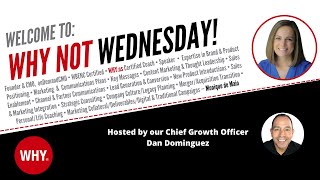
Monique de Maio, founder of On Demand CMO, walks through her YOS framework: Contribute, Simplify, Make Sense, and Trust. She uses it with executive teams to align messaging and strategy, bridging sales and marketing through sales enablement and client-avatar work. Her core advice: stop trying to be everything to everyone, prioritize your existing customers, and tie marketing directly to revenue.
Chapters
These last few years have made us question everything.
Our relationships.
Our jobs.
What constitutes an office.
And who we are.
In a.
World filled with chaos, confusion and uncertainty. It's time for some clarity. It's time to start understanding one another.
It's time to start understanding ourselves.
We envision a world where everyone knows their why. But even more, we envision a world where everyone knows their why. O s, their why, their how and their what.
The operating system that drives you, that lets the world know where you stand.
What your unique gift is, and most importantly, who you are.
Yos.
Are you ready?
Hello everyone and welcome. Why not Wednesday? We are so excited to bring Monique dimeo to you guys today. Let me tell you about our guest today. Monique Dimeo founded her firm on demand CMO 25 years ago as a marketing consultancy that provides businesses, specifically in the B2B services, with insightful and impactful marketing on demand. This can come in the forms of marketing strategy, messaging, positioning, sales enablement, lead generation, and there's so much in between. There's already so much. There's. But there's stuff in between. So as a career marketing veteran, a multilingual immigrant, a mixed martial artist, karate black belt fitness wellness enthusiast and a student of performance coaching, which we've got to ask her about, she will get you to think about how to take little steps in the right direction to get the results that you want personally and professionally. Her straightforward, candid real speak and pragmatic tips and tricks, often taken from her personal experience typically have people discovering something new for themselves that results in some form of behavior modification and or performance optimization. She's launching a book in September appropriately called seven steps to designing the life you love, a pragmatic guide for women in leadership. So everyone, let's welcome Monique Demaio. Welcome, Monique. How are you?
I'm well. How are you?
Diana, it is so exciting. I love your walk up song. Jump from Van Halen that is a little bit older than, than most of us probably care to admit that we know that song. But why? Jump from Van Halen, Monique, jump in.
You just gotta jump into the pool, right?
I love it. I love it. Well, thank you so much for being on today. Man, that introduction is so amazing, Monique. And I wasn't kidding when I posted about our interview today. You are so generous with your knowledge, with your, with everything that you do. Every time I get off the phone with you, I mean, it doesn't matter what we're doing at Y institute, if I share something with Monique, she's got feedback and it's always constructive and positive, and you deliver it so well. That straight talk is so important. So I want to thank you, and I want to thank Lisa Schermerhorn for recommending you to me. That's how we met. And now you're one of our wise, certified coaches, and you're bringing all that talent, all that experience to your world, and you're adding something new to it. So I know a lot of people are going to have questions, okay, how do you use the yos in your marketing? But let's just get started with the first question I always ask. You discovered your yos. Your yos is contribute, simplify, and make sense. And I've talked about it a little bit in the post that I put out there, but how did it feel to you to first to find that out about yourself? What was the. What were your thoughts when you found that out?
Oh, it was so funny. It was like. But of course, now I understand my behavior. So. So really quick, I'll. I'll. I'll break it down. So contribute. People can't help themselves. Like, if somebody says, you know, I have a headache or I want an alternative. This is my world. Right. I have high cholesterol, and I don't want to take drugs. I'll be like, I got the solution for you. I got the cocktail, all these herbs and supplements, and I give them, like, the resume. I can't help myself but to contribute. Right, Right. And Raymond's on. Yay. Raymond, I'm so excited to see you. So it's this idea that you can't help yourself from wanting to contribute and make something better than it was or, you know, make somebody better than they are.
Help them.
Help them. It's like a. It's like an immediate need. It's like my son will tell the story that, you know, I was helping. We were taking him to school, and it was. There was a foot of snow on the ground, and there was a huge tractor trailer, Whole Foods truck that couldn't make the turn, and he was stuck on the street. And I got out of my car, like, just. And I like directing him on how to back up and not take out a telephone pole. He's like, what are you doing? I don't know. I just.
Do you see people that need help, so you go help them, right? That's the contribute part of you. And then I love seeing the simplifying, the make sense in your makeup.
Oh, my God. So this is so simple. So this is very interesting because I used to say before I was a yos coach and before I took. I knew anything about why institute. I always just say my superpower is I make the very complex simple, right? I work with a lot of very, very complicated businesses where it's tech, it's technology services, professional services, it's financial services. It's always this, like, it's not toothpaste and lipstick, right? It's. It's really complicated stuff. And they'll give me mountains of paperwork and it's all jargon and I'm like, oh, so what you really mean is that you, you, you're basically like, you, you have a product that you said and forget it. And people can rely on it, right? And they'll be like, what? Yeah, so you simplify, you make sense of things. It's like very. So I, I got this back and I was like, wow, that's really, really funny.
I love that. You know what did you. Did you. I think I know the company that. So when I was in medical device sales, I used to lead the sales.
Device company. One of our competitors used to tell their nurses, oh, our product is so easy. You just set it and forget it. I wonder if you're the one we need to blame for that because we had to fight hard against that because our product was a little more complex than that. So now we know what about makes sense.
So make sense is fun because like, again, this is a complexity. Some stuff that, that you life.
Yeah.
Logistics. I'm like, okay, we can do that. I can make sense of that. Okay, we'll do this first, we'll do that second. We'll do this first. And then it's the same thing work. Right? Because in the businesses that I, I work with, they're very overwhelmed by the execution. So we'll do the strategy, which is the simplify, right. And the contribute. And then all of a sudden we do the, the implementation, which is the make sense part. So it was like. And then very, very close fourth was trust. And I'm so about trust. So all about trust. So this, this yos for me, when I took it, I was like, okay, I'm in.
Yeah, I remember that, that first phone call that we had, it was so much fun because we're fellow contributes. So we both love to help people. We both share make sense as our what. But your, your simplify and my challenge are very different, right. In terms of how we do things. So it's always. So that's. I think that's one of the reasons I always learned so much from you, because you Kind of take all the chaos that I throw at you and you're like, dan, let's make it really simple. Let me show you how to make it simple. And I get something out of that. And that's one of the things I love to share with people, is you. When you know each other's yos, you can really take advantage of each other's strengths. Hey, I want to talk about the post that I, that I did kind of to introduce you to why Nation. You said getting leads is only half the battle. Getting the right leads and converting those leads is the other half. You don't expect a lot of sales advice from marketing, but you do, because yet that, hey, sales and marketing are linked together. Tell me what, what you mean by that and how you help people implement that.
So I just want to just distinguish one quick thing for people because I think that's part of the simplification. It makes sense. I can't help myself. So we do a lot of consulting on sales enablement. Right. And lead generation like that. So we don't just do the branding and messaging positioning side. We do the implementation and how that goes to market in sales. Which is why I'm on that podcast that I'm on, big Sales Illuminati with, you know, a buyer and a salesperson. I'm the, the one that kind of bridges the gap between sales and marketing. So. And I used to be in sales. I used to run a sales organization, so I'm really familiar with sales. Yeah. The problem that I think people fail to stress is this idea of the perfect customer, the perfect client. They're so busy trying to get all sales that they, they end up being all things to no one.
Right.
No one wants to buy from a generalist. It never, it doesn't work. No one wants to think that you're. Whether it's marketing agency, whether it's your financial advisor, whether it's your technologist, no one wants to buy from somebody that is all things to all people. Jack of all trades, master of none, no one. So if you're not clear who you are, you can't be attracting what you want. And you can't. And until you do the analysis of who your perfect customer is, or at least the, the extrapolation of who you want your perfect customer to be based on who you are. Right. You're not going to succeed. So whether you're a startup or you're an existing business, and I say this to clients of mine who are as big as Iron Mountain and Spectrum, I mean, I'd say this to them. I'll say, okay, this program is not going to appeal to a mid market company. So if you keep talking in the enterprise language that you're speaking, you're going to disenfranchise all of these mid market companies in the, you know, 50 to 2 to $500 million space, which by the way, based on the numbers that you gave me, is your sweet spot customer. So do we want to rethink this strategy?
Yeah, that, that makes so much sense. Right, Jerry. Jerry Fletcher, who said, greetings from sunny Oregon. He's another fellow simplified person who says, look, you got to talk to the right people.
Yeah.
With the right, in the right way.
In the right language. So the other thing that I was going to say that people forget to do is, is based on who your client, your clients or customers, depending on if you're B2B or B2C who they're the perfect avatar is for you. You've got to speak in their language. Like don't, don't like speak down to me. Don't have the awareness of what my pain is in my business. If you don't know my business or you don't convey that you know my business, I'm not working with you. So that's really important. I think people kind of sometimes when they're at, in that ivory tower situation or they're just starting out and they're creating a new company, they want to be so professional that they lose the DNA and that's why the yos comes into play. So if I can bridge that gap and further in the conversation, I'll tell people how to do that.
I love that. In the other post that I posted was about why you get out of bed. And then this is so true. When the solution to your problem becomes apparent and we hear the client say, hmm, I never thought of that before. That's a tremendously satisfying moment. One of the things that I struggle with, and I don't know if you do, Monique, with what makes sense, is I kind of know the answer sometimes, but I think you've perfected the art of helping the client come up with the answer. So how do you do that? Because we all struggle with that sometimes. Like, I know what you need, but let me help you see what you need. So how do you take people through that process?
Well, thanks to you, we've implemented something a little bit before we get into our process, which is yours. So let me explain how that works. I have now started in the last three rebrands that we've done in the last couple of months. I started doing the YOs with the executive team that I'm working with. So not in the enterprise space, because the enterprise space is different, because the marketing managers that I'm dealing with really don't have the ability to impact the organization. But at the mid market level, the CEO and, or the founder and, or the SVP or somebody that's at that level now, you know, tasked with growing the organization, either they're stuck or they're not growing or they're not going fast enough, whatever. So I just, I start with the YOs because I want to understand what I'm dealing with. I need to understand how I'm going to deliver the messages that I'm going to give you and how it's going to land for you. So if I already know how you're wired and you're a challenge person and you're giving me pushback, I don't take it personally.
Right.
I'm going to understand that this is your process, this is your DNA, this is your personality. I'm good with it. Now, in the past, I would have been like, this guy's being such an ass. Why is he doing this?
Right, right.
Or fill in the blanks. Or if you're a mastery person, okay, we're going to be at this a long time. Maybe my price should be.
And you pro. And I'm not, you're not the first one to say, hey, you price accordingly, right?
Well, unfortunately, I do it once they hire us. But to your point, I might want to do it before I do the statement of work. But, but truth be told, that helped me. And so, and, and just the other last week, this. The CEO who took the yos was almost identical to my. To my yos, right? I'd never seen it before. And his PI was just like my. Because I've used AI in the past. So I know how this guy's wired. It's perfect. I don't even need to like sugarcoat anything. I'm good. It's like, okay, Oliver, we're just, we're hitting the, we're hitting the ground running, right? This is what's going on. This is what the challenge is. This is what I want you to do. Okay. So then once you get the yos, then you go through the competitive analysis. You're looking at their keywords for what they rank for. You're looking at their competitors keywords, what those people rank for. So what happens in times is people get blinders on and they're like, well, you don't understand, understand my business. I don't compete with this person. No, you're right. You don't think you compete with this person. But the, the world called Google, they are actually competing with this person. So you got to take these things into consideration. Say that fast three times, then we do it. Then we do a sort of a mapping analysis, almost like a gardener magic quadrant. And we find the white space that is not claimed in their space. There's going to be the snarky one, there's going to be the corporate one, there's going to be the approachable one. There's going to be maybe, maybe not. Maybe there's one that's more male, sort of hard. Maybe there's one that's softer, more feminine. Maybe, maybe there's an opportunity in your space that hasn't been carved out before. So we look for that and then we help them get the vocabulary, the voice and the service offerings to line up with that tone. Because I have a whole presentation on tone. You can say the same thing about a company in three different ways. You know, sort of professional, sort of crisp, sort of not, you know, lengthy and technical or not. So you have to, you have to decide who you want to be and that's personal and professional. That's why sometimes the convergence of the YOS with, with what we do is perfect because you can't be clear about what clients you want to attract if you don't know who you are.
I love that. Thank you so much for sharing that. And you know what, one of the things that I think is so important is understanding how people process information. Right? And I think in an lp, we know that from nlp and I think the YOS helps us do that too, because you know what they're looking for, you know how they're going to take your message and what they're going to do with it. And then you can say, ah, he's not being, as you said, he's not being an ass. He's just being who he is. That's how he processes the information. So you expect that from him or her and then you, you move on. So what, what advice would you give to an entrepreneur about their marketing and sales strategies? What's, what's something they ever, all entrepreneurs need to know?
Well, I think this, this notion of don't be all things to all people, be very clear about who, what you want out of the business and then what, what gives you joy. So if you, if you don't like Working with, you know, mastery people or, or people that might be like engineers and doctors and scientists.
You had it right, engine. When you say mastery to engineers, I think you're right on.
Yeah. I mean it. Ha. You know, I deal with engineers all day long in some ways. Right. So I think you, you have to be clear about who your avatar is. We call it an avatar. It's the keyword for kind of like a, you know, target client or customer. And then you need to look after you've been in business for a while, you look at your 8020 rule really carefully. You notice for yourself. And this is. When I started the business 25 years ago, I didn't have a specialty necessarily. I didn't have the swim lanes that I have today. I was a little bit more like all things, all people. What. I was a startup. So. So then it became, it became obvious to me that I was being.
I was successful with technology and technologists and technology brands and technology services and fintech and all these kinds of. So it became apparent that those were my sweet spot customers. And then you do analysis on your profitability. You do an out. I always tie my marketing to what's happening in sales and in. On the bottom line and the top line.
Right, the top, you know, so revenue and yeah. Profit.
I will. Unlike other marketers. I don't, I don't. I mean, I, I have an mba. So you. As you do. And so our sensibility is very much about the finances. So if I'm going to give somebody advice about who they need to target, I'm going to look at their P. L and say, okay, which ones are profitable and which ones are not? Which ones do we want to let go quietly fire them and who do we want to get more of? So that's what we do. That's the exercise that we do. And then all of a sudden the avatar starts to show up. So if you're targeting a cio. Right, Right. Or a CMO or somebody from marketing, you've got to get their lingo really crisp and you've got to present your services and your products in a way that they want to ingest them. And so that whole language and the positioning, the messaging, that's the net takeaway. Like you've got to do the analysis and you've got to not be so.
Emotional about the business. It needs to be much more driven by data. So it's what makes me happy. That's the, the soft side and then what makes me money. And you need to reconcile those two things. To make sure that they're in alignment because they can be in alignment. People be like, oh no, I can never make money out of my passion. Of course you can. I do it every day.
Right. We can feel it in your energy. And I mean, like I said, I, when I talk to people about Monique, it's like, man, she just jumps off the zoom right into your face.
Right? That's right. Yeah, you just jump right off the screen, right into your face and, and gives you value. So what's the biggest mistake? Because you're talking about messaging and using the right language. What's the biggest mistake businesses make when with their outreach or their lead generation? Because I believe me, I get a lot of those and I get a lot of mistakes and sometimes somebody just does a great job. I respond to them just because their message was so good and so well crafted. And as somebody that's in business development, I just react to that. I say, you know what, I'm going to take your call, I'm going to take a call with you. But what's the biggest mistake people make?
So you, you, I'll reverse engineer what you just liked. And that is one of the problems, I think that there's very, there's a lot of automation going on today and with ChatGPT and I can have an entire conversation with you about chat GPT and how that has impacted the business and your business, everybody's business.
Right.
But the reality is there's so much automation. There's very, very, there's careless marketing, it's mass, it's not niche, it's not thoughtful, it's not on target, it's not valuable. I have so many messages a day that are like do you want to set up a meeting? And I don't, I can't even discern what you're, what you're trying to sell me. So if I clear on what the hell you're selling me, why would I want to call you? So, so the, the, the. There's a couple things. There's. Don't jump to do marketing for the sake of marketing.
Right.
First thing, don't be a too general because if you're not standing for anything, you're standing for nothing. And the other thing is.
The biggest mistake, this is the biggest and it's low hanging fruit or did I answer? Is that.
Your current customers are where you need to fish first. There's three strategies in marketing. It's pretty simple. It's acquisition, retention and growth. That's it. Anything else that anybody tries to sell you is all. That's the plain speak, right?
Okay, yeah, that's perfect.
But so acquisition is the most expensive thing. We all know this. Even if you're not in marketing, you know this. So retention love your customers up. That's another mistake that people make. It's like they get a client, they get a customer, they put them on auto bill and they don't hear from you again. You got to show them love, man. You got to like stay in touch, figure out a way in your marketing that you're showing them love and appreciation. And you know what pisses me off? Giving a new customer a rebate or a valuable incentive. Now at and T just finally got it right. It's good for existing and new customers, right? How many years to figure this out that you're off your installed base? Right? You're like, right, I've been a customer. Verizon did that to me. I've been a customer for 25 years. As long I was one of the first people to have a cell phone because of my business, whatever. And now you're giving him a free phone and I'm paying retail. What are you crazy?
Right? Not because you're not a new customer. Right?
Not good. So you got to love up your customers. And then the growth part of it is look for your, your 8020 rule. You are probably going to find gold in your existing customer base and nobody takes the time to do that. So they hire a marketing firm and they're all about the bright shiny object. And I'm like, well, what about these 80 clients that you haven't maxed out? They're only buying one of five of your services. I don't understand why you haven't done that math.
And that's, that's the low hanging fruit also, right? Because we talked, you know, in, in the pre show, we talked a little bit about what. What is the low hanging fruit that today's business owners need to pay attention to? Tell us.
What I'll do is I'll have them go through and do a really quick Excel spreadsheet and have them map all their clients out. And then I'll take another. This is another tool. People write this down. You do a vertical axis. You do what are your services or product offerings. If you can't put a check mark in each one of those columns for each one of those clients, you got an upsell opportunity.
That's your marketing perfect man. And that. And again, I love how you made it simple. Right? And I talked to simplify people talking bullets Acquisition, retention, and growth. Hey, here's the three things you need to worry about. And so let's take care of those things. So, Monique, tell, tell me you've been doing this for 25 years successfully. When I look at the list, the roster of people that companies that you've worked with and that you've helped, you've made a big impact on a lot of people by bringing simplicity and solving problems. Right. But tell me about your biggest why not moment. When, you know, that's the, that's the title of the show. We want to talk about a why not moment. A time that you said why not to something and you're so glad that you did.
Oh, it was, it was starting my own business because I actually, I've been at this for much longer than 25 years. I don't want to say. But.
But I was, I had a great career. I was a publisher of a magazine. I had salespeople and 14 salespeople all over the country, you know, working with me. And, and I took a flyer when I started my own company. And so that was my why not moment. I was like, you know what? Worst case scenario, go back to corporate. But I started, I worked at, I, I worked at Salomon Brothers. I worked at a not for profit. And then I worked at Adweek magazines. And I didn't know that it was going to work out. And then I, then I call myself thoroughly unemployable now.
Thoroughly, thoroughly and completely unemployable. I like, I like Bruce's comment. Bruce, Bruce, Captain Kirk says simplify is a better way. You know, the, the more I know about my how of challenge, the more I appreciate simplify.
Yeah.
Because I can tend to throw a lot of variables and a lot of shiny objects into everything that I do. And when someone like you that comes in, comes in and says, Dan, it's really just this simple and 8020 is such a great rule. The Pareto principle really does apply. It's only about, you only have to concentrate on 20% of your clients are bringing you 80% of your revenue. Are you loving the heck out of those clients? So that not only are they buying more because then you can branch out, but then they're also bringing you more people like them.
Exactly.
Exactly.
Well, who doesn't like a client that you like? Right, Right.
I, I heard something really cool. I'd love to get your thoughts on it, you know, and Jerry, it was Jerry Fletcher, who's, who's also on. He said, he said, Dan, it, it recommend recommendations no, referrals are good, but recommendations are better.
Yes.
So when somebody has experienced you and had a great experience, and they can say, not only am I referring you to Dan, let me tell you what a great opportunity, what a great experience I had working with Monique, and this is what she did for us, because you. It's a testimonial. It's a recommendation. It's not the. The Just, hey, talk to my friend. Right?
Yeah. It's funny that you say that, because over the course of the. The last couple of years, I think it's been like maybe five, ten years now. We don't respond to RFPs ever. If you, if you can't. If you're not a warm introduction, somebody who specifically knows either myself or my business partner.
Yeah.
I'm not taking or not taking the assignment. So it. It like, if you said, hey, I know Raymond, and Raymond's a great guy and he's wonderful, and, And Monique is great, and you told Raymond about Monique, and that's fine, but if it's cold, where'd you find us? Where'd you find out about us? Google. Yeah.
No, no, we're not taking that call. Right. Well. And it's, again, it's part of really identifying who you want to work with.
Right.
I love that. Well, let's put a couple of things up. Your mission to help simplify the complex and create compelling content to generate customer engagement and sales. Yeah, tell us about that mission. What, What. What brought that together?
Because of the. I think it was the. The I'm sort of at the intersection of sales and marketing, and I believe that if. If you're working with a marketing person, they should make the cash register ring. To use an old adage. If they don't do that, I think it's not good marketing. I think you could do a lot of activity. And that's the problem that I have with a lot of what's going on today. There's a lot of activity, but there's not a lot of achievement. So there's a difference between, you know, I'm so busy. It's like people that tell you they're so busy, but you can't figure out what they do all day. It's the same thing. Right. Activity does not equate to accomplishment. So you could be doing a lot of marketing stuff. Does it hang together? Does it help you build sales? Does it help you build customers? So that my mission was always like, let me make a difference back to contribute. So if I don't make the cash register Ring. I'm doing bad marketing. That's how I associate it. So we've always had that alignment between sales and marketing in our practice.
You know, it's so interesting you talk about that because so many people see sales. Oh, I'm not Mark. I'm not sales. I'm marketing. Right. I do the campaign. I do this. I'm not in sales. And our salespeople say, well, that's marketing. That's separate. Right. Especially I came from a big Fortune 100 where, you know, the marketing team does. They were their own big silo. And the sales team was an entirely different thing. But I love the way you talk about making the register ring. Right. Because you can get involved in a lot of projects that are really fun and really cool to learn more about clients and do all the. All the testing. But at the end of the day, why are you doing it? How is it leading to more leads for the people that are trying to go get. And as we talked about at the beginning of the show. Right. The right leads with the right. The right meetings with the right clients with the right message. You do need the marketing team to give you that right message. So that represents what it is that you bring. I love what Watson said. Make the cash register sing Jump. And you did say something. I was gonna. I was gonna catch you. You said, don't jump at something, but I can't remember what it was because.
Your song is object. Like, people come in and go, you know, I'm a. First of all, digital marketing is. Is it also. I think that's a crappy. That's a crappy term because everything is digital. So, yeah. You say, I'm. I want to take my digital phone. You don't say that. You just say my phone. Right. The word digital is extraneous. It's totally.
Oh, my gosh. That is. That is so funny. Because.
And.
And you know what? One of the things you. You brought. And. And you're right. We could have a whole show on AI or automated marketing, which.
Passionate about it.
Yeah. And it's so good. Right? There's. We use it. We definitely use it. We run things by it. It's great for idea generation. But don't let it create your campaign.
Because your campaigns have to be very, very, very, very. Hang on, let me just. Sorry to jump on. Before I forget. Especially if you're in regulated industries. I'm just going to caution you guys, if you're in a regulated industry, do not. Do not ever, ever, ever download it onto your company server. It is a problem. Everything that you put into your chat bots, whether it's Chat, GPT or any other brand that's using an AI technology. Yes. Do you own your content? Yes, but they own it too. Meaning that they will. You're in the same pool as everybody else. So the data that you're getting from all the aggregated content that they have now, you're adding to that content. So you're making it smarter with your proprietary information. So be careful what you put in it. Also, it has a lot of what we call hallucinations. The hallucinations are perfect. And there was a 60 Minutes show very similar to what I'm talking about right now last week. So look it up. It will create stuff that is actually false. Sounds plausible. It's sourced. It's got titles like fake, as they say, fake. So be careful when you use the AI, it's not foolproof. So what we do it for is we do it like you said, for idea generation, or checking if we've missed, we've crossed our T's or dotted our eyes on, let's say, a list of something. You know, give me the top 10 of this, give me the top 10 of that. You know, things to start or to finish, but never to exclusively. No. Yeah.
And because it's not going to be personalized to what you do, we, we just did a whole idea generation project for our theme for our annual meeting. So I definitely want to tell you about that after the show. We don't want to, we don't want to spoil the surprise for everybody else. So I've got, I've got one more question I wanted to ask you. What would you say to someone, a coach or a business owner that is considering using the yos and what they do? You've done a great job of sharing how you use it as a marketer. I'm sure our coaches are getting some ideas and you've shared so much knowledge, but what would you give, what kind of advice would you give to somebody who's thinking of adding this to what they do?
Run, don't walk.
Run, don't walk. Get it? So I think it's got, it's got a double purpose. One purpose is that I think it makes you more aligned with your internal teams no matter what business you're in. So if you're a business owner and you want, you want to really kick up your performance of your, of your team, your ma, you're what I'll call the master brain team. Do it because you're going to understand at a much more granular level what you need to be saying, doing, and how you need to be pairing people for what roles and what responsibilities. You don't want to give certain roles of responsibilities to somebody who's not wired for it. So that's one. That's one reason. Second reason is if you work with your clients with it, it's a game changer.
Yeah.
It accelerates the whole process. It's just. It's me. It's easier. It's just effortless. It's a lot more. There's less friction in the system, if you will. So I would. I would definitely say do it.
Well, I'm gonna. I'm gonna. I love that. Run, don't walk. Raymond Kemp is quoting it for us. You know what I love about this interview? We kind of have followed all the rules that you've talked about. You came to us not from a referral. It was a recommendation, a really high recommendation. And we had a great initial conversation. I think. I think what we did is it was very personalized to you. You and I had a chance to meet personally and kind of figure out. Because I had to figure out, hey, how's Monique going to use it? Because my world was. I'd been working with coaches, so I wanted to figure out, okay, how are you going to use it? And then you brought so much to the table, and you've taught us so much. So we really appreciate you at Y Institute. We're excited to see you in October. Thank you so much for being on with us. Monique and I look forward to continuing to work with you.
Thank you so much. Such a pleasure. Thank you.
Have a great rest of your week, everyone. We'll see you next week on why not Wednesday? Until then, make it a great day.
Joe.
More from Dr.




Women In Leadership: A Need For A Greater Systemic Change With Belinda Clemmensen






