WHY NOT Wednesday with Paul Wilson
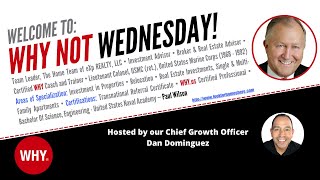
Transcript of a WHY Institute 'WHY Not Wednesday' interview featuring Dan Dominguez and Paul Wilson. Paul, a retired USMC lieutenant colonel and long-time real estate leader and WHY-certified coach, describes how the WHY/ YOS (why, how, what) framework shaped his personal identity, leadership, and real estate practice. He emphasizes listening, trust, growth, ownership, and freedom, and gives examples of applying YOS with clients to improve conversations and outcomes.
Chapters
These last few years have made us question everything.
Hello, everyone.
Our relationships.
Our jobs.
What constitutes an office.
And who we.
Are.
In a world filled with chaos, confusion, and uncertainty. It's time for some clarity. It's time to start understanding one another.
It's time to start understanding ourselves.
We envision a world where everyone knows their why. But even more, we envision a world where everyone knows their why. O s, their why, their how, and their what.
The operating system that drives you, that lets the world know where you stand.
What your unique gift is, and most importantly, who you are.
YOS.
Are you ready?
Welcome to why Not Wednesday. I'm excited to introduce you to our guest today, Mr. Paul Wilson. Paul Wilson is one of our early adopters in the Y Institute. He's a team leader of the home team at EXP Realtor. He's an investment advisor. He's a broker and a real estate advisor. He's a certified Y coach and trainer. He's also a retired lieutenant colonel in the United States Marine Corps. So I might have to slow down a little bit with the question. Right, Paul. But, hey, listen, we really appreciate you being on. Since becoming aware of WHY Institute's program back way back in 2015 almost. Almost 10 years ago, Paul has been challenging people to find their why and begin using that knowledge to cut a larger swath in the life they lead. So, Paul, welcome to why Not Wednesday. How are you doing today?
Hey, Dan, I'm doing great. Thank you very much. I'm pleased to be here. Please.
I'm excited that you're here, Paul, because I remember the first conversation we had. You know, you've been around my institute for a long time, and. And I always get a chuckle. Because, Paul, the why used to be a free resource that used to be out in the Internet before it became the why Institute. And you used to take advantage of it. You used it with your clients for a long time. What insight did you get from that?
Well, people. People can't articulate their why, right? But truthfully, people know their why. And I tell people that all the time. You know, you already know your why. And the reason why you do is because you already do it, right? But most people cannot articulate.
Why they do what they do. They just do what they do. So part of. Part of the beauty about the Hawaii Institute and.
The process of drilling down and finding out the pie, the how and the what is, man, I know who I am now. I can say who I am. So the why Institute and Gary's work and your work of getting the word out, I think, has been.
Huge in terms of helping people understand who they were so that they could be more fully blossomed, if you will, in life and life actions.
I love that. And Paul, I've got to ask you this question because it came up with during, during our time together. I said, you know, Paul, get this phone call. Gary says, hey, you got to talk to Paul. And Paul, you weren't happy that the, you know, we had become a business, right? You know, we were now in business and you had to pay for your wise and tell us about that. That reaction originally.
Well, it wasn't so much about me not having to pay for him, because I'd be happy to pay for him, but I was having a conversation with people about your. Their why.
Right?
You just go to this and you can find out more about was just.
I don't, I don't know, Dan. It just was. It was.
Tilting a little bit, right? So that understanding it. And it's not. He's just about the why either. What's the why? Os, I think, is what's really the most powerful. The why is the why is the why.
But when you put the why and the how and the what in there, it just becomes a lot more powerful. So. Yeah. Okay. All right. Okay, Gary, if you're going to charge for it, we'll do that. Okay.
Well, it was, it was a great conversation, Paul, because I remember, you know, it started with that conversation, but then as we talked more and we got through it, I mean, it didn't take too long from you to going from, hey, man, I don't know that you should be charging for this to hey, how do I get certified? How do I start using? Because by then we had the yos, which is the full. As you've talked about, the full why, the how and the what. And that's a great transition. Let's talk about your yos, Paul. So your why is contribute you, your how is to find a better way in. Your what is trust. And I like to call that the noble sandwich. When you got contributed trust with something really powerful like better way in the middle, you're going to have someone who, you know, what we know about Paul, based on your yos is you care about making a difference. You want to be part of a bigger cause, you want to make an impact. And how you do that is by finding better ways to do things. And one of those better ways for you has been the yos, helping clients discover their why they're how and what and then sharing it with others. And then your what is to create relationships built on trust. So I'm gonna. I know this is taking you far back, but how. How did that feel to you when you first discovered your why, how, and what?
Well, it was validating myself. You know, it's. And when you think about, once people find out their why and their how and their what, right, they can look back in their life and say, oh.
That'S why. Literally, no pun intended, that's why I did such and such or so and so, right? And it really. It. It really binds a life journey.
Together, making it a whole, if you will. So. And I use it not just while I use it with clients. I actually did a presentation not too long ago in. In one of our conferences through my real estate coaching program, right? Gave the presentation about why. And one of the ladies that was there, I had known through seeing her on Zoom.
And. And she did her why. And she looked at me after she did her why. She said, what do you think my why is?
And I thought for. For a second, and I remember some of the conversations that she and I had had, and I said, you know, Karen.
You'Re a better way.
And she said, how did you know that?
And I said, well, because you told me. You told me in what you said how you reacted to people, you know, because you know this. I love Zoom. I love Zoom because it gives people an opportunity to connect, whether the same town or the same state or not. Well, Karen happens to be in San Diego, this particular lady. And. And the nice thing is that we got to know each other before we actually got to see each other eyeball to eyeball, right? And. And the thing is that she was already saying what her why was without her knowing that she was a why or a better way, right? So that's the beauty about this program. If you. Well, when I first got to know my why, it was through that interview process, right? And if you let people talk long enough, they'll tell you what their why, what their how, what their what is. They'll tell you if they're a D, I, S or C on the disc.
On the disc, right?
You know, so they'll. People will tell you who they are. They can't tell you who they are.
They can't articulate who they are, but they'll tell you who they are. So we, as practitioners, if you will, have the. The background and the knowledge to understand what's going on and say, this is maybe who you are. And I. I look at the yos.
As a user y os as a who.ur who you are. Because truly the yos pretty much tells people who they are.
I love that, Paul. And, and you've been using it for a long time. So you know, I posted today or on Monday I posted about the benefit of knowing the why of your real estate clients. What is that benefit? I think is it important to know the driving force behind a client's decision making process before helping them make such a big life decision. And I believe you believe that, that it's important, but it's not only important, but it's vital. Do you agree with.
Oh, absolutely. It's a very important tool, I think right at the top of the food chain, frankly. We can talk about the disk, we can talk about the Myers Briggs, we can talk about all the other things, but I think the why OS is right at the top because it's a very heart and soul of a person. I actually describe the Yoshi as a, an enunciation of the burning bright light within a person that they couldn't dim if they tried to. It's who they are. It's, it's just you, you know, you, you do what you do because of who you are. The YOS is an example of that. So when we talk with people and, and visit with them about the various aspects of their, and I, I do this for my clients, give them a YOS so that they can, so that I can understand better about them and so that they can understand the conversation. Dan is different when, when you know their why OS and when they know your yos, the conversation is so totally different.
So, so Paul, tell me this. You know, and, and I put this in the post on Monday. What kind of homes do you show someone? And maybe, maybe you have an even better example. But let's say does it make a difference what kind of home show to someone if they come in and they, they have a why of challenge. Does it make a difference in what kind of places? What kind of homes are they interested in?
They may, they may want a fixer.
They might.
It just, it depends. It depends on what the, the other side of the, of the relationship says.
Right.
You know, I, I know that in relationship of a, of a couple, typically one is looking at bedrooms and bathrooms and the living space and the other is looking for where am I going to do the grilling and working.
So, so it just depends. You're. I'd say typically.
One side's looking for a nest and the other one's looking for a castle.
Right? Right.
The same thing in One place. So that's a challenge. Yeah.
So. But you said it changes the conversation. Can you give us an example of how it has changed the conversation? When they know that, hey, I'm working with a realtor who wants to contribute to my success, who's going to find a better way to show me the best houses for my. For my situation and who I can trust. When they know that about you and you know, their yos, how does it change the conversation?
Well, I think it's more relaxed. And the conversation is not just on that surface level of, of I've got commission breath and I'm looking to sell them a house because I need. I need a commission so I can have food this week. That's not where it's at. Right. If you have the conversation about what do you want, what are you looking for? And this is a neighborhood that I don't know that you'd really like, but why don't you do a drive by and take a look at it? It's just that the trust goes in. That's my. My what? Trust is huge for me. It's always been right. And so I do things to. To do that. One of the things that I do. This doesn't have anything to do with why. Actually, it probably does. But I listen to people. What are you looking for? You know, I ask and listen, ask and listen, ask and listen. And I'll. Without doing the yos yet, I, I will get to know what their why is. Right? I'll get to know a little bit about what's really driving them. And buying or selling, it doesn't really matter. Or forget. Forget the real estate stuff, just about relationships. Right? Because once you know a person's why.
And.
And understand a little bit more about their bright light that they may not even have been able to. To put their finger on. Right. Again, just a different conversation. And the depth of the conversation, depth of the relationship is just unbelievably powerful and grounded.
You know, Paul, you. You be. Before I got to say this because you're currently a realtor, and you, you and Judy have been serving the Albuquerque metro area for over 25 years. You've held leadership positions at the local, state, and national level. You were the 2019 President of the New Mexico of Realtors and then the 2015 President of the Greater Albuquerque association of Realtors. So you've been, You've held those leadership positions, but even before that, you had a very critical leadership position because when you graduated from the US Naval Academy in what's now referred to as the legendary leadership class of 1968. You joined the Marines. Your MOS was aviation. You flew over 3,000 hours, principally in CH46 helicopters. You were in Vietnam in 1970 and 71. And you've had so much leadership experience, you bring a whole lot of wealth to the table. So you've had two completely separate careers. What translates. What did you bring over from the Marines that you still use today as a lieutenant colonel leading troops and as a, as a realtor leading the Greater Albuquerque association of Realtors over the New Mexico association of Realtors?
Well, I think I've already mentioned something about that, Dan. Very honestly, it's about, about listening. Listening to, to what? What's going on in a person's life that people want to talk about themselves. They want to tell you what about what's going on. They.
And they want to be led. They want to be led by somebody that they know understands Right. What they've got going on. You know, if I know somebody's yos, I've got a pretty good idea of what's going on with them, right? And that's that, that's the beauty about the work of the yos. It really brings to home where a person's at. It's, it gets through the layers of. Oh man, we're.
Sometimes we're so layered with, with.
What, what would it be?
Defensive mechanisms getting to the why again, is, is just peeling back the onion several layers at a time. So I think that that would be the big thing. Dan, thanks. Thanks for reminding me about all that stuff, man. Hey, I, I earned this gray hair and some of this no hair.
You know, looking at you, Paul, and I know our listeners and viewers are going to say the same thing. Looking at you, you wouldn't imagine a 24.
Followed by a 25 year real estate career because you still have that energy. What, what, what gets you up in the morning and we know you want to get up and make a difference in the lives of others. How did that resonate with you and how do you, how do you take that energy throughout the day?
Well, I know that that person is needing some help. I, you know, there's a, there's, I don't know what's going to happen today. The beauty about the real estate business, the real beauty about Marine business. You don't know what's going to happen today. You have an idea. Here's your schedule. But sure enough, there's an interrupt. Interrupts happen, as you know. And, and all of a sudden here is an issue that needs to be dealt with. And let's go see if we can put some energy on it and get it, get it at least addressed, if not completely solved. Yeah, well, I was part of life.
That is beautiful, Paul. And I love the way, you know, it oozes out of you, the contributing you oozes out of. And you mentioned something and I think, I don't know if you heard that from our good friend Larry Levine and selling from the heart, but you talked about commission, Brett. Right. When, when, when somebody you can tell is just all they want to do is close the deal and get you out the door and move on to the next deal versus someone who is asking you questions about what's important to you. So if you know somebody's a challenge, they know that they like to look at things that are different. Right. They're open to challenging the status quo, thinking outside the box. Maybe looking at that weird property out on the, on the east side of town that you haven't been able to show to anybody, they might actually be open to it.
Right. What. What are you looking for? How can I help you? And if you don't know, let's find out what's available. So, yeah, it's about asking and listening. I think the, the L word in real estate is not done nearly as much as it needs to be. There's a lot of, A lot of. Well, in life, I guess in general, people just don't like to listen. They want.
To tell.
Yeah.
Not to show, but to tell. And I think that's. That's a real mistake. And I think part of the success that Judy and I have had, have been listening to people being genuine, being authentic and making a difference in their lives, whether they're clients, buying a house or selling house or not.
Excellent.
So let's look at one of the things, you know, Sunil did a good job of doing some homework on. Paul and Paul's values are growth, ownership, and freedom. Tell us, let's take them one at a time. Tell us what you mean by growth.
Well, you can take that a number of different ways. I think what growth means to me personally is growing myself and, and growing not physically.
Yeah, we got this weight. Weight problem. Right. But growing intellectually and spiritually and emotionally and putting good stuff into the brain. Yeah, this, the. This morning I was reading a new concept for me called the Pomodoro Technique. And it's like, so we, most of us. And when I say most of us, humanity has an issue with time management. It's not time management, it's person management, me management. But the pomodoro was just a good concept that I.
Embraced almost instantaneously. It's basically instead of breaking your, your, your life down in hour or two hour increments, it's breaking it down into 25 minute increments, for instance, and I was sharing that on a national call that I was on on Monday and just wanting people to know they don't have to do four hours at a time. They could do 25 minutes at a time, take a five minute break and then do another 25 minutes.
Right?
So for me, that's growth. And if we're not growing intellectually, emotionally, spiritually, and we're going backwards, we're going to be sinking. So I think spiritual, mental, emotional growth are all part of the same package, if you will. That starts with.
The miracle morning. You probably familiar with that book, right? Morning for me is just absolutely, totally vital in terms of getting my bearings set, getting it straight, and being able to move forward with great gust on the day so that we can be of significance to others.
Fantastic. I love that. And, and you, you definitely show that growth mindset. I mean, it was not a big jump from you learning about yos to you saying, hey, I want to learn this, I want to use this in my business because I think it's going to help me grow individually. And you went through training pretty fast, I remember. Talk about ownership, Paul. That's another one of your values.
Well, it's not my fault.
I think we need to own what we do. I think we need to be responsible for ourselves, be responsible for our time and realize that at the end of the day, the person that's most important to us is a person looking back in the mirror. And we need to own what we do.
We need to own what we don't do. And it really is important basically as a personal accountability and that that's what ownership's about. Stuff is just stuff, as they say. There's no bumper hitches on the back of a hearse. Yes, the ownership is really about doing and saying, doing what you're going to do, saying what you're going to do and then doing what you say you're going to do and being as impactful as possible.
Spoken like a person with the what of trust. If, if Paul says he's going to do it, guess what, he's going to do it. And you're going to go to great lengths to make sure you do it right. You're not going to let somebody down and have them say, I can't trust Paul. How would that feel?
No, we got that in our military background, Dan. You know that, you know, you gotta trust the person next to you in a foxhole, whatever the foxhole is. You got to be sure that. That that trust is there. And that's just.
That's an unspoken. Yeah. Yeah.
Well, Paul, you know, you. You brought that up, and I love this. This connection that you and I have. We're. We're fellow Lobos.
Right.
So. So Paul joined the military in 1968. Right. I was born a year later, but our paths did not cross until 1992. In Paul's last year as a retiring lieutenant colonel for United States mar. You were the commander of the ROTC Marine Unit at the University of New Mexico. In 1992, I was finishing as the cadet commander of the Army ROTC at the University of New Mexico. So as you were leaving your military career, I was getting my commission and starting my. My journey into the military, which, you know, it's a bond that you and I have. I think it's pretty cool that we were there at the same year. You probably knew the Army GU Guys, Major Bieberstein and the guys that were over at the army rotc, and you. You guys probably talked about. Yeah, there's this young cadet, Dominguez over there. Let's see what he ends up doing. But. But first of all, let me say this. It's a great connection that we have. Fellow Lobos, thank you for your service. Your term of service, 24 years, is a long time to spend in the military. How did you. And this. This is a great question, because I want to know, how did you survive in the military with the how of better way, constantly trying to make things better. And. And people always say, you know, I had the how of challenge. So I want to just hear your answer, because challenge gets you in more trouble than better way. At least when you got through with stuff, it was better than before you started. Sometimes, I think, did things different just to do them. But tell us how you dealt with your tendency to want to look for better ways.
Well, you know, Dan, in. In the context of the military, not everybody's a commanding officer, but everybody's a commanding officer of themselves. And. And the first general order is to take charge of this post and all government property in view. That sound familiar?
That was my command. My. You know, and so when I was an aircraft commander, that. That was my command. When I was a squadron, squadron commander, certainly I was command department head and doing Other things just wherever I was, it was almost a three foot rule. If it's a way in three feet, it's under my command and just trying to figure out how.
How to make things, whatever this is a little bit better incrementally, not hugely, but you make it a little bit better every day, then it's going to be pretty good by the time you get through doing it.
Love that. Leave everything better than you found it.
Right, right, right. That's what I think. Better way people do. You take a look at this, let me see if I can make it a little bit better and figure out how to do it so that it makes sense not just for me, but for you as my client or as my friend or as my, my, whatever organizational command is.
So that was, that was. Yeah, all the way through. I mean up, up the rank structure, not a problem because I had places where I, I was staff officer and other times obviously command. Right. There's a lot of opportunities out there to make things better, Dan, as you.
Know and you know a lot of people don't realize. One of the things that I remember and I'm sure it's the same in, in Marine training you. I remember when I went to, to, to through the officer school, one of the things you get rated on is your leadership. But the second thing you get rated on and it's as important is followership. And you just mentioned it. Sometimes you're in command and sometimes you're on the staff. When you're on the staff, your job is to make that commander look good. And as a contributor, that was no problem for you. But as a better way, you probably always had lots of suggestions for how your commander could look better.
I did. I did.
So tell me this. I want, I want to get this one. I think it would be fun to know. Tell me about a time when you're how of better way led to a fantastic result. Town tells us about a time that you came up with an innovation, a better way to do something. You shared it and it was a bang, big bang success.
Oh wow.
I'm sure you got lots of them. Let's pick good ones.
Trying to think more specifically.
Well, I just tell you this, this real quick one about real estate. We had a contract. I'm the buyer's agent. The seller's agent calls me and says we got a real issue because the appraiser wants to have something done at the house and it's going to cost $25,000 per the estimate we got. And I said that's crazy. Let me give you some service providers that I know of that could do that a lot cheaper. So I communicated with her. She called a couple of those folks, she got the job done not for $25,000, but for under 2,000.
And.
We go to closing.
Love it.
The, the seller couldn't have afforded $25,000 on that repair. There's some, there's some people out there that, that are looking for a, a quick buck, if you will. But again, that goes back to, from my perspective and I, I, I've talked with this, about.
About this specific incident with some of the people that I'm in the process of coaching in real estate that the most important thing that we do once we're under contract is communicate with everybody, especially the other side of the selling agent or the buying agent, because there are things that are going to happen, right? And one of the things I love about real estate is that we are, we are competitors and then we become colleagues. Fight, fight, fight for the buyers or for the sellers. And then once we get under contract, buyers and sellers, buyer and seller, brokers get together and work together to be sure that we get to conclusion. That's a huge teamwork. I don't think a lot of people understand that, but it's. Ours is a simple business. It's not easy.
Right.
And the reason why it becomes done is because communication has to be happening all the time.
Love that. Thank you.
That's almost in any, any sphere, I think, Dan, but especially where, where I am right now.
I think you do a great job of talking about it from an abundance standpoint. I think if everybody wins, everybody wins. Right? So, so, Paul, before we get to the end, we're running out of time. I got to ask you that the name of the show is why not Wednesday? So tell me about a time, an opportunity that came your way that you said, hey, why not? And it, and you're so glad you did it. Tell us about a big why not moment in Paul Wilson's life.
Well, I, I'm.
I'm, I'm in a real estate coaching program called Club wealth. And there was an opportunity for me to speak.
On some thing and he asked me what I wanted to speak on, and I gave him a couple of options. Why was one of them actually? And they gave me some other weird, weird thing that I looked at that and said, I don't want to talk on that. I want to talk on why. So I go to the head coach and I say, I want to talk on why. That was a why not? Because I wanted my colleagues to know about the why and the why process and why it's important for them to understand, number one, about themselves, and number two, in the context of.
Talking with their clients, why, why would be incredibly valuable for them and their clients to be able to do their job and job better. That was a why not?
Thank you so much for sharing that, Paul. Where can people get a hold of you if there's a Realtor out there that says, hey, man, I want to learn more about this, my concept, and I want to learn how Paul uses it in his business. If somebody wanted to just touch base with you on that, what's the best way to get a hold of you?
Well, I'd be happy to talk with anybody about that. Not just realtors, just talking about business people in general. But why? Why is really important as part of my life. My email address is paulilsonabq.com My website is why and more.com and my phone number is 505-252-1224.
I just got through publishing Dan at a a chapter in the book the Keys to Authenticity, and there's a chapter in there about the big why and the little why. And I talk about some of these things that may be another place where people can go and take a look about that. It's a great opportunity to be out there big time, and hopefully it'll be.
Something that people will be talking about in the near future, more so than now. I mean, why not?
Why don't we end the show on that note, Paul, it has been an absolute pleasure to talk to you. You mentioned earlier in the, in the interview about the fact that Zoom brings us together where we're in the same town or not. And, you know, I'm still a little bit upset that we've had more Zoom phone calls than in person meetings since you've joined the Y Institute. But we've got to do something to fix.
I'll be over next week.
Sounds great, Paul. Have a great rest of your week, everybody. Thank you for being on why Not Wednesday. And don't forget to tune in next week. We've got a new time. It's at 11:30 Mountain Time, 1:30 Eastern Time. And for those of you on the West coast, that's 10:30, and those of you in the middle of the country, that's 1230. So of course, we've got people all over the world. Please adjust the time zones accordingly, and we'll see you next week on why Not Wednesday. Thank you so much, Paul.
Thanks, Dan. Blessings.
More from Dr.




Women In Leadership: A Need For A Greater Systemic Change With Belinda Clemmensen






