WHY Not Wednesday with Phil Gilkes
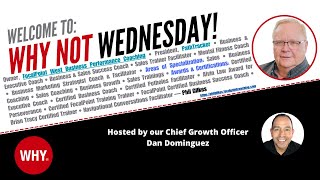
Coach Phil Gilkes talks about his purpose: challenging the status quo and helping others succeed. He emphasizes mental fitness as the foundation for sales, building rapport by listening to resistant people, and making small improvements. A client moved to Mexico and grew her practice after working with him.
Chapters
These last few years have made us question everything.
Our relationships.
Our jobs.
What constitutes an.
Office.
And who we are.
In a.
World filled with chaos, confusion and uncertainty. It's time for some clarity. It's time to start understanding one another.
It's time to start understanding ourselves.
We envision a world where everyone knows their why. But even more, we envision a world where everyone knows their why Os, their why, their how, and their what. The operating system that drives you, that lets the world know where you stand.
What your unique gift is, and most importantly, who you are.
Yos.
Are you ready?
Hello, everyone, and welcome to why not Wednesday. I am so excited to be with coach Phil today. Now, I would normally introduce him by his first and last name, but. And I'm going to do that. He's coach Phil Jilks. But if you look at his name, you're going to mispronounce it. So he made a decision a long time to be a long time ago to go by Coach Phil. And it works really well because he's an ultimate coach. Let me tell you a little bit about Phil. He's a true professional who has absorbed the teachings of industry giants like a sponge. He passes his knowledge along to his clients so they can achieve stellar results in every situation. Whether he's coaching a fellow coach, a small business or a large chain, you can count on coach Phil to bring his A game. He helps entrepreneurs, owners, and business development leaders to develop their mental fitness, get out of their own way and achieve outrageous results. Sales plus marketing plus mental fitness equals living your potential. Phil has taught mindset to athletes and coached hockey. He's trained sales teams to great results and has been re engaged to take that training to other company divisions. He's even helped achieve improvements in situations where the where the trainees were hostile to the trainings. And Phil, I am very familiar with that. Thank you so much for being with us on why not Wednesday? How are you today?
I'm actually wonderful. I'm gonna my little plug.
I'm wonderful, wonderful with. With a you. I love that Coach Phil. You don't do things the way everybody else does. You know, one of the great things about what the work that I do is that I get to meet people like yourself all over the world and I get to know them a little bit better by their yos. And your why is to challenge the status quo, do things differently. And just like you showed up, I mean, it's so amazing how it shows up so quickly. You showed us wonderful with a you.
What, what else? Yeah, go Ahead.
I was going to say the wonderful with you is I like to take credit for it, so I will. I had a mentor many decades ago. Stop counting years. So decades ago introduced that concept to me and I'd forgotten about it for decades. And I reintroduced it about a decade ago, which would be like nine and a half years ago almost. And I've used it ever since because it's representing the you in wonderful is you and you, you and you. And you are uniquely you. So go act like your wonderful self.
I like that a lot. And I want one of those cards. So I'm going to work really hard to make sure you have a great interview.
So.
So I can get one of those wonderful you cards. So, Coach Bill, one of the things I like to start with, and we kind of already did, is talking about your. Your yos. And we. We talked about this when we had our first call. But your why is to challenge the status quo. Think differently. Think outside the box. Bring people ideas they may not have thought of on their own. Your how is to make sense of the complex and challenging. So you take those. You. How you challenge the status quo is by helping people make sense of things. So it comes so helpful, probably is very helpful in your coaching and then that you're. What is to contribute to the success of others. And so what you do at the end of the day is contribute to the success of your clients, your. Your. Your fellow business people, your fellow coaches or whoever it is that you're. You're coaching. And man that there's a coaching spirit in you. So you've always wanted to challenge the status quo, help people make sense of things and contribute to their success. How. How did that. I know we. We talked about it already, but to our audience. How does that feel to you?
How does that feel to me? That's a great question. Normal. Yeah.
Normal is good. You. Well, you. Have you always been an outside the box thinker?
Gosh, I would think for the most part, yeah. I used to describe myself as a rebel.
Sometimes without a cause.
I'm not really a rebel, but I do like to do things a little bit out of the box or expand the box or change it from a box to a circle or some other geometric shape or even an amoeba.
So I guess I think a little bit differently. I just see that as normal. But now that you bring it up, it kind of does seem. I guess that is a little bit different.
Yeah. And it's great that you say that because I love that you said you considered yourself A rebel. A lot of us and I share make sense and challenge with you. With the why of challenge in our top three. Sometimes I felt like we're different than everyone else. And it's not until you embrace that difference and say, hey, that's a strength, right? And I'm sure for you it's a strength as you coach people in sales. So your example that we talked about in your, in your intro training, sales teams who are hostile to the training. Tell me about that environment, how you overcome that because I want to hear the creative ways you do that.
Well.
I was told by the business owner that there was be some hostile individuals and they had brought in somebody to be a support team and mechanism for me. And I realized I don't need somebody sitting in the audience to help me. All I just need to do is build rapport, ask questions and find out about the people in the room and encourage them to participate. And as a result of doing that, listening to them, asking questions, asking questions to get to a deeper understanding what was important to them and why their arms are crossed, sometimes they weren't crossed, but that's one way it shows up. If we have crossed arms, right. As a result of that, at the end of it, the.
I don't have it in front of me here, but to paraphrase that that particular incident happened about six or seven years ago and as a result of that they were really appreciative of the impact that the training had on them both personally and professionally. So I think it's really just by asking questions and listening. About two or three or weeks ago, I came across something that you would think would be normal and we should all pay attention to it. It's automatic. I'm always looking at ways to make myself a little bit better. Not like triple bases are loaded and you get a grand slam home run. We don't have to make changes like that. Small incremental, incremental changes is what I find works best over the consistent basis. And as a result of that, I heard something about three or four weeks ago and it was talking, we've said often heard we've got two of these and one of these and that's the ratio we should listen to. And the one who's asking the question is in control. What I heard that differentiates all of that supports it, but differently is the one who's listening is in control. So when you listen to what people are saying, I mean really listen, being present with them, then you are able to move from a hostile arms cross, maybe.
Individual to somebody who's more open like a parachute. When you jump out of a plane, you want it to be open, so, so it's more effective. And as a result of that, got a thank you card for one particular individual in that training about how it was life changing.
Yeah, just that's. Yeah, I'd forgotten about that for a while, so thanks for bringing that up.
No, there's a lot of gold in a couple of the things that you said asking questions. So many of us, especially in sales, ask questions but don't really care about the answer because we want to get to what we want to say. And I think one of the things you did is you asked questions. You said the key thing is ask the question and then listen. And then you listened to the point where you had somebody who had their arms crossed sent you a thank you card afterward. That's a transformation. And the transformation happens, I believe, when you actually pay attention to the people that you're asking the questions of.
This didn't happen overnight. This happened over a weekend. It was a weekend training Friday to through Sunday. It was reasonably intense, not crazy intense, but you know, they had to give up their social life and their free time to, to do this. And so it did take, you know, more than an hour or two. It was a few days in a row.
You know, Phil, I read this in the introduction to Coach Phil. I gotta remember that. Coach Phil. So Coach Phil, you, you. I like formulas. You said sales plus marketing plus mental fitness equals living your potential. How do you. In. If people are working with Coach Phil, do you apply that formula? What, what's, what makes that formula up and how did you come up with it?
Well, the, the mindset part of it. Mental fitness has always been part of my journey.
Gosh, decades ago, when I first stumbled into people like Brian Tracy and Val Vanderwald talked about it's this thing here. If we change this, everything else will change. So I've been a student of that.
In a life's journey. I don't have any doctorates or degrees in any of this. It's just a street smart degree in. And I'm working on my master's by the way, and I, I heard that you never get a piece of paper on, on the masters that I'm working on because it's not associated to a school, it's associated to life. And as a result of it.
The lessons and things that I pick up along the way from people like you and others add to.
The formula. So a better way to have that Mental fitness would be as the foundational piece. Sales and marketing on top of that. Because without a sale, nothing happens. Whether we're selling the idea of going for ice cream or. Or negotiating an opportunity to help make a business more profitable or to move people to a cause that speaks to them, whatever that might be. Mental fitness is the foundation to it, I believe, because it all starts there. If you change, as Zig Ziglar used to say.
How did he say that? The stinking thinking. So stop your stinking thinking and look at life with possibilities. Napoleon Hill talked about that. If you looking at your ideal end result, that kind of thing. And when we do that, that's the mental fitness side of it. More than just mindset. There's a way to control this, to quiet down the saboteurs in there, because we have 10 of them, a judge and nine supporting cast. And if we can help people identify what they are from 0 to 8, they served as well. But now, after that period of time, there's another way of living and thinking. And if we live in a state of mind, of ease and flow, and stop being like the fly that lives in your house, sneaks in, doesn't pay rent, and is trying to escape through this big piece of glass, your windows, and it's buzzing up against it, bashing into the window. It's too small. It doesn't have the critical mass to break the window. So doing things harder isn't the way. Doing things with concentrated effort is more likely to be successful. Just ask the fly that's sitting on your windowsill right now, today.
That fly example, I've heard it before, but I like the way you talk about it. It's not about doing it harder. It's maybe sometimes it's doing it smarter or doing it different. Right. Activity. I talked to a coach recently. Activity does not necessarily mean productivity. You can sit there and bang your head against the window a lot to be very busy.
Yeah, we actually have three minds, three sections. We don't really, but we do. For what I'm going to tell you, we have a conscious mind, subconscious mind, and a creative subconscious mind. And the creative subconscious mind's job is to maintain our sanity. In other words, our isness, how we see ourselves to be. And when we deviate from that.
It brings us back to our comfort zone into how we see ourselves. So if we have an addiction that's not serving well, it is serving us. That's why you have the addiction. But if we have, if we're not living life the way we'd like to, and we're wishing that we could have a better life, then our greatest subconscious mind is doing its job, keeping us stuck in our isness. But when we get a big enough goal and aspiration that we want to grow into, then the creative juices get turned on and we find ways to solve the problem, the new problem that we've created that turns it into a challenge and an opportunity versus a problem that holds us stuck in the mindset that we had that we're not worthy, we're too small, we're too old, we're too whatever the excuses is our saboteurs minds. That inner critic talks us or attempts to talk us out of what we're doing. And what you reminded me about is I remember reading a book by a doctor out of the.
Pacific Northwest and he was talking about.
The same sort of thing and gave an example of somebody who was in hospital because of obesity and they had some surgery to deal with that. And they knew that they needed to put them on a treadmill to get them active and get the physicality going. And he knew that if he told them about that, they wouldn't do it. So he co yesterday, he said, have you ever seen a treadmill? Yes, I have. Would you be able to just go stand beside it or on it? And anyway, what ended up happening is they stood on it and because they kept under the amygdala, the thing that does the fight and flight mechanism for us, it didn't wake it up. This particular individual, this patient, started walking on it and as a result of that, did what they needed to do without having the creative subconscious mind stop doing it. He said also that a lot of people will do things.
That are comfortable to do and they feel like they're doing a lot of great things, like their turning on the endorphins, dopamine's happening because they're doing stuff. They've got this busyness. He spelled it B U S Y N E S S. But they're not doing the things that would take them to what they aspire to be because those are out of their comfort zone. So they're being.
Hijacked by their saboteurs that are keeping them stuck in their business, as I mentioned before, and in this state of busyness instead of effectiveness. So he was an amazing doctor as well.
Busyness versus effectiveness. I love that. Coach Phil, you talked in. We talked earlier in your introduction about the clients you work with. So it's entrepreneurs, owners and business development leaders. We always ask, you know, who's Your ideal client. What kind of problems do you just say? Man, I'm so glad you came to me because I can help you.
Not the ideal client, the ideal problem that they bring you.
Well, I think this will answer that. You tell me if it does or not. What I discovered in my journey is that.
I want to stop under living and grow into my potential. So what I'm looking for is individuals in the space you talked about, sellers, leaders, business owners, entrepreneurs, where there's, they know that there's more for them to achieve but they seem to be stuck in one way, shape or form and they're looking for a way to stop under living and grow into their own potential. That's what I'm looking for. People are open to.
Being comfortable, being uncomfortable knowing that that's kind of what it takes to get to where they want to get to and aren't afraid of doing it. The work and putting in the effort and again, going back to like the parachute. They're open minded to it. They may not like everything we talked about, but they're willing to give it a try. They're not cynics. They can be skeptical, that's totally okay. And go out and try what we're going to talk about and what we're going to work on. And they want to grow. They're not just.
Not having lip service towards it. They really are inspired to take action. They just want somebody to.
Confide in, to be, help them be accountable, those kind of things and maybe some ideas and strategies, tactics that would support where they're trying to get to. That's kind of what I'm looking for.
That's great. And, and that really does for me it crystallizes to make sense.
Right.
You help people get unstuck and un. You said under living and that's a, that's a great word. Getting people to live to their full potential. You coach some sports too. So, so coach Phil, I'm, I'm about to start cross country season with my 11 year old daughter. What's, you know, you, one of the things you said just now that in cross country one of the hardest things to do is get those athletes to get comfortable being uncomfortable pushing themselves to that limit where your lungs are burning. And it's really not. You know, I had an Olympic athlete once say it's not who, who, who runs fastest at the end, it's who dies the least at the end, who wins the race. What, what advice do you have to a, to a, you know, a coach that's coaching some Middle school kids to help them get comfortable being uncomfortable.
Well, just like your branding there, everywhere says why.
Why are they running? Why do they want to do that? They really need to get in tune with that and do it on a want to choose to love it basis versus have to do it because you don't have to do anything. A really good story about that for one of my mentors, Lou Tice. There was a marathon runner and from another country, Africa I believe it was, they were referring to. And he had asked no. The athlete said, well, I have to run. He said, why do you have to run? He says, oh, he was. First of all, he complained, I get to a certain point in the, in the marathon and it hurts and I just, I, I just don't feel like running, but I have to run. And Lou said, so you don't have to run? He said, well, yeah, I have to run. He says, why do you have to run? He says, well, if I win the race, then I'll win a cow and I'll feed my family and then we'll be looked after. And he says well, because he says well if before you do that, just if you don't want to run, stop running. And that's when he went in and described the story about, well, if I stop running, I won't win the cow, I won't be able to look after my family. So Lou said to him, so shut up and run and get the cow. What's your why? That's really what he was getting at. So big enough reason to be feel like you're being pulled there versus being pushed, have to versus want to. You want to do things on a want to choose to love it basis and when you get there it's easier to do it. So if it's a youngin I and they have aspirations to getting higher education or running for their country in the Olympics or something, get them to focus on that. And all the pain they're going through is just the things they need to do to build the resolve and the habits of competing like a champion.
I have a quote that I read recently. I'm going to run by you, coach Phil. And it's actually the thought for the day that I read somewhere it says, well, which athlete would you bet on? Number one, A one in a million talent who habitually falters when confronted by self doubt, but they're supremely talented. Or number two, a far more modestly gifted performer, but one who could buckle up each day no matter what emotional headwinds he or she was facing and keep grinding. Which one do you want to coach?
Number two. And you took me back to when I think about the last organized coaching I did with athletes.
As their coach was hockey. And we were working with elite girls 15 to 18 years old. And we had three teams at the time that we drafted out of a pool of 120. So some of the girls never made either one of the teams. And the rest of them were split up in the three. And we had some of the best and some of the media and some of the, you know.
Less talented. And what we found was it didn't matter to us. The team that I was with and the other coaches, we had a mindset that if you coach kids in a way that they want to be part of something bigger, then leverage your talented individuals to be leaders on the team and elevate the others. And if they're working together as a cohesive unit, there's more fun, more reward and more opportunity. So that's why I picked number two. I didn't even have to think about it. There's a story about the hare and a tortoise who won the race. The tortoise. And something I just found out recently talking about being a sponge and looking for content. I didn't know the lifespan of a rabbit if they don't get eaten is two years. I didn't know that tortoises are 100. Would you listen to who would you hang out with? The hare like you're talking about or the tortoise? Well, I think the tortoise is the wise one.
I might have figured that out some years back, probably inadvertently. Not. Not near as. As eloquently as you just put it. I remember I used to tell the kids hard work beats talent. When talent doesn't work hard.
I like that. I would take it to the other thing. I'm going to go back to the fly who was trying to hard to put get out. But people that play with heart or show up with heart will have more success than ones that just do it when raw talent.
So true. And. And we see it all the time. Successful, you know, brilliant athletes, brilliant performers who just never live up to their potential because it comes to them so easily.
Yeah, there was. I forget the name of his hockey player. He's from Sweden in an NHL hockey player played in Calgary and they did a talent, raw talent. Man, he was amazing. You could pick a spot on the crossbar on the net and ask him to hit it. And he hit it. But when it came to winning in the big moments. He didn't have the tenacity. He didn't have the will to win, but he was really a talent. Probably. I never met him. He was probably a nice guy, but he didn't have the heart and the work ethic. Because you still have to work. It doesn't have to be hard. It has to be effort. Constant effort.
I like. And then. And it's in. It's constant and consistent.
Yeah.
Coach Phil, we, we talked a little bit about this in the pre show. Tell us about your why not moment. The name of the show is why not Wednesday. Tell us about a time in your life that you said why not to an opportunity, something that came up in your life and you're so glad you did. You did say why not.
Yeah. Okay. I wasn't sure if I'm going to share this one, but I guess I will. So back a few decades ago, I got to a point where I found myself broke, brokenhearted, no place to live, in debt, no credit. And.
My why not? Moment was why not start a business? So I did. And the rest is history. The journey has been to go from there to where I am today and help others along the way. So that was my why not moment. There's been others, but that was probably the most relevant one.
What, what drives you when you're at the lowest point? You said you're broke, brokenhearted, no money, no credit. What. What, what made you say, hey, you know what I'm going to bet on, Phil?
Well, I'm better than the situations. My past does not make my future unless I choose to allow it to leverage it. So one of the things I do on a regular basis and I work with my clients to do as well as develop.
A causative power is the way it was explained to me, the psychological phraseology is self efficacy. And that's just the other side of self esteem. So if we have good high self esteem and high self efficacy, we can get more stuff done. And there was a Dr. Albert Bandura, who was a father of self efficacy. He said, we go through our successes way too lightly and way too quickly. We take ourselves for granted. So I listened to what he was talking about, and I no longer do that. So one of the ways to help elevate myself from average to above average and keeping on, keeping on is looking at what I've done in the past and the wins and successes. And I borrow those emotions from the past, from one of the ones was when I was appointed the captain of my Pee Wee hockey team way Back when. And that's starting to lose its spark and emotional drive, but it still has some. So it's still part of my narrative when I look back, of how do I turn the seemingly extraordinary into the new ordinary? Well, I leverage this list by borrowing the feelings of being a winner and succeeding and overcoming the challenges along the way to elevate myself to another place and turn that into my new normal second nature, just like me. And I share that methodology with all the people I work with. So the clients that I have, well, I got one of them living in Mexico. And as we started working together, she was a single mom, still is, three kids, still has them, and had an accounting practice and didn't like winters. And so she wanted to be able to raise her family, grow her accounting practice away from the winter temperatures that we have sometimes in Canada. And so she had this wishy washy. She didn't. Wouldn't dare to say it was a goal, but kind of this wishy washy dream. So. And working with her, we realized it was more to her than a wishy washy dream. So we got her to think about what would it be like if she turned it into a goal. So the long or the short of it, eight months later, of working together, she was living out of the cold temperatures of our country for half of the time, growing her practice, increasing her revenue, getting rid of the clients that didn't resonate with her and finding more clients that did. And as a result of that, she's living there full time, raising her kids, and she's taught the 100 success list approach to building efficacy to her kids. So that's kind of cool, don't you think?
I like that. You know, and as. As there's so much, you know, we're probably going to have to have you back on Coach Phil, because I like the way your purpose, when we looked at your purpose, you want to impact the world first through your clients and as you just shared through their families, then their employees, their companies, their communities, their regions, their countries and. And then the world. But it starts at home. You start with your client and then their families. And what a great example, because she. You went full circle, right? You started with a dream, which then became a goal, which then she realized. And now going right back to. At the end, she's teaching them the same lessons. Tell me, tell. Let, let's, let's do this. Because when I had my first conversation with you, you introduced me to the difference between congratulations and thank you, and you went back to a TV show the Price is Right. Tell us the difference between congratulations and thank you and then maybe we can get into CTAPs really quick.
Yeah, so my take on that is Bob Barker is where I got this idea from. And if you watch the show the Price Is Right when he was on and hosting it, they would say, congratulations, you're the next contestant on the Price Is Right, congratulating them. So about them being winners. And so all the four guests show up at that panel and then you get to bid on the game. And then if you get up there, congratulations, you coming up on the stage to play this game, and then you're feeling like a winner. And if you play the game and don't win, they'll say, well, thanks for playing the game. But the good thing is you get to play spin the wheel so that they go through that process. Well, the I got out of that was.
Barker. Bob Barker would congratulate the people that continued to advance. So they came out of the seats up to the one of four, from one of the four on the stage, played a game, and then depending whether they won the game or lost the game, it was a thank you or congratulations. Congratulations was when they won.
Thank you was they appreciate you being here. So the thank you is more about.
If I show up to say, hey, thank you for the time today, that's more about me. But if I say congratulations for taking time out of your busy schedule to explore the possibilities, that's certainly more about them. That's what I got from watching TV show Bob Barker hosted the Price Is Right.
Thank you so much. That is a great example. Coach Phil, I have so many more questions I want to ask you. I'm going to have to have you back on a show number two. But for now, what do you say we end the show on that note?
Why not?
Thank you so much for being on Coach Phil. I look forward to having you again. I look forward to being on your show and I look forward to continuing to speak with you and to grow our networks together because I know that this has been a positive connection for me and I hope to make it a positive connection for you.
Absolutely appreciate the opportunity.
Have a great rest of your week and we'll see all of you back next week on why not Wednesday?
More from Dr.




Women In Leadership: A Need For A Greater Systemic Change With Belinda Clemmensen






