WHY Not Wednesday with Raymond Kemp - Fleet Master Chief USN (Ret)!
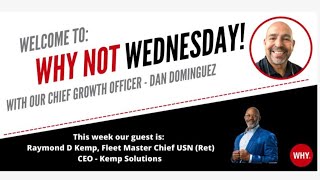
Raymond Kemp spent 33 years in the Navy, rising from enlisted data processor to Fleet Master Chief. He credits a "why not" moment studying for his rating exam as pivotal, and now runs Kemp Solutions helping teams build resilience and resolve conflict.
Questions this video answers
1986
33 years
USS Independence, USS Abraham Lincoln, USS Mason
American Battle Monuments Commission; appointed by President Joe Biden
58 monuments and cemeteries in 17 countries
Chapters
I can. Loud and clear. Can you hear me?
I think we are live.
Raymond.
Yes, I hear you loud and clear, Dan. How me.
If you can hear me? Hang on. We are having some technical issues. We'll be right on.
No problem. I'm too young to be in a hurry.
You.
Okay? Can you hear me now?
Hello?
Okay, can you guys hear me?
I can hear you. Can you hear me?
Yes. Okay, we're ready to get started. Sorry about that. Oh, good.
Let me make sure all my devices are turned off.
Let's put. Let's turn on Raymond's camera.
Oh, God. Sorry about that.
All right, so we are still live. Thank you, whoever is still on. Thank you for your patience. This is. Why not Wednesday? You know, I've been looking forward to this for so long, Raymond. I can't believe we had technical difficulties. Literally had to restart my computer. But, you know, technology is like that, isn't it?
It is, it is. Every now and again you have to go to extreme measures to get to that solution that we're looking for.
Well, Raymond, you know, we've known each other a few months and you've been one of the people that I've just been so glad to meet and learn about. We had a chance to do a workshop together in Oklahoma. We got to see each other live soon after all the restrictions were over. So I, I can't wait to introduce you to, to the Y Society and to everyone that follows us here on why Not Wednesday? So, Raymond Kemp, you're the CEO of Kemp Solutions, but you're also a 33 year Navy veteran who has an amazing story and I'd love to start with, you know, where you started and where you finished. I teased some of the folks on, on LinkedIn today and I talked about what does it take to go from being the lowest ranked guy on a ship to being the highest ranked guy in the Navy over the course of 33 years and meeting every president from President Reagan to President Obama, every president that was in service while you were in the service. So tell us about that journey, because that is an amazing story.
Well, let me tell you, first of all, the super short answer. It takes persistence over resistance. So I joined in 1986. And that era was a very tough era for those who remember back and perhaps for those who just had to read it in books, it was tough as it read. In fact, I would say it's probably even tougher, specifically because the leadership at that time, 1986, if they had 10 years in the Navy, that means they joined right at the end of, you know, the Vietnam era, if they had 15, 20 years in that mean they served while president, while Martin Luther King was still living. And that struggle of civil rights and depending on where they stood on the civil rights, you know, in the civil rights posture, they turn into leaders. So my first master chief that I ever met, so the first E9, as I got assigned to Philadelphia and to my first ship, which was USS Independence and aircraft carrier, I walked in to meet the master chief and it was, it was tough because the data processing technicians before me who went in all got assigned to adp, which is where the computer dudes worked. And it was all male ship. And when I walked in, I noticed immediately there was that burnt orange and cream, you know, flag of the Texas Longhorns. And over his, his, his left shoulder, my right side was a Confederate flag. And because I was born in the great nation of Texas in the 60s, raised in Oklahoma and the 70s, I had a certain lifestyle that held me accountable to certain standards. And so when he said to me, I don't allow any black guys in the computer room, and that was not the language of the day. You're going to go to this other division and instead of working on computers, where you graduated at the top of your class and had the option to choose orders because, because of that performance, you are going to go over here and you'll be painting walls and chipping paint and laying tile and doing all this manual labor. And it was challenging. But then when I got into that division, I saw my goal in the Navy when it comes to rank. Another black person who had. Because that's where all of the black people went. He's. All the black people that he assigned went there. And when I saw that, I was like, well, shucks, if you can do it, I know that I can do it. And relationships are important. And so I asked them and they kind of pointed me in the right direction. In fact, they used to say that I could be, quote, unquote, the one. And turns out that I was. So several ships later, advancement to master chief, command master chief, selection as the first black fleet master chief of Europe and Africa. And things worked out in my favor. Now, what I will say is that for those sailors that are listening, is that the master chief of the Navy unexpectedly retired. And at that point, I was the senior fleet master chief, therefore the senior enlisted person in the Navy.
And that is a 33 year journey.
Raymond.
Yeah, you know, a lot of people, that's a lifetime for a lot of people. You went in As a very young man, and you're still a young man, but now you're doing something different. You're the CEO of Chem Solutions. I've heard you speak. You're a phenomenal speaker and you're a leadership expert. What's the biggest leadership lesson you learned in that time in the Navy?
I'd say during my service time, what was validated because I was raised by a single mom for a good portion of my life, and my grandmother, both of them were just fierce angels, as well as the rest of my aunts. What they told me as a young child is that three things, one, you keep a good attitude. Two, believe that you can do whatever you're assigned to do or whatever you desire. And three, do all things with character. Through my career, it was attitude that allowed me to overcome various different challenges and what I didn't know, because as a young man, I just want to survive. I just want to live. I'm not thinking about being a blazing a pass for anybody else. I'm just trying to live, you know, make the next rank or get to the rank that I wanted to retire and so forth. And what ended up happening is that people were inspired by that good attitude. And thankfully because of that, thankfully because of that, there were other people who were advanced and promoted throughout their careers as well. So long answer. But, you know, the main thing that I learned about being a strong leader is having a solid attitude. Because like the old saying goes, your attitude will determine your aptitude.
So. So I'm off camera because I'm having video issues, but you look great, Raymond, so I'm going to keep you on camera and ask you some, some questions from off camera.
So, Raymond, you recently joined the Y Institute, and we went through your yos, and that was so fun to do that with you. You know, we know that your why is to find a better way, right? Your how is to challenge the status quo and your what is contribute. You had such an aha moment when you found that out. Tell us what that has meant to you since you discovered your yos.
It has been an incredible relief. It has been a validation of some of the thought principles, you know, that I had while I was serving on active duty. And even when I first retired and began to interact with other professionals.
And by that I mean in the Navy and with other services, as we interacted, oftentimes when I entered into a space, there's an impact, you know, on the thermostat, because at that time I was caring about probably 260 pounds and 260 pounds with a 34 inch waist. And clearly 10 or 15 years in the weight room can be intimidating some six, one and a half or so. And that can be intimidating to people. And so because better way is my why, but challenge is the how I get there. Then when I lean towards someone and I say, well, why are you doing it that way? And how about doing it this way? And have you considered these things? Because I challenge the status quo. I challenge traditional thinking, then people would be very disarmed just because of my presence. So what I intentionally did was have relevant relationships around the Navy. And whenever I would go someplace, I would tell people I was coming. Not so they could treat me a certain way, but just so they know where I was going. And if I encounter someone who might have been intimidated and they say, oh my God, I met this guy, he's this way. Those relevant. The people who I knew already would say, whoa, whoa, no, that's camp. He's looking out for your favor. That guy is legit. No matter how, whatever, no matter what he says, do what he says. Believe he's there to help. And now that I know you know, and I'm not 260 anymore, but I'm about that, I can still walk into a space and say, look, I can break down. Look, my. I'm very naturally seeking a better way, and I do that status quo traditional thinking. So don't feel intimidated by my presence, because I'm just here to have a positive impact, to contribute to the greater good of the organization and the people. And it just makes things so, so much better. So I'm, I'm excited and, and share it. Each time I have, every time I have the opportunity to talk to a young, a group of leaders.
That's outstanding. Yeah. So. So, Raymond, the, the other thing I always like to ask is, tell us about your biggest why not moment that you had in your career. Name a time. Talk to us about a time that you said, you know, why not? Because we, we have people on and we ask why. Tell me a time. You just said, why not? I'm just gonna go. Go for it. And how did that work out?
So the, it was actually a moment that just flowed into the rest of my career because I, I had a leader on board a ship that I was stationed on, USS Abraham Lincoln, who told me. It was Fred Hyde who told me. He said, hey, we've done all we can do for you.
Figure out how to get past this rating exam, which is the way the Navy promotes And go from there. Now my paradigm was that the, because of the school system that I grew out of, I wasn't intellectually prepared to take the exam. You know, so on and so forth, right? And once you said it's on you, and I was like.
Okay, let's just try. Let's just lean in and give it all I've got. And so I figured out new studying techniques and I talked to other people and sought out help, which was difficult. And once that happened, dang, it just changed my whole way of learning. It changed my approach toward the rating exam, including the rest is history, because I made my way expedition expeditiously through the ranks. And what was once my ceiling had become my floor and I was standing on it. I wasn't just standing on it, I was walking it out. And so it was the okay, enough with the excuses. Why not lean in and get after it? And then what happened after that is every time I was called upon, I always had a question and I was always prepared to speak. So in an instance, whether it's meeting the president, whether it is listening to the secretary of the Navy give a speech and then say, does anyone have any questions? And a room full of three star, four star admirals and civilian equivalents and no one has a question. I'm like, oh, I do. Why not me? And so that has been. That was probably my biggest why not moment. One more just super quick story. I was in a place with, you know, I was in a combat environment and something just tragic occurred and I knew it was going to be on the news and so forth, and my friends were concerned, family was concerned. But then I get back home and one of my other buddies, Darren Mars, he said to me, man, why are you. I was 21 years in the Navy. He's like, why are you still in the Navy? What are you doing? You need to get out here, do this thing we're doing in real estate, so on and so forth. And I was like, if not me, who's going to do it? Who better than me to stay and lead and teach these folks how to show what right looks like through leadership and through proficiency within their particular skill set. And that's all of that came from that why not? Moment of perhaps I can do it. And I just put all my energy towards being the best person that I could be and then leader.
And you, you took something that could have been negative right in, in that first assignment you got on that first ship, right? You said, you know, I'm gonna lead. And I'm gonna become a leader. And you became a leader, and you rose through the ranks that way. Tell us about that, that initial experience.
Well, I'll tell you the. The. That first day and, you know, being sent out of there because I thought to myself, that's 1986. Surely you can't be. That seems like that language would be over with by now. And he said, you know, you're going to go to this place. And I said, well, where is that? And he's like, you go ask that boy. He had that Southern accent. Sounded like they had four. Four Bs in the front of it. But you asked that boy sitting out there at that desk, and he'll tell you where to go. And that. That was troubling. However, what I knew and I had been taught, you know, through my family line, that you can, if you believe you can, achieve. And so I'm like, whatever. I'm just going to go someplace and be the best because I.
The.
The Navy has its points where it's a meritocracy. And so if it's a meritocracy, then I win because I'm going to go all in with. With all that I have to be successful. But what he thought, you're right. What he thought was going to work out for my bad, actually worked out for my good in a tremendous way, because the first time I heard someone say, that guy is a data processing technician, he could be the one, I. I believed it at that point. And so then it was just a matter of effort over resistance.
I love that. And then you rose to the highest rank for an enlisted person in the Navy, and you have a cool story. You've met every president from President Reagan to President Obama. What was that like for you? A young man coming out of Oklahoma, not a great school system, not a great neighborhood to get to meet all these presidents. That must have been just really exciting. And how did you handle that?
Well, even though, you know, tough situation that I grew out of, I always felt like I had a right to be wherever I was. And I never felt as if it was an accident that I was in a place or meeting a person. And again, that came from the example of the household that I grew up in with my mom and then this incredible support system that she had with my grandmother and her sisters, my aunts. And thankfully, when I was a child, one of my aunts had a. She worked at a banking facility, and I was a banker waiter. And I was around these grown folks as a young kid, 15, 14 years old, and I just learned how to keep my mouth shut because in those days it was important to be seen. I heard and don't speak unless you talk to, unless you're spoken to. And then, you know, so once I got into the, into the Navy and were in the rank and the first time I was, you know, in the space where President Reagan came in and he's walking by and shaking hands and so forth, it was, it was an, it was an interesting situation to see how other people who thought he was the greatest president person in the world were reacting. And each president has their own fan club. Very honestly, I just wasn't intimidated by it. And then, you know, the same thing, you know, later on in my career, whether it be Bill Clinton, President Obama.
W. Bush, the second Bush too, was legit. He was, he had a lot of bad press. But my interaction with him in a very, very private moment on the day that he got his final award at Fort Myers was a interesting, you know, man to man exchange and very, very pleasant. And at that point, again, I wasn't intimidated or nervous about it because I wasn't bred that way.
So, so you went, you know, I've heard this story, but I'd love for you to share it. You had your nieces ask you about meeting President Obama. I want, I want you to share that story with our, with our audience because you had an opportunity to meet, meet him and your nieces were big fans. Tell us about that.
Right? So my, my. So I make my way to Washington D.C. 2008. The election process has taken place. They're looking forward people to be a part of that program. And again, I had just been stationed there so visiting my cousin and so I didn't have any notice. So his, his daughters are my nieces, right? So they're like, uncle Raymond, Uncle Raymond, are you going to get a chance to meet the president? You're going to get a chance to meet President Obama? And I was like, are you kidding me? Is he going to get a chance to meet me? I mean, I've been in the Navy 24 years or whatever. At the time he had a speech, he got elected to Congress. You mean he's new. I've been doing this. Is he going to get a chance to meet me? And they go run and tell, you know, my cousin, Daddy, Daddy, Uncle Raymond said, well, he have a chance to meet him. And he, of course, being my older cousin is giving me gas like, oh, here you go. And sure enough, I got selected by Admiral Roughhead to be the, the Navy representative. On the Armed Force Inauguration committee. And.
Next thing you know, we're at that first kids, the first concert out on the mall, you know, when he got elected. And you know, there's Jamie Foxx and all those should be frank, you know, all those people there, we're there. Then there's the kids inaugural, we're there. And sure enough, I mean, I met him several occasions. So when, when, whenever I see my cousin, I'm like, oh, yeah, remember that time?
I love that. I love that story. So, Raymond, you, you, you left the Navy, had a distinguished career, now you are the CEO of Kemp Solutions. What's your focus? I mean, you, you, you're, you're obviously a better way guy. So what people can expect from you is a better way to do things. How you're going to get to it is by challenging the status quo and doing things differently. But ultimately what people can count on from you is that you're going to contribute to their success. How are you living that? As the CEO of Kemp Solutions and as a keynote speaker, what's your focus?
Right now, my primary focus as I talk to companies or even in this season, right now, as I'll be speaking next week to the recently advanced chief petty officers here in the Dallas area, my focus is building resilient teams and creating an environment where there is a measure of loyalty that is grown within the organization. And so helping those leaders master the pathway to leadership is my primary focus. And teaching team building techniques and, you know, approachability, their skill set, when it comes down to having frank conversations about touchy topics. And we've got aplenty so from the social discord that we've had through, you know, the splitting of a good portion of America with regard to the political posture that we're in right now, as well as, by the way, the COVID 19 pandemic, which is still raging in various different places. And so vaxxers, anti vaxxers. So helping people make their way through conflict and resolving that conflict is my primary focus.
So given that, how are you using your newfound knowledge about yos with the people you work with, how has that made a difference?
Well, so while in.
While in, you know, my former career in the Navy, it was, it was important to, you know, let me show you, I can show you better than I can tell you. And now I can tell you as well as I can show you. And so that allows me to cut down on the lag time where people believe that I'm truly there to be supportive. I tell you what, Dan, if I had this language when I was the IG for the Navy. Oh, gracious. That would have made things so much easier. But as I go into organizations now, then the ability to articulate that to them is extremely, extremely helpful.
We had an opportunity yesterday on a different.
Show that we do to talk to a couple, and they talked about the difference it's made for them to understand each other's why, how, and what. And I remember you and I had a conversation, and I said, you know, Raymond, think about the interactions that you have, and think about whether knowing a person's yos would be helpful to you in that situation. Have you. Have you experienced that anymore since we last spoke?
I have. There's a company that I was working with in North Carolina, and I had the president take his do the yos before we had the. I mean, do the Y discovery before we had the yos discovery discovery. Which is super cool, right? And knowing his why and being able. He's a contribute guy. There's another company that I work with out in Los Angeles. They also, that CEO Darren Mars is a contribute guy makes it just so much easier because, one, I'm a contribute person. It's not my why, but it is my what. And so I can speak the language. And as you and I discussed, when you have one of the. One of the whys in common, you instantly click in that particular area. And that has been so, so accurate. So. Yes, yes, I have. And I'm so thankful for just having the knowledge, because as I said a moment ago, it just cuts down on the conversation we get right to the. I believe.
You know what I'd love to hear, because we've talked a little bit about that, but you recently had a really.
Cool.
Appointment by President Biden to the National Monuments Commission.
Yeah, American Battle Monuments Commission. Yes.
Yeah. Tell. Tell us about that. What that has been like. I know you've. You've visited Washington and tell me what. What that's been all about.
It has been very, very interesting. So the American Battle Monuments Commission is made up of 11 commissioners, of which I'm one. We are all appointed by the President of the United States, and We're responsible for 58 monuments and cemeteries around the world in 17 different countries, including the United States. And so recently, I had the opportunity to go out and get sworn in and do, you know, take our official photos and get the. The government.
Access to the things that I need access to. Very, very pleasurable. And by the way, within the commission, we have committees, and I am on the new monuments Committee. And so super short but interesting story to me is I served on board USS Mason. USS Mason is a guided missile destroyer which are normally named for sailors, Marines and coast guardsmen. This particular ship is named after a crew which just happens to be the first, the Navy's first all black crew during World War II. Just to kind of make it a shorter story, During World War II, they pulled into Ireland. They created a incredible relationship with the folks there. So much so that in 2016, while I was in Europe, the USS Mason pulled back in and there were parliamentarians there. There are all sorts of historians from Ireland who came to rendezvous and meet with the ship. Thanks to Mary Pat Kelly and I know that they are, have been looking forward to and hoping to do something there. And now things have worked out to where I'm on the American Battle Monuments Commission. I can facilitate that conversation between the United States and Ireland. That's exciting.
That is really cool. You've also worked with in countries all over the world with different governments, different diplomats. What's been your most interesting experience outside.
Of the U.S. i would say.
Wow. The most interesting. I would say that I had a short conversation with Benjamin Netanyahu. So he was. And he. I got it. He's a controversial figure to some people, but he was a world leader and had been for a long time. So he had finished doing a speech and talked to the press and he walked away from the microphone, he locked eyes on me and he walked up and he said, so what do you do? And I had the opportunity to share with him how I, you know, transverse the chain of command from the most senior person at the time was Michelle Howard to the most junior person in the Navy. And I can provide, you know, operational feedback as well as quality of life things, you know, to her. And I said, you should have someone like that. You should have someone who's just going to tell you the truth and not just tell you what you think, what they think you want to. What they think you want to hear. And the expression on his face was pretty interesting. Is all the strap hangers were trying to run over and find out what we're talking about. And camera slides.
Right.
But that was probably the most interesting moment. Now there's plenty of stories about, you know, other countries, but with regards to world level leader, that was an interesting time where it was important to, to challenge the status quo because normally people were just saying to him whatever it was he was accustomed to hearing.
I love that you did that, Raymond. You also had a part in something creating a Leadership curriculum in the Navy. I'm gonna probably get this wrong, but is it, Was it Lay the Keel?
Laying the keel. That's right.
Laying the kill. Tell us about that. Because I've heard about that from, from other folks in the Navy, but you had an integral part in that. So tell us about that.
Correct. So Laying the Keel is the. It's the seminal document for the shift in the Navy's focus on educating sailors with regards to leadership. So in days gone by when we were building wooden ships, that one straight, hard beam that was laid at the keel of the ship, everything else fed off of that. And so in the creating of laying the keel, what we did was we talked about the leadership strategy, you know, for those young sailors we talked about.
And that's officers and enlisted. We created an environment where there is a follow up to those initial leadership talks and trainings that they get. And then we brought back initiation for the senior NCOs. And so for those who make their way from E6 to E7, which in the Navy is from first class petty officer to chief, the initiation process we brought back and then we detailed it in such a way where there was enough formality that the entire Navy that made it to that rank would be able to speak the same language, learn the same fundamentals, and still allow each organization to have the flexibility to teach the specific things that were, especially with regard to heritage, that were important to those commands. And so that was, you know, that was a heck of a way to go out. So that that happened probably was finalized maybe about just about a year before I retired. And to see it come to fruition with the support of the Massachusetts of the Navy, Russ Smith, as well as the Chief Naval Operations, was pretty darn exciting. And I don't want to just leave it there. It was satisfying and fulfilling. And that, I believe, is what each and every one of us should find within our profession.
Now, I, I love that. I love this whole conversation. I couldn't wait to have you on. I'm sorry that we had technical difficulties in the beginning, but, you know, like a true gentleman, you stayed on and we got this interview going. If somebody wants to get a hold of you, Raymond, and want to hire you and want to have you speak to their group or they want to learn more about leadership from somebody who's practiced it for 33 years at a very high level and who's now consulting with companies and helping leaders in the corporate sector, how can people get a hold of Raymond?
There are several ways on all social media I'm Raymond D. Kemp and if they want to go to my website, you're welcome to go to www. Kemp solutions.com and certainly on LinkedIn the same Raymond D. Kemp. I am searchable and findable.
There's awesome. Well, Raymond, it's been a pleasure to have you. I. I was looking forward to it for a while. This is a great time. I want to say thank you for your service. You know we're heading into Thanksgiving. I'm thankful for all the folks I get a chance to connect with through my work at Y institute. But I'm especially thankful to have met you and I'm thankful to have such a high, high level leader be a part of our team. And I again, thank you for your service. Look forward to interacting with you some more. And I want to wish you a happy Thanksgiving with you and your family.
Thank you, Dan. And thank you for your service. And to all of those folks who have the opportunity to tune in, I just want to encourage you with 10 two letter words. 10 two letter words that will make you a better person. That will make you a better leader for sure. Those words are if it is to be, it is up to me and we can win.
I love that. Thank you so much, Raymond. Happy Thanksgiving. And I know we'll be talking soon.
Absolutely. Take care, Dan.
More from Dr.




Women In Leadership: A Need For A Greater Systemic Change With Belinda Clemmensen






