WHY NOT Wednesday! with Rob Thomas
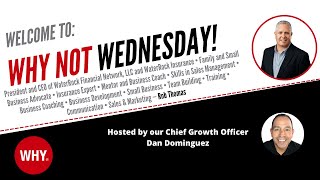
Rob Thomas, president and CEO of Water Rock Financial Network, discusses how understanding your purpose and operating system can reduce failure rates among insurance agents. He shares principles for transforming the industry and helping agents succeed.
Chapters
These last few years have made us question everything.
Our relationships.
Our jobs.
What constitutes an office.
And who we are.
In a.
World filled with chaos, confusion and uncertainty. It's time for some clarity.
Clarity.
It's time to start understanding one another.
It's time to start understanding ourselves.
We envision a world where everyone knows their why. But even more, we envision a world where everyone knows their why. O s, their why, their how, and their what.
The operating system that drives you, that lets the world know where you stand.
What your unique gift is, and most importantly, who you are.
Yos.
Are you ready?
Hey, good afternoon. Happy Wednesday and welcome to why Not Wednesday. I am so excited today to share a brand, brand new guest. And you guys hear the walk up song in the background. This is Brian's song and I mean Rob song, and it's a really great one. So I'm looking forward to introducing you guys to. To our guest today. Our. Our guest today is Rob Thomas. He is the president and CEO of Water Rock Financial Network and Water Rock Insurance. He's got more than 20 years of insurance experience at every level of the industry. He understands that success is not easy, but it's simple when you know the right pathways to success. He is a part of a network of entrepreneurs, innovators, and industry disruptors and legacy builders who are changing the way people work and live. By leveraging the secrets of the largest banks and Fortune 100 companies, he will give you the cutting edge strategies you need to build your business, your success, your life, your and your freedom. So let me introduce you guys to Rob Thomas. Rob Thomas, Welcome. How are you?
Hey, Dan, thanks for having me on the call. I'm doing amazing today and what a privilege to be here with you guys.
You know what's really cool is Rob Thomas. Believe it or not, guys, he and I met yesterday. Gary. Gary Sanchez, our founder and CEO of Y Institute, was given a keynote talk at a business conference here in Albuquerque. Rob Thomas was one of the people that raised his hand and said, hey, I want to know more because in the work that Rob Thomas does to help insurance agents succeed, and we're going to get more into that.
He saw a value in helping people understand their why, their how and their what. So this is somebody who just discovered their YOs yesterday. So let you know, we've got a few people here that we want to recognize. First of all, my good friend Watson Jordan. He was our first why not Wednesday guest and he joins us almost every week. Kurt Vaughn on and bring it on. It's a great Great day to ask why not? And I can tell you, our guest today definitely who will ask why not? Bruce, the captain is on the bridge. And Lorna Shaw. Listen, I think it's working, Lorna. Everybody else, if you can't hear me, let us know. Otherwise we're gonna get started. But Rob, so you just discovered your Y OS yesterday and it obviously made an impact from you. Your why is to find a better way. Your how is to make sense of the complex and challenging, and your what is to challenge the status quo. So you're someone who's always looking for a better way and you want to share that with others. And how, how you find those better ways is by helping people make sense of things that are complex and challenging and then sharing it with them. And then ultimately what you deliver, what people can expect from you, are solutions that are outside the box and different. And you mentioned it during the pre show. You've been sitting on that a little bit. How does that feel for you?
You know, it's a good, it's a really good thing. And the reason why is, you know, I, I told you earlier, we all have a perception of who we are and the way that we present ourselves to the world and what we think we are. Right?
Right.
But there's always this thing in the back of our mind that, that operating system that's going on and we don't really understand the why. Right. And so being able to connect those dots and then you, like I said, you kind of have this place now where you see it in black and white and you have to either accept or deny. And you know, because now it's shifting and changing the way that you operate because you're seeing it, you're starting to understand the, the characteristics. And, and for me, it caused me to rewind into my life in the past and really start seeing those patterns of all of those things playing out. And you come to that realization, you go, okay, now things make a whole lot more sense.
Isn't that amazing? You know, I will tell you when I speak and then when I'm giving talks, one of the things I talk about is people ask, why are you at why Institute? Because when I found out my why, when I discovered my why, my how and my what, all of a sudden my life made sense. And I think that's what you just said. And the coaches that are on the call, Bruce Watson, dez, if you guys have seen, heard that from your clients, how many times do we hear that? It is such an eye opening experience. And you did Exactly. Without any coaching, by the way, Rob, is we take people through. Okay, let's go back through your life. Talk about it. Time. Think about a time when you found a better way and you shared it. Think about a time that you did it by helping people make sense of something and then ultimately helped you deliver something that was different out of the box. And as we go through that, that's what you've probably always done, right?
Yeah. Yeah, exactly. And ironically, in my life, there had been a time where I had done almost like a timeline of my life, but I wasn't looking for my why or any of that. I was looking for my core values and how to identify those. Right? And trying to learn how to live out of those core values really became a big thing. But now those core values, as important as they are, they make. They take on a whole different flavor and.
Way of life when it's coupled with your why and that whole operating system.
You know, one of the things I definitely want to talk about, Rob, and because it's your mission. You. Right, you. You have a mission to make an impact on an industry that currently has a 98% failure rate. And that's the insurance industry I quoted this morning in the post that I put when I was introducing you. So it's 90 to 98% failure. Tell me, you know, tell me a little bit about that, because you have an insider perspective because you were in that industry. How, how. How is it that so many people fail? What leads to that? And then how do you, how do you plan on making an impact?
Yeah, well, so there's a. There's a really, a number of key factors that go into it, but for me, it's a, It's a scary proposition, right? Because running the kind of company I do, I'm asking someone to change their life, to come into a new industry. And let me say it this way, Dan. I think the insurance industry is one of the greatest jobs you could ever have, right? And here's why.
Every day, we protect the things that are most important to families. That's people and paychecks, right? Worst day, we get to be the only person showing up with a check to help make sure that family stays whole. And when we do our jobs the right way, we get paid better than doctors to do our jobs. So, you know, we're helping people, we're doing all those things. Yet there's a 98 failure rate. So there's a disconnect somewhere, right? And a lot of times, insurance companies, the insurance marketing organizations, they paint this picture of this amazing life that you can have and all the money you can make and they, they paint it out there. But the number. There's two key reasons agents fail. Number one, they have no clue what to say when they get in front of somebody. And number two, the more majority of agents run out of money to buy leads, so they don't have anybody to talk to. And they have stacked up debt and stacked up debt and stacked up debt. I talked to an agent one day, she was $27,000 in credit card debt and had to leave the industry. Not from our company, from another company, because she had bought leads and bought leads and bought leads and couldn't close anything. Didn't know what to say. And now suddenly she's, you know, 27, $30,000 in debt. And, and I've heard that story over and over and over and over again. And let's face it, there's only two groups that are really making the money, the insurance company and the lead generation company.
Right? And for me, you know, you look at my, my, why a better way? That's my first question. I go, there has to be a better way than this. Like, there has to be a better way for agents to do this because it's the greatest job.
So what you've done is you've created Water Rock Financial. And I love the origin. Tell us about the origin of Water Rock. I love you. You shared that story yesterday when we met. But tell, tell our listeners and viewers about it.
Yeah, so Water Rock was really, it came out of. I'm a Christian. I'm, you know, have a pretty solid faith. And in the book of Exodus, there's a story of Israelites in the desert. They had no water. There's, you know, 3 million of them with all of their cattle and they're, they're dying. And Moses struck the rock and water began to flow and it filled up the valley. And they were, it was a blessing to them. And we wanted Water Rock to be a place that we were a blessing to families, we were a blessing to business owners. We were a blessing to the agents that we worked with. That, that instead of receiving from them, we were able to give and give and give to them in greater capacity. That's really what this was about.
And water is life, right? I mean, we can't live without water. You know, you can live without food for a while, but you, and you can live without, you can't live without oxygen. You can't live without water. Water is pretty essential. It kind of fuels everything. So I love that because you're bringing life to an industry that, that is, that is frankly got a big failure rate. So we don't, we don't want to see that. Your goal is to work with 1500 agents in the next three years to coach, mentor, develop and lead to an 80% agent success rate. So man, you talk about flipping the algorithm, it's a 98, 90 to 98 failure rate to an 80% success rate. Tell us more about how you, how you come up with that goal. And, and how do you, what are, what are some of the things that you see that you're going to do differently? Yeah.
So, you know, 80, 80 is kind of an arbitrary number on some degree. But for me, as I looked at it, one of the things I had to say to myself is, you know, if we were to tackle this and change, change an industry, which is what we're trying to do, right? What, what number would we be satisfied with as a success rate?
And 80.
We kind of stuck to that 80, 20 rule, right? 80%. 20% of people are going to do 80% of the work. But if we can get 80% of the people to succeed in this, we have now really hit our mission of changing people's lives, right. Being an industry disruptor and really helping people live that life of freedom that, I mean, gosh, how many people are looking for a life of free.
Financial freedom? We're not talking about being rich, we're talking about that freedom that they can work from wherever they've got revenue coming in. They know that if the worst case scenario happens, they've got things covered and it becomes life changing. And so that becomes important to us. We figure there's 1.2 million insurance and financial service professionals in the United States. If we can just do a fraction of that and teach those group to do exactly what we show them and teach them a better way.
Right.
That can then become more of a viral movement amongst them as they go out and they build that life, showing others exactly how to do it. And we are not like other insurance companies. We're not even remotely close.
We talked earlier, Dan. There's close to 400 insurance marketing organizations in the United States. 400. They also the exact same companies, they all recruit the same people, they all.
Are buying the same leads.
Right.
And they're all seeing 98 failure rate.
Right.
It doesn't take a, doesn't take a rocket scientist who has an operating system of a better way to say there has to be a better way. Right. It really doesn't take. I mean, you don't even have to have that operating system to be able to say that.
Right.
For me, that's the thing that keeps me up at night, because I know as a new agent starting, I didn't have that. I was just taught the way to do it. And when it didn't work the way that they said it would, I had to start going, no, no, no, there's. There's a. There's a better way to do this. So that. That's how all of this kind of came around. And we have created some. Not only processes, but some ways to. For agents to succeed that nobody else has. And, and that's not a pat on the back. It was more of, I was in the right place at the right time to meet the right people, to connect the dots, to make sense of things. And now I, I have the, the means to push against a system, to change it, to challenge it, and say, nope, we. We won't go that way. We're going to. We call it Swimming in the Blue Ocean. Right. There's a red ocean.
Right.
We're all where everyone else is swimming, and we're over here in the blue ocean going, man, it's a beautiful, sunshiny day and it's peaceful and we've got people to work with and all of that kind of stuff. And ironically, our agents get paid to get leads.
Excellent. They're not paying for leads. They're getting paid to get leads.
Yes.
I love that. So, so tell me about this passion. You have a passion for helping live people live the life they were meant to live. And we talked about that blue ocean, but everybody can. A lot of people can talk about that. You've actually got, you know, 20 years experience in this industry to help people. You've done this at a really high level, at different levels. And so when someone comes to, to work with Rob, if they sign up to. To be part of your team and learn from you, what. What are they going to get? That's different.
Yeah, that's, that's great. First, let me tackle just that statement, because so many people. It's like a cliche name. Right?
Right.
But you hear a lot of times, live the life you dream of. Right. I don't think it's that it's just a life you dream of. I think there's a life that each of us were meant to live. Right. I really think that. And, and, and finding your yos is a critical part of that. Right, Right. Because there is a life that each of Us were, were meant to live an impact that we were meant to have in, in our families and in our communities and in our cities, whatever level that is, whatever that that looks like to you. But that's. There's a life that we were meant to live. And so we talk about it from that side. Because I'm less interested in just helping you talk about your dreams. I'm more interested in helping you figure out how to live the life that you were actually meant to live. Because that's, you know, Dan, that's, that's when you're the most fulfilled. That's when you're the happiest and have the, the most joy in your life and peace in your life because you are right in that place that you were created to live in. So that's, that's us and that, you.
Know, and it's so interesting you brought that up because, you know, people, people comment about energy. We always talk about in this space and in any space, really, what do you have energy for? Well, we know Rob Thomas is going to have energy for finding a better way. You wake up in the morning looking for better ways to do things right. That, that's going to be something that if you can find, if you have a calendar full of people looking for a better way, it's going to be a good day for you. You're going to help them make sense of things. If you're in a position where you can help them make sense of something, solve a problem and help them understand it, that's how you find those better ways. And then you what is to deliver solutions that are outside the box. So you're not going to do great in an environment where you're told, hey, this is the only solution we have. You're gonna probably have a different solution for every client you work with. And you're okay with stepping outside the box to do that, right?
Oh, absolutely. In fact, we have created a whole platform that is outside of the box.
Yeah, and I saw, I got a chance to see that. So where, where can someone go if they want to just, if they're in the insurance industry here? Let's talk to somebody right now. Let's talk to someone. I, I'm. It's a young person, or let's say, you know, somebody our age that is in the insurance industry and, and they're that $20,000 in debt and they're about to give up and say, you know what? I'm not cut out for this. What would you say to them? What should they do?
You know, and not in a selfish way, but I would say reach out to me. Like, we can help you make sense of what, what you jumped into. Right. It's it for. For most young agents, especially, they. They. They jumped in and they had these grand dreams of something, and now they're disillusioned and. And beat up. Because it's not an easy business.
Right.
If it was easy, everyone would do it. But it's a great business, and if it's something you want, then we can show you how to do that at a different level. I told you earlier, Dan.
About 20 years ago, I wrote a sales script, and I'm a high believer in using sales script and sales. Right, Right. I think it gives an agent a track to run on. The problem was most sales tracks. My first sales track I had to learn was 22 pages long. I had to memorize it verbatim. I had to be able to draw all the diagrams upside down, and I had to actually perform it on video camera so that home office would approve me for it. And I couldn't miss any more than five words. Right. That was insane.
Right.
But it pushed me. But I. Even in that, I went, this is amazing. This is great, but I need to be able to go for. I got to feed my family now, not three meetings from now. I got to be able to write a. Write a policy or close something now, not three, four, five meetings from now.
Right.
And so I began really process processing through that and trying to figure out how. How we could do that. And I wrote a sales script that I have used now faithfully for 20 years. I'd never deviate from it. It is my conversation I have from start to finish, and I can teach it to anyone. And Dan, I can go from hey, Dan, it's nice to meet you, to you saying, what do I have to do next? How do I fill out an application in 90 seconds? I've actually timed it. I don't make that up. I literally have gone into sales training classes. I've taught it and I have performed it, and I've asked people to time it, and they look at their. They look at their, you know, their stopwatch, and they go, it took you 90 seconds. How did you do that?
Right.
And so if I teach an agent how to do that, they suddenly have the confidence to go in, you know, to talk to people. So now they know what to say. Right. So we said that most agents don't know what to say. So we teach them that off the bat and we teach them at A high level.
Right.
The second thing is, who in the world you going to talk to? How do you get people to talk to them? We've got some very specialized systems and.
Programs to do that. I am not a believer in buying leads. I am an anti buy leads guy. Right, right. I. I nearly went broke buying leads myself because I was trying to figure it out. And then we. We connected again with the right people at the right time, and we found a program that allows me to walk into a business which I love, working with businesses because it's daytime activity. I don't have to work at nights, weekends away from my family. I get to go work during the day when everyone else is working, and I can walk in and I can go to networking events and I can talk to a business owner and I can ask some simple questions. How many employees do you have? We've got 10. You guys offer health insurance? Yeah, we do. We offer health insurance. If I could. If I. If I had a benefit that was worth $20,000 and it cost you absolutely nothing for you and your employees. Could we have a cup of coffee? Dan, how many times do you think I get a yes to that question?
You're gonna get a yes 100% of the time for me. Right. And probably from everybody that's listening. You know, I love that you said that Des Ryan talked about there's a life that we were all born to live because you said that finding your iOS sets you back on track if you found yourself off course in your life. And Des is one of our new coaches. He's in Ireland. And so thank you, Des. For, For.
Thank you for chiming in, Des. And then he. He says, you're gonna have to share that powerful 90 second script. I think, Des, you're gonna have to connect with rob here on LinkedIn or otherwise. I know we're. We're gonna bring him into the Yos family. And by the way, Des, we're looking forward to having. I'm gonna have a live show with dez, Luke, Andrew Lamb, Luke Dillon, Andrew Lamb, and, And. And Emma Lamb. We're gonna. You know, they're gonna. Des is in Ireland, Andrew's in the Republic of Texas, and Luke is in South Africa, and Emma is in Texas. But they're really. We're going to talk about the Yos without borders. You know how the Yos is really. We need it everywhere. Right. But Rob, you. I wanted to get back to you a little bit. One of the things we talked about earlier is the difference between principles and values. Tell Me what you see as the difference between principles and values. Yeah.
So this is a pretty big deal and we teach this a lot because I think it's misunderstood. Oftentimes we kind of interchange principles and values. Right? But they're really not interchangeable, and here's why. So the definition of principles is. Principles are eternal. They're immutable, they are unchanging. No matter what you believe, think or say, they don't change. For example, gravity. Not one person on this call late in bed this morning going, gosh, I sure hope gravity works today. Like we just didn't.
It just, it's gonna happen.
It happens. Now here's the thing. We none of us really know. Now, I don't know everyone on the show, but I'm gonna be pretty, you know, solid about this. None of us really know how gravity works, where it comes from, what, what really causes it. We have, we have theories, we have ideas, but no one has ever gone to that mechanism that is causing that and said, oh, there it is, I get it now. Right? We don't know. We just know it does.
Right?
We just know it works. So it's a principle that doesn't change no matter what. However, values, values are man made. They are based on our experiences and who we are, our. Why all of those kinds of things. The problem is that most people live where their values violate principles. And when our values violate principles, we. Here's the beauty. When we're living with, our values are aligned to these eternal principles. It used to take someone months to go from New York to LA on covered wagon, right? Six months or whatever it was. Right now it's two hours, three hours. We can get across the country. Why? Because we're leveraging these principles. Gravity still works, but now we've got the laws of aerodynamics, which always existed, but now we know how to leverage those. And so what we want to value is airplane maintenance. That's what we really need to value. Because if we don't value airplane maintenance and we attempt to leverage these eternal principles, it can end badly. And our lives do the same thing. We, our values, we don't value the right things and they don't align to eternal principles and suddenly we violate them. And it doesn't matter how many times you jump off the building, it does not end well at the bottom no matter how many times you do it. Right? So that's the difference between principles and values. And that's really what we talk a lot about, that. Because.
It doesn't matter what my company values are. If they are not aligned to eternal values. Like, one of our company values is gratitude. Gratitude's a hard thing to understand, but. But did you know there was a study done that it is impossible for the brain to process gratitude and anxiety at the same time? You have to make a choice.
Yeah.
Right. So now when you make that choice, you are aligning your values with one thing or another. Right. We value part of our company. We value generosity. We think that's an important thing. You know, people always talk about, if I won the lottery, I would give all this money to, you know, these. These charitable organizations. Let me tell you, if you're not giving now, you won't give them. Yeah, it's not. So we teach that. And for us, that, that. That's why I'm excited about the YOs, because now we've got an operating system. We couple that with teaching those things, it becomes life changing for someone overnight.
I love. I love that you brought that up. Gratitude. And that is a great statement. The fact that you cannot have gratitude and anxiety, the brain cannot process gratitude and anxiety at the same time. For those of us, and I know there are a few of us on the call then that are listening, and those that are going to be listening to the recording that journal every day. I know part of my journaling includes gratitude, but I love that sometimes. You know, maybe that's why it's such a key part of starting my day. Right. Is the fact that when. When I. When I express that gratitude, it takes away the anxiety because you're thinking about the positive things in life. Right. I love that. Thank you so much for sharing that. And, you know, I don't know if I'd heard that before, but that's the first time I've really looked at it in the. In the perspective that you just shared with us. Well, Rob, you know, we've got a few minutes left. Tell me about your biggest why not moment. You know, that's the name of the show, why not Wednesday. And reason I like to ask that question is, tell me about a time you said why not? To something. You said, hey, why not try it instead of why or no, you said why not? And how has it impacted your life in a positive way?
So, you know, and I don't mean this to really shortcut it, but I have, like, lived my life as a why not? I'm always the one that says, hey, let's just try it. Let's just do it. Why not? I mean, what's the worst thing that happens? So, you know, sometimes that's gotten me into more trouble than I needed to be in. Right. But. But I think for me, it's about experiencing life in a good, positive way. Always thinking about what could be, you know, so it's that for me, again, that was part of that driving force of realizing, hey, better way is really my operating. Because that's the first time, you know, first thing I think of all the. All the time is, why not. Why not try this? What if it's a better way? What if we find a way to do something that's just better? And that for me, my life. And that's why I get excited about this, is now I've been able to identify it and go, that's how I've always operated. That's. That's a. That's the thing that drives me every day. I always go, why not? Why what? What if we find something that no. No one's done or didn't think of, or it makes it better, makes someone's life better. That's. That's my. That's my why not moment. It has literally been my life. And I could. I could probably share a hundred stories or more.
I love that you know, it. It's so funny because my daughter's here at work with me today. She's. She's in a conference room doing homework. But one of the things she talks about it and we talk, there's the, the why of challenge, which is part of your yos also. And people that challenge the status quo are willing to look at things differently. And, and her funny thing that she says, dad, somebody had to be the first person to try out cow's milk. You know, we wouldn't be drinking milk if somebody had said, hey, I wonder how that tastes. Hey, you know what? It's nutritious. It tastes good. Somebody had to take that first chance. And that's everything we need those people, those disruptors like Rob Thomas that are willing to look at an industry and say, you know what? 98% failure rate is not acceptable. What if we flip the script and we looked at an 80% success rate? And what if we can share those secrets with the right people so that they don't go into an industry destined to fail, whether only 2% are winning. How about if we turn that. And I love that you use the pareto principle, that 80, 20 rule, but you flipped it. You want to help people. The 80% succeed.
Right.
And you know that that is such an incredibly important distinction because 20% of the people have 80% of the success. And so if we can help that bottom, 80%, not all of them, but just enough of them to succeed, you can definitely flip that around. Rob, what's been. What's been your biggest since you discovered your yos? And I know it was only 24 hours ago. What's the biggest impact that you've seen as. As you look back through your life? What is the. The thing that that has stuck out to you that makes you say, man, that is so spot on. Or I'm so glad I learned that.
The word that comes to mind is validation. You feel validation in life, and not that you needed that from someone, but, you know, I look at, like, one of the ones we didn't even talk about was. Makes sense, right? There's oftentimes in my life I'm having conversations with people and my brain is running at this high speed. I can, you know, sense it, and I've already seen exactly what they're saying, going to say and know. Know what. What we need to do at the the other end. Right. And so.
I've told people in the past, it's like I can process a large amount of information very quickly. So just get it to me. Like, don't hold back. Just get it to me. I can process it. The flip side of that is I've always wondered, why can I do that? Why is it like that? What do I make sense of that? And this has helped me to put into each category what needed. That helps me now look at my overall processes, look at what I'm doing in my business and with agents, and gives me a better Runway to work, to work with them and work with people. And so that's why I use the term validation.
I love that. That sounds like a great way to end the show. What do you say we end the show on that note, Rob?
Why not?
Thank you so much. Hey, listen, guys, we are so glad to have had Rob on today. Next week, we've got a great guest. We've got. Monique Demaio is going to be on. She's the founder and CMO of On Demand CM. She's our guest for April 26th. She's a newly certified Y coach. She is amazing. She's already shared so much great insight with Y institute on how we can market better. And I know she's going to share some secrets with all of you next week. So look forward to Monique de Mayo next week. I look forward to seeing all of you. And between now and then, don't forget to say, why not?
More from Dr.




Women In Leadership: A Need For A Greater Systemic Change With Belinda Clemmensen






