WHY NOT Wednesday With Robin Treasure
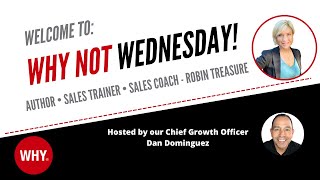
Robin Treasure, a sales trainer for functional medicine companies, built a territory from $220,000 to $2.9 million in five years by focusing on trust and solving client problems. She shares her sales philosophy and tactics in Heart Powered Sales, available on Amazon.
Questions this video answers
November 24, 2022.
First year: $220,000; later grown to $2.9 million (achieved over five years).
Five years.
Why: to contribute to the success of others. How: by making things clear and understandable (clarify). What people can count on: that she is trusted / will follow through.
Available on Amazon as paperback, ebook, and Audible (narrated by the author).
Chapters
These last few years have made us question everything.
Our relationships.
Our jobs.
What constitutes an office.
And who we are.
In a.
World filled with chaos, confusion and uncertainty.
It's time for some clarity. It's time to start understanding one another.
It's time to start understanding ourselves.
We envision a world where everyone knows their why. But even more, we envision a world where everyone knows their why. O s, their why, their how and their what. The operating system that drives you, that lets the world know where you stand.
What your unique gift is, and most importantly, who you are.
Yos.
Are you ready?
Foreign.
And welcome to why Not Wednesday. I am so excited to introduce you guys to our guest today, Robin Treasure. And I knew I had to get this in earlier. I'll forget. Robin Treasure is a fellow New Mexican operating out of Northern California. She's an author, a sales trainer and a sales coach. Let me tell you a little bit about her. She has worked in the functional medicine space for about nine years as a health coach, as a top performing sales rep, a mentor and sales coach. And her sales expertise is in the nutraceutical industry and the healthcare industry. When she's not writing a book, coaching sales professionals or learning a new language, you can find her hiking, taking a bar class, or spending time with her daughter and her loved ones. She passionately believes. And this is why I think I like her so much that sales growth, accelerated sales growth is made possible when approached from a perspective of of service, personal growth and human connection. So welcome to the show. Robin, how are you?
Thank you so much. I'm doing great and super happy to be here with you.
I am super glad that you're here. I had so much fun just in the pre show, just talking to you and learning a little bit more. You know, we've met. I've gotten a copy of your book. I can't wait to learn more about your book and have you talk about it. And then I want to hear what the questions are from, from our, from our guests that are going to be listening in today. So we'll mix them in as we go. So let's, let's, let's start with your yos because that's important, right? It's, that's the reason the show exists. We want to talk about your why not moment, but we want to talk about your why operating system which we discovered together. So your why is to contribute to the success of others. And then how you do that is by making things clear and understandable and what people can count on you is that you can be someone who's trusted. So you love to help people you like to. How you help them is by making things clear and understandable. And what people can count on you is that, hey, if Robin says she's going to do something, she's going to do it. How does that fit for you?
You know, when I, when I discovered my why operating system, thanks to you, it completely made sense to me. The description that I read afterwards that described my why and my how and my it just absolutely resonated. And some of the words in there were verbatim. The words that I've used to describe myself. For example, you know, when I read about contribute, and it says in there, you know, you often find yourself saying, I just want to contribute to something larger than myself.
Right.
That's verbatim words that I've used about myself. So I knew that, you know, this was, this truly hit the mark, and it was absolutely accurate.
Well, I'm so glad we came together. You know, the way we came together. Robin was through Larry and D. Larry Levine's and Daryl Amy's Trust Challenge. Right. You were a speaker, I think, on day two, and I was a speaker on day three, and I tuned in to listen to see, all right, what, what does Robin have to say? And you had some amazing quotes. I was immediately impressed. I said, I've got to reach out to Robin and get to know her. I want to add her to my network. Hey, TJ Davidson from Texas. Welcome. Congrats on your new role. TJ we're so glad to see you. See you. So one of the, one of the questions that I saw you in the interview, so I think what, what the, what the host asked you is what does trust mean to you? And your answer was so good. You said, trust is about do I trust myself to live up to my promises and to do my absolute best for your clients? Right. For your. Do you trust yourself to live up to your promise? So tell me, what is that? What does that mean? Let's talk about that, because that's such a great statement.
Yeah. So first of all, it is so important to cultivate trust in your clients and prospects. They need to trust you. But before you can do that and before you even try to do that, you need to be sure that you trust yourself.
Right.
And I think we don't quite give enough attention to that. Pardon me, about how much we can really trust ourselves to follow through. Follow through, again, is, it's so important in sales. Right. Follow through on what you promise to deliver to your Prospects. And so that to me is where it all starts. Also, trust means what is the way that you view the world? Through what lens do you view the world? Do you view the world as a threat or do you view the world as being full of opportunities and new possibilities for you? And depending on your answer, that will shift your energy in an entirely different way and you show up in an entirely different way.
Absolutely. And I think that's, you know, that's one of the things that, that's so attractive about you and the work that you do. It's, it all comes from a really positive energy side. Right. Oh, good, we've got your mission up. I want to talk about your mission. So your mission is to create a quadruple win in the integrative healthcare space where you, your company, your healthcare practitioner clients and their patients all thrive. So this is such a good point. And you're in the healthcare space primarily, that's the sales. That's kind of your niche. So tell us about what the mission, where does it come from?
Yes, pardon me, in, in some circles, sales is almost approached from an adversarial spirit, where it's almost like, you know, winning over your customer. Winning. And yes, we do want to win, but it's not a win lose situation. You can absolutely create what I view as being a triple win or a quadruple win, where everybody truly is, their lives are made better as a result of that sales interaction. And in the integrative healthcare space, you know, we have in, in general a health crisis in this country. And functional medicine and integrative medicine offer the opportunity for patients to truly thrive and to have true health and not just sick care, but true health care. And in order for that magic to happen, there has to be a sale. And so my intention is to, and what the work that I do is to work with sales teams and in the functional medicine space that are often with nutraceutical companies. And what they are doing is helping the healthcare practitioner to thrive in their business, to drive better clinical outcomes for their patients. And then the patients win as well. So it's a quadruple win.
So you know what, I love that you called it the quadruple win. And guys, if you're listening to Robin Treasure, she, she's not only talking about it, she's done it. You took a territory that the first year you were in it, I think you did $220,000 in sales. And by the time you were done, it was a 2.9 million dollar territory, almost a 10x growth. And how many. And how many years did you do that in?
Five years.
Five years. So I remember at the start of your book, you talk about that conversation, right, with your regional manager, and he's talking about what you've been able to do to that territory. So how did you know how to do that? Because a lot of people have been in sales for a long time and don't have that kind of success. Right. So how did you find the secrets and then how did you implement them?
I attribute a large part of my success to my level of emotional intelligence and ability to understand my clients and where they're at. So I was in a role working with healthcare practitioners. So selling nutraceuticals to healthcare practitioners. And as we all know, emotion drives decision, right. And I was able to work with clients with the.
Business problems that they were facing, right? Helping them overcome their business problems and understanding and being anchored in the emotions that they were experiencing in that moment. And when people feel that you understand them, that you understand their emotional state as well as the actual problems that they're facing in their business. And in the case of healthcare practitioners, that's their business problems and the clinical problems that they are facing and helping their patients with. When they feel that you understand them, there is a whole level of opening and an opportunity to do business in a way that feels really good and happens in a very organic way.
I, I love that because, you know, I think you bring up a couple of good things that we want to definitely unpack. And Danielle Dobson's listening all the way from down under. So it's tomorrow where Danielle is. So welcome, Danielle, from Thursday, it's Thanksgiving. Although you guys don't celebrate Thanksgiving in Australia, your Thanksgiving, our Thanksgiving is already happening there for the Americans there. But you talk about.
The importance of understanding and, and working from a place of solving the client's problem. Not about, it's not about closing the sale, it's about solving a problem. And I think so many of us forget, right. If you, and you mentioned it earlier, if you have a product that the client needs, sale needs to happen in order for them to be able to make a difference for their clients. Right?
That's absolutely right. But you really do start with focusing on their problems, not on your product. No matter how wonderful your product is, is, you really have to start with focusing on where they're at and how you can help them.
So what's a great question you would ask? Because, you know, as you know, my background is in the healthcare space also. What's A really great question. Somebody that's starting out in Nutraceuticals and kind of go open a territory or medical sales for any for that case. What's a great question you asked?
Well, sometimes we want to lead them to the answer. So a product centric approach that I do not advocate might be something like, you know, do you have patients dealing with XYZ problem? Well, first of all, that's research that you should have already done. So you should already have a good inkling of whether or not they deal with that kind of a patient. Right?
Sure.
So instead I believe in, first of all, keep it simple and keep it open. You may want to open with, you know, tell me about your practice and tell me about your patients. Letting the dialogue kind of open up with what's most important to them. Right. And so depending on that, that can be, you know, just a way to don't. Rather than leading the witness.
Right.
You want to let it open up and you can also, in doing so, let them know that you have done your research. I see from your website that you deal with XYZ patients. Can you tell me a little bit more about that? Right. So that's a nice way to show that you've done your research, you are informed, and yet you're not going to lead them to the answers. You want to open it up. It's about opening a conversation rather than closing them immediately on us on a product sale.
I love that. You know, one of my favorite new people that I'm following is Mark Hunter and he talks about it's not about closing the sale, it's about opening the relationship. And so Danielle Dobson, Bruce Kirk, Jerry Fletcher, all coaches in the Y community. And I really take, I love that approach in that when you close the sales, really when the relationship starts now, you've got to work right now, the work begins to be dependable and continue to be a resource for them. And that approach that you take, being very open, not product centric, it's what can I help you with? Because didn't it often lead to solutions that you had that maybe had nothing to do with your product but eventually led to your product? Tell us about that.
So many times, for example, you know, I may have worked with a practitioner who said, well, you know, right now I can't deal with XYZ because I'm short staffed, because I'm searching for someone from my front desk. Do you know anyone? And I would, you know, think for a moment and yes, the perfect person would come to mind. And actually, in at least three instances, I actually helped facilitate a hire. I was mad. Matchmaking, right. Nothing to do with my product. But, you know, it. It ended up solving that client's problem, deepening our relationship, and creating again, a triple win for everyone, including the person that I helped bring on board into that office.
I love that. Well, and now you've got an advocate right now. Now the. The hiring person is happy because you help them find somebody great. And by the way, now the person you helped find a job is probably pretty grateful. I don't think you had a hard time getting back in that office again, right?
Not at all. Not at all.
I love that. So let's talk real quick because we want to get into the book. What would you say about how your yos ties into the book that you wrote?
It ties in so well because first of all, to contribute. It's what drove me to write the book in the first place. I wanted to share, I wanted to help other people. I wanted to create something of value that my peers could enjoy and read. Then with the how of clarify, that absolutely speaks to what I do. Not just in writing the book, but I think it also really helped me as a seller. Your buyers are inundated with information. They don't need more information. What they need is clarity. You as the seller are the person who can help vet information and clarify information and decide distill it down into what's relevant for the, for. For the buyer so that they don't have to sift through tons and tons of information. So that's what helped me as a seller. Right. And clarify is what I have hopefully achieved in my book because I wanted to clarify and kind of simplify a lot of the mystery that there is around the sales process and what it even is and, and what it isn't. And, and so that's, that's what I did in my book. And then finally, my. What is trust? And to me, trust is everything, as we, you know, spoke to a little bit earlier, is that trust is fundamental. It has to be there between buyer and seller. And you as the seller, need to trust yourself and you need to trust this universe that you are going to be okay. Because if you don't trust that you are going to be okay, you are going to approach the sale from a place of success. Scarcity. Scarcity is something that buyers can feel and they will run from. Right. When they feel that there's a level of desperation.
Larry Levine calls it commission breath. Right. That you commission it.
Exactly, exactly. And they can sense it and feel it. And so you do not want to show up with that energy. You want to show up being willing to play the long game. So that, for example, when you're in my case with my practitioners telling me I need a front desk person, that's where I would devote my energy. It temporarily took energy and time away from the product sale. I was willing to play that long game because I knew in the end it would actually serve everyone else, everyone involved in a better way.
Love that. Love that. And so let's get into the book. Because heart powered sales talk about clarity. Talk about a well structured book. So part one of the book was called what's love got to do with it? And you explore following your part. The first part is called how you found how sales found you. Not how you found sales, but how sales found you. So what does love have to do with it? What's love got to do with it?
Robin, what's love got to do with it? It has everything to do with it. Because when you are centered in your heart and in an energy of love and gratitude, being grateful for the opportunity to be to connect with your buyers and prospects, being grateful for the opportunity to serve that creates that energy that I believe is fundamental to your success in sales. You also have to love the product or service that you represent.
Right?
That's different from being product centric. Okay. So you're not going to lead with your product, but what you are going to do is you have absolute faith and trust knowing that that product can help people. But before you, you know, start pitching your product again, you focus on your client, understand what problems they have, and then connect the dots back to your product. If your product is the solution. Right? So to me it's all about love. Because also it's just a lovelier way to live. Right. When you're, when you're showing up with that energy.
I love that. And you have such a great energy. So. So what's love got to do? The part two. There's four parts, right? Part two talks about. We already talked about what's love got to do with. The second part is called let it grow. And you talk about how you had it all wrong. Tell us more about what that means. So what did you have all wrong?
Yes. So sales is a second career for me. And if we have time, we'll talk about my first career. But way back when I was still in college, I did a some. I spent a semester abroad in Italy and I was short on spending cash and I decided to get a job under the table. My Italian was good enough, so I got a job under the table selling perfumes door to door. Wow. Now, mind you, sales was the last thing I ever thought I'd do. I never thought. I. You know, I never gave it a thought. But in that moment, the opportunity presented itself, and I said, okay, let's give this a try. Well, I show up, you know, with this team. We get like, five minutes of training and what to do. You knock on a door, you hand them a brochure, you ask them if you can, you know, give them a sample of this thing. So I go into this on this apartment building. Knock on a door. My hand is trembling. This is my very first call ever in my life. Sales call, if you can call it that. Knock on the door. A matronly woman opens the door. You know, she has an apron on. She says, how can I help you? In Italian. And I say, I pitch her my line. Can I hand. Can I give you this brochure? Right. With these perfumes and these. Mind you, these are not nice perfumes. These are cheap, knockoff perfumes, imitation perfumes. Okay. And I've got my little sample kit with me. So she's looking over this brochure, and then I tell her my next line that I've been coached on doing, which is, can I give you a sample? Right. And so I hold up a bottle, and I'm about to spray her wrist, and she kind of recoils in fear and tells me, no, I'm allergic. Right.
Oh, gosh.
And I was horrified and mortified in that moment. And so I apologized, I turned my back, my eyes were welling with tears, and I went out the apartment building, and I think I lasted maybe a day and a half in that job.
Wow.
So all of that is to say that my initial impression of sales and what lasted with me for two decades and which prevented me from going into sales until decades later, is that I thought sales was about foisting something upon someone that they do not want or need or that could even harm them.
Right.
That was my impression.
You could have killed her. She was allergic.
I could have killed her. Right.
Oh, my gosh. And that's your first sales call? First exposure to sales. Yes. That would scare anyone away from sales. And we've all got that first sales job experience. Right. So I love that you shared that. That leads me to my next question, because I want to make sure I ask this question, because sometimes we get so into our interview that we forget to ask that question. Tell us about your biggest why not moment, Robin.
So my biggest why not moment, watershed moment in my life was a few years later.
After that event that I just told you about. I got a master's degree in Italian translation in the United States.
Okay.
And after I completed that master's degree in Italian translation, my next thought was, okay, now what? And I said, why don't I just move to Rome? I've always loved Rome. Why don't I just move there? Did I have a job? No. Did I have much money saved? No. All I had was a master's degree. I had one name of a friend of a friend to call on when I got there, Right. And all of my belongings in several suitcases. And that was it.
Wow.
And I said, why not? I was 24 years old, right? So I did it. I moved over there. I ended up staying for four years. I ended up creating an amazing job as an Italian translator. So that was my first career, Right. And I was just freelancing mainly in the film industry and also in the wine industry. And. And it was an amazing time in my life. Again, I was there for four years. And what it gave me was this almost unshakable faith in myself in being able to just take a leap without knowing if there was a net there or not and just trusting that things were going to work out. And in fact, they often do work out far better than you could have ever imagined.
Right. You know, we were talking in the pre show. Steven Pressfield wrote today in the email that he sends out about the fact that we all have those trials in our lives. We always look back and we say, I wouldn't be the person I am had I not gone through that. You wouldn't have probably the perspective you have on sales had you not had that horrible experience with that lady. And now you understand that there's a better way to do it and you're sharing it. You definitely figured out a better way to do it when you worked in the Nutraceuticals and you helped grow a territory. I mean, it's amazing. I. I would love to have had you on my team. I would love anybody that could come in and take a $200,000 territory, make it a 2.8 million dollar territory in five years. Amazing growth. You know how to do it. I want to. I want to give Steve Johnson a shout out. He says, showing up with commission breath. Classic. It's true, though. We have to be willing to show up truly wanting to learn first before prescribing any solution, you know? Right. Diagnose before you prescribe. So many of us come in and then I remember because I started out in the pharmaceutical industry when I started my sales career, I was like, hey, I have a pill for that. Let me, let me tell you all about it. And not even realizing whether the practitioner was interested in that part of what you're selling. So I love, love, love your approach. So let's go back to the book a little bit. The third part is called the heart powered sales method. That's your sales method and it has four parts. I want to talk about the third part, follow up and own up, because you say the fortune is in the follow up. So I love the fact that somebody with the last name of Treasure talks about fortune. So what does it mean that the fortune is in the follow up?
Yes. The follow up is the piece that is often neglected and forgotten because there's so much attention given to, you know, how do I drive the top of funnel, how do I get more leads? How can I find more prospects? Right? And even, you know, once I get my prospects, I get them into a meeting, how can I convert them into paying customers? Well, the follow up is the missing piece. The follow up is where the fortune takes place. You're, in most cases, you're not going to close that sale. You shouldn't even try to on the first meeting.
Right.
Of course your sales cycle depends on the product that you represent. But still there is, there will be so many opportunities to follow through with deliverables. You may have to, to have multiple touch points with that prospect before they agree to take a meeting with you in the first place. Right. Keep following up. We are all so driven by Shiny Object syndrome because of the world that we live in. There, you know, there are a million sources of distraction. Keep on it, whatever you choose. If you've identified a prospect as being truly qualified, as being truly a good lead, stick with it. Keep following up. Use pleasant persistence, Be relevant. Keep, keep being relevant to them and their, their situation. And that is where you will find the good fortune. And that's certainly what I found for me.
You made me, you made me laugh when you talked about Shiny Object Syndrome. I could see the team, the Y Institute, or what we call our internal team, the Y Force, just laughing because Gary and I and Jerry can totally be accused of Shiny Object Syndrome. We follow things and we just go and forget. And Kelly, who is amazing at brown herding cats, and Nikki now, they're always the ones that say, hey, let's bring it back in. And you're absolutely right. We've all got so much going on. But when you have a professional, pleasantly persistent sales professional following up and being relevant. You talked about that. It's not, who wants. Nobody wants to hear your, hey, just following up. Right? Tell me something relevant.
Exactly. And when you're leading with the word just, you're immediately disempowering yourself. Just starting with the word just. I'm just following up. So that's not the way to do it. But, but being relevant, you know, continuing to present it, information that's relevant, asking questions that are perhaps even provocative or, you know, will. Will help the. The buyer or the prospect to really see things in a new light, that's where the magic happens. And I can't tell you how many times there were times where I hesitated, oh, should I, Should I follow up with this prospect again? They haven't gotten back to me. And then eventually when I did, they thanked me. They actually thanked me for my quote, unquote, pleasant persistence. And they use those words.
I love that, Robin. And we've all had clients tell us, man, I'm so glad you followed up because I had forgotten about the great conversation we had. And then they. Now they're your client. So I want to recognize. Bruce says, love equals making a difference. Contributing love. That. And Steve Johnson. I love this Steve Johnson. Be lovingly bold.
So I love that.
I knew you were gonna like that. So let's go through the. The part four of the book. So, guys, if you don't have the book, Robin, where, Where can they get hard powered sales? How do you get. How do we get the book?
Yeah, so they can get it on Amazon and it's available as a paperback. Yep, you've got the link there. Paperback, ebook, or audible. And I did record the audible myself and had a blast doing it. So.
So we get to hear your stories in your words.
Yeah, yeah, exactly. Yes.
Fantastic. And you've got some great stories, and I'm not going to give it away, but there's a funny, funny story at the beginning when you talk about growing up in northern New Mexico and just being at a party with your parents and those of you who are familiar with New Mexico, Northern New Mexico is just such a fun.
I think it's both. It's a very bohemian space. Right. And you grew up in that space. Yes, we grew up around the same age. You're a little younger than me, but I, I can totally remember those kind of parties that you talk about. So it's in the book. Guys, you're gonna have to get the book to see it. But let's talk about part four. Thrive.
The.
The part four is called Thrive through Crisis and Avoid Common Pitfalls. I love chapter 18. Crisis is opportunity. Tell us about that.
So with any crisis, and of course we've just been through a two year extended protracted crisis, right? But crisis really can be opportunity. And that's not at all to diminish the loss that has happened over the last couple of years. But there has also been great opportunity. Opportunity for great personal transformation and growth. Great opportunity for people to pivot in their business or even to discover or tap into something that they had long forgotten in themselves. So with any crisis, you have the opportunity to either view the hardship or to acknowledge the hardship. But rather than continuing to focus on that, to ask yourself, what am I meant to learn here? Or what is the opportunity that I'm not immediately seeing? And when you ask yourself those questions, you're TR your brain to see things in a different way and to discover new opportunities. So there truly is, there are unlimited possibilities for what you can do yourself, for what you can achieve for new prospects and customers that you can uncover even in the most difficult moments. It's all a question of how you train your brain to see things or not see things.
What is the opportunity that I'm not seeing? Right. I love that. Hey, Bruce. Kirk. Captain Kirk, you know, he's going to be on in a couple of weeks, says you're top shelf. Robin, thanks for sharing yourself authentically. You've been so great. You know what, you know, we had one of the longest pre show conversations I've had in a long time. I logged in early, but. And you were on. So I said, well, might as well. Yes, might as well talk to Robin. Hey, is that, is that at your house?
Yes, it is. I'm so sorry.
That's all right. No, I just want to make sure it wasn't me. I was like, hey, do I need to mute somebody? But so we had a great pre show conversation when I forgot to tell you how we like to end the show. And you have. I know you've listened to a few episodes, but one of the things I like to ask is end on a question. And then when you give me a great answer, I say, what do we say? What do you say we end the show on that note. And your answer is, why not? So I'm going to ask a question, you're going to give me a great answer because you've been giving me nothing but great answers. And then when you do that I'm going to say, what do you say we end the show on that note? And you say, why not? So, guys, we're doing show prep right here. Joe, if you're. When you're going through the clips, let's make sure we capture this one. So, Robin, what would you say to someone who is, you know, again, so you've been through the YOS process. You've seen how it applies to your life. You're going through some really intense training right now to prepare for your clients. But what would you say to someone who's thinking of adding this tool to their arsenal to help their clients using the yos?
First of all, I'd say, why not do it? I would say that the YOS is absolutely. It's an. It's a really important tool to add to your arsenal if you are a coach, because it will enable you to provide clarity for your clients that they cannot see. You know, we. We often are too subjective to be able to. To view ourselves with a more objective lens. And often, again, as I said earlier, we're all inundated with information and even opportunities. So the question isn't so much, you know, and I know that this was true for me when I discovered my yof, right? It was very affirming. It resonated. I said, yes, that's right. And it allowed me to discard all of the other possibilities and opportunities and other things that are out there, because it's like, oh, that's not me.
Right?
This is me, and this is what I'm going to focus on, right In. In terms of what I'm delivering in my career, whatever it may be. So that's what I would say is it's a great reason to implement the YOS.
In your system as a coach.
I love that. So what do you say we end on that note, Robin?
Okay, so why not?
Excellent. See, not too much practice. Robin, it has been an absolute pleasure to have you on. You are. You brought so much knowledge. Our listeners, the ones that commented, you know, as you know, for everyone that comments, there's probably 10 others that are listening that don't comment. So we. We appreciate Steve Johnson, Bruce, Danielle Dobson. There were so many people that commented during the show. You brought so much value to our audience. And. And let me tell you guys about next week. We're going to have Scott Schilling on. So if you haven't heard Scott Schilling, he is going to bring a ton of value next week. We're just going to continue bringing amazing guests to why not Wednesday? And Robin, you are certainly one of them. So thank you for being on. And I look forward to continuing to work with you. I think this bit, you know, I told you at the beginning, if we don't get to everything, we're going to have to have you back. So I'd love to have you back sometime. I think we're going to leave on that note. Have a great Thanksgiving, everybody. We'll see you guys next Wednesday with Scott Schilling. Have a happy Thanksgiving.
Thanks so much. Happy Thanksgiving. Thanks for having me. Bye. Bye.
More from Dr.




Women In Leadership: A Need For A Greater Systemic Change With Belinda Clemmensen






