WHY Not Wednesday with Rory Sheppard
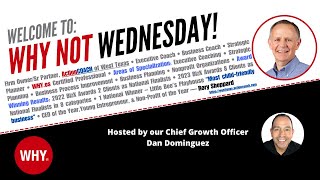
Rory Sheppard, an Action Coach from Amarillo, Texas, explains his coaching philosophy built on simplifying business systems. He uses assessments like DISC and Working Genius to align clients around their top 3-5 priorities, then tracks progress through 90-day planning cycles. His clients have become national BizX finalists and winners.
Chapters
Who believes what we believe.
Who leads people to greatness, who gets people unstuck, who unlocks all of your passion. A coach who helps people discover what drives them to tap into their superpowers. Then knowing your why is the first step to untap potential.
To focus.
To breakthroughs.
A coach who's looking for a better way.
Are you that coach?
Hey, good afternoon, everyone and welcome to why Not Wednesday. I've got my good friend Rory shepherd all the way from West Texas with us today and we're going to talking, we're going to be talking about simplifying things. Rory shepherd is an action coach in West Texas and he is one of our newly certified coaches. And so he's had some recent experience using yos. So we're going to ask him about that. We're going to ask him what it's like to be a business coach, an action coach in West Texas. But let me tell you a little bit about Rory because he is a great guest. He's a firm owner and a senior partner at Action Coach of West Texas. He's got about a 30 plus year track record of working and growing and experience and responsibility with some of the most iconic brands in Texas. So we'll probably hear about that. So let's talk about his yos, right? He believes in making things simple so they're useful and understandable. He is constantly working to simplify business planning and training approaches to help business leaders and owners. So that's the why of simplify. He adds value to his clients and his community through quickly solving problems and making sense of complex and challenging situations. He enjoys taking large amounts of facts, data and information and making it understandable and useful. And he works with his clients to develop systems and processes so that they are more profitable getting consistent and predictable results. And those of you who are y coaches in the audience, you know, we're talking about simplify make sense and right way. Welcome to the show, Rory.
Well, thank you, Dan. It's good to be here, man.
It's great to have you. We've been having some great conversations between you and Donna, doing some work on other assessments that you use along with yos and then introducing that to your audience and then just getting to know you as you went through the certification process. It's been a real pleasure to get to know you, Rory. So welcome to why Society and welcome to why not Wednesday today.
Well, thank you, sir. I appreciate it.
So, so Rory, you know, as I, as I went through that introduction, I've never had someone which is great I'm going to give you kudos, actually use their yos in the introduction that. That they created. So I always ask people, hey, do you want to be introduced? A lot of people say, I just use what. What I've got on LinkedIn. But you went through that work. You made it really simple for me. All I had to do was read it. So thank you for doing that. How much. How long did that take you to do?
Not very long. So actually, in fact, most of that was already written.
I would tell you that after I took the Y discovery, I went back and tweaked the language and walked it through. Why, how, and what. Just like it comes to us as part of that.
View of ourselves after we take that discovery. Absolutely. Have been a simplified person forever, want things to make sense, and are in that process always of creating systems and processes. So it aligned very, very well. It was already who I was, but I was able to steal some great language from you guys and the work that you all have done over the last years of developing that. So I thought it was awesome, but pretty easy for me to create.
And you're a double dipper, Rory, because I was on your webcast when we did the. Using different assessments. But I grabbed you and Donna and I put you on our webcast that we did a webinar with Ira Wolf to talk about disk and yos. And you actually, we took you and talked about your disk and your yos. Everyone at Action Coach uses disk. I mean, we go to Bizx every year and we hear people introduce themselves and they talk about there being an I being a D being S or a C. And I'm looking forward to going back this year now that we've given everybody their yos and have people introduce themselves with their yos and disk for those that weren't on the. On those webinars. What's the value that you see when you combine these two tools together?
So, great question. And I think the value for. For me as a coach, but more so for the people that are consuming that. Right. Is that each assessment gives you a different facet, a different perspective. And so, absolutely, it's important to know what my why is, my why, how and what. Right. And I love that because that's that. That North Star, where am I going? Why? Why do you encounter me the way that you do?
Right.
But then from a behavior point of view, I think you get a viewpoint from disc that says, you know, when you're communicating with Rory, you know, these are the things you ought to do when you're communicating with Rory, these are things you shouldn't do. Right. This is when I do my best work. Right. And I think again, I get a view of saying simplify. Right. That's my why. But then when you put on top of that that I'm more task oriented than I am people oriented, but people are still important. Right. And so a lot of people, when they interact with me, say, you have got to be high.
I.
You've got to be a, you know, a diet in the wool people person. And that's because that's how I connect with you. But I'm all about system and process. Right. And so being able to put language around that and be able to have those interactions, conversations about.
Getting aligned quicker, what is, you know, what is important on communication, what is important in culture.
Right.
How should we interact with each other? I think having multiple tools allows you that different perspective. And so we've been students of assessments for years and love that we've gotten introduced to yos and can add that to our tool chest.
Well, we've enjoyed, we've enjoyed working with you guys because again, you bring such a depth and at action coach, you guys really work with your clients at a deep level. I want to give you some kudos, Rory, because you've won some awards at the national level. At the 22 BizX Awards, you had two clients as national finance as national finalists, and then in 23, you had eight clients as national finalists in eight categories. And, and you've had one national winner, the Little B's Playhouse for most child friendly business. You've also been CEO of the Year, Young Entrepreneur and Nonprofit of the Year. So those awards are all there. That's got to be pretty satisfying. What do you, what's the, what's the best takeaway from when you take a client up to a national ceremony and they win an award?
Yeah. So I think in so many cases, especially, you know, small or medium sized businesses that are in West Texas, you know, they think, yeah, we're a good business here, but I think what it allows us to be able to show them is that no, you are a world class business. Right. You can compete on a national level.
Right.
To be a finalist, to be a winner. And so I think in a lot of cases, we look down at our shoes when somebody starts talking about awards or being recognized nationally, when we should hold our head up. Right. And so I think for me as a coach and me, you know, getting to be engaged with those, those clients, it's, it's really more about that idea that letting them see their full potential and that they are at a level that they can compete nationally. And I think that's, that's tremendous.
That's fantastic. And look, you're not too far from us. I can't believe we haven't had lunch yet. Rory, you're in Amarillo, Texas. That's, that's a hop, skip and a jump from Albuquerque. You know, I, I love that your why is simplify. And it's funny because one of the things I noticed as I was doing my homework on Rory as you were becoming a client is you have a podcast called Simply Put. And so that was, that was titled way before that. You, you knew that your why was simplified. What is simply Put about?
So that is a, it's, it's a blog, not a pod podcast.
That's right.
Yeah. No worries. So it's a weekly blog post that I do that truly. I'm just taking. As crazy as it sounds, I usually ask my wife on Monday or Tuesday night, what word am I writing about this week? She gives me a word and then I give you my kind of simple viewpoint on that word or that concept and how it relates back to business. It's less than 225 words. So it's a very short, simple, to the point 1 min read on a weekly basis. I've got another blog post that is called Chalk Talk that can be a little bit longer, but no more than three to five minutes. That really is more business focused. A system or process, something like that that we, we tackle every week. But a couple of opportunities for me to use in my working genius. I am invent is one of my, my geniuses. And so I get to be that creative, inventive writer a couple of times a week.
So yeah, and you do a great job of that. You know, one of the things I've learned and so my, my why is contribute. My how is challenge the status quo and do things differently. There's nothing simple about challenging the status quo. We don't do, we don't follow rules. We do things just to do them. Sometimes we drive coaches like you crazy because you come in and sit with us and say, Dan, you, last time we talked you were going to do this and we'll say, yeah, but this idea came in and I started doing this and look, look at who I'm collaborating with. So you know when you get those challenge clients, right. But one of the things I've learned and, and by the way, the why of simplify is the rarest. And so we rarely find it. And that's why people like you are so valuable to people like me who can't keep things simple, who need somebody to say, hey, let me, let me break it down. These are the things you need to do. But what one of the sayings, I, Gary and I have been talking about it. He's next door, and we've been about it a lot. Just because it's simple doesn't mean it's easy. There's a lot of simple things we all need to do that aren't easy to do. And I think that's the genius you bring because you make sense of how that simple concept you give to that client, to someone like me who doesn't want to follow any rules, doesn't want to follow any processes.
How.
How do you overcome that to help people get, get things done? Because like I said, it's simple, but it's not easy.
Yeah. So, and one of my favorite examples is simple but not easy is, you know, this device, right? So Steve Jobs, right, when they were the, creating the iPhone, the number one competitor or the phone that was out there was the BlackBerry.
Right?
And there was nothing simple about a BlackBerry. Right. I mean, 43 buttons, lots of things going on. Right. And he said, you get one button, right? And which made it way harder, right. I mean, right. So a simple interface, but not easy at all from a developer point of view on how to create that. But then once we got that, all of a sudden, all the foreign function changed. And so for me, as a coach, it's to get you to listen long enough to go, no, there is a, there is a simpler way to do this. And then once you do it, you fall in love with it just like you would the iPhone. Yeah.
So, so Rory, I, I like that. You know, you, you, you got, you talk about simplicity. Even your messaging is simple. Hey, I got to give you enough so you pay attention. So let's get, let's get that done. And then now let's talk about the intricacies. But the other thing you do, and that's the other thing that people with, with my why. And there's a lot of ways, better ways are all also always looking for a better way. So they tend to follow shiny objects. But when you add that with your what of right way creating systems and processes so you're not left out there, just, hey, here's what you need to do. And it's like, well, okay, how do I do it? Help us make sense of that. How and then give us a system and a process so we can get that done.
Yeah. And I think Tiffany Carter that you've met, that's on my team is a better way.
Yes.
And so, you know, there are times where she comes in with that better way, and I'm like, you know, slow your role just a little bit. Let's get the process right before we start making changes. Right. Let's get to a spot where we're consistent and repeatable and reliable before we start making change so that we've got a baseline we can measure. Right. So one of the things that we do with all of our clients is knowing your numbers, getting a baseline so that I can see that improvement over time. And so we've got to slow down a little bit on introducing a lot of new change, because we got to get a baseline and say, this is where we are, so that we can start improving. All about continuous improvement. I just need to make sure that I'm consistent and reliable first.
That makes. That makes a ton of sense. And you're reminding me of another guy that, you know. Remember the movie City Slickers? I'm reading a book right now by, I think, Keller from Keller Williams. I think it's William Keller, but it's called the one Thing, right? Remember the movie? And you're an Amarillo, of course. You know this movie. You know, what's his name? Yeah. Curly. They're riding on the horses, and one of the. One of the comedians asked him, hey, so. So what's the secret to life? Right. Curly's an old grizzled cowboy, and he says one thing, right? Just do one thing the best that you can. So to a simplified guy that's got to just speak to you, is it one thing? Let's just do one thing really well and then tackle the next thing. So how do you approach.
The one thing philosophy with your clients if you do now?
We do. And one of the things that we talk about pretty consistently is that there are times where I have to give up doing some really, really good things so that I can do great things. And so if I have, you know, five or more things on my list of things to do, I'm probably spreading myself too thin and not doing great work on all those. And so getting down to less than 5 and focusing on those and hammering on those to do great work is way more than important than being all things to everybody, because we know what that yields. It's nothing to everyone. Right. And so getting a short list, being focused so, you know, one of the things that we talk about, we do 90 day planning. So every quarter we're doing planning with our, with our clients.
Right.
You know, we want one financial goal. Right. We want one personal goal. We want short list of things that we can stay on top of, be focused on and complete. Because we want to be able to celebrate. Yeah. You know, the world does a pretty darn good job of beating us up. And so we've got, even on our own, have to be able to create situations where we can win and then we can celebrate. And so, yeah, it is hard, Right. Because even I want to do a lot of different things and there can be shiny objects. Right?
Right.
But I need to focus down on the, you know, three, four, five at most, things that I'm going to work on each quarter so that I can get better.
And, you know, there's, there's a story, I think, and there's a quote. You know, you don't fear the. In karate, you don't fear the guy that knows 40 different kicks. You fear the guy that practices one. One kick 40 times a day or 400 times. You're really good at that one thing. Right. And you know, it's so funny because I'm a contribute challenge. And so Rory would be my ideal coach because you, you bring the two things that I don't have, that simplicity and that right way, systems and processes, things that don't come naturally to me as a contributor. One of the things that used to drive me crazy is I would try to help everyone. And I often would be spread so thin. I'd be trying to be on a board for two or three different charities, plus volunteering at my daughter's school and coaching such and such. And next thing I knew, and I think people know who we are. Right. When you're, when you're a contributor and a giver, people know who you are and they know that, hey, if you ask him, he's going to say yes. And I remember even in my Rotary Club days, you know, being president, but when I wasn't president, it was, I was on every committee anyway, because you know who those volunteers are. And probably every organization, that civic organization has those people that are going to do all the work, right? And I was one of those people. What, what's, what's something you would say to someone who is spread thin and they come to you and, you know, let's talk to our audience right now. Coaches who are coaching people like myself who used to do all that stuff. What would your advice be?
So I'LL tell you a quick story that comes out of Atomic Habit's James Clear book. It's the story of Mike Flint, who was a pilot that worked for.
Somebody that you might know, Warren Buffett, and he asked Warren Buffett for career advice. I'll shortcut the story a little bit, but what Warren Buffett gave him as that advice was create your top five. What are those five things that you want to get done? And those are the things that you focus on. And then in that process that he walked him through, he actually had him create his top 25 list. And he asked him, what do I do? What do you do with number 6 through 25? And Mike Flint said, well, if I have a little spare time, I'm gonna take on number six and number seven and number eight, because they're pretty close to my top five. And Warren Buffett said, no, that's your absolutely. Avoid at all cost.
Don't do 6 through 25. Stay focused on 1 through 5. And then when you finish one of those, don't just pick up number six, but reprioritize your list. Right. Because as soon as I get 1:1 through 5 finished, my priorities may have changed. Right. I might not even need number six or number seven. So as difficult as it is to stay focused, we know that that's what I've got to do now. Just ask you a quick question. Right. So are you a New Year's resolutions guy?
By chance I pick a word of these?
Okay. Love it. Love it. That's a. That's a new practice, Right. That a lot of people do. Yeah, but on New Year's resolutions, right, There's a. A fitness app called Strava. One of the things Strava did is in 2019, they analyzed 800 million points of data of exercises in their app, and they came back and said January 19th is National Quitters Day. So of all the people that create New Year's resolutions, they quit on January 19th. So they make it less than three weeks.
Yeah.
And the reason they do quit is because they add something to their lives, but they don't take anything away. So if I go back to you now as contribute, and you want to just keep adding and keep volunteering, keep raising your hand, but you don't ever take anything off. You become overwhelmed, you get burned out, you start seeing things fall off the edge of the plate. Right. And so I love the Warren Buffett advice of stay focused on no more than five.
I love five because it's one hand.
Yes.
I can do things with It. Right. But also it allows me to say, if that's the most important, what am I taking off?
Yeah.
And so for you, I would say being, you know, just maniacal on managing myself and saying, those are the five things that I need to focus on and staying there. That would be the advice that I would give you or any client that I'm working with.
Yeah. No, that's such valuable advice. That's the advice my coach told me. When I began working with the coach, it was, Dan, if you go around making a little difference in a lot of places, number one, nobody even notices. Right. And as a contributor, you thrive on that positive feedback from making a difference. And if you don't feel like you're making a difference, you're going to actually resent that organization where you're driving three hours to a Rotary Club meeting in Amarillo. So you can speak for five minutes. They're not going to remember who you are, and then you're going to come back because somebody couldn't make it to that, and you're not going to get any recognition whatsoever. You're not going to feel like you made a difference. So it's going to be a negative for you. Right. So, no, what you're talking about makes absolute sense. And I love. You know, there's your. So my word for the year, I'll throw this out to you. It's traction.
Traction.
So I'm reading a book, it's right behind me called indistractable, and at the start of the book, near all talks about the fact that people think that the opposite of distraction is focus. But if you break down the word, the opposite of distraction is traction. Right. Actually moving forward towards your goals. So what you just said really resonates with somebody who needs to just really break it down. Keep. Keep the things. You know, I do my weekly show, I do my. My coach interviews, and. And you can't do everything for everyone, so.
Well, I'll give you another book. Yeah, it's a little dated now. It's probably 12 to 15 years old, but it's called getting out of your own way. But one of the things they talk about in there is the difference between motion in movement. So I can have a lot of motion, Right. I can be water bugging around and doing a lot of things, but not really taking movement in a direction. Right. So that idea of traction aligns very closely with that of just now. I need movement in a direction as opposed to just a lot of motion.
A lot of motion. A lot of us can Be busy, but not productive.
Right, Right.
And that, that would, that used to be me. I could be very busy doing a lot of things, but, but at the end of the day, I'd look at, okay, what difference did you really make? So I love that you help people do that and I love your mission. Rory, when I looked at your mission, it is to be to empower and support business owners so that they surpass their initial aspirations by leveraging the abundant business knowledge and capabilities unique to your region. So you guide people and you point them to the resources and you enable success so they can leave a lasting impact, not just locally, but beyond. And no more better proof than all those national awards that your businesses have won. And a lot of people would say, Amarillo, what are the resources? I can, I can imagine Amarillo is probably a place where you, you know, you got billionaires driving old, old beat up pickup trucks. What, what. How do you leverage that with your, with your clients and with your businesses? Yes.
I think again, back to even just that idea that we've got businesses that are at that national level, world class businesses. Right. So being a connector, right. And being able to connect a great person in one industry with somebody else in another, right. We don't have to go to the, to the Metroplex or Houston or San Antonio to get great resources. But then, you know, that, that pioneer spirit that is here, right? And plugging into that.
You know, lord knows that 200 years ago, if you moved to this part of the world, you were pretty darn tough. Right?
Right.
So that get it done, you know, willingness to work, work and work hard and never let go of something. Right. I mean, I think that is a, is a natural resource that's here. But then we've got, you know, we do have water, we've got cattle, we've got helium, we've got natural gas, we've got oil. Right. I mean, all those resources are here. And, you know, I think over the Next, you know, five to 10 years, there's some great work going on in our community. A new program called the Range that got kicked off about four to six months ago of just being able to leverage that and say, you know, for not just the United States, but for the world, how can Amarillo, Texas be the epicenter of, you know, the cattle industry? Right. 30 of the cattle that are cons, you know, the beef that's consumed in the United States comes From, you know, 150 mile radius of Amarillo, Texas. Right. I mean, but we've got corn, we've got Cotton, we've got wheat, we've got Milo. Right. So food resource. We are kind of that. That crucible. Right. Of food resource that can serve as we go from, you know, 8 billion people and beyond. Right. How do you take care of that? But protein being number one, right?
Yeah.
And so over the next five to 10 years, I think, you know, it's pretty darn exciting on what's going to happen in our region. There's a new highway, a new interstate project that will connect, you know, all the way from the coast up to the. To the plains and go through Lubbock and Amarillo. So some exciting things going on, and I'm just excited to be part of that and be. Be plugged in.
You know, one of the things that I. I can tell about you, Rory, and it's in your bio, it's you care about your community. And you talked about that. Because when you look at. If I. If I look at Rory, just by his yos, he's all business. He wants to make things simple. He wants to make sense of things, and he wants to do things the right way. And you would never get that feel. But listening to you, how much you care about your community, how much you understand about your community. Community, and how much you want to make a difference really brings out that which you talked about, which is you connect with people, and that's important to you.
Yeah. And I would tell you, if we look at yos, right. Half of my team, right. Four of us have contribute, as, you know, in our top three, A couple of them have it as the number one. So it's kind of in our DNA that. That idea of contribute. So if it's not coming from me, it's coming from my team. But absolutely, we want to plug in and make a difference because we know when businesses get better, they invest back in the nonprofits.
Right.
And when the nonprofits are thriving and taking care of the community, then, you know, rising tide lifts all boats. And so we encourage every one of our clients, if not out of every dollar they make, for sure, out of the dollars that we help them make, we want them to pick a. A nonprofit and make that contribution so that we can improve overall our community. Just very important for us.
That's fantastic, Rory, and thank you for doing that. And so many businesses need to have that focus. And I bet some of those people, it's the first time they thought about, hey, I need to take a percentage of what I net and give. So that's great that you're bringing that. Tell us about, because we want to make sure we ask this question. Your biggest why not? Moment, Rory, a time in your life when you said why not? And you're so glad that you did, and you're, you're, you live to, to tell about it, and it's a good thing.
Yeah. So that was, as I thought about that. Right. And just what was that why not? Moment? Took me a moment, but then it kind of crystallized back to a time early in my career. I don't know, I was probably 22, 23 years old, worked for a company that some people, at least in the Amarillo area will still absolutely remember, which was Hastings Books and Records.
Oh, yeah.
But we introduced video, and originally we. That was two transactions. You had a book and a music sale, and you had a rental transaction. And we traveled around trying to find a way to put that all into one transaction on the point of sale system. Could not find a solution at that time. And so the question came to us of can you build your own point of sale system? Can you do that? And I attribute it to being too young and too stupid to know better, but I said, absolutely, yeah, we can build that. And so we spent time at a guy that was writing code all day, and I was buying cash drawers and printers and barcode readers, and we built our own point of sale system and launched it within a year and had that running, you know, 120 Hastings stores in pretty short order. And that would be that why not Moment of just going, can we do that? And the answer was, yes, we can, or why not? And we built it. And so for me, I would say that that was what, probably at 43, I would have said was impossible. But at 23, I said, why not? Yeah. And it changed everything, not only for Hastings, but for me as a, as a business person going now you can tackle even what should be impossible, right? What everybody else says, no, you can't do those two transactions together. We were able to do that.
That is a fantastic story. What a great way to end the show. What do you say we end on that note, Rory?
Why not?
Thank you so much for being here, Rory. I look forward to, to talking to you again. I know we'll, we'll have some more conversations, but thank you for sharing your story, sharing West Texas, sharing your Simply Put blog. We can't wait to share all of that with you. If somebody wants to work with you, Rory, where should they go?
So they can go to westtexas.actioncoach.com or they can call us at 806-69-9, 10, 2, 4.
That's fantastic. Thank you so much, Rory. Have a great rest of your week. And we'll see all of you next week on why not Wednesday?
Thank you, Dan.
More from Dr.




Women In Leadership: A Need For A Greater Systemic Change With Belinda Clemmensen






