WHY Not Wednesday with Sha Sparks
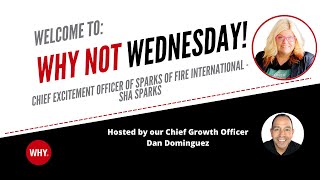
Sha Sparks, who calls herself Chief Excitement Officer, talks with Dr. Gary Sanchez and Dan Dominguez about her work coaching veterans through career transitions and her book How to Get Your Voice Back, a six-step journal for finding your voice again.
Questions this video answers
June 8 (episode stated: 'This is June 8th').
How to Get Your Voice Back.
A six‑step journal/process (she describes it as a six‑step approach).
Chief Excitement Officer (also styled as Chief Fired Up Officer)
Chapters
Everything.
Our relationships.
Our jobs.
What constitutes an office.
And who we are.
In a.
World filled with chaos, confusion and uncertainty. It's time for some clarity. It's time to start understanding one another.
It's time to start understanding ourselves.
We envision a world where everyone knows their why. But even more, we envision a world where everyone knows their why. O s their why, their how and their what. The operating system that drives you, that lets the world know where you stand.
What your unique gift is, and most importantly, who you are.
Yos.
Are you ready?
Hello and welcome to why not Wednesday. This is June 8th, and we're talking to Shay Sparks today. Shay Sparks and I connected a couple of weeks ago, and she such an amazing and interesting individual that I had to share her with Y Nation. So welcome to the show. Shea Sparks. How are you?
I'm great. Thank you for having me. I'm so excited to be here.
I'm excited to share you, like I said, with Y Nation. So you're the chief excitement officer, Sparks of Fire International. You host a podcast called the power of investing in people, which, by the way, I think I'm going to be on in August. So I'm excited about that. You're the author of a book called how to get your voice back. The. The other cool thing about you is you're a certified fearless living coach and trainer, and then you're the co founder of the Firestarters book project. Did I get all that right?
Yes, you did. Thank you. Thank you. Yeah, That's a lot.
That is a lot. So let's start with. I mean, the obvious one is chief excitement officer, so why not the boring old chief executive officer?
Well, I. It's funny because it kind of plays into what my why is. Right? So I am not officey is how I look at it. The word chief executive is just such a word that is kind of icky to me to describe myself. I think it's great for other people if that fits their personality, but it didn't really fit mine, so it was kind of like in.
It put me in a box being an office word. And that is not who I am. So I decided I needed to spice it up a little bit. And for most of my life, I realized I was waiting to die. So I started to heal, peel away the layers of the. Of the onion that I am, that we all are, right? And. And started to heal and went, God, what am I talking about? Waiting to die. I am so on fire for life.
So, yeah, I'm the chief excitement officer or Chief fired up officer.
Love it. Hey, you know, so we're getting a couple of questions, because one of the things I always do at the beginning is talk about your yos, and after I did your introduction. But so let's get started with your yos so that everybody knows who we're talking to, because a lot of the people that watch are either our coaches or they're people that are familiar. They have had their yos done for them by one of our coaches or they went on our site and did it. So your yos is to challenge the status quo by finding better ways and ultimately contributing to the success of others. So we've got your why of challenge, your how of better way, and a what of contribute. So let's start with that. How does that resonate with Shay?
Well, obviously, as you can tell with the chief excitement officer, the challenge is always there. I. You call it status quo. I call it comfort zone. And I've been a practitioner, is how I call it a practitioner. Stepping out of my comfort zone during this whole healing journey process and really just stepping into what's. What's new and different. And then, you know, I love to meet different people and have great conversations, as do you. And so, you know, you never know who you're going to meet. And then, you know, find out how. How I can best serve them. And it always seems like they might be. Especially in my podcast, they'll be telling me a story and might be giving me advice or something, and I'm like, so what I'm hearing is, you know, and it's a simple sentence rather than, you know, a big, long way. And it's not that I'm doing it on purpose, right. To, like, you know, simplify what they just said, but it's more for me to understand it. Yeah.
So it's a better way, right?
Yeah. Yeah. Which. Which is so funny because I didn't realize that's what I was doing until I took your.
The discovery. Yeah. Awesome. I helped you there. But you were gonna say it, right? I always. I always. I always want to help people say it right. And you. You. You had it. So you took the discovery. We went through your. Your. Your yos, and I. I was. I happened to get a chance to get interviewed by you, so I'm excited about that. But. But let's answer some questions. So watching Jordan, so, you know, he sparks up sparks of fire. He says, do you burn books? I'll let you answer that one, because I'm sure we know what the answer is, but let's have some fun with it.
I only light them on fire when I'm writing them. I don't actually burn them, though. Yeah.
And you've got a couple of books and Kurt Van Ahnin, who's going to be on our show here soon, says, great to see you and an excitement officer. So, people, you know, when we, we had a conversation this week at Y Institute about who it is that we want to target, who is our ideal client, and when we look at where we are as a company, where we're. We're ramping up, right? And when we look at the law of diffusion of innovation, those first three and a half percent or two and a half percent are your innovators, right? The people that like to do things better, the people that are willing to be the rebels and challenge the status quo and do it differently. And those heroes, those contributors that want to be part of a movement. So really, you fit that to a T because you're challenged, right? So you're that person that's a rebel. You're a better way person. So you're an innovator and you're a contributor. So how about the contribute side of it? How does that feel to you? Making a difference, making a positive impact in the lives of others? Because I know that one of the people that you serve are veterans. So tell us about, why do you serve veterans?
Yeah, great question. So I, as a coach, had started out in my career helping, thought I was helping only women who had been in abusive relationships and helping them really get their voice back in that. And so I said that I transformed trauma into treasure. And at a podcast conference, I had met, you know, 300 people. And on the last day, I met a gentleman who was asking me about my coaching business. He said, tell me what you do. And I said, I transformed trauma into treasure. And he's like, wow, have you considered working with veterans? And I said, well, that's funny that you should mention that. I keep meeting them at networking events everywhere I go, right? And he said, well, I'm also a veteran and I work with Bunker Labs, and. And I was like, you're kidding me. I've been waiting for Bunker Labs to launch in my city, in Kansas City for the past five years. And he's like, well, they're just getting ready to launch. So let me connect you with the, with the, the city leader for Kansas City. And the rest, as they say, is history.
I love that, you know, one thing you just shared, you know, the way, just the conversation that you had this with this gentleman from. From Bunker Labs. Is this is your banner on LinkedIn? Fearless Communicator.
Yeah.
You know, you. You just. You didn't wait. You just went and said, hello. Hey. This is. You know, you started having this conversation, and then you communicated your need, and your need got met. Right. Because now you're. You're connected to the person in Kansas City who you needed to talk to. You're not in Kansas City anymore, but you got in touch with the Bunker Labs point of contact through this person. What does fearless communicator mean?
So fearless communicator is actually being. Having the ability to be intentional with the communication rather than just letting words fly out of your mouth. You kind of give them a thought before you. You answer. Now, do I still fly off the mountain? Absolutely. There are times where I don't have a filter. But as a leader, when we really focus on having intentional conversations and intentional communication with our team, Right. It makes a huge difference because it comes from a different place. It comes from a place of how we're choosing to show up rather than putting expectations on the team.
So how does that work with your team?
Right. So let's. Excuse me, let's take an example, and I'm just gonna make something up here. Let's take an example where the leader says, okay, this is the deadline, and this is when the project is due, and then leaves a whole lot of information out and the team starts to assume and fill in the blanks rather than ask questions, Right? Yes. And part of it could be they don't ask questions because they don't want to look stupid. They don't want to look weak. They don't want to look like they're not good enough for their job. They don't want to, you know, they don't want to look bad. Right. So there's some fear on their part. So as leaders, we can kind of minimize the fear of our team by really setting setting in an intention of, you know, how you want to show up when you are presenting. So you can say, this is when the deadline is who has the first question.
Yes.
And then it becomes more of a dialogue and things start to get talked about rather than just an assignment. So.
Right. Well, so that's. I love what you said. You said a dialogue. So it's part of fearless communicating. A dialogue versus a monologue versus.
Yes.
Yes. Here's the mission. Here's everything I expect you to do. Here's when I expect it to be done. You know, why Institute? We have a team too and what we talk about is there's. There's a principle that we abide by. It's called just ask.
Yes.
If you have a question, if you're starting to make up a story in your mind about what? Oh, what did she mean by that? Let me, let me think about. Oh, I think what she means is she doesn't think I'm capable of doing it. Well, no, let me just pick up the phone. Hey, Shay, when you gave me that very specific instruction, can you tell me why you did that? Is there something that you wanted to convey that you thought maybe I needed to hear? But let's just ask the question, because you might just say, oh, I saw your face and I thought you were confused. So I wanted to make sure I was very specific. And you're like, oh, I was confused about something I read somewhere else. Right. As I was listening to you. So what a great. I love that, that culture there that you're talking about. So tell me about the Firestarters book project. What is that? What is that all about? And Watson. No, it's not about burning books.
Yes, yes. Yeah, it is definitely not about burning books. It is about. Well, it all came out of the pandemic. So during the shutdown, you know, I'm used to going to network events on a weekly basis, and now here we are. Nothing, right? It can't even be quote, unquote, allowed out of our houses. And so I thought, what if we bring like minded people who really talk about contribute. They really are the change that they want to see in the world. And what if we brought them together inside a book in order to not just network with each other, but also network with each other's audiences.
Right?
And so the way that we have structured the book is that each author has their own chapter, and then they have a place for their. Their headshot and their bio. And then we also have the E copies as well, so the ebooks as well, so they can, you know, click on the actual links and go and connect with them. But it was really about bringing people together to create a bigger fire. Because when we are a single match, then it's lit, it fizzles out quickly. But when we bring all the fires, all the matches together, it builds a stronger fire and that's. And then it spreads like a wildfire. And no offense to the, the, you know, people in California who get wildfires, but it's really about spreading the movement. It's about contributing. It's about connecting and being able to go, hey, can I be on your podcast or how can I serve you and Beth? You know, and it's kind of like what we're doing here. You know, we connected on LinkedIn. You know, you said, hey, I want you to hear about the. What the Y Institute is. And then we talked and you were on my podcast. And now here I am today. So it's just literally that. That's kind of what it is. So for me, that's the movement is the Firestarter movement.
So what is, what's the process? What. What's next for the Fire starters book project?
Yeah, so we are actually taking co author applications and I say applications? Really? It's an interview on why would you want to be a part of this? What's your idea for the chapter? So we have a theme. So the first book came out, is called how to be a spark of hope in the midst of change. And people shared their stories of overcoming their obstacles and how fear showed up, how, you know, how. What. What did they learn about themselves and shared their story. So the next collection that comes out, and we have 15 titles for collections, but we're doing them one at a time. So the next one that's coming out is called how to be fearless in pursuit of what sets your soul on fire. Because in the world after the pandemic, that's kind of what really is happening. Right. We're kind of all asking ourselves, what's important or what is our why?
Yeah, I love that. And so, so you. You mentioned that even. Even since. Since you discovered your why, you. You kind of went back and you started looking at your life and saying, oh, my gosh, some of this stuff makes sense. Tell us about some of those moments of clarity that you've had.
Yeah, so I was always the one either in the back of the room or in the front of the room. I was never in the middle of the room. I was either in the back of the room or the front of the room. Kind of always asking teachers really random questions.
And then they would get, I think, frustrated on being like, God, why does she have so many stupid questions? And that was my own story, right? Stupid questions. But then I would go into the principal's office and I'd be like, hey, so have you considered what if we did this? And he, I know, just had the look on his face like, oh, here she comes again.
Right?
Here comes.
Here comes Shay.
Here comes Shay again. And, you know, I've been known to. Well, during high school years, I was actually a big partier. I was a teenage alcoholic. So you never knew what I was going to say when I was coming in there. I could be actually intoxicated, or I could have gotten in trouble, or I could come in there and have a question of, hey, why don't we do this right? And. Or, why are we doing things this way? And it's funny, I look back and I think my mom used to do that all the time, too. So clearly that challenge is hereditary.
It's hereditary. And what place did that come from? Because I think a lot of us wonder, okay, when did I start challenging the status quo? When did I realize that, you know, what being different is, is what is how I operate and then take that to the place where now, you know, I mean, there is no doubt that Shay has no problem being different than everyone else. When did it become a strength for you?
Let's see, what year is it? No, I think it's just really become a strength in the last. Probably just a few years. I would just say maybe five at the most.
And I think it was because my own insecurities and fears were showing up for me that I knew that I was a leader. But I wasn't willing to step into the role at the. At that moment five years ago. And I think it was because I just didn't have enough.
Enough confidence in myself because of all the stuff that I had endured throughout my lifetime. And so then what ended up happening is people would start to speak life into me. And I truly believe that when the teacher is ready, the student appears. And when the teacher is ready, or when the student is ready, the teacher appears. Yeah, clearly I was ready to start getting life spoken into me. And what I did was borrow their confidence in me and started to go, okay, I am the leader, because I was always put in that position.
Right.
Naturally. But I would always question it, like, why are you putting me in the charge? I'm not in charge here. But it just naturally would happen. And I would always kind of shy away from that. And so finally I was like, well, what if I embrace this? What would happen? And I just actually happened to be at a podcast, another podcast conference, just recently in the last couple of weeks. And because I am also a connector, I had so many people coming up to me and was like, oh, my God, it's so good to see you again. And then the person I would be with, I would connect them, and then they would say, how do you know that person? It's like, because I'm willing to talk.
I'm willing, fearless communicator, right?
I'm willing to say, hey, how are you? What's going on? And really be genuinely interested.
That's awesome. So I'm gonna. I'm. There's been a few people that have joined us, so Tiffany joined us from Charleston, South Carolina. She joined a little late, and I think I need to connect you with Tiffany because she also does work with veterans, so maybe you guys. And I know Tiffany has a podcast that's her big, big initiative right now. So let's make sure we connect you guys. Gary Sanchez says the pink glasses give it away. Love it. You know, there's nothing like the guy that. That figured out the nine whys figuring out. And he's looking at you and saying, you know what? I see challenge. Now. He cheated because he. I know he listened to the introduction, and that's one of the things we've stopped doing. We used to try to guess people's why based on, you know, when you saw them. But what we found is if we make that assumption, especially.
Your how could be challenged or your what could be challenged. So the why not necessarily, but for you, it's definitely out there. And I want to share this from Bill Summers because he says, as a principal, you are my kind of student. And he's reading the Art of Insubordination right now. Have you read that?
No. No.
It sounds like that's a how to book for people with the why of challenge, right?
Yeah, definitely.
I don't know that we need to read it, but we probably need to read it so that other people can know. Oh, so that's who we are. You know, the other thing that we have heard, Shea, in people that we work with and when we go through the yos discovery, and I've heard this from a few people, is I now have language to say kind of what I've always known about myself. And you sound like you went through that process over the past five years. Does being able to say, look, in everything I do, I believe in challenging the status quo and thinking differently. And you said challenging the. What did you say? The. The comfort zone. So challenge. Get uncomfortable. Right? Be comfortable being uncomfortable. My little 10 year old who. Who shares your why? Ever since she was little, she always. There was a quote from a movie that she says, well, why. Why fit in when you were born? To stand out.
Yes. Yes.
Does that resonate with you?
Yes. She sounds like my spirit animal. Yes.
Yeah. Oh, she'll love to hear that. We'll have to play that for her later. So we've talked about your yos We've talked about the Firestarters book, why you work with veterans. Now tell us about. You have a special reason for wanting to work with veterans and it comes from your dad, right?
Yes. So I. About six months before my dad passed away and I didn't know, of course, that that's when it was going to happen.
Right.
But he shared with my brother and I for the first time that he was drafted into Korea and I believe the Vietnam War. He never said it was the Vietnam War. And my entire life up until that moment, I thought he had enlisted. I had no idea that he was drafted. And so he then tells us the story because he had never talked about it before. And he was sharing with us the. The story of, you know, that he was just a farm kid. And I use the word in quotations just because that's his term. Right. He was like, I was just a farm kid. And here I am, you know, now on an army base, find myself in an army base in Korea. And I kind of didn't know what to do. And I asked him a certain question and I honestly cannot remember what the question was. I think it had to do something with. He loved being. He was also an air traffic controller. And I was like, why didn't you do air traffic control? And I think. I'm not quite sure. But his answer to the question was, I didn't have a choice. And when he said that phrase, it just permeated my soul. Like, wow, how many times have I said that to myself? And one of those ways was when I was in an abusive relationship, I thought, I don't have a choice. He's going to kill me one day. So I just have. I made my bed, I have to lie in it. And I didn't think I had options. And so I truly believe that if I had had the skills that I have now from coaching and just the emotional intelligence and mind intelligence and mindfulness to be able to recreate, not recreate, but be able to give my dad some skills and tools, he would have been a different person. I will say that he wasn't a very good father and he wasn't a good husband to my mom or my stepmom. However, because I healed and we change, I changed the way I communicated with him at Fearless Communicator and just talked to him in a way that he'd never been talked to before and asked him questions he'd never been asked before.
Right.
Like. Like, are you trying to manipulate me? And he didn't even know what that meant that he started to change and he ended up becoming my best friend in the last five years of his life.
Oh, wow. Yeah, that is, that is so, so special. Thank you for sharing that. And you know, I can see that, that in the, in the work that you do to help veterans not think that they have no choice. Right?
Yeah.
Because if we transition, you know, and if you, if you're looking behind me, you know that I'm a veteran also. As we transition from every day, you know your why, right? Your, Your why is to defend your country and to. And to make the ultimate sacrifice that you raise your right hand for if necessary, and to go from that world to the world where all of a sudden you're just Joe, Average Joe on the street. And that literally happens overnight.
Yeah.
And I know there are transition programs that, that the military offers, but not having that clarity of who are you really and what is it that, that you bring? What's your gift? And I can see how you're helping bring that clarity to the folks that you're working with. I want to acknowledge Kurt because he said something really nice. He said, I love seeing hesitant leaders find their path to success. Thank you, Shea, for stepping into your called leadership role. So Kurt now, now you gotta have to watch Kurt's show. I think he's coming in the next couple of weeks. And Hugh Hornsby, he just joined the Y Society recently. If he says, well done, congratulations, they need you and I will tell you if there's anything you need. Hugh Hornsby is your guy. He is a networker. He has introduced me to so many people. I, I love having Hugh as part of the Y Society. So if needed, he's, he's on my LinkedIn. Shay, as you're going, you've got an exciting trip coming up. San Francisco, Los Angeles, San Diego, I think Salt Lake City. What are you going to be doing?
Yeah, so I am going on a podcast and book tour and so I am recently moved to Florida. So now that I'm no longer in the middle of the country where flights were, you know, no big deal to fly out to one place, you know, a couple of hours now it's an all day event now that I'm across the country. So I have a coaching retreat at the end of the month in so Park City, Utah. And I beautiful. Got to, got to thinking like, huh. Well, and I'm a huge, like I love to travel and I love to connect with people that I've met in online but not met in person. And so I was like, huh. So how far is it to San Francisco? Oh, it's only ten hours. Okay, well, let's. And that's how my brain works. Talk about challenging. Right? Like, totally out of the box. And I thought, well, I have family there that I need to see, and, well, who else do I know? And then who else do I know in California and who. And then it was like, oh, I need to go to San Francisco and then to LA and then San Diego and then. Okay, well, how's the route? What is the route? Oh, I'm going to pass through Vegas. Oh, I've got people in Vegas to see. Right. And then Park City, and then now I have an interview, literally my last day in Salt Lake City. So it's like I'm doing interviews along the way, but then I'm also getting interviewed with people, with other podcasters along the way, and then speaking about the book as well. So that is my big trip coming up.
Perfect. Perfect. Well, so now that you've, you know, we've been, I think, like, we've known each other right? Now we've known each other forever because we've been on each other's shows and tell me, how has discovering your yos impacted the way you communicate? You're talking about when you talk about the. Your. Your why, your how and your what, and the fact that you're our ideal person to be talking to. I love that. But what does that mean?
Well, so for me, I mean, seriously, the. Just to see it on paper that my, My. I'm a challenge person. And not that I am a challenge, but I like to challenge. Right. I think that was the. Literally, the, The. The switch in my head of, I'm not a challenge, but I like to challenge.
Right.
And so that's really changed my mindset on the leadership and all the things that I'm doing in my business and, and coaching and. And I also do brainstorming for your. For businesses and things like that. And so just to think about that in such a different way is like, wow, that makes so much sense. So, yeah. And then the whole contribute piece, you know, my goal is to give back. My goal is to pay it forward. My goal is to just connect with people and. And always say, how can I. How can I help you? And, you know, it's not always about money. In fact, it's probably 90% about. Not about money and 10% about money. That's it. Yeah. It's about building that friendship and that relationship. So when I go to conferences and people are like, how do you know, these people, it's like. Because I talk to them and, you know, maybe help them in some way, shape or form.
Yeah. You know, I was listening to Michael Jr. He's a comedian that is in a video that we use to talk about the importance of why. But he talked about a change that he made in his comedy. He says, I used to do comedy to get laughs, and I made a mindset change that instead of getting laughs, I'm going to give people the opportunity to laugh.
Yeah.
Went from getting to giving, and he said it made all the difference in the world. And I think that's what you're talking about. You start with giving.
Yes.
And you get back probably far more than you give.
Absolutely.
In the long run. Yeah. Well, thank you so much. Shay. Is there any closing words that we want to. We want to make sure. Is there anything we forgot to talk about? I know we didn't. We probably have a few minutes. I definitely want to talk about the book, the how to get your voice back. So that was. Was that your first book?
Yes, that was my first book. And. Tell me about that. It was. It was based out of. Well, let me just say this. I'm a very spiritual, prayerful person, and it was literally a gift from God. It's how I see it. I was supposed to go work on my website, and I. The Internet was down, and so I couldn't bring up my Google Doc to work on my website. I was. I was at the time just really kind of crafting who I am as a coach for my website. And so I just opened a Word document and just literally prayed right before, like, okay, God, what do you want me to write? And six hours later, I sit back and I was like, I think I have a book. I think I. I think I just wrote my first book. Like, this is not normal. And what's crazy is that I had actually had how to get your voice back come to me probably two years prior, when in my former career, I was a hairstylist and I was at a battered women's shelter doing hair. I'm doing makeovers on these women. And my. My person who asked me to do this also asked me to speak and share my story and. And share where I'm at now. And so the next day, as I was replaying, like, every. How honored I was to be asked to be there.
Right.
I thought of the phrase how to get your voice back popped into my head. So after I wrote this book, I was like, oh, my gosh, this book is a. Is a journal prompt book. So it's really the six steps that really helped me pull my negativity, inner thoughts out and look at them and then be able to dissect them and go, okay, this is not who I am. This is not who I choose to be.
Right.
And. And then be able to rewrite it. So that is how. What is how to get your voice back.
Love that. And so there's a six step process that you go. You go through in the book.
Yes, there's a re.
There's a good reason for. And where can we find the book? Is it on Amazon? Where. Where do we find it?
It's on Amazon and it is under, I believe, how to get your voice back. If it's actually there. If it's still there.
Excellent.
It's been a while since it's been there, so. Yes.
Well, I want to leave with a great little message from Watson and travel and in real life, meetings for the win. Congratulations on your upcoming trip. I'm jealous. I think you're gonna go right if you're. If you're driving, you know, as you're driving home, you're gonna pass right by New Mexico. When you. When you're leaving Utah, you're gonna have to come south a little. So come by and say hello to us. And thank you so much for being on. Shay. It's been a pleasure to talk to you, to share your message and to share Sparks on fire with the rest of the world and with the Y nation. So have a great rest of your day and thank you for being on.
Thank you for having me. Thank you.
More from Dr.




Women In Leadership: A Need For A Greater Systemic Change With Belinda Clemmensen






