WHY NOT Wednesday with Stu Heinecke
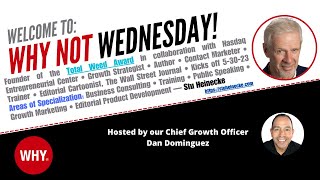
Stu Heinecke explains how weeds offer a business model: they produce millions of seeds, mutate to survive, and spread fast. He gives the Total Weed Awards to Clear, Calendly, Dandelion Energy, and Richard Branson for embodying these traits, and shares how a personalized cartoon once got him a meeting that changed his life.
Chapters
These last few years have made us question everything.
Our relationships.
Our jobs.
What constitutes an office.
And who we are.
In a.
World filled with chaos, confusion and uncertainty. It's time for some clarity. It's time to start understanding one another.
It's time to start understanding ourselves.
We envision a world where everyone knows their why. But even more, we envision a world where everyone knows their why. O s, their why, their how and their what.
The operating system that drives you, that lets the world know where you stand.
What your unique gift is, and most importantly, who you are.
Yos.
Are you ready?
Hello and good afternoon, good morning, good evening, or wherever you are in the world, whatever time it is. We're welcoming you to Wireless, not Wednesday. Really excited today to invite invite you to learn a little bit more about my guest, Stu Hynek, who is a best selling business business author. If you've seen my post this week about him, he's a hall of fame nominated marketer, a Wall Street Journal cartoonist. His first book was how to get a meeting with anyone and it was named one of the top 64 sales books of all time. If you're in sales, if you're in business, that's a invaluable book. You his latest book is really one. We'll spend some time talking about how to grow your business like a weed, which lays out a complete model for explosive business growth based on the strategies, attributes and tools that weeds use to grow, expand and dominate and defend their turf. That's all stuff we all want to know as business owners, right? So he's a twice nominated hall of fame marketer, a NASDAQ Entrepreneurial center author in residence. He was named the father of contact marketing by the American Marketing Association. And his mission, which I love, is to provide unfair advantages to help enterprise small business startup sales teams get more C level meetings with top accounts faster and more efficiently. Man, I am so glad to have Stu Hynek with us today. How are you doing, Stu?
Great to join you, Dan. Thanks for having me on, man.
It's been so cool to get to know you over the past few months. You know, we, I think, I don't remember how we got connected. I think someone introduced us. But every time I talk to you, I learned something new. And as I was reading your introduction, I realized what a great value you're bringing to people. So thank you for what you do, Stu.
Thank you so much. Yeah, we're, you know, I think one of the really cool things is you and I are collaborators. So that's, that's I'm really excited about that.
You know, that's. That's great that you brought that up. You know, when we, when we live in a world where, you know, we want to work with people that want to make the world a better place, and we do that by communicating what it is that. That we do best. Right. And so we'll start with that. You know, you bring up a great point. Stu's why, and I posted about this, Stu's why is to find a better way and share it with others. And as I talked about that, what is what A better illustration of that than the fact that you found a better way for people to grow their businesses and you said, hey, let's use the metaphor of the weed. And then you're sharing it with the world. You wrote about it. It's not. You don't have a limited mentality or scarcity mindset. You're like, hey, I learned this. Now I'm going to share it with everybody else. How does the why a better way fit you, Stu?
Well, I mean, I think all of that makes sense. When I took the. When I took. I guess it's not a test, but the discovery. The discovery, yeah. And then, then the results came back, I thought, huh, that's. Well, that's pretty good, you know, because I was always. I've always been thinking, well, I know what I'm. I'm trying to create unfair advantages for my clients. So I. I suppose I have a little bit different nomenclature for. For it, but it's the same thing. If I'm giving you an unfair advantage, I'm giving you a better way to do something. Not only that, it's a way that. That really kind of squashes your competition because you're doing it better. You have, you, you have. I don't know, you just. You have advantages that they can't match. But all of this is about finding better ways to do things right. And, and when you see, let's say when you. Because you mention. And they must be. People must be thinking, are they talking about this kind of weed? I don't know. No, we're not talking about that kind of weed. We're talking about the dandy, the dandelions and the other weeds that show up in our lawns and on the sides of roadways and in the middle of freeways, growing out of cracks in the sidewalks. All of these really very resilient plants that are almost magical. I mean, we, we're kind of irritated by them because, really, because they're so effective. But if you think about it, look at what they're doing. They're pulling off the most amazing things, and it turns out we can learn from them and, and use. I mean, they have a model and we can use it in our businesses. It's pretty amazing.
Well, you know, I talked about that in the post, you know, because one of the things I said is, you know, nobody likes weeds. They grow everywhere, they spread easily, they're hard to kill, and they're relentlessly adaptable, so they're almost impossible to get rid of. Yeah, you take that and what if. Apply it to your business. What if your business was like a weed? What if it grew everywhere? What if it spread easily? What if it was hard to kill and was relentlessly adaptable and almost impossible to get rid of? Now that we're sitting on the other side of it and we're like, hey, I want my business to be like a weed, right?
Yeah. Yeah, that's right. You know, I mean, we're always going through disruptions all the time. We just came out of the pandemic, I guess. I mean, people are still walking around with masks on where I am, But. But we just come out of a pandemic. We might have just come out of a recession. Perhaps we're heading into one where it's inevitable. We'll be heading into another one and one. And another one. That's. It's breathing in and out for the economy. We're always going through, through.
Through these disruptions. And, and if you look at what weeds do, think about the nature of weeds. They. They always deal with what is. I mean, they don't. They don't. They don't. Their emotions. They don't have emotions. We do. They get in our way. They don't have emotions. They just, They're. They're just very. A matter matter of fact, this is what I have to deal with. If I was just. If we were just cut down, we go right back to work rebuilding. There's no emotion about it. There's no. I don't know. They're not. Let's say they're not just. They're not discouraged by it at all. They don't feel anything about it. They just keep going. And so then, Then they also. They never do anything without an unfair advantage. They never do anything alone. They're always. They're natural collaborators, and they always focus on what makes them win. But one of the most amazing things is, Dan, that they. That they thrive best in disruption, or I should say in disrupted ground. So as we're going through all this disruption in our businesses and in our lives. It seems to that like I can see it, that the weed strategy, the weed model for growth, actually is the perfect model for thriving during those tough times.
And you've got to have partners, right? You've got to collaborate. And they do such a great job of that. You know, it's funny you're saying that because I'm dealing with weeds right now in my yard. I have a beautiful lawn that, you know, we had our sprinklers go out for a little bit and when the sprinklers go out, the grass stops growing. Guess what? The weeds thrive. And the weeds really took over some parts of my yard. The disruption was the sprinklers weren't working. Yeah, guess what? We'll take advantage of that and grow. So why not do that? And I think the businesses that thrive during the pandemic as you're talking about is those that were able to make a pivot and do something different. But the one thing that never stopped was that collaboration. And I love Bruce. He's a fellow better way guy, by the way. Still, he says unfair advantage equals competitive edge equals a better way. So that definitely matches up with your, your why of better way. Let's talk about your how of challenge, challenging the status quo, doing things differently. I talked about it in my post. I talked about the fact, well, what's. So what's different and out of the box, more different out of the box than saying, hey, let's take something that nobody likes and let's turn it into a positive, let's look at the positive aspects of weeds. And then not only that, you also took that and created a roadmap for how to take those advantage, those advantages and compare them to how weeds grow. I love the sections in the book where you talk about the different weeds at the beginning of the chapters and how they, the strategies that they use and then you turn that into a business. Where did that come from? I mean, that's a very creative, that's very challenge of you. You know, just take something completely out of the box and say, hey, let's do it. What made you think, hey, I'm going to use weeds and I'm going to build a business model around it.
Well, I mean, there are lots of weeds. And so I, I knew what I needed to write about. And there are, there are always weeds that, that, that follow those, those strategies. I, you know, one of the, one of the most amazing ones because you just, I wasn't expecting to Talk about these. And I won't, I won't talk too much, too long about them. But there's, if you look at what weeds are up to, my God, they're just incredible. They're so perfected in the way that they adapt and, and, and just gain ground. And so one of those is weed known as Waterhemp. And this is a plant that is, it's taking over farmland across North America right now. It's just, it's just insidious stuff, although it's also amazing. And so, you know, we think about, let's say dandelions. Dandelions produce 15,000 seeds per plant over a five to 10 year lifespan. That's a lot of seeds. We know they get all over the place. Once they start doing that, you're not going to get rid of them. So. But that's 15,000 seeds. Water hemp lives their annuals, so the entire population lives and dies every year. And, and so it's, it's very, very quick evolution as a result. And, and then they also produce up to 4.8 million seeds per plant. So think about that. I mean you're never going to, you will never get rid of this plant. And, and, but the other thing about that is that there are so many iterations of their seeds and of their DNA instructions within those seeds that there are always useful mutations. And that's how it evolves around challenges. So, so Roundup. I'm sorry, it's not Roundup, but, but so waterhemp has developed immunity to Roundup and it took four years to do it. And we all, I think we all know how, just how toxic that stuff is. Right. But it worked around it within four years. That's incredible. So there are all these, you're right. All these weeds have got really interest.
Lessons to, to offer us about putting down roots further than everyone else about and spreading. Yeah.
When you talk about the wheat, the, the number of seeds per plant, that's incredible. How do you stop that?
You'll never get rid of them.
And if you, and if you're a collaborator and you're working with lots of people and lots of people are talking about your business and lots of people are connecting you to other. Then that's how you become like a weed. You spread like wildfire. You spread like a weed.
Exactly. Yeah. I mean we all know what it means to grow like a weed.
Everybody understands there's a lot of genius behind that, Stu, and I really appreciate that you brought that to the forefront. Let's talk. I want to I want to make sure we have time to talk about the book how to grow your business like a weed. And we've talked a little bit about it, but that led to the total weed awards, which is really, really cool. You had the first total weed Awards here recently, and you had four winners. And when I look at the companies that won three of them, three of the award winners going to know, I think everybody knows Clear the secure, the airport security company. We've all been through that. Or we, we, if we haven't been through, we wish we had been through it. Right. How they, how they use wheat strategy calendly. And that's, that's a lot of our coaches, a lot of people in our audience use calendly to book their appointments. Dandelion Energy, you're gonna have to tell us a little bit about it. And then your number four was Richard Branson. So tell us about each one of. Let's tell us real quick what category Clear won in. And tell us a little bit about why you chose them as the winners.
Well, so clear, we were focused on unfair advantages and all weeds. They have unfair advantages. That's how they a big part of how they spread and conquer territory. So if you've ever been to the airport in the US and you're in one of those long security lines, you have a few choices. You could just get in the regular TSA line and you might wait, I don't know, you could wait up to an hour and a half, half perhaps. These can be very, very long waits and you're in long lines. Or you can take a little bit of time, a little bit forethought, and go through the process to become pre checked TSA prechecked. So you go through a shorter line. But then there's always these clear lines that are empty and they're inviting you to come up and join Clear. There's a fee, but they'll take a very quick biometric image of your eyes and your fingerprints and off you go to the front of that whole line. So here's the unfair advantage. One, there's two of them. One is while you're standing and you're standing and they, they are there during your moment of pain. And so while you're standing in that long line, it's just dangling right in front of you. You can just get out of line, go over to Clear, join and get right to the front of the line and do away with all of it. The other is, who would have ever known that a private company could squeeze their, their Cues into these. Into these crowded airport lobbies. But they figured out a way to do it, and. And they got to do it. Now, if someone else wanted to compete against that, there's no room.
Right.
You know, it's already. It's already booked.
So they took the space and they're there.
Yeah. Really incredible unfair advantages. Now, these are not really unfair. I mean, there's nothing illegal about it. It's very clever and creative what they did. But what. But by unfair advantage, I. So I don't mean un. I don't mean unfair, and I don't mean. I don't mean illegal or anything or unethical. All I'm saying is I want the competitors who are facing those advantages to be saying. I want them to be saying that's unfair. How are we going to do that? How are we going to compete with this? So beautiful unfair advantages.
Well, you know, I'm glad you brought that up, because we like to talk about knowing a person's yos. Knowing a person's Y operating system is an unfair advantage if you know somebody's. Why operate. If I know that Stu is looking for a better way. He's looking to challenge the status quo, and he's looking to build trust. Guess what I'm going to talk to Stu about? I'm going to talk about how working with me is going to help them find a better way, how it's going to help them be different than everybody else, and it's going to. How it's going to help them build trust. You know, you. That. Is that. Is that unethical? No, I'm just using what I know so that when I connect with Stu, we connect better because those are the words he's looking for. He's going to connect with me if I talk about things that are better, he's going to connect with me if I talk about things that are different and out of the box, he's going to connect with me when I talk about building trust. So why not know that about everyone you work with? If you're in sales, if you're in. In marketing, you want to connect with people using the language they want to hear. And so that's our unfair advantage. I love the. The way that you frame that. It's not unfair in that it's illegal or unethical. It's just an advantage that you have. Why not use it? Right?
Yeah, it's just a totally clever, audacious, competitive advantage that no one can match. This is the best. Well, those are the best kind. And I would say one of the best kinds of un. Unfair advantages are really what you just described. It's an unfair advantage that you can bring to. That you can confer on your clients what a great form of it. There are a lot of forms, but that's certainly one of them. And Clear does that they give you a great unfair advantage. When you get to the airport, just go through that empty line and I just learned something.
I just learned something. By the way, Stu, you can actually go right then and there, sign up and get through the line. So if I'm. Next time I'm stuck. Clear might just get my money, thanks to you. Yeah, so they'll make sure we're getting royalties for you on that. Tell me about Calendly. What category did Calendly win?
Well, so Calendly, the thing that we were recognizing is that really weed like spread, because, well, you know, I mean, that's. We. You see how weeds spread. They're. They're just. It's geometric. It's. They're seeds. If they're. If it's dandelion seeds or that kind of seed that flies, they can spread for hundreds of miles. So that's, That's. That certainly is what facilitates their spread. But with Calendly, we. We were really admiring the fact that every time you use Calendly, we've all been through it. Either you know someone or you're using yourself. But if, if anytime you get an invite, you're also invited to try it for free. And I think that's incredibly clever. They're reaching exactly the people who would use a calendar, a calendar app. And they're saying, come on in and try it out for free. So it's. It's just a perfect, sort of a perfect closed loop. That is how they grew their business. And I believe. I'm trying to remember. It's been a little while now since we're focused on the next ones, but. But I think they have something like a million. 11 million subs.
Well, I can tell you, Stu, I deal with people online all the time, and I can't tell you how many of them have Calendly. A very high percentage. I use. I use HubSpot because that's the platform our company's on. But Calendly makes it so easy, and I've used it before. It makes it so easy to join, so easy to share with everyone, and it's almost becoming. They're probably in. In danger of losing their name. You know, why don't you Calendly me? That Right. The way Xerox did and other, because it just becomes such an easy way to book an appointment with someone and you can create all kinds of formats. So they've got some great advantages. So you recognize them for their ability to spread, love it, spread like a weed. All right, this next one, the next one, I know why you chose them, because they have the right name. How do you not choose a company called Dandelion Energy.
For the total Weed award? Right. So tell me about Dandelion. What, what category did they win?
Yeah, I was gonna say it surely did catch our attention because of the name as well. But, but, well, here's the thing. Weeds have a mindset. Now again, it's not, you know, I mentioned it before, it's not a bunch of guys sitting around smoking dupes. That's not the mindset we're talking about. We're talking about this resilient, aggressive, urgent.
Perseverance mindset. Also just that they're natural collaborators, but they are fierce. They don't give up, they just keep going. And, and so they're relent. So one of the things that we noticed about the Dandelion Energy story is that they're a startup. They start up, they started up in the, I think it's called the Google Moonworks or Moon Factor. I think it's Moonworks. So it's an incubator within Google of different various startup ideas. And so they started there and their premise was this. Look, we've got all of these condenser based heating, heating and cooling. What have just apparatus, apparatus in our houses. The infrastructure devices. Yeah, but these devices that, that, that are rather inefficient because they, they use this, this condenser technology to either produce heat or, or, or cool cooler air. And, and they were saying why don't we take advantage of the natural, the naturally regulated temperatures. Just geothermal energy is really what I'm talking about. But it's just.
Temperatures down a little bit, just a little bit down below the surface. And so, so they were saying, you know, let's, let's link geothermal energy to, to these heat pumps and we'll end up with a much, a much more efficient heat pump. Really great idea. But the problem was that the only technology for producing or let's say digging down and, and installing the tubes that, or loops or pipes that would go down into the ground were all industrial based. And so to all that at a house, at a house level would cost like $80,000. Certainly that's not going to work. But they Persevere. This, their weed mindset that helped them just push and push and push to find a solution. And finally they did. They found a Swedish company that had already solved this. The same thing. They had this very cost effective way of putting loops, these loops down into the ground, which is exactly what they needed. And that brought the cost down to one that's actually affordable for homeowners. So they're spreading because of that. That.
I like that. So that was the relentlessness. Weed, weed relentlessness. Right?
Yeah, yeah.
And then, and then Richard Branson, I mean, nobody's ever heard of this guy. How does he get this award? Right? Who, how do you choose? Richard Branson. And what category did he get?
Well, he's hard to ignore him. I'm a big fan. I think we're all, most of us are a big fan. The thing is I, you know, I read his biography recently and, and I was just, I knew some of somewhat of what his story was. But when you read his biography, it's just he's so audacious and when he goes, when he starts.
When he's introducing a new venture in a market, he does it with these events that just cause everybody to become aware immediately. So he's a master at that. And the thing is, he just doesn't give up. Now when this happened.
Virgin Orbit had just ceased operation. So that was the operation where they were launching rockets off of a pylon on a 747. And so that one ceased operations. And we were just thinking, look, we know that. I mean, one of the things that weeds really do well is they bounce back. They come roaring back. If you go out and you cut your lawn and you cut down all these weeds, they're going to come right back. You cut them down, they'll come right back. They don't give up. They don't stop running their process. And so Richard Branson was the one that, that reminded us the most of them. There are a lot of, actually on all of these, all of these categories, there are a lot of possibilities. But I just, I felt because I'm the one who chose these, that that Richard was a great example because I knew he'd just become, just come roaring back. And sure enough, Virgin Galactic is another of his space ventures that are, they're now, they're back in the news and they're, they're picking up on, on their launch and pretty soon we'll be able to go and fly that, that spaceship and, and then come back and it'll be an amazing experience. I Just know that Richard will always come back and roaring back in ways that are just so audacious. So he certainly captures the, the spirit of being a weed.
I love that. So he's so, the, the relentlessness was dandelion energy. This is more about coming back from you've killed. You can't kill him. Right?
Yeah, yeah. It's just exactly like a weed. He's a total weed.
Hey, I'm going to give you a question from Bruce Kirk, and this is great. Bruce is a clarifier, so he love, he likes to get clarity. He wants to know how a weed strategy difference differs from a blue ocean strategy. I have some thoughts. I don't know if you've read Blue Ocean, all of us. Yeah, I think, I think I know the answer, but I want you to answer. We got the author here.
Yeah, well, brewing. Bruce. Well, the author of one of them.
That's right.
That's right. Yeah. Bruce, thank you for the question. And well, look, the essence of blue ocean strategy is you're either in blue or red water. If you're in red water, what you're in is a crowded. Well, I would call it a crowded channel. We're going to mix metaphors here a little bit, but a crowded marketplace where there's blood in the water. And what the authors are saying essentially is you want to find clear areas of blue water where there aren't. Aren't competitors already. It's sort of like what Chris Christopher Lockhead talks about with, with a strategy, I mean, with a category of one. So you want to be out in areas where you just, you're free of competition. That's great. And it makes a lot of sense. Makes a lot of sense to be a category of one.
Right.
But here's the thing, the thing that, that I think one of the big differences is that we're. Both of these are, are, are drawing experiences and models from nature. But I don't know how, I don't know how ocean, how water relates to growth really. And I think that one of the big unfair advantages that weeds have is that as a model anyways, as our progenitor of this model, is that we know what it means to grow like a weed. And we have lots of examples of how they're doing it, how they're pulling it off, because we keep trying to get rid of them. And their miracle is, I mean, we don't. Maybe we don't experience it as a miracle, but they keep coming back. And if you watch what they're doing, you'll see, you can see exactly what the tools that they use and the attributes and the strategies that they, that they use to do that. So we have a much more accessible model and I think one that actually makes sense because it, because we don't, we don't associate ocean with growth per se or water with growth. So I, I like their, I like the metaphor, but I just, I really like the weeds metaphor much better. It's just a much more thorough model really of. You can see how they do it. You can see that they, that they use unfair advantages and collective scale and they, they leverage that. I should say they've got this, this fierce mindset and unfair advantages and they leverage that against collective scale and they do it according to process that's millions of years old, but it changes on a dime when it needs to. So all of that makes a lot of sense. I think it makes a lot more sense. It's a much more.
I would say it's a much more complete model because you just, you can see exactly, you know exactly what you need to do.
Well, I think you, you answered the question with growth. It's about growth.
Yeah.
Books about growth. Blue Ocean strategy is more about moving to a place or creating something. But there, what's the strategy for growth? Right. And I think what you, I think you can use both. I think they're complementary to each other. But I do agree with you. You, you know, you, you, you've got to read both of them. So good, good on you, Bruce, because he's obviously a well, well read guy. Hey, we, we're running out of time. I want to make sure we get to two questions. One question is, look, your first book, how to get a Meeting with anyone. You, I love the story of your, your Wall Street Journal cartoonist. So you have. That is an unfair advantage that not everybody who's trying to get a meeting with people has. But you did something really fun. You used to send.
Cartoons that you, you published in Wall Street Journal to people and you'd put, you'd make big cardboard. So tell us about that story real quick.
Oh, well, you know.
I just, I discovered a long time ago that, that if I send a cartoon to someone and it's about them, it was always personalized. Then that became a huge unfair advantage. That launched my business. My first campaign, I sent it to 24 people. It launched my business. It was worth millions of dollars. It gave me 100% penetration in the magazine publishing industry from a single campaign that cost me about 100 bucks. And it was, that was based on using cartoons and personalization to do it. And, oh, my God, there's a whole other story about contact marketing, about how to get. Get in touch with people, and, And. And the. Really. I mean, it's not just about cartoons. There are really clever things that. That people have been doing to break through and can change the scale of everything. And the response rates and the ROI that come out of these campaigns are higher than any other form of marketing that I know of.
Yeah, Love that. No, that. That was such a good story. I'm glad. I'm glad you shared it. Let's ask before we get off the air, I want to make sure we ask the question. Tell us your biggest why not moments.
Do.
We talked a little bit about this and you said, hey, you got. You got something good for me, so I can't wait to hear this story.
I hope so.
Huh? Well, my biggest why not is if someone says something is impossible, that's your invitation to go do it. So I've done a lot of those things. One of those was I spotted a woman in a magazine, and I was. I had this fantasy. I don't know, this high school fantasy. I was gonna meet one of those beautiful, blonde Scandinavian women. And. But. But I wouldn't have found them in Boston where I was growing up. So I had to go to one of those countries for a couple of months maybe and bring someone home. I thought, man, what a great adventure that would be. That would be incredible. And so a dozen years later, I had my office. I mean, I had my business going, and I was based in Beverly Hills, and. And I was thinking, okay, what's next? I know I gotta make a film based on that, that, that. That fantasy. And so I hired the screenwriter who wrote the. The script for the Pink Panther, won an Oscar for it. We did a story treatment together. And then I was. I was. I thought, okay, the next thing I gotta do is I've got to go to the one of those countries with my video camera and videotape the place and the people and interview some. Some models or some actresses. Some. Somehow I've got to stitch something together. And so about a month before I was set to go, I saw this picture in a magazine. And I said, oh, my God, if I was going on this fantasy for real, this is the woman I would bring home. And so my. Why not? Was. I reached out to the magazine and we got in touch, and I arranged to interview her. And she's my wife.
Wow. That.
You.
You know what that is? That. That is such A great story, Stu. How long have you been married?
Oh, 30. How many years? I don't know. About 30. I've got to think about it. But was it 32 years?
I don't know that I've heard such a great story. Because you literally saw her in a magazine, said, that's the. That's the woman I want to meet. You got in touch with the magazine, figured out a way to get over to what country was you.
It. It was. Well, it was Denmark. Copenhagen.
You went to Copenhagen? Interviewed her, got to meet her. And I know. I know you've got family. 30 years of marriage. Congratulations.
Thank you so much. I mean, I. I wake up. I wake up with her every morning, and I go, wow, you're here. Oh, my God. That's fantastic.
Do you have the magazine still? I'm sure you do.
No, I don't have. I have the picture, but I don't have the magazine anymore. She's a Penthouse cover. Moment level. I was trying to be discreet, but, wow. All of that. That's supposed to be impossible, right?
That is so.
That is something that's impossible.
You know what, Stu? I. I'm gonna end on that. And what do you say we end the show on that note?
Why not?
This has been amazing. I am so glad you came on. I'm so glad you. You came into my network. I'm so excited to share your talents, your genius. Everything that you do is so, so good. You bring such value. So we're glad to have you on why Not Wednesday. We're proud to have you as part of WHY Institute, and I'm looking forward to continued collaboration with you. Have a great rest of the week, everyone. We will see you next week on why Not Wednesday. Thank you, Stu.
Thank you so much.
More from Dr.




Women In Leadership: A Need For A Greater Systemic Change With Belinda Clemmensen






