WHY Not Wednesday with Tanika Vital-Pringle
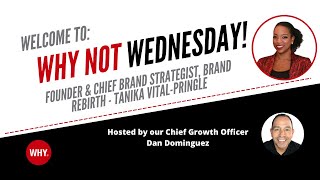
Transcript of a live interview (WHY Not Wednesday) where Dan Dominguez interviews Tanika Vital-Pringle about personal and corporate branding, her agency Brand Rebirth, and adopting the WHY operating system in executive coaching. Tanika describes her 20+ years in corporate/global brand management, her move into personal branding and online learning (Rebirth U), her coaching approach (inside-out branding), and examples of applying the WHY operating system with leaders and teams. She also discusses speaking engagements (Twitter Spaces, WBEC accelerator) and shares personal motivation rooted in family and contribution.
Questions this video answers
Brand Rebirth
Over 20 years
Over 4,000 hours
Five years old
Four Hacks to Rebirth Your Brand (ebook)
Chapters
Sam.
Hello, everyone, and welcome to Wednesday. We've got Tanika with us today. I am so excited about our show today. Tanika, welcome.
Thank you. Thank you. Hi, Dan.
Hola. Hola. Hola. Hola. You know, I forgot to. To. To that you're bilingual. And I said we've got to talk some Spanish trilingual, right?
See? See, See?
Yes, yes, yes.
So, Tanika, actually, you drove through Albuquerque, and we just missed you. I was in Denver, in. Gary. Was in Florida. Of course, you come through Y Institute headquarters territory, and neither of us is in town, so we weren't able to connect. But you got to connect with a friend of yours here in Albuquerque.
I did. Albuquerque is so beautiful.
Thank you so much. Well, what was the purpose of the trip? Don't tell. You know, for everybody else.
For my little one, we took her on a road trip to see the Southwest and to really go to my alma mater and to go to Phoenix, Arizona, and go to. And to go to Sedona. She wanted to hike, so it was great. It was a fun trip.
Was it a great spring break for her? It.
Was it really?
Nine years old, right, Tanika?
No, five.
Five years old. Oh, my gosh. So I doubled her. She's probably going to be so proud that I thought she was 10 years old. Good for her. So mine is 10 years old, so I don't know why I thought yours was nine years old, but. Well, let's get started. You know, for those of you that don't know, I was running late. Tanika was ready to go. Annette, I know, was like, dan, better get on here, because we're going live in one minute, but we're all here. We had another meeting that was going on at the same time, and it ran, of course, as always, it ran a little bit late, but. So Tanika is the founder and chief brand strategist at Brand Rebirth. So your trilingual global brand strategist who is passionate about inculcating Rebirth. I love that word change that leads to a new period of growth and improvement for your brand. So you founded Brand Rebirth, a boutique brand agency that has a purpose of boldly unleashing authenticity in organizations and individuals through personal branding, corporate branding, and online and live learning. So that. That is a lot. So tell us a little bit more about what. What. What does that all mean, Tanika? Because that is. You're doing a lot of stuff.
Sure. Well, it's just an evolution, I think, of. Of the company. Corporate branding is my core, as I've been doing corporate branding in the form of brand management, global brand management and marketing for over 20 years. And as I've worked with leaders and if I as I've worked with people in order to develop brands, I've been able to work with leaders. And that has also evolved into personal branding and helping them, because I strongly believe that you need to imbue authenticity, you need to have it in order to imbue it into the organization. So personal branding has evolved, has evolved into that a long time ago. And I love to train and develop and teach and coach. So. And we'll talk about it a little bit later. So this is how the online learning came about, which is called Rebirth. You learning.
So you're also an author of four hacks to rebirth your brand, and that's an ebook. So I'm sure we're going to talk a little bit about that because you're all about rebirthing brands by infusing purpose and strategy. So let's get started with the most important part of what I like to share with everyone about our guests, and that's your why operating system. So, Tanika, your why is to challenge the status quo and do things differently. Your how is to find a better way and share it with others, and your what is to contribute. So what that tells us is that you're a person that likes to look at things differently, do things differently, think outside the box. And how you go about doing that for your clients or for everything that you do is by finding better ways to do things. So you're always looking for a better way, and that's how you challenge the status quo. But ultimately, what people can count on from you is that you've got their best interest in mind and you're here to contribute to their success. Does that pretty much match who we're talking about here and who we're talking better than?
I could.
Definitely. So, Dan, it really, really does.
Have you always been that person that likes to look at things differently?
I have. I have. And I didn't always like the fact that I was, you know, different in that way. Sometimes when you're younger, you want to kind of fit in, but I always had a different thought. But as I've gotten older, I've learned that that's a good thing. That's what breeds innovation. That's what helps people move to the next level, particularly in business and in their pursuits of happiness in other areas of their life. So. But yes, I've always been like that. I could not just settle on learning one additional language, settled on two, you know, so it's just always like that. But I love to learn and I love to grow, and I like new things and new projects and new experiences, and I like to bring those to people, to clients, and to teams. So when I worked with you on this and discovered my why, os, meaning the operating system, my why, how, and what, it was actually refreshing and a confirmation that I am not the only person in the world like this.
Yeah, look, Aidan is saying that is so common with people with challenge in their yos. You often feel like, oh, my gosh, you know, I've always been different. I haven't always embraced. And Bella says it's interesting, a lot of people at the wife challenge kind of fought it at a younger age. And then as you grow into it, you've grown into and you accept it is, hey, this is my superpower. Right. I look at things differently. I'm an innovator. The other cool thing about your operating system, Tanika, is that it is also your. Your. Your. You've got better way.
Yes.
So not only do you challenge the status quo, but then you find a better way to do it. Because, you know, often people ask me, well, what's the difference? Because those seem like very similar whys. Challenging the status quo, doing things differently, finding a better way to do something. In order to find a better way, you've got to do it differently. And the way I explain it, and you're a coach now, you're one of us. So you maybe this is, you know, you can tell us how you explain it, but I always find that people who have the why of challenge will do things differently just to be different. People with the why of better way will do it differently if it's better. So you are kind of your own filter because you've got both of them in your yos. Have you found that to be the case? Yes.
Yes. I don't like to repeat, like, you know, I don't like to copy other people's work or, you know, from a creative standpoint. So if I design a solution for you, it is for you. I specialize in bespoke something that hasn't been done before because that brings me fulfillment. And that also makes you or the client, as a client, more authentic.
Right? Right. So you say you look for different, but you also look for better. Tell me about contribute. What about the contribute part? What people can count on from you is that you're going to contribute to their success.
Oh, I'm always going to try to help you and contribute. I mean, you know, who doesn't want to make the world a better place. And being a contributor just enables me to do that. And, you know, that goes deep. That's a part of what I call my brand DNA. It's a part of who I am as a part of who my family is. My. My mother is a retired registered nurse, and she constantly helps people. She constantly ministers in church. And my. My father, my recent. My late father, tomorrow actually will be a year since he passed. This is my father. He was a social worker and he helped people all the time. So if I can be a little bit like my parents in terms of helping others, I feel fulfilled. I really, really do.
So it's great when you help somebody, when you go in and help somebody rebrand their rebirth, their brand. Right. So that you've contributed to their success. And that feels good. Right? Love that. So, you know, one of the things that I wanted to ask you about is what. What in your professional background led you to coach leaders on personal branding?
Sure, sure. Well, I like to start off by saying that, as many people should be aware of who Steve Forbes is from Forbes magazine, and he says, he put it best, that your brand is the single most important investment you can make in your business. Now, we can take this to mean your corporate brand, because it is actually true, but you can also take it to mean your personal brand. So investing in yourself, your professional development is important because how can you help someone else if you have not figured yourself out?
For those who are motivated by finances, there is a cool statistic that is known that professionals who build their brands make 47% more than those who don't. So there is the financial benefit, if that's what motivates you. And, and before fully answering your question, I just want to make sure that I establish a proper definition for branding for what a brand is. So in the truest sense, you know, whether we're talking about a corporate brand or personal brand, it refers to an intangible attribute that exists in someone's mind or heart about you. It's what people think about you or about you when you're not in the room. And those attributes, and those words are, are the things that help to attract or magnetize people to the brand. And in this case, the person is the brand. So I just wanted to establish that we're talking about attributes, not something you can see. We're not talking about a website or web design tools. But to fully answer your question, Dan, I spent a lot of time working on brands and developing new brands. And my approach has always been to, to develop or build the brands from the inside out, meaning focusing on the employees, focusing on people, and obviously focusing on leaders. Because leaders have to be the media spokespersons internally and externally for the brand. So in order to prepare them to launch a brand, and when I say brand, I mean launching core values, launching the purpose for the organization, launching the vision. There has to be a connection, an authentic, or there should be an authentic connection between what the leader is talking about and what the values really are, what the brand values are. So I found myself connecting with the leaders in that way and making sure that how they showed up was consistent.
With the brand. And so that meant coaching them, helping them to show up in a different way, helping them to prepare how they speak, how they talk, even writing some of their speeches, you know, at times as well.
Yeah, I want to, I want to stop. Because Steph McPhee said. Yes, so true. You have to know yourself before you can sell it. If you haven't met Steph Tanika, she's the why coach. I mean, it's right there in her title. She joined us recently and she, she, she talks so much about how important it is to know yourself. So, so you've done that at a high level in the past and now you're helping people discover that on their own with your help. Yes, you start from within.
And I've also witnessed where leadership has gotten it right. And I've also witnessed when they didn't, when they haven't. So there are always opportunities to help because I like to contribute and there's always a better way to do something. And so that really helps, you know me with my exposure and helping.
Well, you posted something yesterday and I'm always, whenever I have a guest, I always want to look at, hey, what are they talking about? So yesterday you talked about Tom Peters quote that says, we are the CEOs of our own companies, Me Inc. To be in business today, our most important job is to be head marketer for the brand called you. I love that. What does that mean? What is the brand called you mean?
So the brand called you means just that, like, you know, branding is not just for entrepreneurs or for people who were just trying to get noticed.
Right.
It's actually for folks inside the corporation as well. It's for corporate leaders. Because in many cases, if you're a leader or an emerging executive, which is my area focus, you, you lead teams and you lead people, and branding magnetizes people to you. It pulls you in, branding pulls you in. But marketing pushes things out. It's a push and a pull. So where purpose and the why sit is still in the branding bucket. It's something that won't change you. I will never change. I will never not want to contribute. I will never stop, you know, challenging the status quo. How I do that might change. You know, I might have a marketing campaign on LinkedIn or whatnot, but it's the core at. At the core.
Right.
This is what I always do. So you, Everyone should think of themselves as a brand and apply the same tenets and strategies used for branding of companies, of Fortune 500 companies to themselves. Because you, you know, you have value, you have skills, you have things that you offer, and you connect with people. And it's really important to think of yourself as a brand every day, regardless of your role.
Perfect. So let me ask you this. You. You've. You've been doing this for a while.
You.
You've got an established coaching practice, and you were presenting. Actually, I attended one of your workshops. So what made you say, you know what, I want to add the yos to what I do? What about it attracted you?
Well, you know what? I will say you are an excellent chief growth officer, Dan, because I am a hard person to sell to. I'll say that. And I appreciated the fact that you actually attended the webinar. At the time, I was speaking to a group of women in nabo, the national association of Women Business Owners. And I was speaking on a topic, and I was actually talking about purpose as well as part of my topic. And I followed Simon Sinek for many years and used a lot of his methodologies and frameworks in doing branding for teams and building brands. But what I realized after meeting with you and talking to you is that having a tangible way to provide that to people like, you know, real people and not just companies, was lacking a little bit. I could do it, but it would take a lot longer, a lot of diagnosis to get to. Yes, Dan is the best, Isabella. It should get to the bottom line. So I was looking for a way to simplify. I was looking for a better way.
Right.
To. So that I can provide this to emerging executives and their teams. So when I, when you reach out to me, I listened. I liked what I heard. And then it was very helpful to speak to other. Why coaches like Melanie ache.
Yeah, Melanie, She's. She's usually on. We'll probably get a comment from her in a while.
Okay. Melanie was awesome. Jerry Lujan as well, and ultimately Jason Madison, he's been amazing.
Yeah.
And helping me to understand how he contributes and how he helps people. People with this tool. And so I really liked it. And. And I see how they've been able to upscale their offerings by thinking about. By using all of the whys. So I found discovering my why of challenging the. Challenging the status quo so empowering. And my how of a better way, you know, helpful in terms of improvement. And then. And also my what of contributor making a big. A better world, a bigger difference. What not so comforting and actually therapeutic.
Yes.
Other six whys. Trust, make sense. Right way, Mastery, clarify and simplify. Really help clients understand why they do, why they behave. They behave, and so that they can own it and learn about the good things about these whys. And also maybe some of the conflicts associated with it.
Love that. You know, I got to give. Give some love to. To all the commenters. So Steph McPhee said, Love this so much. What do you want to be known for? So she resonates with what you're saying. And I think we all know what we love to do, what we want to do, but what do you want to be known for? And that's part of that brand that you're building. And I love that you talk from starting from the inside out. So love that comment. And then we have another one. I gotta. I gotta highlight this. Dan is the best. So thank you so much for the love, Bella, but I want to acknowledge the fact that you acknowledged our community. James Madison, Melanie Ake. There was someone else in there who they. Jerry Lujan. So, you know, all those people helped you make a decision. And it's interesting because you, you know, and we say that to everyone. Look, talk to our coaches. Our coaches will tell you what this has added to their practice. Don't. Don't take my word for it, because my job is. Is different. I'm here to bring you in, but we also want to make sure we're bringing in the right people. And I love the work that you were doing, even when I attended your workshop, because I said, when somebody's talking about purpose and why, I want to go listen. And I went and listened to your workshop. You did a fantastic job. And I said, okay, now I've got to talk to her and see where this fits with what we do. And it seems like James Madison's provided you some great, great additional resources.
Yes, he has. And what I learned about some of the Y coaches, Stan, is that some of them also are John Maxwell coaches, or I've learned about John Maxwell. And so they actually integrated faith in with their practice, where appropriate.
Right.
Along with the why. Using the why tool as well. And I like that as well.
Fantastic. You know, there was, you know, you've been busy yesterday. You were, you were on another, on another show. And so you. It was called. You did. The topic was discover you your why and elevate your personal brand. But you were on Twitter space talking about this. And so it was, it was a great conversation. But tell us how that went yesterday and who were you talking to? Because I think it was people in the AI community. Right.
Artificial intelligence.
So Black women in artificial intelligence. So yes, tell us a little bit about that.
So it was, it was great. It was my first time doing Twitter spaces. And so it's different because it's all audio. It's more like a podcast. So speaking to them about how to elevate their personal brand and speaking to them and talking about some of the challenges that people, leaders within the technology space, some of the challenges they experience and how personal branding can benefit. And I should clarify, when I talk about personal branding, I am still talking about a type of executive coaching that involves discovery, a lot of discovery, pulling information out, which is why the why.
This why tool or assessment tool is so important before getting to pushing content out. The sexy side of personal branding, where people think about pictures and photo shoots. Yes, that is a part of personal branding. Discovering who you are, thinking about your strategy, your channel strategy, even performing SWOT analyses. Strengths, weaknesses, opportunities and threats. It's a part of the process. But an insight that I picked up on is that about 58% of tech employees actually experience an imposter syndrome. So it's not just women, it's also tech employees, 58 of them. This came from a survey from CMIT in 2018. And you know, it's such a major insight. And what I mean by that is sometimes people unconsciously sabotage their success. They over. They're overworked or they just burn out, or there's an intense fear failure which many of us experience experience as well. And so I, you know, I, I saw that insight and I wanted to find a way to help them better understand themselves so they can show up stronger and better. And also for them to understand why they are not alone and obviously to expose them to the. The why. The why tool. The why tool from the Y Institute.
Fantastic. I love that you brought that up because, you know, people think, oh, it's imposter syndrome is something that only coaches face or only people in really high. I think we all can suffer from imposter syndrome, regardless of what role you're in. So it's important to understand who you are, why you do what you do, and then bring that to the work that you do so that you feel connected to that work. Did you do you find that with the folks that you work with?
Yes, I do. And also most people who want to be on the leadership track will have to lead teams. They can't get, they can't get away from it.
Right.
So when you're investing in your personal, your professional development, particularly with personal branding, you're learning how to work with others. You learn how to motivate teams, which is why we like to perform. Use the why tool on your teams as well so that you can map out the whys on your team, because that really helps, you know, if you want to amplify your leadership potential. If there's disharming or unbalanced, it's the next way of saying you're having problems on your team. It helps, it's helpful. Even if you want to attract mentors within your organization outside, that's really, really important. And most importantly is you're able to communicate from a point of strength and a lot of things, a lot of, I guess tech leaders move up or sin because of their technical skills.
Right.
But in order to move into the C suite, you're going to have to use the soft skills. And this is where this fits in. And the soft skills can help you to attract more, gain more, and ultimately become an influencer and have more emotional intelligence, self awareness.
Yeah, so you talk about that. So you, you've actually, when you take a team through the process of understanding everyone around them, their why, how and what. So just let's use you. Use just you for an example. Challenge, Better way. Contribute. Dan Dominguez is contribute. Challenge makes sense. So we share a couple of the same. But just knowing what I know, hey, T.J. davidson, he's always on everyone's why is written in their DNA. But until they seek their purpose, they won't truly discover their why. We're going to have such great conversations around purpose and why, tj. Because the hard part about purpose and why is you use them in the definition for each other, right? So if somebody says to me, well, is your per. Does your purpose help you discover your why or does your why help you discover your purpose? Well, you use the definition, right? Well, your purpose is why you do what you do and your why is your purpose. So it's, it's really hard. So my answer is always yes.
Tanika yes, they go hand in hand.
But let, let's let you know. Thank you, TJ for the comment, but let's go back to the conversation. Knowing that you're a person who is going to challenge the status quo. I know that when I'm talking to Tanika, I need to, I need to bring stuff to her that's different. It's got to be different than what everybody else is doing. If it's not different, if it's not better and it doesn't help people, are you that interested in it?
No, I don't want to be like other people. I just want to be my best self. Right.
And so you got to be you. And if you're talking to Dan. Right. Same thing Dan cares about. How does it help people? How is it different? And does it make sense? What problem does it solve? So I think when you do that to an entire team, and we were just talking to a group that we're working with at Purpose Point, and they've just been introduced to the yos, and they talk about the fact that everybody in the room knows, hey, that's a strength there. Oh, that's their contributor coming out. That's their better way coming out. That's their trust coming out. And then they understand how to communicate with each other because they understand the tendencies of the people around them.
Exactly.
So let's, let's get to the so, you know, can you believe it? We're almost done. But the question I always ask, what is your biggest why not moment? And I know you, you've got a couple probably you want to talk to us about. So time when you said why not to an opportunity, a circumstance, a choice. Steph, if you're still on, this comes right from you because she, she uses this phrase why not. So tell us about your. Your biggest why not moment.
Well, one of my why not why not moments was when, like recently actually I had an opportunity to pitch my Rebirth learning to an organization called the Women's Business Enterprise Network, the local organization. And, you know, I have content on core values and purpose. I have master classes on these topics to help organizations. And so the request came through for me to actually be a part of an accelerator program consisting of successful business owners who have, you know, high network, high net, high sales, and to teach a module of, of the accelerator. But we're, we're still in a pandemic, so it had to be done virtually. And it's a six hour, basically almost a full business day. Yeah. So, yes, I taught, I trained many people about Your training. You know, I have over 4,000 hours of training under my belt in my career, but doing six hours online and keeping people engaged was a challenge. But hey, I said, why not? How can I make it fun? How can I make it interesting? How can I break up the content? And how can I infuse content from Rebirth, you learning into it? And so the organization was open to it. Oh, great, Steph. And so I was able to kind of bring Rebirth U into it, and it worked out really well. Everyone was highly engaged and it was great. But it was a challenge to kind of, to kind of do that. And I also talked about purpose as well.
And you had some, some heavy hitters in the room when you did that.
I did.
I did.
I had some heavy hitters. I mean, maybe, you know, business owners that I just aspire to become like as well.
Yes.
So it's kind of exciting, intimidating all at once, but it was great. It was, it was, it was a great experience.
You definitely had to say why not? And I know Steph McPhee is like, yes, we have to connect. I work with WBEC too, so I know you guys will connect. And you know how to connect with her through our coaches, through your internal website. Just find Steph and, and give her a call. Or you guys can connect through LinkedIn if you're not already connected. So that's awesome. Tell me about your other one because you, you, you mentioned a couple in the pre call.
Yes.
What led you to focus on personal branding and executive coaching?
Oh, I guess that one as well. I'm trying to remember. I said so much.
But I. What I want to focus on with that is that. Oh, I, I remember. So like last year, a number of people, you know, when I've been talking about my corporate branding and other areas of my business, you know, said, hey, can you help me A little bit of a personal branding. Can you help me? And it's saying, well, okay, I can, but, you know, so it took me some time to process it.
Right, right.
Why not? Why not apply all the tenets of brand strategy from. And not focus just on a company or corporate entity, but actually focus on the person? I love people. I love to connect with people and they all the strategies hold to be true. So that was a big. Why not transitioning to pivoting and transitioning or adding that to personal branding to the offering, but finding my space in it because again, I don't want to copy off of other people. So. So with personal branding with me, you're getting executive coaching with personal branding as well. So I'll help you to discover your truest self. I'll help build a strategy around that specifically for you and then I'll help you activate it. If you'd like to activate or position, meaning tangible things to do to be.
Seen and heard and talk about different. You're doing this in the tech industry? Yes.
Okay, well, you know, you know, in the tech industry because you know what, quite honestly, as much as I'm a brand person, colorful, I spent most of my career in the energy sector. I didn't talk about that. 15 years starting out in Tanares, working in Veracruz, Mexico, Argentina a little bit and also based in Houston and also Royal Dutch Shell. So you know, a lot of smart people, a lot of Antonaras, a lot of metallurgists, people in engineers who focus on steel, a lot of people in process engineering, chemical engineering, all types of engineering technology, building out innovation centers of excellence. So I spent most of my time doing branding and marketing with technologists, with people in STEM fields, taking a lot of information and deducing it and making it palatable. So I just, it's just a comfort zone and I get them very well how they think. They're very left brained and I want, I want them to be whole brained so they can really enrich your personal brands and, and their projects.
I love. You're the second person, second guest I've had and I'm sure other guests have brought it up, but you talk about using both parts of the brain. And I remember Sonia Shelton talked about, you know, people always say culture eats strategy for breakfast. And instead of taking the scarcity mindset, she said, you know what, culture and strategy should have breakfast together. Not, not one beats the other. Culture strategy better than culture. And you just said, you know, people are left brain but I want them to be whole brain. And so let's that abundance. I love that. Tanika, it's been so fun to talk to you. Let me ask you one last question because this is the part that I want, this is the part that I show to people like Tanika that say, well, Dan, tell me more. Right, but what would you say to a coach that's listening right now and saying, you know what, I like this yos stuff, but I'm thinking about it. What would you say to someone who's on the fence about becoming a wise society member and getting certified?
Well, if you're looking for a tool to help you help others in a very efficient way, you know, it doesn't take long to at least get the results. Now, it takes time to share the results and walk through things, depending on the client. But if you're looking for something to help you, like, operationalize, you know, your knowledge and move quickly and faster and meaningful, I think, you know, going this way, you know, is amazing. And also the community is just really, really great. A lot of smart people who like to help grow and learn. We're really passionate about purpose driven everything. I'm passionate about purpose driven branding and marketing, but there's so many different flavors of it and I really love it.
Thank you so much, Tanika. It's been this half hour flew by, so thank you so much for being on. And now one thing I'm going to ask you. Next time you're in the Albuquerque area or you're going to be in the Albuquerque area, you got to give us some notice. I get a text from Tanika the morning she's going to be at Albuquerque. I'm in Denver. I mean, I don't know that I would have moved my trip, but I would have been able to tell you, hey, look, this is the time that we're spontaneous.
It was a spontaneous move. I was in Santa Fe. I said, oh, I need to see someone. So that's how it happened. But yes, I will give you more time.
Let's give us more notice. And of course, would we expect anything different from somebody with a why of challenge, the status quo? You just going to go and call you when I get there and let's have fun. So thank you so much for being on Tanika. Have a great rest of the week. I look forward to seeing you again.
Thank you so much, Dan.
Ciao, ciao.
More from Dr.




Women In Leadership: A Need For A Greater Systemic Change With Belinda Clemmensen






