WHY NOT Wednesday with Vanessa Judelman
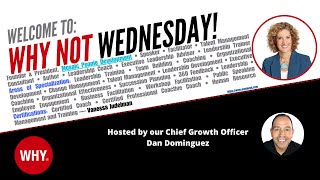
Vanessa Judelman, president of Mosaic People Development, shares her leadership framework built on knowing yourself, managing your team, and leading the business. She describes her why as contribute, how as simplify, what as trust, and explains a practice she calls hell yes or hell no for making decisions.
Chapters
Question everything.
Our relationships.
Our jobs.
What constitutes an.
Office.
And who we are.
In a.
World filled with chaos, confusion and uncertainty. It's time for some clarity. It's time to start understanding one another.
It's time to start understanding ourselves.
We envision a world where everyone knows their why. But even more, we envision a world where everyone knows their why. O s, their why, their how, and their what. The operating system that drives you, that lets the world know where you stand.
What your unique gift is, and most importantly, who you are.
Yos.
Are you ready?
Hello, everyone, and welcome to why not Wednesday, our weekly show where we talk to amazing coaches, consultants and individuals who are either coaches in the Y Institute or friends of the Y Institute who have had an experience with their yos that we want to talk about. We're going to ask them the question, what is your biggest why not moment? So today we have on the show Vanessa Udelman, who is the president of Mosaic People development. For over 20 years, Vanessa has been helping clients to develop leaders who inspire great results. She is a speaker, a facilitator, a talent management consultant, and a certified coach. She has been a consultant and has worked in house as a business leader. So combining that experience, she designs and delivers programs that are practical, customized, and can be applied on the job immediately. Welcome to why not Wednesday. Vanessa, how are you?
Great. How are you?
I am fantastic. Excited to share you and your talents with Y nation. It's been, you know, we've. It's been a short time since we met and, you know, one of the first questions we're going to ask on this show is how did learning your yos feel to you? Because you've done so much and you've been a coach for a long time, you've been a leadership trainer, but this is something new. And you were introduced. We were introduced by Noemi. So thank you, shout out to Noemi for introducing, introducing us. But she's your. She's your podcast scheduler. And I'm so glad she introduced us because when I learned about the work that you do, I was really intrigued and I couldn't wait to share your talents with our. Our crew. Your why is to contribute to the success of others, make a difference. Your how is to simplify, make things simple and easy to understand. So it's how you contribute by making things simple and easy to understand and implement. And it's even in the intro that we talked about. And your what is trust? What people can count you is that you can be trusted to do what you say you're going to do. How did that feel to you, Vanessa, when you first heard it?
I have to say it resonated a lot. I was actually quite surprised because I've never done an assessment. I've done lots of assessments around work style and personality and temperament. But what I love about this tool, which is so different is that it focuses on how you operate and it resonated a lot. I have to say. You know, a lot of people in our line of work are there because they do want to make a difference. And that's why I'm driven to do the work I do is really to bring light to the corporate world. I mean, I believe as a leadership consultant coach that leaders set the tone. They are the glue that holds an organization together. And I've had experiences over my career where I've had terrible leaders and I'm sure people listening have as well. And so we know, like the research indicates that people leave management, they don't leave organizations. And so that's why my work of helping leaders to really understand their role because it's very different. A lot of people around my, my why around contribute is so meaningful to me because a lot of leaders get promoted into leadership positions without really any training or development. Right? And I always use the analogy of car teaching a 16 year old to drive a car, right? You don't just say to them, here's your car keys, now go ahead and drive. Right? You take them to driver's ed class and you give them. They take online lessons and it's a whole process. But why do we just throw leaders into the deep end and say lead, right? And so that's why I really love that first piece for me around contribute, because that's a contribution I'm here to provide to the world is to really help leaders know what it takes to lead, give them the tools and also increase their confidence so they can really do a good job.
That definitely comes across in, in, in, in your mission. You know, we're going to get into that a little bit, but I want to comment on that with, with regards to leaders. It is so true. You know, I came from a corporate environment where we took our best salespeople. I've always been in sales. We took our best salespeople and then we made them managers. Because if you're a good salesman, you must be a good manager, right? Or you're a good technician. Right. Or you're a good customer service rep. The best people get promoted into leadership positions. But you're absolutely right. There's A void in terms of leadership training. And that's where you come in. You provide leadership training. You provide team building, coaching, organizational development, change management. What's your, what's the area that you love the most out of all those things that you do? What's the one area where you say, man, I can't wait to do that part with the next client I'm working with?
It's a good question. I, you know, when you have worked in Consulting for 25 years, so there's a lot of things that I can do and I always lead with leadership because like, like the nuts and bolts of leadership. So that's literally rolling up my sleeves and working with groups of leaders. Some of them, when they start working with me, have had some training before and some of them have really never done any kind of leadership training. So I take them through sort of a process with three pillars. So interesting, because I'm gonna, I'm gonna dive into simplify, which is my how. And I was so blown away by Simplify being my how, because that's what I do when I work with leaders. Leadership is really, really complex. It's got, it's multifaceted. And a lot of leaders kind of fall into the web, what I call the web of leadership, where they're just overwhelmed and sucked in by the complexity of leadership. So I simplify for them. And the way I do that is I share the three pillars of leadership success. So the first pillar is a leader. You have to know yourself. That's that whole self awareness piece. The second pillar is manage your team. You've got to know how to coach your people. You've got to know how to develop them, give feedback. And then the last pillar is leader business. And that's all about executing strategically and leading and managing change and even things like prioritization and delegation. So that's really what I love to do, Dan. I love to take the complexity of leadership and really simplify it for leaders and then give them practical tools that they can implement on the job to help them lead effectively.
And true to a why, how of simplify, it's three things. It's not 10 things, it's not 12 things or 25 things. It's three things. So the three pillars are know yourself. So self awareness is so important, which we love. Talking about managing yourself and then leading your business. So three things. And I'm sure there's sub things under that, but that's really simple. I mean, here's three things you need to do to be successful as a Leader, know yourself, manage your team and then lead your business. I love that. So one of the things we talked about in the pre show, Vanessa, that I wanted to ask you about is, is your, your, your mission. Your mission is to provide leaders with the skills, tools and confidence to lead with impact. Where does that mission come from and how do you bring it to life?
So where it comes from is actually a really bad experience that I had. So I was working in consulting for many years and then I moved in house and I was running a team and I had a great team and a great leader and I went on my second maternity leave and while I was on my maternity leave, a new leader joined the organization and she was my new boss and it was an absolute nightmare. She would yell at me in front of people, she criticized me in front of people, she took away all my responsibilities and in fact I moved from being like a very high performing individual in that organization to someone who was really disengaged within about four or five months of coming back from my maternity leave. So I never had, I mean I had okay leaders before and I had amazing leaders before, but I never had a terrible leader that really impacted my self esteem. And so while it was really hard at the time to go through that experience, I'm so glad I had it because now it really solidified my passion to give leaders the tools they need to.
To nurture their team, to grow their team, to develop their team. Because you as a leader, and I always tell leaders when I start working with them, you as a leader, make or break people's experiences at work just like this leader did for me. I left an amazing organization that I love because of this leader. So that's why this work is so meaningful to me. It's really as for many people who start their own business based on a personal experience that I had and you.
Brought that up earlier. You talked about people don't leave organizations. Usually organizations are amazing and they have great missions and they're doing great things. They leave their immediate leader and after a bad experience, what if we went back? Vanessa, what if you could coach that leader today? What if that leader came to you? What would you, what would that, what would you be able to help her with that would have made your experience better?
So I'm actually going to go to my what my what is trust and what this leader did not do is build trust with her team. I love this. I don't know if you're familiar, there's an amazing book called the Speed of Trust by Stephen Mr. Covey and Stephen Covey is the son of Stephen Covey, who wrote the amazing book the 7 Habits of Highly Effective People. And what he does so brilliantly, brilliantly in this book is he breaks down trust into two components. That to have high trust relationships you have to have character and competence. So the character side is things like I'm respectful and I'm transparent and I'm loyal. The competence side is things like I get results, I get better. I have those crucial conversations with people, I'm accountable to others. And then there's three that are character and character and competence, which is listening, which is keeping my commitments. I mean if you don't keep your commitments, you automatically lose trust. And then the third one that's both character and competence is I extend trust. So I purposely create an environment that is high trust. And so what this leader did, which is very interesting, she was very high on the competent side. So she delivered amazing results. But she was very low on the character side. She was very disrespectful for people, she was very disloyal. She sort of would have conversations about you behind your back to other people. And of course I've been at the organization a long time and so people just tell me what she said. So that's really the key thing. And I like to start there with leaders. I like to start with what does it mean for you to develop trust? Because if you have trust as a foundation, you can build a high performing team. As a foundation, you as a leader will never create a high performance, a high performing team. You'll just never get that.
That makes a lot of sense. Thank you so much for sharing that. And let's get us both on here together. Here we go here. I told you I was going to play with it and I would might make a, make a mistake or two. So I was playing with our, our solo layout. That makes so much sense and trust is such an important component. So for you, has trust always been a big part of everything that you do?
You know which part of trust has I gotta say? Because trust is all like those 13 behaviors that I just mentioned. The one that has always been part of my DNA is keep commitments. I like if I say to somebody I'm going to show up at 5pm, I'm going to be there at 459. If I say to someone, I'm going to deliver that proposal to you Friday at noon. It'll be there Friday at 11. Right. And so that's part of my DNA, but it's not a part of a lot of people's DNA. Maybe it's Dan, it's part of my simplify piece. Maybe. I don't know. You can tell me a little bit about that. If sort of keeping commitments is part of that brain that, that likes to simplify. But that's, and that's one of the key ways to build trust as an entrepreneur with my clients. I mean, can you imagine as an entrepreneur not keeping your commitments to your clients? You know, many people say, how have you run a successful business for almost 12 years? I think keeping commitments is a big part of that.
Do what you say you're going to do. And that is so important to people with trust in their top three. And it's simple, right? If, in terms of keeping it simple, if, if you know that if Dan said he's going to do something that it's done and you can check it off, that's simple. But if you have to follow up with him and remind him or check that he actually did it, that's not simple and that's no fun for you. Right. And so the, the other part, as you were describing that manager, experience, trust, being in your top three, I can imagine that that became an environment where you could not, you could almost not exist there.
Yeah, I think, yeah. In terms of, it's a great point in terms of motivation, you know, different people are motivated by different things at work. And I think you've hit the nail on the head. For me, it's very motivating to be in an environment that's high trust. I don't know anyone who can work in an environment that's low trust. I know many people who stay in environments that are low trust because better the devil you know. Right. I think people, often people feel like they're stuck in a workplace that's not healthy for them. But you're never stuck. It's. It's mindset. Right. That's that first pillar of know yourself. I also talk to leaders about mindset and having a growth mindset and realizing sometimes when you feel you're stuck, it's just a story you're telling yourself. You're not really stuck. You, you can choose to stay there and that's your choice, and that's fine. Or you can choose to leave and, and find a new role or find a new job or move within the organization and that's your choice as well.
Yeah, that's. That, that's so important, I think, understanding who you are. So you start with self awareness. Now you also have A book called Mastering Leadership. What It Takes to Lead in Today's Fast Paced World. So as I looked into the book, I like that you again, maybe it's the simplify you. You talk about finishing versus perfectionism, courage versus fear, team versus independence, and ambition versus competition. Tell me about the book. What it, what is the, the big lesson? Why did you write the book? And what is it that you're trying to get to the world through it?
So I wrote the book because I see so many leaders struggle. And I know that, you know, most of my clients or organization pays for me to support them and not everybody can afford that. So I really wanted to democratize the process of giving people everybody. You know, if you've got 20 bucks, you can learn a lot about leadership by reading my book. And I had so many experiences that I just wanted to share with people. And I blog once a week. If anyone's interested, go on my website, just Google Mosaic, people development. I blog literally every single Friday and I've been doing it consistently for five years. And that's free leadership resources that you can tap into immediately. And so I wrote the book because I wanted to provide people with a tool and tools to develop as a leader. I wanted to really explain what my philosophy is around leadership. You know, a lot of people at the time were talking about human capital and you know, words like that. I can't stand that term, human capital. Why would you refer to people as human capital? Just call the people, you know.
Yeah.
So yeah, I needed to get my, my philosophy and some of my thoughts about leadership out there. Dan, that would be one example. Another example is, is a term which I can't stand, which is.
When you say that, imposter syndrome, right. It's talked about so much and none of us are imposters, nor do we have a syndrome, right? And so I talk about that, you know, imposter syndrome is merely when people take on a new opportunity. They have development gaps. Again, you were, let me give the example, someone being promoted, you were promoted into a new position and you feel imposter syndrome. No, you have to stop using that term. Rather, what you need to do is say, okay, what are the gaps between, let's say you move from a director to a vp. What was I really confident at as a director and what are the gaps that I need to focus on in this new VP role? In fact, I have a client who's in a director position right now that I'm coaching one on one, and she's moving into a VP role. Who girls move into her VP role next year. So one of the gaps that she has is executing strategically. And so we've identified that as a gap and that's what we're focusing on during coaching. So no more imposter. You don't have a syndrome. Let's just look at what gaps you need to close in your development.
Love it. Love it. Well, you had some lessons learned from writing your book. When I went into Mosaic people development, and I know we had the link up. So if you're interested, you can go there. But tell us about finishing there. So there's some four lessons learned that I want to talk about. Finishing versus perfectionism. Tell us about that.
So I see a lot of leaders who are perfectionists and I personally am a recovered perfectionist, I have to admit. And that's why this one is very near and dear to my heart. So in the past, if I made a mistake, I would beat myself up and I would ruminate on it for weeks and just drive myself crazy. And then I learned that you have to ship. At some point, you have to ship. And so first of all, growth. Another wonderful book that I love is Carol Dweck's book. Her name is Carol Dweck. D W E C K. Her book is called Mindset the New Psychology of Success. And she talks about fixed and growth mindset. So when I read her book, it was a game changer because I learned that fixed mindset, you believe things are set in stone. Growth mindset, you believe nothing set in stone. With hard work, you can improve. And that's why this is. This book is compulsory reading for all of my clients because you have to come to leadership with a growth mindset. So for me, that perfectionism is about, I am wrong. This skill is set in stone, which is completely not true. The growth mindset and moving from finish from perfectionism to finishing is nothing set in stone. So I have to know that this, let's say I'm working on a. A proposal for a client, right? I have a colleague, for example, we were in the same same job for five years. I would finish work at 5pm, 6pm and off I go on my merry way. And she would finish work at say, 9pm and we had the same job. Why? Because she was a perfectionist. She would change the font and the color of the font. And it gets to a point where your client doesn't care whether it's this font or that font or the font is black and blue, right? So that's really the piece around finishing versus perfection. You have to know when you're 80% there. And I want you to ask yourself this question. If you're a perfectionist, ask yourself, is this good enough? Is this good enough? Right. And that's the time to shift and to finish rather than driving yourself crazy and focusing on it to be perfect. Because the reality is none of us are perfect. Why? We're human. So you will never be perfect. So it's an unrealistic, unrealistic expectation to put on yourself.
Yeah, I love that you have some resources that you have that you, that are related to your what of trust, Vanessa. So let's talk about some of those resources and how could people access them? Or is that something that people get when they're working with you?
For sure? Yeah. I have a trust assessment that I use with people to identify what areas they're doing well in terms of building a high trust team and where some of their gaps are. Also on my, on my website, I've got lots of resources you can also go to if you want one place. What I would recommend is YourLeadershipResources.com if you go to YourLeadershipResources.com I put up a quiz that you can do that's free. A link to some of my favorite podcasts, a link to some of my favorite blogs, and it's sort of a one stop shop for some, some free resources that are related to leadership. And that's, that's probably the first place I'd recommend people go is, is to YourLeadershipResources.com perfect.
And let me ask you this, because this is a cool question. Where does the name Mosaic come from? Because that's such a cool, cool name. But what does it mean? Mosaic, People Development. Yeah.
So when I was thinking about naming my business, which is really hard to do if you've ever named anything, it's really, really hard to do. I was thinking about a word that really represented people, businesses and organizations and teams. The word Mosaic popped to mind because if you think about it, we as individuals are unique. We're mosaics built of many different strengths and weaknesses, and we all have different values. And then as teams, our teams are mosaics of different people. Our teams are based on people. Again, with different work styles and different values and different strengths and different weaknesses. And then organizations are sort of a mosaic of different teams who all have different functionalities. And so Mosaic was really that beautiful image that encapsulated that sense for me.
I am so glad I asked that question because I really like the Picture you paint of all the different colors and all the different people. Because really, organizations are complex and mosaics are complex, right? You. When you stand back, you can just see the image. But when you get closer, you start seeing all the details. And I think that's a lot of the work that you do as a consultant, as a coach, as a leadership expert. Let's talk a little bit about your. I saw that your goal, right? Your goal is to develop great leaders at all levels. And you got three steps. Coaching individual leaders to grow leaps and bounds in a short period of time. The next one's really key. Training new managers to successfully transition into a leadership role and then providing senior leaders with the necessary tools to align their people with their business strategy. Let's talk about that first one. Coaching individual leaders to grow leaps and bounds in a short period of time. Give us the simple, right? Give us. How do you do that? Okay. Oh, oh.
How do you do that? I. I do that by setting goals. If I'm a person who simplifies, Dan, I'm going to set goals with people, right? So when I start coaching an individual, we set three goals. Again, back to the rule of threes, right? Everything. I do the rule of threes. And that's because people remember things that are in threes. So when I work with a client, we set three goals, and then we meet for an hour every couple of weeks, and we go back to those goals, and we talk about strategies to implement the goals, to achieve the goals. We talk about tools. I provide all of the people that I coach with a toolkit. I call it their leadership toolkit of tools. Let me give you an example of what a goal could be for coaching. It could be something like, I know that a lot of leaders tend to avoid giving feedback, and so one goal could be around not avoiding crucial conversations anymore and really learning how to manage conflict and give tough feedback. So that's an example of what a goal could be. A goal could be something like.
Really around communication skills and really learning how to communicate to different work styles. Because some of us, in the way we communicate, are very direct. Some of us are very indirect in the way we communicate. Some of us tend to be a little more assertive in our communication style. Some of us tend to be a little quieter, maybe even a little more passive in the way we communicate. And so that's what we need to learn is what is my style around communication, and how do I need to change or adjust that to meet the needs of others? So, for example, if I. Someone who's super direct, which I am sometimes all, okay, if you think about it this way, Dan and I know in your operating system, you probably think about this too. Sometimes our strengths, when we overuse them, actually become our weaknesses. So if I think about my communication style, this is the kind of conversation I would have with a coaching client. I may say to them, okay, you're someone who's very direct. What's good about being direct? Well, what's good about being direct? Well, people know what I'm thinking and feeling, and I'm just very upfront about that, which is amazing. And then I might say to them, okay, what happens when you overuse your directness so it becomes a weakness? And they may say something like, well, sometimes people find I can be a little bit rude because I'm just too direct. And I. And so then we'll talk about a strategy of, okay, well, what can you do to kind of dial that down? And listen, if two direct people are talking to each other, no problem. But if you have someone who's kind of on your team, is a little more soft spoken, you may want to tone it down a little bit. So that would be an example of a goal that we would focus on together.
And it's such an important goal because you're talking about those difficult conversations. Crucial conversations are critical conversations that people need to have. And if you're avoiding those, that's. That's a tough thing to work with. Not just for the leader, but also for the people working with them. If they're not getting that feedback, they can't improve. Right. So I love that as a goal. How about training new managers to successfully transition into a leadership role? We talked about that deficit of leadership training. So you train new managers to successfully transition. What are a couple of key things that you work with them on?
So I work with new managers for eight months. I rarely do things like boot camps because I don't believe they work. I've been developing leaders for 20 years and I don't like taking leaders to an off site for two days and saying, here's leadership, two days, go for it. Now when I'm working with new leaders, we work together for eight months. I'll work with maybe a group of like 15 to 20 leaders and we'll meet for a couple hours a month and we'll focus on one part of learning, one part of leadership. Let's say it's coaching. And then they have a whole month to apply all the coaching tools that we, we talked about in the session. Then we'll move on to another topic. Let's say it's how to build a high performing team and then they'll do a mini assessment together and then they'll go off and they'll practice the tools that everybody, every, everyone has homework. That's how you develop new leaders. You can't just you know, say read a book or go to a two day off site. It takes time to develop leadership skills as I mentioned before, because they are complex. So that's why we meet for one month. We focus on one part of leadership, we practice it, we come back, we debrief, we look at what worked, what didn't. People debrief their partner, they're learning with a partner to get input from their partner on what they did. And so we really look at the philosophy around the homework is not did I do it perfectly? The philosophy is really what did I learn from that and what will I do differently next time? So that's really the approach that I leverage because when I work with new leaders there's so much to learn. I really want to sustainable behavioral change with them. And so that's why we work together for, for at least eight months.
What I really like about that is, I mean it's, it's a two day off site, 16 hours or two hours a month for eight months, still 16 hours. But that homework and coming back and, and learning and applying because if you do that two day off site and you're gone, there's nobody to ask questions from, hey, this didn't work and it's all thrown at you so quickly. So I like the way you break it down into eight months. We're going to still hours. We're just going to do it a little bit differently and it's going to be a lot easier to implement which again simple, a lot simpler to implement one idea and, and, and start getting, getting yourself ready for the next session and you actually implement stuff. We're running out of time. We've got to ask the, the big question, Vanessa. Where Tell us about a time in your life. Name of the show is why not Wednesday? So we always ask the question, tell us a time in your life when you said why not to something and you're so glad that you did.
Well, I have a little bit of a twist. I was thinking a lot about that question and my twist is, you know, when I reached a certain age, I kind of said to myself, I need to live my life by not pleasing other people all the time or pleasing other people constantly at the risk of being stressed out and overwhelmed myself. So I have this philosophy which is kind of like, why not? But it's hell yes and hell no. And so every time somebody asks me to do something, it's a hell yes or hell no. And so let me give you an example. Somebody says.
I'm going to a concert this weekend and it's a two hour drive. Would you like to come? And I don't like the person. Maybe it's kind of music I don't like. And I don't want to sit in a car for two hours in the middle of the summer. I'd rather be outside hiking in nature. I'll say thank you so much for the invite, but no thank you. It's not going to work for me. Right? And so that's, that's the philosophy that I use now is hell yes or hell no. And it's just so empowering.
If it's not a hell yes, it's a hell no. I love that. Vanessa Udeman, you've just given us a great tool that we can use. And that example, boy, sitting in a car with someone you don't like for four hours because you got to get there and you got to get back.
Or even someone you do like. Even so, it doesn't be someone I love. It's just not what I like to do in the summer.
Not what you want to do. Well, what do you say we end on that note? That's a great answer. Thank you so much, Vanessa.
Thank you so much. Pleasure chatting with you today.
It has been great to have you on why not Wednesday? We want to thank you for sharing your wisdom and your story of your success. If someone wants to work with Vanessa, what's the best way to do it?
Go to www.maicpd.com.
Fantastic. So we've got your website up on the screen. If you want to reach out to Vanessa, she's on LinkedIn also, she's connected to me. Have a great rest of your week, everyone, and we'll see you next week on why not Wednesday. Thank you so much, Vanessa.
Thanks so much.
More from Dr.




Women In Leadership: A Need For A Greater Systemic Change With Belinda Clemmensen






