WHY Not Wednesday with Velma Gallant
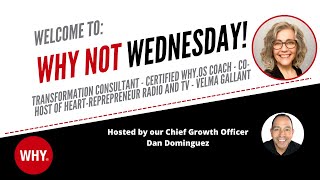
Dr. Gary Sanchez and Dan talk with Velma Gallant about her Heart Compass method for divorced women and the importance of understanding your why operating system. Gallant works with women rebuilding their lives after divorce, helping them reconnect with their purpose.
Chapters
These last few years have made us question everything.
Our relationships.
Our jobs.
What constitutes an office.
And who we are.
In a.
World filled with chaos, confusion, and uncertainty. It's time for clarity. It's time to start understanding one another.
It's time to start understanding ourselves.
We envision a world where everyone knows their why. But even more, we envision a world where everyone knows their why. O s, their why, their how, and their what. The operating system that drives you, that lets the world know where you stand.
What your unique gift is, and most importantly, who you are.
Yos.
Are you ready?
Hello, everyone, and welcome to why not Wednesday. I am so excited to be back. You know, we had a great week with all our coaches. Descended upon Albuquerque last week, and we got a chance to spend some time with a lot of our coaches. So we weren't on the air last week. We hope you guys are back and you're gonna enjoy this show because today we have Velma Gallant with us, and she helps divorced women create peace without guilt using her proprietary heart compass method. We want to hear about that, and she guarantees it. She's the host of the Divorced Women creating peace show where she interviews inspiring women who created peace and joy after their divorce. She is a survivor of teen trauma. She's been divorced twice, including a high conflict divorce with a child. So we know how traumatic that can be. Velma has interviewed and studied personal growth in transformational Experts for over 20 years, including three of the teachers of the Secret that were teaching the secret before the Secret was the Secret. So I'm excited to introduce you guys to one of our early adopters of the Y discovery and somebody who's been there for the edition of the YOS and someone that we really have enjoyed having as part of why society, let's welcome Velma. Hello, Velma.
Hello. I'm excited to be here today.
I'm excited to have you here. Listen, we always start by sharing with everyone your yos, Velma. So, you know, I want to make sure and share with everyone because we share the same why and how. So for everyone listening, and we always start the show this way. Velma's Y operating system consists of contribute, challenge, and simplify. So, Velma, you believe that success happens when we contribute to. To the success of others, contribute to a greater cause and make a difference. Now, how you go about doing that is by challenging the status quo, doing things differently, bringing ideas that are out of the box and. And. And are different. And what you bring, what people can count on you, what your clients can count on from you are simple solutions that are easy to implement. How's that, how's that for a description of Velma?
For me, it's. It is, it is bang on. When you, when you talked about.
When you talked about my, my introduction there and you were talking about the teachers of the Secret, how I'd interviewed teachers. The Secret before. The secret was the Secret. That really was.
One of, one of the things when I looked back on my life through the lens of my why operating system, it's like that was my Y operating system full on in action, even when I didn't know it existed.
So tell me what that means. Where did you, how did it fit what you were doing and with the Secret?
So what it was, was I did. Well, I did a telesummit before. Telesummits were telesummits.
Right, of course.
Because I'm an out of the box thinker. Right. Like that's. I, I do things differently. I love doing those creative ideas. And so that's what this was. Yeah, was a talisman before they really existed. And So I interviewed 18 different coaches, speakers, teachers on the subject of abundance.
Right.
And three of those people that I interviewed were teachers that were ultimately two years later in the Secret. And that was Joe Vitale, Mike Dooley and Bob Doyle.
Okay.
And so, you know, the 18 interviews, the intention was for these to be a contribution to anyone who listened to them. Right, right. It was an out of the box way of doing it because telesummits weren't really a thing back then. So, you know, doing, doing things differently.
And at the end of the day, it was really simple. I went out, I asked people. The intention was for these to be a contribution to anyone who listened to them.
Right.
No, we got echo going on. At least my ears.
Sorry, go ahead. I heard, I heard you twice. So sorry about that. Little technical difficulty there.
That's okay. And, and so in the end, it was a really simple way to do it. I went out and I asked people and I interviewed them on the phone. On the phone and I had people coming and listening and, and it was, it was a lot of fun. Like there was. I had one question that I was going to ask and that was what was their most valuable lesson on abundance and what made that so valuable?
Excellent.
And then we just had an organic conversation from there. I still have those audios to this day.
And then from there again, building on what I'd already done. I had a four year podcast before. Podcasts were really a big thing.
Love that. Love that. Hey, your, your neighbor, your seat mate from last week says hello kid casting him says, hi, Velma. We are sitting next to each other yet again. I love that. And TJ Davidson, who watches every week from Texas. Howdy from Texas, Velma and Dan. Thank you, TJ for commenting. And of course, our, our why language creator out of Florida, Lynn Everard says hi Dan and Velma. And then this is one of someone from your network, Sneha Radia. Hi, Velma. Can only stay for a bit, but glad to catch what I can. You look great. She does, doesn't she? She looks like she spent some time in some beautiful sunny weather in New Mexico. I think she's got some glow.
Love that. Love that. So glad to see people are tuning back in. You know, it's, it's hard because we skipped a week. Right. And one want to make sure that people come back. So I'm glad to hear, to see T.J. and, and Lynn and Kit joining us. So tell me a little bit about, let's talk about your host, your show Divorced Helping Divorced Women Creating Peace. Tell me about what that's like and how does that fit into your Y operating system?
Well, in, in a lot of ways, I, I, you know that saying, don't, don't bother reinventing the wheel, just change the tires.
Yeah.
So I didn't bother reinventing the wheels, right. I just changed the tires. So excellent. The, the, the interviews that I first did back in 2004 turned into the podcast that I did for four years.
Right.
And I kind of took that same concept and I've turned that into this show, podcast, whatever you want to call it. I do, I do do it live because one of the things that I believe about divorce is it's a really raw experience. So my show is raw, it's live, and we talk right in the moment. I don't bother, I don't edit it. I don't do anything. Like, we just get in there and we do it. And I took that question from that first, again, simple solutions, right? Like, don't go bother reinventing things. I took that same question I had in that first interview, but I changed it towards the divorced women. And that is what was the most valuable lesson about your divorce that you received and what made that so valuable? So we have that start. Conversation starts with that and then we just have an organic conversation from there. The show is about 30 minutes. So again, simple solutions like I don't bother reinventing the wheel. I take what I already know, tweak it and fit it where it is.
I love that. So in. In typical with the how of challenge, there's no.
Pre. Predetermined format. You kind of let it free flow.
I do. I do. And I've always done it that way. Like, even when I had. When I had my previous show again, that. That was before podcasting was really big, and I did it all wrong, and I loved every single second of it. You know, like, my shows were an hour long. I mean, there are some shows out there that are an hour long now, but a lot of people are really busy, so it's like, I can't. I don't want to do that part the same.
Mm.
And so I took it and I tweaked it down to 30 minutes, right. Because that's enough. It's a good. It's enough time. We can get some really good information in there without bogging people down, because life is busy these days. It really shouldn't be, but it is. And so we go where people are at.
Right? And I think half an hour is. Is digestible. I try to keep our show down to half an hour. I've gone long. But when, you know, if it goes long, it's usually something really interesting or we're answering a long question. But for the most part, like, to keep it to half an hour, because I think people can give up a half hour in the middle of their day. It's hard to ask people to give up a full hour with everything we have going on. Bruce Kirk, by the way. Welcome to Y Institute. Bruce, you're one. One of our new coaches. Bruce, Captain Kirk. The captain is here. So we're. We're glad to see you here, Bruce, and thanks for being on. So, Velma, so tell me a little bit more about your why not moment. The. The name of the show is why not Wednesday. Tell us about a time when you said why not to something, and it turned out to be a great decision for you.
I say why not a lot because, honestly, it's. It's like, well, why not try this? Why not try that? Right? So it really was.
You know, the first. The first set of interviews, the podcast that I did, leaving a business behind and. And going back into crocodile marrow. Why not do that? Because that was the right decision at that time. Super valuable. No regrets, right? Always. I. You know, you can have an experience, and it can sometimes feel like maybe. Maybe this isn't a good decision, but at the same time, it's like, why not go for it?
So what's your biggest what's your biggest why not decision? If you had to pick one time when you said why not, that's really stands out.
Becoming a why coach, really, honestly, it really was because I knew I was in that space in my life where I was stepping back out into the entrepreneurial world. I hadn't actually made a full on decision about where I wanted to be, where I felt like I needed to be. I just knew that it was time to start moving forward as an entrepreneur again. And it was, you know, it was an investment.
Right.
And it, in a lot of ways, yes, it was an investment for my business, but it was a huge investment for me because I got some answers about who I am that I always knew that I couldn't articulate.
Yes.
And you know, like the challenge, why is it as the whole time I was, you know, young adulting, I. I hated being at a job for more than two years. Hated it, Judged myself.
As soon as it became routine, did it become boring?
Yeah, as soon, as soon as I got everything down to a system. Because I'm a simplify. Right, right. And it was like, I don't want to do this. And, and I was raised by, by parents who were. That you stay at a job forever and ever. Amen. You go for that pension or whatever or RSPs or whatever it is.
Right, right.
That you're going for. That's. That's the way you're supposed to do it. And I'm like, I don't want to do it the way I'm supposed to do it. But I was, I was trained that way. So even though I'm, I'm fighting again, I'm fighting against who I am out in the world. Right. And so to be able to look back at that and go, oh, that's.
Why I did that. Right. Fantastic. And you know, you mentioned something, because when we look at the nine wise and we look at the contrast, there is, there's a big difference. By the way. Thank you, Jerry. Where, where's Jerry? He just made a comment, he said, velma, good to see you again. Thank you, Jerry. Velma, you got a fan in Jerry. Jerry was at the conference last week. So, so glad to see Jerry here. Velma, one of the things that, that we know when, with the different wise. Challenge doesn't do anything simple and simplify. Doesn't really like challenge, but that's in your operating system. How do you deal it? Is it a conflict for you? But I think what you just talked about is a way that it causes you to move on Right. It gets you to that next challenge because you simplify things. You make them routine. And now that. Now that it's all set, you're like, okay, now this is boring. I got to find something else to simplify. Have you seen that pattern throughout your life?
I see it, like, even looking back at my first marriage. There were times where, you know, do you think maybe my challenge contributed to a couple of divorces? Maybe a little bit. But. But that is where knowing my why operating system actually makes. Can make my relationships, all my relationships better. Because I accept who I am, and I can teach someone Right. About who I am and. And support them to find a way to, you know, for our. Whatever. Our why operating systems to work side by side.
So as you work. I'm sorry, were you gonna say something else?
No, go ahead.
So as you work with divorced women, how does the. How does the. The why play into that? Do you work. Do you help people as you're. As you're working with them? Is that the first step? What is it that. That the YOS provides for that?
The Y operating system is the first step in. In the work that. That I do. And it's there for two reasons.
Yeah.
The first one is. Is that it gives me the clarity that I need to know how they operate, where their gaps might be, where this. How has your operating system impacted or supported you with where you're at right now? Are you in alignment with your Y operating system? What did your Y operating system show you about your divorce? Your life? Looking back, where are you right now? Are you fully expressed in your Y operating system? If not, what do we do about that? And visioning forward through your Y operating system, I think is a really critical step, because, again, I want to be able to move forward in my life in a way where I'm being wholly and completely myself. So I want to vision through my Y operating system. I kind of look at them as my operating system can be. The glasses that I put on my face.
Right.
And so when I look back at my life, where is. Where has it shown up? Where was I not in alignment with it and unhappy.
Right.
Because if I'm out of alignment with myself, I'm. I'm gonna be miserable.
Right, Right, right.
Which. Which might, again, contribute to. For myself, my divorce. Right.
Because. Well, and. And it. And it did. Like, when I look back.
Everybody loves a contributor.
Right?
Yeah. I want you to contribute to me. I will ask you. I can count on you. I will ask you, and Velma will say yes.
Right.
And at the Same time, those particular partners did not like it when I would challenge the way things were thought about or done.
Right.
Did not like it when I was doing things differently from the way they figured it should be done and, and simplifying things. Sometimes it helped, but sometimes it didn't. But I, I do think that the challenge, though, was the part that, that impacted my divorces. And it's not because they were horrible men. It has nothing to do with it. It has to do with the fact that we had not found. I didn't know anything about my operating system.
Sure.
Didn't know anything about theirs. And so we didn't know how.
To run, you know, like the, like the, the wheels in a watch. Right.
Right. How to fit together. Right. We call it, we call it the pieces of the puzzle. Right. There's a certain way that Velma and I are going to fit with each other. And I can tell you that it's, you know, we're going to get along pretty great. And we do. Right. We've met, we've known each other for a couple of years now. And I remember that, that connection we had because I'm contribute challenge makes sense. And your contribute sound challenge and simplify and make sense and simplify are very similar. You know, you take things down to their basic level and communicate it and make it simple. And I like things to make sense. Well, simple things make sense. So I can see why Velma and I got along. But knowing the yos of the. Your previous partners, what do you think it would have been helpful for you in terms of how you communicated to them or how they communicated with you or just setting the rules in the relationship?
Absolutely. Absolutely. And it actually.
I was in a relationship, a long term relationship when I went through this training.
Yeah.
And I had the person do the what just the why discovery. I didn't have the operating system discovery at that point because, you know, I was a noob. Yeah. And it actually gave me the answers why we were having such a challenge with each other.
And, and ultimately I did end up making the decision to leave that relationship because it was not supporting either of us. Who I was was a big challenge for him and it made, and it made him unhappy. And who, who I was inside of that relationship had me being unhappy as well. So.
So a lot of people say that, you know, if you just introduce yourself that way, you're kind of letting people know what to expect. Right. So if animal comes, you know, how do you introduce yourself using your yos new person that you're Meeting, whether it's, let's say it's a new client. How do you. How do you do that?
Well, I really, I am here. I'm in this world to make a difference, period. That is the way I came into this world. I've always been that way. I will always be that way. And I love doing things differently. You know, went silver when I. When a lot of people weren't going silver, you know, when I put purple in my hair. I don't do anything normal. Right.
Right.
And I'm okay with that. I've gotten to that point in my life where I am really okay with, with how unique I am and I love it. And my solutions are unique. How I am in the world is. Is unique. And at the end of the day, I like simple. Keep it simple, sweetie is everything to me.
Oh, keep it simple, sweetie. I love that twist on that very common phrase. And. And keep it simple, sweetie is such a much better way to say it. So tell me about. Because one of the things that we know about from your bio, Velma, is that you use your proprietary Heart Compass method. So what is the Heart Compass method? And it's no surprise that somebody with the why of contribute has a heart in what they do. Tell us a little bit about the Heart Compass method because that is what helps you help women create peace guaranteed. So that we all want guarantee. So tell us about it.
So. So our heart is our compass. In. In the simplest form of the method, our heart is our compass. If my heart hurts, I'm out of alignment. If my heart is cold, I'm out of alignment, and so on. Heart is a bit of an acronym as well. Heal, Expand, Achieve, Rebuild, and Transform.
And then Expand, achieve, Reveal, Rebuild, Rebuild and Transform. Okay, Tell us about each of those.
So healing.
Right? Right.
Because when. When a divorce happens, there's a lot of things that come up. There's beliefs that come up, there's judgments that come up with their identity has disappeared against. That's why the Y operating system fits so beautifully in here. In here is because that is our true identity. It's not I'm a mom or I'm a businesswoman or I'm a wife or any of those things. Those are not our true identity. The Y operating system is our true identity.
Right.
So healing and coming back to that homeostasis that, that core of ourselves and expanding is about that vision, looking forward in our lives. Right. And. And expanding into the truth of who we are, which gives us the opportunity to achieve. We can actually start achieving things Again, from that place of the truth of who we are. Right. I mentioned to you that I didn't like being at a job for more than. More than two years, Right? Because that was not who I was. And so if I'm going to achieve, I need to achieve in a way that is in alignment with me. So really that a could also be alignment.
Right?
And rebuild.
Right.
When you're. When you're done with the divorce, it is time to rebuild. It is time to reclaim your life, yourself, and the essence of who you are. You're rebuilding your life, you're rebuilding yourself. And that really ultimately creates transformation.
Transformation. Love that, and thank you for sharing the acronym with us. And so, Velma, you just brought up something. You know, Joe Lander recommended a book last week. I don't know if you remember, we were in one of the discussions. It's the Five Regrets of the Dying. And so as you were going through that heart method, it really reminded me some of these things. If we don't do right, if we don't heal, we don't expand, we don't rebuild and take action.
Those are things we. We go to the grave with. Right? And then in the book, she talks about. The author talks about the regrets of the dying because they're so passionate to say, hey, don't do what I did. Right? Don't stay in a relationship, in a bad relationship, because you think you have to. Don't not follow your dreams because other people have told you not to. And so you took this entrepreneurial journey on and you took a chance and you invested in yourself to become a YOS certified coach. It's now a key part of what you do. What other ways have you implemented the why or the YOS into the work that you do? Because you do not. You don't just do coaching. You also have a show and you do a lot of other things. So tell me a little bit about how that implements.
Well, the why. The why, my why operating system is. Is at the core of. Of the coaching that I do and the different methods that I've. That I've brought to the table. I work with women with respect to their beliefs and behaviors and emotions that aren't serving them anymore.
Right.
And it is, again, it's just. It's a simple method. Once we find a belief, it takes 20 minutes to get rid of it. Can't get any easier than that.
I.
It made. It made sense to me. I know, I know you're a make sensor, but it was simple enough that it made sense. To me. And I could see the way they, the way they blend together because I've also found that the Y operating system, which is again why it's such a critical part and why it is the first part, the why operating system often points to some of the places where we might have had beliefs.
Right.
So I, I have a client whose how is mastery?
Right.
She used to read encyclopedias to deal with her stress before going to sleep.
Really?
Yeah, when she was, when she was a teenager.
Mastery. That makes sense. She wanted to learn.
She used. She used actually. And, and she went through her whole life believing she was not smart enough.
Right.
So you know that, you know, that's one of the beliefs that, that we dealt with was I'm not smart enough. And it is quite interesting that somebody who thinks they're not smart enough hasn't has a how of mastery.
I love that. I was looking for our other friend's book, Every in Every Belief is a Lie. Lisa Schermer Horn's book. And we've got to have her on just to talk about the book again. Lynn Everard says this. That is a great book. Read it several years ago. Lynn is such a scholar. He reads everything and he puts great posts out. And then Captain Kirk, you know, he and his wife just celebrated their 35 years. I can't wait to have him on because listen, I'm going on to 30 years and my wife and I talk about it all the time. It is not easy being married to the same person for 28 plus years and raising kids and doing all the things you do as a couple without going through some bumps. I can tell you and my wife and I are so different. Velma, you could counsel us. I'm contribute. Challenge makes sense. She's clarify right way. Trust. So clarify right way. There's a lot of that doesn't mesh really well with contributed challenge.
But at the same time, haven't you found that knowing each other's wise and what's important to you through those is has given you guys the opportunity to extend each other grace?
Yes, and, and that's a great way to put it, Velma. I think that happens in the workplace when we know someone's yos and you, you heard us talk about it all week last week when we laugh about it. Because you know, having challenge and makes sense is my how and what. I tend to justify things that I do because I just make sense of it for myself and it's way out of the box, way against the rules. And I'm like, you Know, it made sense because this is how I. What I was trying to accomplish. So I've already gone and justified. And other people in the room are like, wait a minute, what about the. How it impacts everyone else? And so while it gives us understanding and we might laugh about it, it's also something to watch out for because our actions have impact on others. Right?
They do. They do. And it's actually, I look at. I look at the way my operating system works inside of my family. So I have young adults. Well, an adult, adult son. He's 21 now, so it's not a young adult so much anymore. And he knows me so well that when he introduces a new friend to me, he actually gives the friend the warning, oh, by the way, she'll probably adopt you.
You love people, right?
Absolute. Absolutely love them. I want to make a difference for them.
Yeah.
You know, I do. I do get the opportunity with a lot of these young people, be able to speak into their lives. Yeah, right. And the simplicity of it, it simply is.
Do you want me to speak into this or do you just want me to listen?
Right.
That one simple phrase has made all the difference in every one of my relationships. Every single one. And especially with my son.
Love that. That is a great, great point. And I love the way you bring that back to your personal life. So Bruce is a new, new coach. Velma, you've been around a while. You said it was a great time in your life when you made that decision. So I speak to new coaches every day for, you know, for different reasons. What would you say to a coach who's looking at that investment and saying, is that something I want to do? What would you say to someone who is on the fence right now and saying, hmm, should I do it or should I not?
Fences hurt.
I mean, I know that. Again, you know, I like going back to the simple. But fences really do hurt. And at the same time, how much better can you be there for your client if you know their operating system, if you know why they do things the way they do them, how they're going to do them, and the kind of results that. That they bring? So if you're a business coach, are you going to be able to support them better with creating those results? Because you know how they're going to be creating those results and what kind of results they're going to be giving? Business coaches, it makes a whole lot of sense to have them leadership. I know I'm working with women who are, in essence, doesn't matter where they're a leader out in the corporate world, they are leaders inside of their families.
Right.
Period. Leaders need to know the operating system of the people who are working with them. So knowing my son's operating system makes it so much easier for me to be able to guide him. That's knowing anyone in my team, knowing their operating system, make sure I've got them in the right place, and it makes sure that I'm supporting in the way they need to be supported.
Right. And we talked about this on a mastermind that I was in last night, the Platinum Rule. When you know somebody's Y operating system, you talk to them the way they like to be talked to. Right? Bruce says truth, Velma. Knowing mutual y oss allows for better personal and family relationships. And I know Bruce just came off a 35th anniversary trip with his wife, so I can't wait to hear about it. He and I actually have to still do a debrief call, so thank you so much, Velma. I really enjoyed. First of all, I have enjoyed being.
In this coach client relationship for almost two years with you and learning along with you and having you along as we've developed so many things here at Y Institute. And I want to say thank you. Thank you for joining us in Albuquerque. And for those of you who are Y coaches, Velma will be there next year. She's a VIP and the first one to sign up. So we're looking forward to y con 23 and having you there. Velma, what do you say we end on that note?
Why not?
More from Dr.




Women In Leadership: A Need For A Greater Systemic Change With Belinda Clemmensen






