WHY Not Wednesday with Veronica Kirin - Forbes #NEXT1000 Entrepreneur!
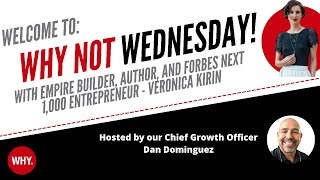
Veronica Kirin, a Forbes NEXT1000 entrepreneur and anthropologist, discusses her YOS framework for sharpening messaging and team coaching. She shares how ethnographic projects like Stories of Elders shaped her work, her 2018 tech company sale, and her three-pillar empire-building system: automation, systems, and hiring.
Chapters
Hello and welcome to why Not Wednesday. I am so excited to have our rock star guest today, Veronica Kieran, empire builder coaching. Veronica, I'm so glad you're here. Let me give you a proper introduction because this deserves a good introduction. So Veronica Kieran is an anthropologist, an author, an award winning serial entrepreneur. She is the creator of the three Pillars of Business Scaling, which I'm sure we're going to hear more about and has been named a Forbes Next 1000 business leader. She's done two TedX talks that feature her anthropological research on paradise, paradigm shifts. And her first book, stories of elders won the 2020 National Indie Excellence Award for U.S. history. And she's a finalist for the 2020 International Book Awards for general history. I know that's a mouthful, but welcome Veronica. We are so glad to have you. How are you?
Hi. I'm so pleased to be here and spend time with you. You're one of my favorite humans and I love the Y Institute as well as you know. So like I'm here for it. I can't wait to. It's exciting and yeah, I'm, I'm very well. It's winter time here in Berlin, but Berlin winters are a little bit different, you know, kind of more like, like in London, what you would expect, like maybe a little dusting of snow, but mostly just kind of like misty and gray. So I miss the sun, but otherwise I'm quite well. How are you?
I am so great. You know, I want to thank you because, you know, as I look back on our interaction. So I posted about this. No, you and I, you and I met through our good friend J.C. who we were. I did an interview talking about why and I knew right away that I was going to hit it off with you. I didn't know what it was. And then when we took you, you did your why, we found out your why is to challenge the status quo. But then you and I did some work one on one, and we got to figure out your yos, which is to challenge the status quo, make sense of the complex and contribute to the success of others. We have the same three why's in our yos. And I realized that that's why we were finishing each other's sentences even in that first interview we did.
Yeah, yeah, just simpatico the whole way through for sure.
It was so cool. And I've done more work obviously since then, but I think it was January of 2021 when we did that. So now that you know, you know and you've been at this Now, I think you got certified in May. Now that you know your yos, what's been the biggest impact that that's had on you to know that you're a challenger? Somebody likes to do things differently.
Well, I think it's just affirming. Like, I think that's like at least the very baseline value proposition. If you don't know what else to say about the WHY Institute, at the very least you have affirmation about who you are and everything that you've suspected about yourself throughout your life suddenly kind of makes sense. So just it allows me to say, like, yeah, I'm a why of challenge. So of course this is what I want to do and it's totally valid and okay for me to act this way or do do this thing even when other people are like, what are you doing? That's a crazy. And I'm like, heck, yeah, it's a crazy idea. That's exactly where I want to be.
That's exactly why you're doing it. Right. Because it's a crazy idea. It's different.
Can't help it.
Yeah. So, you know, for those that don't know, let's go over that. So your yos is challenge makes sense contribute. So your why is to challenge the status quo. How you do that is by making sense of and solving complex and challenging problems. But ultimately, what you bring are ways to contribute and add value in order to make an impact in the lives of others.
How has that changed your messaging now that you know that about yourself, you know, and we talked about the why, but what about the total package?
Yeah, I think it's actually just amplified a lot of the messaging that I was doing. So as a coach, especially for entrepreneurs, messaging is super important. So I'd actually honed and got really close to that. Like, I was already using impact in my messaging. I knew I wanted to work with impact driven entrepreneurs. I knew that I wanted to make an impact. That's why I did two years of disaster relief for the United States government. Like, I was already kind of like living in that space. I think the how of making sense actually really helped. I think that was the most helpful one because I knew about my impact desire and I knew I was feisty, but the, the helping to things make sense. I'd been told that I was good at explaining things, and I'll bet you've been told that you're good at explaining things. Right. But.
It. That's kind of like a hard superpower to really quantify. Like, oh, you're really Good at explaining. It just feels kind of ethereal. And when you draw it down to say no, like, I make sense of the complex. That's part of who I am. I think that's the one that had the most impact on my work and kind of my confidence about what I had going on, you know, and what.
We have found, it's your how. So it's how you challenge by making sense. It's you solve problems to make, to challenge, and then you solve problems in order to contribute. So we find that our how applies to our why and our what. So it's in everything that you do. And I love what you just said in terms of. Yeah, you always knew you could explain things, but now you have. You have language that really explains it at a much higher level so that you can add value. Right. Hey.
Right.
You've got a problem. You've got something you can't figure out. It's complex and challenging. Give it to Veronica. Now, she's going to do it differently than you probably would want to, but she's going to help you make sense of it. And I love that. You know, I looked at your website and one of the things I loved is I saw where you talk about. I'm a serial entrepreneur, author and anthropologist. I dream big, thrive on out of the box thinking, challenge. I truly believe change is possible as long as we figure out the how makes sense. And then you say, I provide the guidance, structure and expertise to scale your business into the diverse legacy you envision while freeing your time and energy to continue your work long term. So there's your contributor. All three are in there. I don't know if you did that on purpose or if that was already there, but it just really reaffirms what we know about you.
Yeah, I think probably so I rewrote that copy in July. I did a whole website overhaul experience.
And you and I had met, as you said, in January, and actually, you and I had met, what, days? Weeks after I moved to Berlin from the United States.
That's right.
Like, I was in a totally different space that, like, it wasn't even my own apartment. I didn't even have an apartment. It was like just squatting in an Airbnb. That's right.
You've gotten there.
Yeah. And so. Yeah, so. And I did all of my yos over the course of the first and second quarter. So when I was redoing my website copy, probably that's like, I didn't sit down and intentionally hammer it out in that format, like intentionally, but it certainly. It's had an impact on me. So it's. It's sitting around in my mind and making a difference and the way that I'm communicating and now. So, like, your order is you like to make sense. No, you like to contribute. Your why is contribute correct, but your how is your how also make sense? Or is your house?
My how is challenge? My what is make sense?
So. So. So what I do is I do things differently in order to contribute and in order to make sense. And then ultimately, what I bring are solutions that make sense. Ultimately, what you bring are solutions that contribute. Right. So they're in a different. Yeah, I mean, it's there because, you know, one of the things we've learned, and you probably know this as you're working with people. These are our beliefs and our motivations. Right. If you even. You don't. Even if you never called it a why, how, and a what, you could say, look, I believe in challenging the status quo. I believe it's important to make sense of things, and I believe in contributing to the success of others. So there's a belief, and it's what motivates you. If you're in a place where you're challenging, you're making sense of things, and you're contributing, that's a great place, right?
Yeah, absolutely. Happy?
Yes. Watson says shared wise. Ftw.
What does that mean? We're gonna have to ask you that.
Watson, for the win.
For the win. That's right.
Let me ask you this question, Veronica. Do you find that when you run into people that share one, two, or three of your top three, that these conversations are much easier?
It's kismet.
Yeah.
Yeah. Also. Hi, Watson. Watson and I are also besties now because, again, just like you're talking about, like, the clarity around your why, like, your entire yos helps to root you in a very particular way, and it gives you a lexicon in order to communicate about yourself with others. And so when I'm meeting fellow coaches throughout through the Y Institute, we're able to just, like, cut straight through into the meaningful conversation because we. We already have the lexicon in order to explain who we are. And we're. We're brought. We brought in. We, like. We get the lexicon that the other person is using. I don't have to hammer on the edges in order to get to the middle.
So you work with entrepreneurs, and you often work with their entire teams. What impact have you seen when people on a team understand each other at their yos?
Oh, my gosh. It really does make an impact. And so to clarify, I work with entrepreneurs in order to help them do, in order to help them scale their businesses. And oftentimes that involves teamwork and restructuring. I mean, I've had a couple of clients who just, like, totally dismantle their team and start over because they have to restructure and create something that is much more sustainable. Right. Like, the whole point is freedom. So, yeah, I, I, I have a client that I'm working with now who she has a couple trying team members, and she was telling me how much she, she works really hard to.
Improve. She always wants to improve. And so she gets an assignment in from one of her team members, and then she, she looks for ways to improve it.
And I'm hearing her say this, and I'm like, she's a better way. And then the way she's describing one of her teammates who is saying, like, well, I, I did all the steps. I'm like, he's a right way. That's why they're having so much conflict. Which is why I appreciate from you, when we talk about, like, how do the different why, hows and what's, like, how do those go together and how do they clash? I think that's really important too. So knowing that and being able to kind of, like, diagnose, even if I don't say it out loud to a client, like, if they haven't been through the yos yet.
Right.
I can, I feel like I better understand my clients and their teams, even if I've never met them, just based on what they're describing to me.
Right. And you start looking, you know, what words you're looking for. Right. And so you know, what's in their top three as, as you're listening to them. So then when you bring the assessment in, it just really helps solidify that. And then what we do is, you know, I'm sure you're doing this, Veronica, because we just put a spreadsheet up. We with their why, how, and what for everybody on the team. And then everybody understands, hey, this is, this is why Veronica's always saying, hey, can we make this fun? Hey, why do we have to do it that way? Right? So then they understand you. And then the other thing that leaders like and you, I'd love to hear from you. What's the biggest insight a leader has given you? Because for me, it's always, what, can we, can we do this with my team? What about you? What, what do leaders commonly.
How do leaders commonly react.
To the yos? Yeah, oh, yeah. So it's. It's again, like, peace of mind and clarity. I think, like, just like for myself, it helped to affirm and diagnose just the things that I already knew were happening in my life. But so now I understand the behaviors better. And so when a client does the yos with their team, which is something that I provide for a lot of my clients, just complimentary because it's so powerful.
They then will say, oh, like, now I understand why. Like, it doesn't get through the first time. I have to always say it this way or always deliver the information in a certain manner that feels maybe a little bit unique to them. Like, that it's not the way that they would talk. But like my. My teammate, like, they will not get it unless they see it in writing or they will not get it unless a schematic. It's like, oh, this is why. Or like, they have to hear. They have to see the big picture. Right? And so I know, I know, like, people who are tuning in are like, oh, yeah, I've been through that. I've been through that. I have a team member who is really annoying like that.
It's like, you know, the why Ana said a little while ago, I feel that that's me because she's. I think she's got right way in her top three. So. Well, let me ask you this. The name of the show is why Not Wednesday. What's your biggest why not moment professionally and personally? You can give us both of them.
Totally. My book. I would just say my book. So I, like, I. This was like the moment in my life where everyone was like, okay, I know Veronica is really audacious and very driven.
But she's running a company right now and yet also wants to hit the road for six weeks to interview people about the high tech revolution to write a book. And she's never written a book before that we know of. And we're going to do a Kickstarter to raise funding for it. And how is she going to balance all this and how is it going to happen? And then as I mentioned to you now, like, that I met my publishers in the same way I met you through my podcast. And just like all these little pieces fell into place and I could see the big picture. I knew that was going to pull us off. I knew it never been done before. I knew it was a never first of its kind, never been done before study. I knew that my chops as a businesswoman and as an anthropologist was going to make it happen. I Just I knew I would make it happen. It wasn't a question in my mind, but to everyone else, I mean, who gets up one day and says, you know what? I really want to hear from our elders about technology and then fundraises and hits the road and just goes and talks to them about it?
Yeah, and, and, and why would you not do that? Right? So it's.
And why wouldn't I?
Your life is probably, you know, people that are listening, that know the whys, they're like, well, her why is challenge. Her life is full of why not moments. What about moving to Berlin?
I know I picked that up just before you said it. Yeah, exactly. Like, why not? You know, I had always known that I wanted to live abroad, and so I formed a company that was international long before I was international.
But yeah, it was, it was like, well, the pandemic has shut down all of our connections here. Why not just leave? We already aren't seeing people. We already aren't participating in this society anymore. Everything's closed. So we figured it out and we did it. And yeah, it's been very fun.
And it sounds like you're having a great time. So one of the things you're, you're famous for is you, you've created. Well, first of all, you are an anthropologist, right? So you know about people, you studied people, and now you help people scale their businesses. How do the two relate.
So closely?
Well, and I just said, saw Gary's comment. Hi, Gary. And I said to Gary, actually, something along these lines that my challenge why? Comes through in my anthropology, because anthropology as a discipline tends to want anthropology to be done academically.
And there's, there's some historical trauma to that. There's very good reasoning behind it. But if anyone goes rogue, as I have, and is doing anthropology outside of the academic realm, it's very frowned upon. And so to me, I'm like, well, I'm challenging the status quo. I think anthropology can be done anywhere and be done well, anywhere, and to be done healthfully.
And so I'm going to do it and I'm going to prove it, because why not.
Anthropology studies? So for, for people who aren't totally familiar, anthropology is basically the study of humanity. We're really interested in what makes humans humans. And so we are looking at four disciplines. We have cultural anthropology, which a lot of people will default to thinking that's what anthropology is looking at. Living cultures, preserving them, et cetera. We have archaeology, which is Indiana Jones to some extent, so ancient cultures. We have linguistics, and we look at how language and culture interact, inform each other. And we have biological anthropology. So we're looking at our evolution. So what makes us humans? What made us humans thousands of years ago? So I'm a cultural anthropologist, and I study paradigm shifts. Now, if you were to take the word culture or subculture and just swap it out with target markets. Markets, it's the same thing. It really is the same thing. So I have been trained to have a laser focus into how other people act and think and interact with products in their lives, with other people. And all I have to do is just swap that into business, and I'm able to see very clearly and very easily into what a target market might want and see those trends.
It's really quite fun. But again, it's definitely challenging the status quo as to what an anthropologist is supposed to be doing.
I love that. Now you're working on something that's going to end soon, documenting the pandemic. It's your latest work called Stories of COVID and you're documenting the pandemic for future generations. Tell me what attracted you to that and how is that going?
Well, so I'm an anthropologist who studies paradigm shifts, as you mentioned.
Yeah.
And so it's the beginning of March 2020, and all this stuff is happening to us, and it is on a large scale. So there's no way this isn't going to have a lasting impact on our cultures and societies globally, especially as we are an increasingly globalized society. I also am somebody that has to take action in order to feel safe. I can't sit back and allow all the way to the point where if I have blood being drawn, I have to watch. I have to somehow, like, be a part of the experience. I can't close my eyes. It's not good. So those two things came together and I said, okay, we're about to enter a massive critical paradigm shift. Huge historical events, and this isn't going to go away in two weeks. I mean, come on. I didn't think it would last this long, but I. I was aware that it was going to be longer than two weeks.
Right.
And I have to take action in order to feel safe. So I am going to do what I do best, and I'm going to put my ethnography hat back on, just like I did for my first book, use the same methodology. It worked very well. I learned some lessons, so I just simply improved it. And on March 23, 2020, I had my first interview, and it's been off to the races ever since. And I've been talking to people all around the world about their experiences with the pandemic. For better or worse. I've heard incredible stories, stories of hope, studies of fear, stories of heartbreak, stories of adventure. And as you said, I've got to wrap it up. I just, there's no way a book is ever going to get written if I'm doing interviews ad nauseam. So I decided to end it at the two year mark. So on March 23rd, we'll do the last interview and I'll start writing.
I love that. So you, we just saw a comment from another person, Eileen McDard, who also has Ryos. She is Make Sense Challenge contribute. So we've got three different orders between the three of us. So thank you for the comment, Eileen. And she just absolutely, as Aiden says, you know, as a marketing strategist, somebody who can do what you do with archaeology and marketing together, it's really brilliant. Now you do something really cool. You're an empire builder coach. Tell me what that is. Tell, tell our audience what that is.
Yeah, so I, I, every so often I pause and think to myself like, you're using a word, empire, which has sometimes especially anthropologically implied some like pretty intense experiences for humanity. But I mean empire in that you are building something big and something audacious, probably something challenging. You want to make an impact on the world and you're doing it through business. I actually really believe that entrepreneurship is the path through freedom and to freedom in so many different ways. It's to financial freedom, freedom of location, freedom to choose who you want to and don't want to work with, freedom to do what you love every day or to do something you don't necessarily love so that you can do what you love as a hobby and never have to cross paths like you get to choose. It's the freedom of choice and everything. And so I help people to grow and scale into an empire. So to me, an empire is more than one offering. So I have a podcast, I have a book, I have a study, I have a retreat, I have private coaching, I have products coming out this year. And so I have multiple income streams and rental property actually. So multiple income streams. That's an empire. That's all an empire is. And that's what I want. For anyone who thinks that they ever want to do it, I'm here for it. I will help you.
Fantastic. So without giving away all your secrets, you talk about the, the three pillars of business scaling, right? That's what the, the empire retreat is all about. So what can you tell us about this? What are the three pillars?
Yeah, so the three pillars of business scaling I created as I was a small business owner languishing in the lack of knowledge and understanding of scaling for small businesses. So what, what makes me the most mad is that the startup community gets eons of resources. They have grants from the government, they have university grants, they have venture capitalists and accelerators and incubators like all of these programs, all the support. But we keep saying how small businesses are, you know, the backbone of the economy and employ more people around the world than any other type of business and da, da, da, da, Right. So like we just are always saying how much small businesses are so important and yet we really throw them under the bus as far as supporting them. And so I worked really hard in my own business, first in my tech company, which I sold in 2018, to figure out scaling for small businesses to steal the startup scaling tactics and get myself to a healthy place. I was burnt out. I was working 70 hours a week when I started this.
So by the time I sold my company in 2018 after two years of scaling, I was working 10 hours a week. It was very nice. And so that's where the three pillars come from. Just to be clear, I have them in a specific order because they work best in that order. But a lot of my clients come to me already down on the third pillar and we need to backtrack a little bit and sometimes you go back and forth. So I just want to caution everyone, this is not like set in stone. We move back and forth as needed because life is fluid, humans are fluid, businesses are fluid. So the first pillar of scaling is.
Is automation. And today we have like, like, look at us, look at this, look at this amazing thing we're doing using technology. And so much of it was automated. The, the calendar, the invitations, the sign up. Like, I don't even think you had to talk to me in order. You sent me a link and I signed myself up.
Right.
It saved you so much time and made sure we were all here. It was easy. We've got a great audience with us today. And automation is definitely a way that you can make money in your sleep through selling products online, for getting signups, et cetera. So we love to automate. Let's, let's use as many free tools first in order to save you time so that we have time to then take the next pillar, which is systems. And these, they really go hand in hand. So if your systems and processes are solid, your automation will be solid and vice versa. I want you to not have to think about what you're doing every day. I want you to be able to think about all the creative and fun stuff that you want to be doing. But if you're constantly thinking about what's the next step they want my client to go through, or what, what do I need to send next to this person, or how do I do this? Even though you've done it several times before, like, I'm sure, Dan, that there are things that you've repeated on a daily basis that for some reason you never wrote down. And so you have to sit and think for a second. Okay, what do I do next? Yeah, like so, hashtag relatable. I don't know. This is. Even though I know this well.
And I love hearing a challenge person talk about systems because.
No matter what, systems are so important. So automation systems, that probably you bring people around to help you with that. But what's the third one?
You just hit it. Hiring.
Yes.
So with automation, you have got technology doing things that humans don't really need to be doing. With systems, again, you've offloaded so much of your brain space and your time and you've made everything streamlined. And with good systems, you now can study your business, which is also part of the foundations of empire building. With those things put together, you now can hire and you're hiring people to do work where humans are really needed. So you're not paying somebody to do something that a tech could do. And you have incredible systems so their training is easier, so you make a better hire so they can dive back in and have value and impact in the business Right away. They feel valued, you feel excited, Everybody feels good. As I said, that doesn't always. They don't always go in that order. And sometimes I have people hire me when they're kind of panicked about their team. But that's okay. It's a lesson learned.
You know what's really cool is you did exactly what I was thinking. What's going to happen? We finished a sentence. I actually finished the sentence before I asked the question. Isn't that cool? I talked about hiring right before I asked you about it.
You did it? Yes.
That is amazing. I love that. So you're doing something really cool in May. So you have an empire retreat coming up. I want to ask you, where is it? Tell me what's going to happen at it. And the location is amazing. So tell us about that.
Well, Dan, I think I. I don't know if you know this but my lineage is Croatian. And in September I became a Croatian citizen. So I'm now a dual citizen with the United States. And so I just can't help but tout the beauty and wonder and history of my country. And most people don't realize that Croatia, yes, it's got beautiful beaches, but it, it looks over the sea directly at Italy. And it used to be part of the Roman Empire, at least the coastal parts were. And so I'm inviting several entrepreneurs who want to learn my scaling methodology, but learn it fast. And an intensive five day retreat where they get all the downloads into their brains, make the plan totally revolutionize their business, and they go home and they just hit the ground running like they've never dreamed they could ever do before. I've decided to invite them to Split, Croatia, which is on the coast in the southern area of Croatia. And Split is where Emperor Diocletian of the Roman Empire decided to build his retirement palace. And so we will be staying in the palace of a Roman emperor to build our empires. And it's going to be really, really fun. I've got a CEO photo shoot scheduled for all of them as well. So you're going home feeling like an amazing empire builder. Having lived in an empire, emperor's palace, learning the skills of an empire builder, it's just gonna be really great.
And you talk about, you know, it's great because it all kind of comes together because you talk about pillars and we're talking about an empire, so it all kind of goes together. So, Veronica, this has been so much fun. One last question for you. I love to ask this because I'm going to use it as a testimonial. If you knew someone who is thinking about doing the YOS certification and joining the wise Society, but they're just thinking about it, they're not quite there, what would you say to them?
First of all, I mean, we've already talked about how impactful and supportive knowing your discovery is. So I would just do it. Like get in, do your why discovery. At the very least, I would say do the whole yos, like get, get your whole system figured out. Even if you just, just to take it away and know what you're about, it really does help. And it's. I tell people this and this is off script. Like, Dan never told me to say this, Gary never told me to say this. But it is the only personality test that I've come across that tells you your why. Everyone else is saying, this is how you operate. This is what you're good at. This is the one that tells you your why.
If you're thinking about becoming a y certified coach, I mean, do it, you know, like, we're an amazing community, obviously. Obviously, Dan's involved, so, you know, it's good.
But it just. It's such a wonderful value add to at least to my business. Like, I think it's just such a beautiful value add. It really gives you the chance to be so much more supportive to your clients and, like, really take care of them. And I think most people here watching today are the type of people who really want to take care of their clients. Yeah.
Love that. Thank you so much, Veronica. It's been a blast. We're right on time, so we're going to end the show and say goodbye to everyone. Thank you so much for being with us today.
Thank you.
More from Dr.




Women In Leadership: A Need For A Greater Systemic Change With Belinda Clemmensen






