WHY Not Wednesday with Watson Jordan - The Resilience Initiative!
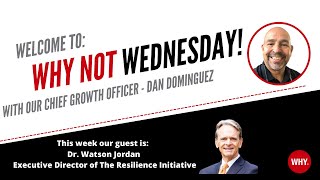
Watson Jordan talks about the Resilience Initiative, which offers coaching and classes on finance, health, and emotional resilience. He explains the "yos" framework (why, how, what) he uses with individuals and teams, and discusses his book Mine, Ours and Yours about losing a child and supporting bereaved families.
Chapters
Foreign.
Hello, and welcome to our first why Not Wednesday. We are so excited to get this started, and I'm so excited to share today with my good friend Watson Jordan. You know, Watson, we've known each other only a couple of months, but I feel like I've known you forever because I've gotten to take you through the process of discovering your yos, and we're going to talk a little bit about that. But you're so interesting. You have such a great background. I want our viewers to hear a little bit about you. So I don't know if you want to start with the Resilience Initiative. I'd love for you to tell us a little bit about what that is.
Sure. I'm a lifelong educator, and most of my work has been in the independent boarding school world. But in the last three years, I've worked as a volunteer with the Asheville city Schools.
Okay, so.
But I'm an educator and an innovator at heart. The Resilience Initiative was born out of my work with the Future Proof tribe out of Hong Kong. And Diana Wu David is really a mentor for me, and I was telling her about the projects I'm involved in, so. So one of them is underserved youth here in Asheville. Another one is working to help people who want to start investing. To start so not to become a millionaire, but to go from having no savings account to having a savings account, to having no investments, to having one investment. To be the person who says, you can not only go to college, you can graduate from college, you can not only begin investing, but you can make a habit of it, and you can do it. Other people who invest do, and all that's beneficial. The same with fitness. So for me, it all kind of made sense, but when I would describe seemed like a mess. So Diana is just so brilliant. And she said, you know, it all really sounds like resilience to me. And it really similarly to our conversation. It really struck a chord. And I went, well, I really like the sound of that, Diana. So, like, when the right thing drops into place, right? It was, oh, it's the Resilience Initiative. Oh, and we help people develop resilience, and we work in areas of finance, health, and emotionally. And so very quickly, I put together a few udemy classes, which were a lot of fun. I established a podcast. This was right when the pandemic was starting. So the first season of the podcast was interviewing friends around the world who got firsthand pandemic information first. And I said, what can you tell us so, you know, on the first episode, my friend Shamale goes, will you wear a mask? For three reasons. You know, you wear a mask to protect yourself from others. To protect others from yourself.
Right.
And to keep from touching your face all the dadgum time. So it was just so fun. So now I have a podcast, which is fun. I do some writing. I really love the yos, and in my. We'll get to that in a second. So that's the Resilience initiative. We promote resilience around the world, and we do that with coaching and writing primarily. So.
So I'm not going to let you off the hook there. You're famous for doing a headstand watching when you talk about resilience. So I'm not going to ask you to do it right now unless you want to. But tell me, where did the headstand come from? Because if people follow you and your followers are going to be watching. We've got five viewers on right now, and people are still coming. So if you're viewing and you have a question for Jordan, for Watson, put it in the comments and we'll ask him. We'll make sure he answers it. So a lot of people are joining us as we speak. We got a couple of people from Facebook, and we've got people on LinkedIn and on YouTube. So, Watson, tell us about the headstand.
So I belong to the greatest fitness program in the world, which is Kinseye. So I'm constantly finding things to do to stay active.
And.
And so they had a handstand course. So I went, well, I gotta learn how to do this. Well, it's so difficult. Not the. Not the strength part, but the teaching your wiring inside how to do that. So it's really difficult for me, and I have to work at it a lot, but it's also a lot of fun. And I thought it was a great example of, well, what am I willing to do to prove to you that I care about your resilience and want to be a part of buttressing it and fortifying it? So I thought, well, that handstand is pretty fun. And I, you know, I like it. And. And it's fun. Like. Like the yos. It's fun. You know, it's fun.
Well, you brought that up a couple of times, and I want to make sure we talk about your why not moments. So what's your biggest why not moment, Watson? Before we get to the why, I was. What's, you know, you probably said why not to the YOs, but what's the biggest why not moment in your life.
You know, I thought about that as the title for the show, and kind of they were asking, you know, why not? And, you know, I think the art of life, you know, is finding out when. When to say why not, Kind of under the camp of nothing ventured, nothing gained, and when to say why. It kind of been the look before you leap. So as we get older, and I'm going to be 60 in April, which is a remarkable age to be, but it's not 25, you get better at listening to kind of your internal.
Self and when it gets really excited. So I thought about kind of two examples. So my fitness program, Kenzai, I was looking for something, and a former student had started this out of Japan, and I tried it, and it immediately clicked, and it was fantastic. And all the things that it did were all the things that I was looking for. And in a similar way, I go to hot yoga. Right. So I went to hot yoga the first time. I went the first time, and it was like a cylinder in the lock of my life dropped into place, and I was like, man, I'm coming back tomorrow. So those are two really easy examples. But when you were talking to me about the Yoshi and why and kind of how it works, it really immediately resonated with, yes, I've been. I've been looking for a much better answer, and this is it. So I'm very excited and passionate about it and, you know, for all sorts of reasons, but those are the, you know, kind of why not Moments. Because you do learn.
To kind of listen to yourself and go, that's for me. And so I wouldn't encourage people to be rash all the time, but there are plenty of times in your life where you kind of go, I'm gonna go for it, you know, and what's the. Something favors the bold. Yeah.
Fortune favors the bold, right?
Yeah. You know, not to be afraid and to be willing to try new things and to be comfortable with no as an answer and things not going the way you think. And as a guy who promotes resilience. Yeah, that's a key part of, you know, being willing to try something. So.
Yeah. Well, let's talk about your yos, because it's come up a couple of times. So let's talk about it, because we. I want to ask you some more questions. Want to put them in context of your why, your how and what. Because you're an educated person with an educational doctorate. You've studied a lot of this stuff. You ask the tough Questions, and that's what you're known for. But your why is to find a better way and share it with others. Your how is to make sense of the complex and challenging, and your what is ultimately to contribute. So the way we like to say that at Y Institute is you like to find better ways and share them with others. How you do that is by making sense of the complex and challenging and. And ultimately what you do is contribute to the success of others. So how does that. When you go back, I know we had a kind of a breakthrough moment when we went through that with you. You started thinking about all the times you've been successful were times when you were finding better ways, helping people make sense and contributing to their success. Tell me what that felt like for you, because I know a lot of people that are watching want to know. Okay, how does somebody that's that educated find something this simple, so effective? How did you connect with it?
Well, the real connection was having a powerful experience that just laid right on top of that experience. So the easiest one to talk about was my career at the Asheville School. And I went there. I was the technology man. This was in the late 90s, right. So it was. You have. I got. The charge was to innovate as successfully and fast as we could for the next decade. So that was literally find a better way. You know, it was innovate. It was. And it was complex. For example, what we're doing right now, which is going well and was very straightforward to do, was not this easy.
Right.
Years ago, it just wasn't. So there was a lot of taking things that are complex, breaking them down, finding out the pieces. There was a lot of working with, because organizationally, you can't innovate every single department, every single day of the year because they will kill you. And they. But if you're thoughtful about it, you can find the right, most impactful pieces and to kind of move the organization forward.
And it can retain its kind of operational elegance, you know, because a school's job and this gets to contribute.
It's all about the students. So if I felt great about what we were doing, but it didn't serve the students very well, then I was wrong, you know, and I had to, you know, keep going. This has to work well for the students, which means it has to work well for the teachers. And so that it just got them all right in there. And I couldn't have. I couldn't have had more energy and been more grateful and had more fun than I did during that Time. So it was. And I saw that and I went, yeah, that's exactly.
How I like to work. And it. And it lines up with, I think, you know, Gary's initial question. You know, tell us about a time you were really successful. Yeah, that's one of the stories I would tell you. I would go, oh. Cause it was so fun. And it was fun, but it was totally overwhelming. And it was constantly innovating. But going from zero to one, which is. That's the hardest. I mean, that's really a challenge, going from zero to one. But we. We did it. And I feel great about my part in helping the school be a great school while I was there.
Well, and that's to contribute. Right. You needed to do something for that school, so you found a better way. You helped them make sense of the issues and the problems that they were having. And that's your gift. Right. It's your superpower. You'd find better ways by making sense of things, and that's how you contributed to the school. And like, I love what you said. That's when you had the most energy.
Oh, yeah.
When you're working that, you know, I hate to use from someone else, but why not? It's a better way, right? It's your zone of genius. When you're working in that yos, it's really. You can't not want to do that. We just had a comment from Stephanie McPhee, who just recently joined the team, and she. She is the Y coach. And. And Stephanie said her biggest why not moment was starting her business and talking about doing it. And then when the finally was presented with the opportunity just to say why not and then go forward. And now she's on a mission to help other women do the same thing. So I know what her why, how, and what is and how much she's living into it. Sent me a message earlier today about working with a client who. Whose why was right way. And Watson, I don't know if you've done this, but she said the client wasn't really sure. And then they went back and look at. Looked at some emails that she had sent out recently.
And.
And the words right way were literally in all the emails. And then when they went through her whole why, how, and what, it really felt comfortable. So I'm sure you've had some of those moments with your clients.
I have the funniest one. I was literally talking to.
Someone taking the yos.
Right?
And we were doing it the Y discovery, and then we were doing it by hand. So we were working it out, and he goes, well, let me ask you that another way. So I said, clarity.
Right.
Because he wanted more. He wanted to verify, you know, that what he'd said to me is what I was getting back, what you received. Right. So that was a big ticket item for him.
So I love that. I love that. Well, there's another part of you that. That I want to hear about, because you wrote a book that was titled Mine, Ours and Yours, A Father's Journey through the Life and Death of a Child.
Right.
That is not normally something that we associate with joy and strength, but. But what an amazing experience that must have been and how you've turned into that, into a positive. I really want to hear about that, Watson.
Well.
So I'll kind of start in the middle and work around a little bit.
Okay.
It was re. When you have a child die, it's really horrible. It's really. I mean, talk, you know, and you people. I do. People worry about things all the time, but most almost everything you worry about never happens. But then real things happen that you never saw coming, and, you know, it's cataclysmic. So. But I was fortunate. And what. I mean, fortunate if. And in the Resilience Initiative, we talk about a 5, 31 plan, where you have five people who are in your inner circle, who you can count on, who you're glad. They're those five people in three communities and a core belief. So part of my identifying that was hearing lots of different things. But right when this happened, as isolated as we felt, we just weren't alone.
So we went through it. But the school was great. We had friends. We had.
A faith thing that my wife and I share. We.
Had family. So being resourced gives you a chance to kind of work through real hardship, because it's. It's a. It's hard to do. But the book came about.
Most Saturdays, I have breakfast with my best friend, Frank.
Okay.
And every. And so. And we both have gotten. So we go. This really is a beneficial thing for me. Over the course of the year. Over the course of years. Right. Have that consistency of connection. And for the first. Gosh, I don't know, it was a number of years. I was just trying to make sense out of what had happened.
So all those breakfasts, I would eventually get some peace with things. So I had all these stories, and I had the idea.
To write a book, and, you know, some ideas pop up, and then they go away. Some ideas pop up and they really take root and they grow and are Fortified and turn into something. And at the end, it would have been harder not to write, not to write the book than it was to write it. And so we. So I wrote it, and it's a key part of my. What I hope to do is to reach out. We have a program that's almost getting ready to be for consumption, but it's for families who have lost children. And it's not a, if you do this, you don't have any more problems. It's a, here's something you can do that you can start and finish that can be a cornerstone or part of the foundation of the life that you're going to build after this. And I like that there's a beginning and an end, because especially in grief, it's true, but it's also really overwhelming to constantly hear everything is different, and you never know how long it's going to take.
I like to get closure on things, probably to a point that it doesn't serve me well all the time.
A better way.
Well, so I thought I, I bet I'm not alone, right? If that can be a part of someone's path because you want to do something because it's such a powerless experience. But there's not a lot you can do. I mean, there's just not very much you can do after.
Someone dies to make them not be dead.
Right.
So it's really about coming to terms and being at peace with what happened and then going, what's my life going to look like? How is my life going to be meaningful going forward?
So it's a better. So I'm looking at it. So you found a better way to make sense of something that's really hard to make sense of.
It's. I would say it's as complex a path as there is.
And, you know, the contribute part is wanting to help others, you know, because a huge.
When you do hard things, right, they're a hundred times harder if you're alone or if you feel alone.
Right.
So just that having those five people or three communities that you participate in, you know, you give to them and you harvest from them and having a core belief, and I always joke you can have more than one core belief, but you can't have 10,000. I mean, you got to narrow it down. And so. But that's about the book and it.
Well, I love that you, you brought that all together, Watson, because, you know, one of the things I want to make sure we talk about is you're now, you know, implementing what you, what you've done with. With the Yos into your coaching practice. So what's. What's it been? What's changed for you since you learned your yos in terms of how you deal with your clients?
It's. It's such a powerful step forward because everyone would say, yeah, you have to know why you're doing this. But at least from my perspective, there's a lot of confusion between why do I do what I do? And what's my motivation for doing this. So it's easy to kind of go, well, my why is wanting to get this red bike or to look right in this suit or whatever the goal is. But those are all termed. They might be longer term, it might be shorter term, but they end. And so then you have to go through this, at best, recalibration and at worst, kind of crashing into the ditch because you don't have your North Star anymore, and then getting going again because momentum is really our friend.
So.
It'S an awkward question. It was awkward for me to answer. You know, I would go, what's my why? And I would go, you know, I want to look great in a suit, or, you know, I want to take. You know, I want to take my family on a safari in Kenya, or. But. Which are great goals, but it's not why I do what I do.
Right.
It's not the gravitational field that allows me to go forward.
So, literally, when we were talking, I was like, oh, thank God. Because it lets you really put something in place. Because it's an important question to answer, but it's the beginning of the work that you do. It's a foundational piece to do work on. You know, it's a cornerstone to build from. It's not an end in itself. And so if you had to spend a bunch of time helping someone get to the point where they were comfortable with an answer that you knew was temporary, you can replace it with.
The yos. And I love to say this now. This is my. It's fast, it's fun, and it's insightful. Yeah, that's a lot. And you can kind of go, yep, here you go, and we can back and look at it again. We can revisit this because, like every assessment in the world.
You don't get the same result for the rest of your life. But it's fast and it's fun, and it's insightful, and you can work from that and the other. Yeah, so that's the biggest change is I feel like it's such a huge value, right, for me. And for the people I work with.
Yeah. Well, you also mentioned in the pre interview we were talking about you like working with teams and, and schools. And I was just on the phone with Bill Summers and Betty Burks. They're two of our coaches in Texas who work with school systems and principals and superintendents. So how are you implementing this with teams and schools? How. What's your plan?
You know, I'm just so. So I worked at a school for a long time and there are moments in the life of the school, especially for the administrative team or any of the teams of the adults at the school, where if you can get some fresh insight into the people who are working together, both for the executive and for the people on the team. And again, it's fast and it's fun and it's insightful that really can lift up a school. You know, you have an experience. It's fast and it's fun and it's insightful. People get some new vocabulary. But one of the best things, one of the many great things, all the vocabulary in the yos, you don't have to then hire the yos for the rest of your life to interpret the results. Right. You know, you can leverage some guidance and some insight, which can be the right decision for a lot of people. But it's sixth grade so that you can understand it and so that people can understand it. And you know, I think it's great to be able to look at your team and go, and this is what we're talking about that I think is key if you're building a team. So I'll start with the contrapositive. So the worst team in the world is ten of me.
That's the worst team of all time. So the best team is if you have the right amount of variety.
So and pick a variable, but with gender, with interest, with race, with whatever you value and you can share. You need to have enough shared perspective and context to be a good team. Right. But that really needs to be overlap where you can get the most out of it. Somebody said, yeah, you can use this and look at everyone's why and if it doesn't make sense to you. So if everyone is a mastery, you better be in a field where mastery really makes the boat go. Right?
But that's a different way. That doesn't have lots of demographic baggage to look at who's on my team and then to kind of go, what am I asking them to do? So it lines up, you know, if their tasks are.
Clarity centric, right. And their.
Challenge.
Challenge. Then everybody can do everything. Right. And it's going to be a disaster.
Right, Right.
So you. You can really leverage that alignment, you know, because.
You want to go through life, you know, with the doors being open. You know, I talk a lot about alignment with the classic example of there's a. You know, there are 50 doors to go through, and they're either all unlocked and people are there helping to open them and open from the same side, or they're all closed and they open from different sides and some pull and two are stuck. And you want to be. You want to set things up with alignment so that you're going and they're already open.
Yeah, that makes a lot of sense. Right. Why fight against it when. Let's put you where you are going to shine. We talk about that, especially with the why of challenge. You know, we're fond of saying, look, you take somebody with the why of challenge and you put them in a box, they're going to wilt. But if you put them in a place where they can be creative and they can be. Think outside the box, they can. They're going to thrive. So I want to ask you. We're almost out of time, Watson. One of the things you were talking about is what impact this has had on your life with your wife in promoting this as a tool for couples during the holidays. Tell me about that, because you're going to do something with it. Maybe some of our other coaches will say, you know what, that's a great idea. I need to talk about that.
So I had the. The fun. So I. My wife did the yos and she came back. Her why is clarify, which is a great why to have.
But a clarify person in general wants things to get clearer and clearer and clearer and clearer and clearer. And there's not a we. We need to make a decision. There's an infinite amount of wanting more clarity. So if I wanted to wrap things up, that could end up being a really kind of headbutting type of. But if you know that, you kind of go, oh, that's a. That's. That's her gravitational field of operation at work.
Yeah.
And there's lots of upside to that. Then it gave me a real path to go, oh, well, I need to look at this. If there are 10 examples, probably eight, it doesn't matter. I. I need to get over it. But on two of them, there are things I can say, like, I want to make sure you have all the information you need. And this is the last cycle of questions because we have to make a decision tomorrow at noon. Right. So everybody's clear. It's not kind of at the last minute. So that was really great. And I was talking with a friend who took it, and Martina said, you know, this would be really great for empty nest people.
Because they're at kind of a new place, Right. And they kind of go, how can I get some new information? And again.
What is it? It's fast, it's fun, and it's insightful, so it's easy to do. And especially, you know, for that demographic.
It'S much more valuable to have experiences that let you connect more than. Than to get new socks.
Yes.
So I. So I thought, well, that would be really fun. So I'm gonna, you know, promote that and we'll see what happens. But I thought that would be fun and it would help people, and I love that.
Well, I'm looking forward to hearing about it. I'm taking away from today. The most important thing is it's fast, it's fun, and it's insightful. I'm sure I'm going to see that on your LinkedIn. I'm going to see it on your promotional materials. Watson. Hey, we got through our first why not Wednesday? So thank you very much for volunteering to be on.
We'll see if I can pull it off.
Yes.
That is Watson doing a handstand, and why not, right?
All right.
Thank you so much, indeed. Thanks, Dan.
Thanks for being on, and we'll talk soon.
Great. Bye.
Bye.
More from Dr.




Women In Leadership: A Need For A Greater Systemic Change With Belinda Clemmensen






