WHY Not Wednesday with William E. "Bill" Kieffer
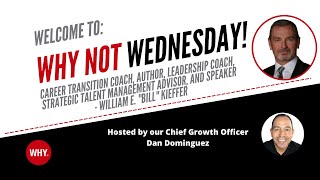
Bill Kieffer, a career coach for military and law-enforcement veterans, uses the Why Operating System to help people translate their service into civilian work. His why is making sense of complex challenges, his how is mastery, and his what is delivering trust. He shares how veterans lose identity in transition and how an elevator pitch built from why, how, and what helps employers understand what they actually bring.
Chapters
There's a certain kind of coach who believes what we believe.
Who leads people to greatness, who gets people unstuck, who unlocks all of your passion. A coach who helps people discover what drives them to tap into their superpowers. That knowing your why is the first step to untap potential.
To focus.
To breakthroughs.
A coach who's looking for a better way.
Are you that coach?
Hello, Bill. Welcome to why not Wednesday. Thanks for being with us today. How are you?
Great, Dan.
Thanks.
It's a pleasure to be here.
It's great to have you. I want to introduce you. You know, Bill, you've got a great set of skills, and you're an amazing coach. I'm so glad I got to meet you. You've got so many connections that we have in common, too. So you, you're a career transition coach. You're a leadership coach. You're a strategic talent management advisor, a speaker, and an author. I see the book behind you. And so what I'd love to talk about today is how you do all of those things. And now that you found your yos, we always want to talk about that. So I know you've got a connection to the Honor foundation and a couple other organizations that we're going to talk about, but what I always like to start with is your why operating system. Because everybody that's listening is familiar with the why or familiar with the why discovery, if not the yos. We've got a lot of coaches on board, but you've got a very unique yos. Your why is to make sense of the complex and challenging. How you do that is by seeking mastery, depth, and breadth. And then your what is. What you bring is trusting the ability and the delivery of trusting relationships. So we were just talking about that in the pre show. You just learned about that yourself maybe a month ago. And you've gone through our training. How does that feel now that you've had some time to sit into it?
On the one hand, it's kind of intriguing. On the other hand, it's almost relieving. It's like, oh, wait a minute. That explains why this, that, and the other happened through history. You know, one of the things that's typical of a make sense person is you can come to solutions pretty darn quickly. Right. And I. I've been blessed or cursed with that my whole life. I can cut through the malarkey pretty fast and get to what's the real issue? What are the potential solutions? And let's get to a solution that works without Wasting a lot of time.
Right.
And for some folks, that's great. They receive that well and they understand I'm just moving forward to get the solution. So we get onto other things. Other folks go, wait a minute, you know, slow down there, smart guy. You know, and it's never intended to be anything other than finding that best possible solution as quickly as possible, as efficiently as possible, and making sure that it's well researched that mastery bet make sure we've done all the diligence possible in the time allowed. All for, in my mind, the purpose of being able to deliver a solution you can trust.
Right.
Because at the end of the day, doing what I do trust is core to it. You know, people can't trust what I'm doing and how I'm doing it. I'm not going to have a client base for long.
Well, and your clients are very special, right. So.
You'Re working in career transition, specifically in for military and law enforcement veterans. And then even there you're even more specific because you work with special operations. And then even there you go even further, more specialized when you work with Ranger for life. So what's the relevance to you? And as you look at people that are making a career transition in terms of using people's Y operating system for the veterans.
Yeah.
So guys, right?
So, you know, the population I primarily support is very specialized, whether it's law enforcement or whether it's a special operations community from all branches.
Right.
But many of the issues are similar to anyone in career transition, perhaps felt a little more strongly with this group. And that's this loss of identity. You know, for many folks, they were the uniform, they were the rank. You know, I was, you know, Johnny was a Navy seal, and that's how I identified. Or it was a Marine Raider or, you know, whichever, Right. I was a police detective or a SWAT team member. And it becomes a very deep and robust part of your whole identity. And when you transition, whether it's voluntary or not, right. That identity is gone. And not only is the identity gone, the affiliation with the machine, the environment, the tribe, if you will, that's now gone, or at least going away. And it leaves a person kind of naked, I would say, and they go, okay, so I'm no longer that. I'm no longer part of this. Right? Who am I or what am I and why am I? Right. And if they don't understand that, you know, before I started with the Y Institute, one of my first steps in my model of coaching model was who are you, what are you Bringing the party. And it was not quite as clear and crisp as the Y operating system. Right.
The.
Getting the answer to the why is one thing. And you know, I think, you know, we've had discussions, you know, with folks, well, you know, what's my why? And people come up with stuff and. But I was always left with, well, now what, what do I do with it?
Right.
That's the what. But so what?
Right, right.
Yeah. So what intrigued me with the yos is it goes beyond just the, well, here's your why.
Here'S how that manifests itself. Here's how you go about doing it. It's how you bring it to life. And then the what at the back end, or, yeah, the what at the back end it should deliver. And I think as you and I talked early on, you know, I like the phrase, you know, my why is my purpose, my how is my process, and my what is my promise.
Right.
And that's how I approach it. And I take that not just from a coach standpoint, but I try to apply that mindset to the folks that I'm coaching. Because in the end of the day, folks in career transition need to be able to articulate to potential employers the value that they're going to bring to that opportunity. Right, right. And they have to convince the employer that they are the best person to fill that open hole. Right, Right, right. And I believe if someone can sit down and answer that first question and says, well, tell me about yourself. Right. In a way that makes sense, in a way that's logical, in a way that's thoughtful, in a way that can be customized.
And it would address the open needs. Right now they've set themselves apart right out of the gate. Right. So tell me about yourself. Well, you know, I can tell you that, you know, I've done some great work with the, the Y Institute, and I understand my why, and my why is making sense of things. And let me tell you a little bit about that. Right. And I go about that through mastery. And the way that what that looks like is I do deep research as much time as possible.
Right.
And the reason I do it all is so that I can build trusting relationships and deliver solutions that you can trust over time. That opens up a whole conversation in an interview type setting, in a networking type setting, in an informational interview. Even now, all of a sudden, you go from a kind of a blank face person who's interested in a job, someone who's really interesting to the employer. Right.
And the conversation flows from that. You know, we've had a lot of people that we've worked with that they, they will add this to the top of their resume. And so then the conversation is about, well, tell me about your why of makes sense. Tell me how you've done that in the past. And guess what, Bill has made sense of a lot of stuff in his life. And so you get a chance to tell stories of your success. Right? It's, it's your why and it's what you've always done. It's what you like doing. Hey, she likes Bella loves your explanation of why, how and what. Your what being promise. Right. And Bella, I will tell you, her, her why is trust. So she loves that promise in, in trust. So thank you, Bella, for your comment and thank you for welcoming us. As I was saying, you know, when you put your why, your how and what, then you get asked the question, Bill, as a veteran looking for your first civilian job, tell me about how you, how you do that. And you say, well, I do that by seeking depth and breath and researching. And then what I, what you can count on from me because you can trust me. If you, if you, if I say it's going to get done, it's going to get done. Right. You'll go to great extremes to be reliable. So who doesn't want to work with someone that does? And I find that with regardless of the yos, do you find that also?
Well, I do. And you know, one of the, one of the challenges that military and law enforcement folks have in career transition is speaking the civilian language.
Right.
You know, I say this a little bit tongue in cheek, but oftentimes our veterans, they like to speak mil speak or veteranese. And you know, 93% of the population never served in uniform. They have no idea what you're saying.
Right.
So I believe that the construct of the yos helps to open the conversation in a way that's not all military. It breaks that ice and says, okay, wait a minute, I understand making sense of things and I understand mastery. And it's easily described in civilian business consumable terms. Right. And then when they follow up and use those behavioral event interview questions like, well, tell me about a time when then they can open the door. And even if they use a little bit of mil speaker, veterinaese, it's already grounded in civilian language.
I'm writing that one down. As a veteran, I have never heard a mill speak or veteran ease. Come on.
I actually made them up.
There you go. Well, you know, those are great, great, great, great phrases. And we and we get caught up in that. Right. And you think everybody will understand what you're saying because you can. I remember the, the combat engineers. You know what, what do you do? I bro, I blow stuff up. What do you mean? You know, what skills do you need to do that? We gotta. There's a lot of leadership lessons and blowing stuff up too.
Well, I'll give you a great example. I got out and you know one of the first questions, well, tell me about yourself. Which did the military. I said, well I was a 90 Alpha 5 Papa 3 Romeo. And they look at me like what in the world was that? And I thought I'd help. So I explained I was a tackle multifunctional logistics officer, was airborne and nuclear, biological and company certified. And they went, I got nothing. I don't know what that means. If I'd have come with the YOS shop. Well, you know what, let me tell you about myself. You know, my why is about making sense of things. And I've made sense of some really complex things in some really dangerous circumstances. And here's a couple examples. And my how is mastery and here's an example of that and all that. My promise is trust.
Yeah.
Examples of where that it changes the conversation immediately and it causes the, the, the, the, the candidate, the person transition to connect at a better level with whoever they're networking with or interviewing with.
So you work with three different.
What we call, what do we. I think we. The, the word that we used is you're working in career transition with three different veteran law enforcement organizations. One is the Honor foundation and Jeff Pottinger was on last week and he talked to us about that. So you can, you can touch on that one. But the other one is Ranger for Life which is very specialized. And the third one is Law enforcement Connect. Tell me about each one of those for those that don't know what Ranger for Life is.
Yeah. So I'm sure Jeff did a great job. He was one of the founding people at Donner foundation, so I'm sure he covered that well. Ranger for Life is a relatively newer non profit that supports career transition for members of the Army 75th Ranger Regiment. That's exclusively who we deal with right now. It's a relatively newer program and it's a fantastic approach to helping our very specialized Army Rangers understand, like I like to say, who they are, what do they bring into the party, how they define success and they look at it multidimensionally. I happen to be the subject matter expert or they call, we call it Master trainer or things related to employment. So what does career transition look like and what does talent acquisition look like and what do you need to be ready for in those regards and points like I made earlier, how do you get ready to answer those early questions? Right. Law Enforcement Connect partnered with a gentleman named John Siporski who is a former law enforcement officer who does career transition work for law enforcement. And the job there is very similar. It's to help set up and define programs and interventions that help law enforcement officers make the transition from law enforcement to. To non law enforcement career fields, whatever that might be.
Yeah.
In all these cases what we're trying to do is help people better understand themselves, the value proposition that they're offering to the civilian work market and then help them figure out how to make the transition from where they are today to where they might be in the future.
So. So you wrote a book called Military Career Transition, A View from the Other side of the Desk. You just got some great kudos this week from some someone on LinkedIn. I was following that post. A lot of people really like that. What would you add to that chapter? Given the new skills you just recently completed certification? What would you, would you, would it be another chapter? Would it be a communication module? What would you add based on what you know now?
Yeah, I think you know, the book itself's got five different chapters in it and the focus is really on helping readers understand career transition. Military career transition, specifically from the employer side of the desk. But a lot of discussion about career transition that doesn't ever include or discuss the wants and needs of the employer. So that's what I'm offering there. I think what I learned through the Y Institute and the work I'm doing now would probably go back towards.
The kind of process I build, a six step framework for transition. And I think it would add it and be. To make the first step more robust. Who are you? What are you bringing to the party? Right.
Yeah.
So who you are. Yeah. You know, what I do now is a self designed initial assessment and about 36 different dimensions. I ask people to document and figure out what they're doing. But this is a nice framework that takes that input, help formulate it. If you think of the early stages of the work with the yos, you did interviews. This wasn't intended that way, but it's an interview based. This could be a nice supplement. So I think the discussion there or I'm sorry, the topic would be added in the discussion there. The other bit would be with networking and the Section on interviewing. Because I think there's great potential, as I said before, to really clarify your elevator pitch and answer that question of, well, tell me about yourself. Right.
That's such a tough question for a lot of people. Right. And, you know, when I talk to new coaches or specialty coaches that I'm talking to the first time about why, that's one of the questions I say, look, everybody wants to answer why, but nobody really has a great answer. I was just talking to a new, new connection, Jennifer Mallory, a while ago, and she says, you know, I used to think that my why was my kids and, and that you can answer that way, and that's okay. But if you. It's the same thing for a veteran. If a veteran says, well, my. Why is my. Is my. My branch of the military, Right. Well, what happens when you retire?
Where's your wife's gone then? Yeah.
Right.
Yeah.
So then you what then, then you're searching for that meaning. Whereas when you know what drives you to do what you do, you can take that anywhere, whether it's law enforcement, whether it's the 75th Ranger Regiment or your Special Operations command veteran, or you're Joe that runs the purchasing department at the hospital. Right. You're still going to make sense of things. You're still going to seek mastery and you're still going to build trust. So it makes it a little bit easier to communicate.
Well, it does. And I think the other thing it helps you do, you know, one of the, one of the mental models I use is you have to view career transition as a decision process. Right. And many of our military folks are highly skilled at decision making. They teach you how to make decisions. Right? Right. And I say, you know what? If you understand your why, your how and your what, that can become part of your decision criteria.
Right.
You know, I understand for me, that making sense of things is my why. Well, then I'm going to want to seek out jobs and opportunities and careers that allow me to bring that to life. Okay. You know, I'm not a great fit, and I didn't really understand this until I went through this, this training. But I'm not a great fit in doing routine, redundant kind of things. Right. Some folks, it's a great fit for them.
Right.
That works for them. For me, no way. Because I'm always trying to figure out, how do I make this move faster, how do I make it more efficient, how do I make the quality better, how do I do some. How do I make sense of all this confusing stuff? Right. And quite Frankly, I get bored kind of quick.
Yeah. Once you made sense of it, okay, now it's working. What else can I go fix?
Right. Yeah, yeah.
Gary just said, have you, have you heard our Coffee Bean podcast? So one of the things that he talks about in the podcast is how he helps prisoners transition to civilian life also. So again, very different environment than the civilian world, but they're searching for answers also. So very, very good point that Gary brings up. So let me ask you this because you. We talked in the, in the pre show a little bit about you're an elected official and you recently experienced something where your, your why OS was really evident. And one of the things that I love that you said was the knowing this about yourself. Can I. It's almost like a sigh of relief. So tell us about, tell us about 93 questions. Tell us that scenario.
So, yes, I'm president of our local village council. It's a very small community, but, you know, we have issues that are important to us. One of the big issues was on the table, and it was a. I won't bore you with the details, but it's a big. We make this decision, it's going to impact the village for decades. Right, Right. And there's a lot of great reasons to do it, and there's some reasons maybe not to do it. And we were moving forward, and I thought, wait a minute, there's a lot of questions Astri, that need to be answered before we make any decisions or take any actions.
Right?
And some of my colleagues said, yeah, there are. And the other ones, like, no, you know, I think we got enough. So I said, you know what? I'm just. I sat down and wrote 93 questions, all relevant, and they were all relevant. Everybody admitted they were good questions.
Right.
But they were like, this will take us forever. And because I've got that make sense of thing of things thing, they were like. I was like, no, it won't. We're going to figure this out quick. And what I thought, we got to the 93 and it's like, well, who do it for? Then it's easy. I just got to figure out who to talk to.
Right?
And then we go talk to them. And, you know, then it made sense. And then we got to figure, okay, now we got answers to, you know, as many of the 93, some of them were redundant and, you know, all that.
Right.
We got sufficient amount of answers to make me comfortable. Right. Was then able to package it together so we could present it in a way that would make sense to Our constituents and so on and so forth. And that drove a lot of good action. And along the way, there were some folks going, oh, my God, that's Bill being Bill.
Yeah.
And there were others folks going, wow, thank God Bill's being Bill. Right. And. And along the way, I felt this kind of conflict. You know, I wanted to make sense of things. I wanted the resolution not in a unreasonably fast time, but I wanted to make progress towards making sense, which is consistent towards the make sense. Why? Right, right. But I couldn't get there without understanding with enough detail.
Everything in enough breadth and depth behind it to go, yes, this makes sense. And the whole what of it all is because I want to know that people can trust the decision that the diligence was done.
Right.
So had I known this before I dealt with all that, it wouldn't have been maybe quite so frustrating. Looking back, it's. It's very explanatory of my. My approach, my reaction, others approaches, others reactions, and how we played off each other, good and bad, throughout the process.
So you're the president of the town council. Right. So I know how those meetings go. I've been to them. Right. And especially if you're. If you're walking in and you just got elected, hey, guys. And you're introducing yourself, would it have been helpful for you to say, you know what? Here's what you need to know about me in everything I do. I am always looking to solve problems. I love solving problems. I like challenging and complex issues that I can solve. But put me in that position. Now, what you have to know is that I seek a lot of information. That's how I come up with those solutions. So if I'm asking a lot of questions, I don't want you guys to get frustrated. But for me, the more information you give me, the better. Some people don't want a lot of information. Don't be afraid to send the whole book to me. I'll read it. Right.
I've said those things.
Yeah. And so when you say that, then they understand it. And. But. And then you. And then you close with but. By the way, the only reason I do those things is because I want to be a trusted source. I want to make sure that whatever decisions we make in here, our constituents can know that due diligence was done so they can trust that decision.
Along those lines. Absolutely. Along those lines, you know, the whole yos being able to understand that for yourself, no matter what circumstance you're new to, there's benefit to it. You Know whether it's in a career transition, if you're taking a new position, you volunteered on a local.
Group, you know, if you're in a non. Whatever. Absolutely. You know, that whole self awareness, knowing who you are and like I say, who you are, what you bring in the party.
Yeah.
Why you do what you do, how you do it, and what the end result might be, that's valuable in any kind of circumstance. Sure.
Exactly. No, that's, that's fantastic. So. So, Bill, tell us about how, you know, speaking. How did you get into speaking training and coaching?
Well, it's been a long and strange trip. It's kind of a. Was a Grateful Dead kind of thing with a long, strange trip. My first speaking experience was at my high school graduation. I've been a public speaker for a very long time.
Some would argue I'm pretty good. Some would argue not so much. They hear me once and we don't need to do that again. But, but I've been doing this a very long time. So I did 12 years active duty as a military officer and then I did 22 years as a corporate HR executive. And throughout that I have done public speaking. You know, you were, you're a military veteran. You know, if you're in a position of authority, you have responsibility to speak to things. Right. In the civilian world, I started out in the learning and development leader development space, designing classes, delivering classes, building and running programs, administering departments, that kind of thing. And then in 2018, I decided I was just kind of done with the corporate world.
Right.
It was just, I was burned out and I knew what I wanted to do and that was to hang out my own shingle, be my own boss, and be a coach and advisor for folks on leadership topics and career transition primarily. I still do some other things, but that's kind of how I got to where I am today.
Makes a lot of sense. And, and tell me about, you know, maybe that, maybe we just answered it. But one of the name of the show is why not Wednesday? Right. So one of the questions I love to ask is tell us about a time you said why not to an opportunity, a circumstance, a choice you made, and it made a positive impact or for you or for others.
Yeah. So I actually have two of them, if that's okay. So the first one is the getting out of the military. My family circumstance changed and I was on a promotion list when I resigned. So I went through that. I go, well, why wouldn't I do this? Okay, in my case, the why not, the why outweighed. The why not. Okay.
Yeah.
I needed to create. I didn't know this at the time, but I needed to create a solution to a challenging family situation. And the solution based on a whole lot of homework was from my perspective, the best was that I get out and do something different. I want to be as close to my kids as I logically could. The second one is when I left corporate America to start this coaching and advising role. Right. You know, I was, I wasn't, I don't want to say I was running from something, but I was burned out. A corporate world, you know, 60, 70 hour weeks and 50 to 75% global travel, that could burn you out.
Absolutely.
And I thought, you know what? I think I want to do something. I go, well, why not?
Yeah.
And I had some concerns.
Yeah.
And I love that. Isabella, the why was greater than the why not, you know.
Yeah.
My why was to go make sense of things. And the thing that kept I thought needed to have it sense made of it. Right. Was this whole thing about career transition, especially for military veterans. Right. Well, if I'm going to get out, I don't want to go work for somebody else. Why not give this a shot? And I did. And I'm starting to make sense of some things that I think and apparently a few other folks think are beneficial to this whole world of military career transition.
Well, that's a great, you know, that leads me into, I wasn't in the, in the pre show questions but who's your ideal client, Bill? Who is it that you just love working with?
Yeah, so I work with all ranks. I work with all branches. I work with special operations. I work with non special operations. My sweet spot where I'm really best are the career folks. There's E7 to E9, the 04 to 06. Those folks that have been in a while, they've got some great long tenured experience. They bring great capabilities to the civilian workforce. Not that the others don't, but this population has, I think more time and more depth and distance between them and the civilian work world. And you know, the whole genesis of this thing is a culture gap between our veterans and employers and the civilian work world. So I think the biggest hit I can make, the biggest benefit I can add is to those folks that have been out the longest doing things different than what the civilian world does.
Well, here's, here's a self serving question. I always ask it because, you know, there are coaches that are listening or potential coaches that are listening. What, what brought you to Y institute How'd you learn about us and how. Why did you decide to join?
Honestly, I think you reached out to me.
Yeah.
I think we connected on LinkedIn.
We connected on LinkedIn. I, you know, I made a conscious decision not to get all over social media and not to spend a lot of money on marketing and advertising. I said, you know what, I'm going to do this by word of mouth and LinkedIn. You know, I'm up to, I don't know, over 13,000 connections now, which is not gigantic, but it's reasonable.
It's very good.
You know, momentum creates its own. And we connected there. And you said, hey, you know, have you ever thought about this? And I was intrigued by the why, the original stuff, but it always left me with, well, then what? So I know my why. Big deal. What does that mean?
Right?
And it always kind of felt like I was hanging on for something else. And then when I saw the yos stuff, it answered that question for me in a way that made sense. And, you know, being me, Dan, I'll share that. You know, I pushed back with quite a few questions.
Yeah, you did.
Because I needed to understand what's the science behind this thing. And if I'm going to do this because trust is my thing, I need to know that statistically valid and reliable. And, you know, tell me about how we got to where we are and why does this work and how come there's only nine whys? And how did you get. I don't think I had 93 questions, but I might have had 20 or 30.
Well, what's great about that is, you know, I knew, I knew mastery was in your top three, so I knew to expect that. So it, you know, you, and you'll, you'll do the same thing as you work with clients. You'll know what to expect. It's almost, it's very predictable. So, so, you know, we're not. Bill's not going to jump at this and say, okay, let's go. He's going to ask his questions, got to do his research, he's got to feel comfortable so that we can then move forward. And why would we not want to make sure you're. All your questions are answered? Because, you know, the, the people that are, that are looking for a better way, they, they move pretty quickly, right? And they're like, hey, this is a better way. What do I need to do? And you and I had a couple of just great conversations, and you can checked in on some things and you called some people, and then when you Felt comfortable then it was easy.
Yeah. Once it makes sense to me, you're right. I'm in. Let's go.
Yeah. Let me ask you this question because you're a family man. How is understanding your yos? I don't know if you've done it with your family, but how has it impacted your personal life?
I haven't done it with the family yet, but we've had conversations about it. Yeah, I can see some. Great. It's funny, I do and I know I shouldn't do this as a coach, but I do some kind of. I think this person is probably got that why and right. Maybe that how. And, and I go, you know, just stop. That's. I don't want to commit informal malpractice here, you know.
Right.
But yeah, I think it can be very helpful, whether it's family or work or social network or whatever, to help people better understand 1 themselves and 2 each other. So, you know, when, you know, my kids are all grown now, but I know growing up, you know, I was, I mean I was. We need to figure this out. Right. And whatever it happened to be. And okay, we got to look into this, we gotta look into that. And I know at least one of my kids does not share the same why, how or what as I do because I drove them crazy. I drove them crazy like, well, hang on, we gotta check into this. And they're like, no, let's just go do it. It's all good. Right. So that, you know, the upside, regardless of the relationship, I think can be, you know, gigantically positive. Excellent.
No, and I think you bring up a great point. And you know Bill, Bill Summers, one of our coaches is working with, he's putting a program together for parents of college bound students. Right. Let's, let's figure out their why now. Let's not figure it out when they've paid four years of tuition and they came out with an engineering degree and figure out that that is just not a place for them. Right. That they, they want to travel and be. Do different things and their wired differently than what they're doing. Because then once you get out, you get a job and then you buy a house and then you buy a car, you get married and now it's really hard to make a career transition. Right, Absolutely. So I love that, that work that a couple of our coaches are doing. But Bill came to mind because he posted about it recently and he's, he's trying to help those young people make better decisions before they decide on what they're doing. And then there's the other part of it is they may not have to go to college. Sometimes the trades are a great place for them to go and can do just as well. And you know, as, as I think one of his posts said, you know that there are a lot of millionaire business people that never went to college. So let's, let's not absolutely put them into, into a box that, where they, that's exactly where they have to go.
So, you know, and I think regardless of context, I think each of these whys can be impactful. For example, I talk with folks who are interested in entrepreneurship. Now my understanding is if someone has a why of challenge and you've got to work within a franchise set of rules that may or may not go so well.
Right?
But just having that level of awareness I think can be really added value to whatever the career choice and whatever phase of the life you're in.
Right. And I think it's very important. Especially like you said with challenge, one of the first questions I have a how of challenge. So any question, the first question I would ask is how much flexibility will I have? You know, how much am I going to be allowed to play? Because if you put me here, I'm not going to have any fun. If you open it up like this and say, hey, working here, okay, then I can have fun in that I can be myself.
Well, and you bring up another good point. If you understand who you are in this regard, you know, you have that self awareness, you can then understand what's important to you and you can, in the context of Grigory transition, you should figure out what to ask. Right?
I don't even know what to ask, you know.
Oh, exactly. Well, they're not just interviewing you, you're interviewing them. And I think making sure that it's going to be a fit for what it is that drives you. For me it's hey, how much, how much of a difference am I going to be able to make? Can I, can I do things my own way? Am I going to be allowed to be creative and does it make sense? Right? So for you it's going to be like, okay, does it make sense? What problem are we solving? Am I going to be allowed to do depth and breadth of research so I can feel good about what I'm doing and will it build trust? Right? All those three things check off. All right, I'll accept the job. If not, probably not going to go there. Well, we're out of time. I can't believe we went a couple of minutes over, but that was fantastic. Thanks so much for being on, Bill. I look forward to seeing you in Albuquerque in september with the rest of our coaches. And thank you for being on. Have a great rest of your day.
Thanks, Dan. I appreciate it. Have a great day.
Thanks.
More from Dr.




Women In Leadership: A Need For A Greater Systemic Change With Belinda Clemmensen






