WHY Not Wednesday with Yasmine Saad - NYC’s Top 3 Psychologists
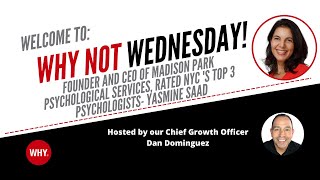
Dr. Yasmine Saad, a NYC psychologist and author, blends Western psychology with Traditional Chinese Medicine. She discusses why she switched from business to psychology at 16, how kids adjusted when mask mandates ended, and her UCU method for transforming pain into growth.
Chapters
There's a certain kind of coach who believes what we believe.
Who leads people to greatness, who gets people unstuck, who unlocks all of your passion. A coach who helps people discover what drives them to tap into their superpowers. That knowing your why is the first step to untap potential.
To focus.
To breakthroughs.
A coach who's looking for a better way.
Are you that coach?
Foreign.
Hello and welcome to why Not Wednesday. Today we have Dr. Yasmine Saad with us and I am so excited to introduce you guys to her. She is so interesting and so knowledgeable. I can't wait to share her with you guys. Dr. Yasmine Saad is an international best selling author and a top rated New York City licensed clinical psychologist with a national and international reputation. She blends eastern and western healing modalities. She uncovers, connects and untangles what is happening in your body, mind and life so that you can move forward empowered and with purpose. Her UCU method leads you to see you and the essence of love that is behind everything that happens inside and outside of you. Welcome to the show, Yasmine.
Thank you, Dan. What an introduction. Thank you.
I have loved following you. Gary introduced us a couple of months ago and so we've been in conversations and the more I followed your content, the more I said, you know what, we've got to have her on why not Wednesday to talk about all those interesting things that you're doing. But as you know, Dr. Yasmeen, one of the things I love to do is let people know the why operating system of our guests so that they can know what, what can they expect from you? I mean, over the next 30 minutes. So your yos is to make sense of the complex and challenging your how is to find a better way and share it with others and your what is to contribute to the success of others. So what that tells me is you love solving problems. You can take in a lot of information and, and make sense of it. And that's what you do in the videos I've been watching of you. You love making sense of things for others. You, you do that by finding better ways, better ways to deal with situations, better ways for your client to deal with the situations, a better way to uncover, connect and untangle. And then ultimately what you do, what you bring is you contribute to the success of your clients both in their life, in their personal life, professional lives. Does that sound like you?
Yes, that sounds totally like me. And I would add, not only contribute to the well being of my clients, but to my psychologist, you know, I train psychologists. And so the idea is I want to contribute to their life.
Fantastic. Well, you know, something, you know, we were talking in the pre show about something that's been on the news. We talked about it this morning in my group, and it's been on everybody's mind is what happened at the Oscars between Will Smith and Chris Rock. And I know you're going to be talking about that on the news soon, but we'd like to get a sneak peek. What is Dr. Saad's analysis of what happened?
Yes, and the analysis is coming up now. I think it might be already live on FOX News. So here's a sneak peek for your people.
Excellent.
I mean, everybody saw Will Smith hit, you know, Rock. So the way what, what happened is you can see that his wife was upset and, and upset for, you know, valid reasons.
She has a medical condition called alopecia. And alopecia is something that is very difficult to navigate and negotiate, especially, especially as women, because alopecia is. You start losing your hair. And hair is symbol of femininity. It's symbol of who you are. And for women, you have to renegotiate who you are, redefine who you are, reassert yourself. So for someone to make fun of something that is really difficult, that is a suffering, is such an offense that it's something you don't joke about. It's almost like if somebody has cancer, you don't go joking about them having cancer. So it's so offensive. And I think Will Smith, as a husband.
You know, felt that his wife was so disrespected and in such a weaker position that he went and asserted his willpower and asserted, like, respect for his wife. So I think it was an attempt to reassert respect, but unfortunately, it was done in an aggressive way because, like, he was extremely triggered.
Yeah. And, you know, I love, you know, you're very clever, Yasmeen. And I love that you said he asserted his willpower and it was Will Smith.
I know. I don't know if you did that on purpose, but one of the things I have enjoyed about following you is you're always helping people make sense of things. You're showing them a better way and then contributing to them. So. So you recently posted about an appearance you made a couple of weeks ago on wham, ABC News Rochester. And you talked about the impact of the lifting of the mask mandate for kids in elementary schools. So you talked about how kids process information and how it affects their ability to Adapt. I love that. Can you tell our viewers a little bit about that and how you came to those conclusions?
Yes. So. So, you know, for about two years, we've been telling our children that the mask is the way to protect ourselves and protect others. And suddenly out of the blue, we're telling them, oh, you don't need to wear the mask. Well, then how do they protect themselves and others? Like, what has changed? You know, kids don't understand. So it's really important that parents speak their child's language. And every child has a different language. Some children feel their parents. So if their parents are very relaxed, they will be relaxed. Other children really need logic. And so it's really important that their parents explain what has changed, why it has changed, and how we can change again. It has to make sense. And as you say, you know, every kid already has a why in some way and a way of operating. So it's very important that we speak to our children through their language of operating like their operating language.
And it's great that you brought that up because you have the why of makes sense. And one of the things we know about people with your why is you process information quickly. So you can take in a lot of information and kind of say, okay, this is what I'm going to do. But if your kid does not have that why, they're going to struggle with it a little bit longer. They may need time to process it. Someone with the why of right way, who likes to follow a process as systems and do things the way they're supposed to be done. You can't change the rule overnight and have them feel comfortable. Right?
Exactly. Exactly. You have to understand how they operate and who they are and what do they need for it to make sense to them.
For them to feel comfortable and feel safe again.
I love that. Thank you so much for sharing that insight. And for. And I know across the country it's different. Across the world it's different. I know in New Mexico we had the opportunity, kids didn't have to wear masks. It's been almost a month, but this is fairly new in New York. And it's going to be different in different areas depending on what the local feeling is and what the law is. Right. I love the post you made yesterday because this is something I don't enjoy. But.
You found that spring cleaning you posted about spring cleaning boosting our mental health. So talk about that because you had a great take on it.
Yes. So everything that bothers you outside of you is related. What's happening within You. So when your mind is cluttered, when you have a lot of stress, how many of us always like a tidy home? Like, we come home and we clean and we feel better. And other times, you know, we. It doesn't bother us. It's very much related to what's happening within. So there is really spring cleaning. There's two ways of doing it. You can clean inside you or outside of you, but once you clean your life, your outside life, your mind is more peaceful. Life is more peaceful. There is a connection. That's why some people feel great when they're next to the sea, some other next to nature. We're so connected to our environment. So changing the environment, change your internal life and vice versa. You change your internal life, you're no longer bothered by clutter. And it happens, you know, reciprocity in a reciprocal way.
Yeah, I love that you said that because, you know, there's a box in my office. You can't see it from here, but it's a. It's a shelf I took down and I put it in a storage bin. And it hadn't bothered me for a while until someone walked in and says, what's this storage bin doing here? And I thought, you know, I probably need to take all those books and find a shelf for them. But it wouldn't bother me until someone noticed it. So I'm sure there's a. There's a reason behind that, because now I. Now I've made it a goal. I've got to get all those books out of that storage bin and put them away, because it does clutter the office. And so you've got to eliminate that clutter, probably to feel better and then eliminates clutter internally. Sounds like.
Yes, exactly. And in your case, what happened is a criticism came along the way. So you receive negative. And that negative was the stroke that broke the camelback. It made you feel like, ooh, this is bothering now. Like it's. And you needed that to get to the level of it being bothered by it before. You can just go your natural way of ignoring it and just, you know, living peacefully in your environment. But now that somebody said that it's an eyesore, you can no longer operate the way you used to operate.
Right. With my why of contribute. I can't. I cannot have something in my office that bothers people. I want them to be comfortable when they come in my office. So that makes total sense. So this was my favorite post that you've had recently, and I can't remember when it was, but you said it was about the lotus flower. It says, I believe that all our ailments are meant to be transformed and that the end result is an improved version of you. Look at the lotus flower. It transforms its muddy, dirty water to blossom into a gorgeous flower that is in sync with nature's cycle, opening during the day and closing at night. Let's follow its lead and transform the hardship you face so that you can blossom. That is you. See you there. So tell me the wisdom behind that. I loved it.
Yes. I think the idea is that everything that happened in the world is based on energy. And energy always have a movement for growth. So it can feel bad, it can be negative, but it's not meant to be. It's meant to be to enhance you, to bring something to you. So can you look at your ailments? Can you look at your pain? Can you look at what's going in your life as a way of refining you? And if you can, every obstacle, every negative word is an opportunity. It's a gift for growth. And so I fully believe in that. You know, I work in the mental health field. I believe every mental health issue is an opportunity to recalibrate, is an opportunity to rebalance. It's here like a child pulling your sleeve and telling you, pay attention to me. You need to rebalance this. And so I fully believe that it's meant to be transformed.
In the way you brought the example of the lotus flower. So I'm sure you've heard of kintsugi, the Japanese art of taking broken pottery. And instead, you know, what do we do with a broken pot or a broken base? We throw it. The kintsugi takes it and repairs it, but then they enhance the repair with gold so that you know where the breaks were. So it's taking something that that's damaging or hard or difficult and then making it part of the better, more improved you. So great, great example. And guys, if you, if you're not following yasmeen saad on LinkedIn and, and you're on all the platforms, I think you're on Facebook, you're on Instagram, you're on LinkedIn. Follow her. She has some amazing insights and we're so glad you're part of the why universe. So thank you for being part of it and thank you for sharing your wisdom with us through all of the platforms. And here's something else I just found out in the pre interview. Yasmeen puts out all her own content, so there is no one in the background creating all this amazing content. She Creates it all herself. She does have a team to help her put it out, but it is all original content, which is admirable, considering you're one of the top three psychologists in New York City. How busy are you that you find and you find time to do that?
I am very busy, but as you know, I want to contribute to the world, so I make sure I train my staff so well so they can take some segments for me. So the social media is a bit harder because, you know, it's my own wisdom, but I have a team who puts it together, makes it nice, and I do the final seal of approval. But, yes, I am very busy, but it's all about priority and knowing what's important and really staying grounded in what is your mission, what is your goal, what are you here to accomplish?
And finding a better way, right?
That's right.
Finding a better way. So I love you. You have found a better way to get that done. And like you said, you give the final approval and you do great job. So like I said to anybody who's listening, if you're watching, if you're watching the record, go check out Dr. Yasmeen Saad on LinkedIn, on Facebook, or on Instagram. So one of the things I want to talk to you about is this is, I think, how we connected. I saw you on. On the. On the book tour for Ignite the Hunger in youn. You co wrote that with les Brown and 34 other authors, which, by the way, just became an international bestseller. What was that experience like working with Les Brown?
Oh, it's been wonderful. You know, he's such a great motivational speaker. He has an art and a talent, and he just shows it. You know, it's. It's. And he has a wonderful, wonderful heart. He's a beautiful human being with a beautiful heart who really wants to empower people and ignite their hunger. He believes that, you know, you got to be hungry in life to succeed, to get somewhere. So. So it's been an amazing experience.
Yeah. And I think you've got to be hungry is so. I mean, that's his trademark. Right. So his book is Ignite the Hunger in youn. And then your other book, Ignite Possibilities, was awarded the International Impact Book Award for inspiration. What was Ignite Possibilities about?
So as the title describes it, it's about igniting possibility in people. So there's also about 34 authors sharing their story of how they ignited possibility in their life and what was their ignite moment. And we all share. So in Ignite possibilities. I shared how a miscarriage really led me to build my group practice, find traditional Chinese medicine, and become who I am today. And so it's very much a journey of the lotus flower that you described from your muddy water. Transform them and it ignite the hunger in you. I talked about how to give great voice to who you are in light of those around you and not in spite. And I talk about my journey as a psychologist from Warton, Lebanon, to top three psychologists in New York City.
Oh, you know what? I gotta recognize there's some people commenting. So Bill, Bill Summers Lencioni says you need to be hungry, humble, and smart. And guess what? Yasmeen fits all of those. She. She is incredibly humble, great, great guest, and very, very, very knowledgeable. So you're humble and smart. And then I want to. Tanika said, congratulations on the book launch. And then Watson very early said, why not Dan? Right? So, you know, we've got a few people listening, and these are some of our coaches that are. That are chiming in that I'm sure you'll get a chance to meet. Guys, reach out to Yasmin and like I said, check out her content, because she's doing some incredible things. So let's talk about the question of the show, right? The why not? Tell us about your biggest why not moment. So you kind of talked about a little bit about what launched. Launched you into starting your group practice. And it's okay if that's the moment, but tell us about a time when you said why not to an opportunity, a circumstance, or a choice, and it made a significant positive impact for you.
There are so many in my life. I'll give you the first one because that was the first why not. So you have to imagine me, I grew up in Paris from parents who immigrated from the war in Lebanon. So I was good in math, and so safety was very important. I was in a very good school, set to go to business school, right? And that was a safe pass. And one day during a math exam, I was like, this is gonna be the death of me if I become a businesswoman managing people's money. This is the death of me. Like, there's no. And I thought, what do I like? And I loved helping people already, you know, I have a melodious tone. People come to me for help. I love that. And I loved helping people. And I was like, I will become a psychologist. That was my first why not? And that was a big why not. And I came home and told my parents. I figured out what I'm going to do. And they were like, what? And I told my mom, and my mom was like, made for you. Absolutely. This is made for you. I told my dad, like, are you crazy? I mean, you're gonna go take care of people who are not well when you have a career that will provide you safety, financial safety, success that is set. It didn't make sense to him. It did not make sense at all. But it was, why not, right? And my father told me, you know, I warned you, but you do what you want. So I went with why not? And that was my first, first biggest why not?
And how old were you at the time?
16.
16. When you made that. That's a big decision to make at 16. Especially since you were pretty much set down another path already, right?
I was. You know, in France, you decide the school. It's not really like us where your bachelor. You choose a lot of thing in France between 16 and 18. You have to decide your career for the future, because you will specialize in that when you leave high school. So it was very important which path. And that was the path. And that was one of my big why not now? There are many others.
That's huge. And T.J. davidson just said it's time to add Ignite Possibilities to the top of the reading list. You know, that's something that I did last year. Really well, I think I read 48 books this year. I'm far behind that pace. And I don't know if. And I've had so many more books to add to my list, but Ignite Abilities is definitely one that. That I want to look at. And then Ignite the Hunger in you, of course, because you're our second Ignite the Hunger. We had Ashley on who is part of Ignite. Ashley Patterson was part of Ignite the Hunger. So we've had. Oh, my gosh, yes. So many people are tied to Y Institute from Ignite the Hunger. So it's so great to see you guys and to see that collaboration, as you said, Les Brown. I mean, I remember hearing him. Gosh, it's been 30 years since I first heard him. And you can't help but be inspired by his message and what he does. Right. And how he brings that energy. It's. It's. It's infectious. You can't be in a room with him and not just enjoy his presence.
Yes. He has an infectious laughter, too.
Yes. You're. You're gonna laugh when you hear him laugh. We were lucky enough to have him on our podcast also, so he's amazing. Well, you said you had two big two why not moments. What's the second one?
The second one is more of a personal one, which is when I married my husband and decided to marry him. It was an unconventional choice because my husband is older than me, comes from a different religion, different background, so it was very different. But, you know, I said, why not? And we're the happiest married couple for more than. I don't know how long it is now, 16, 15. 16 years, something like that. So that was a big why not, especially in the context of my family and everything. So that was a big one. And the other one was my group practice.
Yeah.
Because you have to remember.
I was working in a hospital, and I decided to open my own private practice. And then it was like I realized I was working way too many long hours. I was very successful, but how could I have a family working so long? And I thought, why not? And at the time, there was only one two group practices in New York City, and they were all led by really famous psychologists. And I was nowhere near famous.
Right. And.
But someone told me, oh, you're going to go open your group practice. And I was like, who does he think I am? There's no way.
Yeah.
And then one day I thought, well, he thought I could, so why not?
And I did, and it was unbelievable. And through opening the group practice, I helped train so many psychologists. I delved also into traditional Chinese medicine, which was something I would never imagine. I was very, as I said, scientific, logical, you know, Eastern philosophy were more esoteric for me. And so opening myself to that, that was another huge why not? So those were major why not pillars that have made me who I am today and have brought a new holistic movement in the world of psychology. Just because I said why not? It's very powerful. What happens when you say why not? Now we have tons of patients healed holistically by the psychologists I've trained, because I said why not? To traditional Chinese medicine and my group practice.
And I love that you say that, because I wish Steph McPhee was on. I don't know if she's going to. She'll probably listen to the recording. But that's her. That's her big thing. Why not? You know, she puts that out almost every day. She's one of our coaches.
She.
So I'm sure she'll be commenting later, but, you know, I see that in your background, too, Yasmine. So your parents left Lebanon, your family left Lebanon to go to France, and then from France to the United States. So even though your dad might have said, well, maybe that's not something you do, you know, he had a why not moment, probably, as you moved your family, right from one country to another. And now you're in the United States now. I don't know if he's still around. Is your dad still around?
Unfortunately, he passed away.
Were you, were you a top three psychologist before he passed away? So you know. So now he knows. Hey, you're, you're running a business, so you are that businesswoman. But you're doing what you love and you're, you're living your why, you're helping people make sense, you're helping them find a better way and you're contributing to them. It's got to feel a lot better. How do you think you'd feel if you were vp, a corporate VP at a firm in France today?
Oh, yeah, I would not. This will not hit home for me. It would not. I operate from the heart and I need to impact people from the heart. And so that's really important for me. And my parents impacted me from the heart. My father was actually very proud of me and I described the journey and ignite the hunger in you. And he was very proud of me because I actually took his advice to heart. His advice was, if you go in this field, how are you going to maintain your mental health? You are listening to problems all day long. How are you going to manage your own health? And his second concern was, how will you make a living in Paris? Psychologists do not make a good living. And so it was like, how are you going to sustain yourself? And it was very important for him that I'd be independent and that I be well. And so I developed a way of listening to patients that honor my dad, that I see the positive behind every negative. So I never really connect to a problem. I only connect to an opportunity. I connect to the growth. I connect to the loving message behind. And so thanks to my dad, I'm living essence of my own message. And thanks to him, so he continued to live through what I teach people because that was, that was this. He was the seed to my message, how are you going to deal with problems?
And isn't that so great? Because I, you know, again, that there's that solving the problem, right? And you're teaching psychologists. So that is such a great lesson because I do have, I have friends in that field and therapists, and it is one of the biggest causes of burnout, because you do hear so much. But the way, again, a better way to do it is to look at the positive and everything that's coming out. And so you look at the solution and how can we get to it, rather than internalizing. So the problem doesn't become you.
Exactly.
I like that.
Pain is just a messenger for you to pay attention, for you to do the work, because pain is there so that you get rid of it, and it forces you to do the work. If pain wasn't there, nobody will be looking inward.
So, Yasmeen, how has learning. Let's go back to it, because we've talked about how you make sense of things. You find better ways, and you contribute. How has learning your yos impacted you? It's only been a short amount of time, but I see you using the language and you talk about it, and we've even talked about how do we use that professionally. So tell me what impact it's had on you.
Oh, I think it's a wonderful thing to have a label because it's so hard to put a label on who you are. And this is comprehensive. Right. So to say I make sense now, I do use it way much more than anything else because it really captures what I do so well and what I even like, it's the refinement of the description. So I think when you describe making sense, you say people are very quick, and sometimes when they give directions, you know, people don't get it. And I often have this problem with myself. I think what. You know what I'm talking about, right? It's like, I say it. It's like, of course, like, let's clarify. Did you mean this or did you mean that? And I learned, you know, managing people.
Yes.
I really have to really write it down in. In a sequence, you know, to explain my thought process so that we're all on the same page. Because in my mind, it's so clear. Of course you're going to think the same thing that I'm thinking. So I love not only, you know, the. The labeling is. The labeling. It gives you an identity. It's like a skin. Right. It gives you something that you can hold on to. But I also loved the description and the refinement about it.
Excellent, Watson. He's saying, great advice. So I'm sure he's talking about not internalizing it. And for all our coaches. Right. Because even if you are not a psychologist, if you're an executive coach and you're working with clients, you sometimes do kind of play the role of counselor to your clients, and so they're dealing with that. So thank you so much. And I love what Watson said. Nice to have a label language for the limbic brain, right? So we love doing that. So I think we've done a great job of keeping this right to the half hour. Yasmeen, one last question. I often talk to clients, prospects who are saying, you know what? I'd like to add the YOS certification to my practice. What would you say to someone who's thinking of adding this? What benefit do you think they would add if they. They have this so they can use it with their clients?
Oh, I think it will speed up the work so much because you already have a framework to operate under that is so quick. Like, most of the time, you have to do the work of finding who the person is, what their why, so that you can speak their language, have an impact on them. Right now, you know, in just a 30 minute, you have it. And so it speed up the process in such a way. So I think it's. It's great. I mean, I told, you know, Gary, it's amazing. What you guys created is really, really cool. It's really. I think it's. It's very, very, very helpful to many.
Thank you so much, Yasmeen. It has been a blast to talk to you. I was looking forward to this all week long, and I'm glad we're finally here. I want to say thank you for being on. Thank you for taking time out of your busy schedule to share your wisdom with our why Nation and all our viewers and listeners. And this is going to be on YouTube, on Facebook, and on LinkedIn. So we'll share the replay with you and we'll share some clips from today with everyone. Have a great rest of your day. And thank you for being on.
Thank you for having me, Dan, it was a real pleasure.
Thank you so much. We'll talk to you soon.
Sounds great.
More from Dr.




Women In Leadership: A Need For A Greater Systemic Change With Belinda Clemmensen






