WHY to WHY February 2022 - With Watson Jordan and Keynon Lake
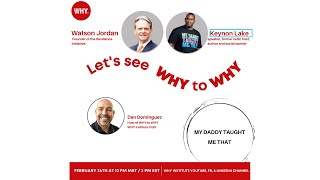
Keynon Lake and Watson Jordan discuss Lake's mentorship program for young men ages 12 to 19, rooted in his 2012 book My Daddy Taught Me That. Watson shares how he volunteered and learned about showing up across cultures, plus a practical resilience framework called five-three-one.
Questions this video answers
February 25, 2022.
Young men between ages 12 and 19.
2012.
2010.
www.mydaddytaughtmethat.org.
Chapters
Hello everyone and welcome to Y2Y for the month of February. We have a very special show for you guys today. The title of the show is My Daddy Taught Me that. I'm Dan Dominguez, the Chief Growth officer at the Y Institute. And my why is to contribute to the success of others. How I do that is by challenging the status quo and thinking differently. And what I bring are solutions that make sense. Now that's all going to make a little more sense to you once I review the nine whys with you. I like to do that at the beginning of every why to why because we do it every month and some of you might not remember. So the nine whys are as follows. The first one is to contribute to contribute to a greater cause, make a difference, add value or have an impact. Second, why is trust to create relationships based on trust. Third, why is make sense to make sense out of things, especially if they're complex or complicated. Number four is better way to find a better way and share it with others. Number five is right way to do things the right way in order to get results. Number six is challenge to think differently and challenge the status quo. Number seven is mastery to seek mastery and understanding. Number eight is clarify to make crystal clear and understandable. And number nine is simplify to decrease complexity. Now, one of the things I like to do also because you're listening to us and you're going to be on with our great guest today is offer you the discounted yos if you go to our website www.yinstitute.com and you want discover your Y O s, you can do it for $97. But if you put the code Y2Y, you will get it for 50% off the regular price. So if you're interested in learning more about your why after you listen to the show, we want to give you that discount. So I want to introduce our guests because today we have a very, very special show. We've got Watson Jordan. He is one of our YOS certified coaches. His why is better way, his how is make sense and these his what is contribute. Watson is the founder of the Resilience Initiative. He's an author, he's a lifelong educator and we have enjoyed having Watson as part of the Y Institute team. We're going to learn a little bit more about him as we go on. Welcome to the show, Watson, and thank you for bringing your guest today. I cannot wait to meet him. And let's tell our listeners a little bit about your guest and Keenan, Keenan Lake. His why is make Sense his how is better way and is what is contribute. So we've got Keenan here. Let me tell you a little bit about him. He's a speaker. He's a former radio host, author and social worker with nearly 20 years of community involvement and outreach to his credit. He was raised by his mother and father, Robin and Benny Lake, who I am sure are very proud of him. Keenan is a homegrown Asheville native. He is a family legacy in basketball. Keenan followed in his dad's footsteps being one of the best, one of the best basketball players in the western North Carolina area and the state. His father, who's also a Nashville native, Benny Lake, played with the original Harlem Globetrotters. Keenan established My Daddy Taught Me that, a developmental mentorship program for young men between the ages of 12 and 19. And in 2012, so he's been at this for a little while, coming up on a 10 year anniversary and it's based on his 2012 book of the same name. So welcome to the show, Keenan and Watson. How are you guys doing today?
Thanks, Dan. I'm great, but I'm super excited for the Y universe to get to meet my friend Keenan, who's does heroic work in our country and kind of specifically in my community. So I'm grateful to be on the show and excited to introduce Keenan.
Thank you for bringing Keenan. Hi, Keenan.
Well, hello. Hello. Thank you guys for both having me. Thank you, you know, Watson, for bringing me on the show and thank you, Mr. Dan, for having me on the show. I'm elated to be here and looking forward to a great interview and kind of chopping it up with both of you guys.
Well, we're excited, you know, today our topic is My Daddy Taught Me that. And that sounds like a very simple phrase that a young boy or a teenager might say. But when it's coming from a full grown adult who has written a book about it and has started a program by the same name, we've got to know more. So, Keenan, tell us about My Daddy Taught Me that. How did it begin?
So, Dan, you know, this is a, you know, it's been a long time coming and people, I get that question a lot, like, where did you get that name from? How did you come up with that name? And to be quite honest, you know, it's, it's exactly what it stands for. My father, my daddy really actually taught me that. And so like you said in the introduction, I was blessed to have two great parents. You know, I had a great father who passed away in 2010. My My mother is still alive, Robin Lake. And I'm just blessed to have them. And so, you know, I look at when I. When I go back and look at. My daddy taught me that, you know, this thing was in the works for a very long time. You know, I had no aspirations to kind of follow in my dad's footsteps, with the exception of basketball. You know, basketball was a love that we both shared. You know, growing up playing it, you know, I just loved it. And that was it. You know, he ended up getting. He ended up being a social worker for the juvenile evaluation center for almost 30 years. That's where he retired from after playing ball. I got my degree in sports medicine. I never wanted to do social work, but I found myself graduating from college and needing a job working with the county. And lo and behold, I started doing social work. And so after. After almost 20 years working with the county, 10 of those years was in CPS, Child Protective Service, social work, dealing with neglected and abused kids. You know, I found myself in a position where, you know, I really started wanting to work with youth and young adults. And so how this all started was this. In 2010, my father passed away. And, you know, I started to write a. Basically a newspaper article about what my dad meant to the community, to the family, you know, the impact that he had on my community. And one of my good friends who also was a publisher, he said, you know, if you write just a few thousand more words, you'll have a book. Well, then the light bulb went off. It said, you know, what can I possibly write about or talk about? You know, and it was like, well, you know, you're in the business of helping servitude. And so that's what your father would have done. So why not write a book that can really help people? At the same time, you know, the pipeline of prison was coming down the pipe. And so the book my daddy taught me that was written to an educate and inform primarily men about what I feel is the biggest issue and problem in our country, which is absent parent, single parent homes. 15.9 million single families in this country, 84% are headed by single moms. So what that tells us if we have 10 kids living in a single parent home, you know, eight and a half of those kids are being raised with no positive male role models or influences. And it's just, you know, that that cannot be the norm or the way, you know, particularly when we're dealing in our country, you know, we talk about being, you know, led by Christ or men leading the household. And leading the families and stuff like that. And so if you're ever going to be a leader, you know, you got to make sure that we're stepping up to the plate. Our mothers and our wives can't be the only ones, you know, taking care of our youth and stuff, like. And themselves. And so.
Right.
What can I have possibly done, you know, to, you know, to kind of not only talk about it within the book and, you know, give examples in the book that I wrote through not only my social work experience, but the things that I've dealt with, but to create a program, a mentoring program to get these young men, first of all, at an earlier age, to instill, you know, morals and discipline, let them know that, you know, as long as you're breathing, you'll make mistakes. But when you make the same mistakes over and over again, that's no longer a mistake. That's a bad decision. So let's talk about that again. I mentioned the pipeline of prison. Let's talk about how we avoid those pitfalls and roadblocks. And so really trying to create a program that's conducive to our young folks, giving them the resources that they need to be successful.
Man, that is. That sounds like you. You really worked at it, and it developed. You know, it reminds me of the phrase, you know, you. You become an overnight sensation. 20 years. You.
You.
You put a lot of work. There was a lot of work that went into building the person that began this work in 2012. You'd already done a lot of background work, so kudos to you for doing that. Now, here's the question. You know, I look at you guys. How did you guys meet? And what's the connection between you two? Watson.
So I'm glad you asked. And it's. It's one of my favorite stories, and it starts out a little bit sad. I had read the book New Jim Crow, okay? And she was speaking in Asheville, and I went and listened to her.
And. Taking a really thoughtful, informed look at the challenges of race in America. I was just so. I felt hopeless.
And I didn't. I went, I have nothing. This is. I identified some of the challenges more accurately than I ever had in my life.
And.
And I just had nothing.
But I was probably on a run or something, and. Which is where kind of good ideas come to me, right? And I went, you know, I'm an educator. I don't know what an actual solution is, but I believe in education, and if I could help in this specific case, for me, yeah. Ten black Men not go to college, but graduate. That would make a difference. And I did. You don't know what difference it would make. But I went, there are big things that happen in families, home ownership, college graduation, right. That are massively impactful, right? So I went, well, I'm going to do that. So there I was, and my daughter laughed at me. She went. I said, what are you going to do? And I said, well, I'm going to go talk to some black men. And she said, okay, but just know you're going in as an old, over educated white guy and you're going into a room of young black men and you're saying, I want to help.
Yeah.
And I went, okay. And I went, okay, maybe you have a point there. So I went, well, how can I do this? So I knew the people at the middle school where my kids had gone, right? And I went in and I. I said, I'm looking to volunteer to try to find some way to help and support this. So I got to meet Bruce Waller, okay? And I talked to him and I said what I was trying to do. And he looked at me and his eyes l lit up. And he said, you've got to meet Keenan Lake. And I said, who? He said, you've got to meet Keenan Lake. So I met. I. I called up Keenan and I told him my story. And we went out and had coffee. And.
I couldn't tell you what Keenan's response to a guy like me coming to him saying, I'd like to help.
Yeah.
But when I met Keenan, I went, here's someone that I respect.
And that I admire, what he's trying to do, that I can support. And so I said, this is what I'd like to do. And he said, great, because I think this has happened to him more than once. So he said, well, the next step really is to come and work with us on a. He meets with the students, right? For sure, two days a week. They have program. So I just started going to program. And so after about a year, I started to develop some relationships with some of the young men in the program. And of course, I'd gotten to know Keenan better over the course of the year, but that's how we met. And the pandemic has not helped my ability to be supportive in all the ways that I'd like. But that's exactly how we met.
That is a really cool. Bella says, wow, that's really cool. So, Keenan, when you guys met, you had already started. My daddy taught me that. And then Watson came in because Somebody said, if that's what you want to do, I think you got to get together with Keenan. So that's a great place to start. I had a look around your website. There's some amazing things that you're doing and you got some really big goals. So, Keenan, you have. Let me, let me, because I always like to tie this back. You have a yos of make sense, better way and contribute. And what that tells me about you is that you're a problem solver, someone who can take in lots of information, process it quickly, and come up with solutions that make sense and how you do that based on your how better ways. By constantly looking for better ways to do things and then sharing them with others, which you did with Watson, in that what you ultimately bring is a desire to contribute to the success of others and to make a positive impact. Does that pretty much describe you?
Yeah, I would say so. I think, you know, when we actually did the, the why training with Watson, you know, it was, it was able to. It was actually a very good training. It was allowing me to see the why, the reason why. And so I think that you're right on, you know, hitting the nail right on the head. The other thing is this, I will add though, you know, one of the questions that again, people always asked is, what did your daddy teach you? Right? And one of the things that I. The thing that resonates with me the most is love. He taught me love. And so I try to operate from that standpoint in everything that I do is, you know, exuding, exhibiting love to not only the youth that I deal with, but those who are around me. And so I think you're right. Trying to, I was blessed, you know, to say that, you know, growing, growing up again, having my family, my parents. But then, you know, just looking at my life, you know, playing sports, you know, sports was huge in my life, but then working for a government institution, it would allow me to see how the government does things, so allowed me to really see and put me in a position where I can not only advocate for folks, but be able to understand. And so you're exactly right. Being able to put all these things into practice and say, you know, what's the best approach? What's the best way to, you know, tackle a situation? And so I think you're right. Right on the money.
You know, it's great that you brought that up because we, we've talked about this over the past couple of weeks. I've seen posts from some of our coaches talking about the importance of talking to people in the language that they understand. And so. So, Keenan, you know, with. With. With the why of. Of make sense and a how better way and a what of contribute. You connected with Watson. I realized, you know, I'm looking at your. At your makeup, and both of you share the same three whys, just in a different order. So Watson leads with finding better ways. How he does that is by making sense of complex and challenging things. But both of you have the what of contribute. And you know, what I have found is that when I share one of my top three with someone, we get along great. If I share two of them, it's an instant connection. But if we share all three, we're almost finishing each other's sentences. Was that. Was there that kind of connection with you guys when. When you met. I mean, did you find that you think about things the same way?
Doc, you. Go ahead, Go ahead. Back off of you.
I definitely find that we look at things similarly, kind of a bit observational look, you know, what are the moving pieces? What are impactful things we can do?
Right.
So. And the thing that you mentioned, the. The most powerful connection is a really deep kind of marrow level dedication to finding ways to make the world a better place. Yeah.
And you mentioned love, Keenan, but I want to talk about the connections. I want to come back to love. Go ahead.
No, so I think. I think Doc is, you know, right on the money. You know, of course, our day to days and, you know, our backgrounds and lifestyles are probably totally different. Right.
You know, Dr. Might find us a little funny. I think the first couple of years of our relationship, I thought Doc might have been an FBI agent like Doc was, you know, like Doc. What do you do, you know? Well, you know, I can't really.
But what I found. And Doc is so modest, you know, not only did he come to, you know, program, he literally volunteered in our program for over a year, really engaging and working with our young men. And so what he was saying to you earlier was that, you know, we get approached by, you know, people of the opposite color or Caucasian people, whatever you want to call it, wanting to come in and work with, you know, the population of youth that we deal with. But it's very. It's very few that you find are sincere about it. You know, really, no strings attached. We're not coming in to check a box. We're not coming in to do X, Y and Z. You know, I'm coming in here because I really want to help and I really care. And so I think Doc again, hit the nail right on the head when he talks about really, you know, just wanting to do the work and make a better place for people.
Right.
I really saw that in him. Like, you know, this is not about me coming in to stroke my ego or to say that I'm doing, you know, I, so to speak, came off my proverbial high horse to help those who might be viewed as less than I am or whatever the world wants to say, stereotypes. But he came from a real passion of, I'm really sincere about what I want to do and I really want to help in any way that I can. And so I truly appreciated that in him.
Yeah. And that obviously leads to that great connection because you both have the what of contribute. At the end of the day, what people can count on from both of you is you want to help, you want to make a difference, you want to make a positive impact. And Watson came in and said, how can I help? Right. Like a lot of contributors, what can I do to help? And Keenan, you were already on that mission. You were built to, to. To make a difference. Your, Your organization was built to make a difference. One of the things that, what I was going to talk about when it comes to you mentioned love. So with the why, why it makes sense better way and contribute what we found, what we've heard comments, is when we talk to people in their. In their language, right? So when Watson talks to Keenan, and it's very easy because that's his language too, he wants to talk to you about things, ways to solve problems, better ways to do those things, and then share with you how those things are going to make a positive impact. And when you talk to you, when he talks to you that way, what does that make you feel like?
Well, first of all, it allows me to understand that I'm not the only one on this boat by myself. You know, there's others involved in the work, but then even more importantly, there's others who care about some of the same things and passions that you have. And so, you know, when you're doing, I like to call it, you know, servitude work, and you really, it can get really lonely, particularly when you've been doing it for as long as I have. It's, you know, it's like you'd go through the politics, you know, of, you know, government. You go through the politics of just social media. And so when you have a person who genuinely comes to you again, it allows you to know that you're. The work that you're doing. Is not in vain. And there are others who, you know, who have the same, you know, mindset as you.
Right. Watch it. Anything you want to add to that?
You know, I guess the talking about kind of whys and as a better way person, it was a. And it is still a very powerful experience for me to work with Keenan and his kids, because my default is, oh, I know a better way, because I just can't turn that off.
Right.
But it's also good for me to know I have no expertise in this area.
Mm.
And to find a better way, I have to be able to kind of recalibrate my expectation. So most of the time, unless it's just Keenan and I talking, my default in supporting Keenan is, you know, they say who's got the most to learn in the room? And I need to raise my hand because there's so much to learn. And my funny example, it's easy for me to go to church and go, I wish we had more diversity in my church.
I wish some black people would come to my church so we'd have some diversity. And that idea has a lot of good things in it.
But I think that really doesn't get many people very far. So I've tried to go, what if I'm the person that goes to a church that's led in the black community? What if I go there and be the person that learns? And that's. It's always a little. I feel a little ham handed talking about this specifically, but as a better way person, really powerful for me to go. I have a lot to learn before I should share that. Because, you know, one of the challenges for a better way person on a little bit funnier example is not everybody wants to hear my ideas about how they can do it a better way. And learning to kind of have a governor about that and to kind of go, I'm the person learning the most. So I should wait and kind of find a time to share this with Keenan privately before. Because I really want my. And I'm not the only person.
Who goes to program with Keenan and who's been. Right. So it's important to say that.
Yeah. So watching, I mean, you. You brought something up that's really important. For those that are listening that have the why a better way, we talk about the fact you can't turn it off, but it sounds like you found a hack a way to turn it off. And how has that worked for you? Because it's got to be. If you're watching something and you think, God, I can Think of a better way. But it sounds like what you did is you put yourself in the role of student, and you said, okay, I may have a better way, but I'm learning here, so I'm going to sit back and learn before I make my suggestions. And was that a mindset change that allowed you to turn off your better way because you were learning and then you could come back once you've learned a little bit more?
Yes. And so the my hack was I went, okay.
Keep your mouth shut, and if you have an idea, write it down. Literally write it down. And then look at it and go, is this going to help Keenan right now.
Or not? And if I wasn't sure, then my answer was, I can share this with Keenan individually later.
Right.
But when you're with the kids, there's. I wanted being there, right. To be supportive of Keenan. 100 of the time. I didn't get kind of, oh, and for 10, I cannot do that to kind of go, why am I here? To support Keenan. So it was outstanding. So kind of short circuiting that a little bit. But writing it down is a very good hack because it gets it onto some paper and then I can remember it, but I don't have to act on it.
I like that a lot. And that's, that's a good. That's a great point for challenges, too. Right. Those of us that. That want to just, hey, there's a different way to do it. I like the process you went through. You said, you know, what is this going to help right now? So let me write it down. Let me have that conversation with Keenan offline, not in front of the kids or not bringing it up in front of the group, and then we can talk about whether it's a better way or not. Keenan, how does that work with you? You know, here's the other thing I asked you guys before the show. You know, Watson is 5 foot 6, 145 pounds. Keenan is a former Bass College basketball player.
Real athlete.
265 pounds. Right. Two completely different people that just mesh well together culturally. And, and, you know, you. You go to different churches. How that, that combination of you guys coming together, What. What a great contrast. What's that like in the community? You know, I mean, you guys are already friends, so, you know, where. Where do you guys see each other? You went to Rotary this morning, Watson.
Yeah. Well, I want to hear what Keenan has to say.
Yeah.
First, so, so, you know, to, you know, Doc is really modest and, and, you know, and humble. But let me just Say this, you know, he is. So again, we get tons of people who want to volunteer for the program or come in for this, that and the third. Right.
And particularly when you, you know, so let me, let me put this out there as a precursor. So my daddy taught me that as a youth organization program, you know, geared to enlighten, support, and help any young man, no matter what race, creed of color. So any young man who wants to be a part of the program, who wants to grow, who wants to learn, you know, we're welcome for that. Over the years, we've gotten pigeonholed. And so, you know, through media, social media, news outlets, we have been viewed as an organization who only works with young men of color. Right. And that is the majority. That's about 95% of our population. Now, when we first started, believe it or not, 55% of our population were Caucasian young men. But over the years, like I said, that's what's been the narrative, that we only supposedly work with kids of color. With that being said, a lot of people, you know, want to come in and talk and have a idea to engage. And a lot of times, to be quite honest, you know, most of the intentions are good. You know, it's not about the bad intentions or people are coming here to.
Harm, hinder, or hurt the youth of the program. The problem is exactly what Doc talked about, you know. You know, again, good intentions is the pathway to hell. But you come in with good intentions, and sometimes people come in with the savior mentality. Doc never came in with that mentality. And it was all about, I'm gonna come in, I'm gonna learn, I'm gonna listen, I'm gonna feel my way around before I start, you know, implementing or instituting my, my ideas or about what I want to have happen, you know. And then as he slowly became truly a part of the organization where the kids, you know, and that's. That's Mentoring 101 people. Don't, you know, here's a tip. Mentoring 101 is, is rapport and relationship building.
Yeah.
And so being able to build those relationships with those young folks, for them to come in and not just see a stranger, but not only a stranger, a stranger of the opposite color. But then, you know, as they started coming in every day, it's like, okay, he's going to be here. He's not just going to be a fly by night or somebody who's coming in to, so to speak, you know, get the data and use us as a petri dish. He's going to be here to, you know, for the long haul. And so as he was here again, you know, for over a year with our youth before COVID he probably would have still been here had it not been for Covid.
You know, our youth became, you know, it became he's part of the crew. And then he was able to get particularly, you know, some of our older guys, our d', Angelos, our Bates, you know, some of those guys who were in college and really working with those guys, doing more one on one and stuff like that. And so, you know, it was just his approach and his mindset as to why, you know, we're talking about why, why he decided to do that. And it was really beneficial not only to our program and our youth, but I think as well to him as well. Like, I'm going to really be able to sit back, learn, see what this program is about, see what these kids are talking about, and then I'll be able to implement some of the things that I want to do.
You know, that, that. Thank you so much, Keenan. As you were talking, I was thinking, Watson, you know what you've done? You found a better way to be a better way, right? Because you literally just gave us a tip or how to be a better way so that you are not constantly changing things, but you're, you're holding on to them. And Lynn gave us some great advice and if we can get that, that banner up, but he said writing it down can be a pressure relief valve and then we can feel less pressure to make something happen right now while keeping the idea for later. And I think that's just far more collaborative too. You know, we get into a situation when you're the experienced guy that's been around a little bit longer, you feel like, hey, I gotta help. I saw that idea and then sometimes, and I found that too in mentoring. You sit back and the person you were going to give the idea to comes up with that same solution on their own, right? So it's a delicate balance to get there. And you're working with really young men, 12 to 19 years old, that are really vulnerable. And so I think one of the things you brought up that I think is very important is consistency, right? It's not you just show up once and then you leave, and then you might come back. Every once, once a year you show up. It's Watson, you said Doc kept showing up day after day or week after week. And they started seeing, hey, he's going to be here, so I can start depending on him being here. So. So I might start listening to him. So now Watson can start sharing some of his ideas. So, Watson, what's. What's been the biggest impact for you in. In. In being involved with Keenan's organization?
Well, it's the thing I. Well, I've learned a lot.
Yeah.
You know, and so kind of the. In a lot of. Especially about myself, but about race. About race in America. So just for some context, a few years before I met Keenan, I would see Black Lives Matter signs in the neighborhood. And if I was with my son or my daughter, I had this. I really want to understand, but I don't understand, because all lives matter. My lives, you know, which is an easy to understand starting point. What I didn't know is that that really meant I had. I knew a negative amount. I wasn't even at knowing zero. I knew a negative amount of information that I needed to kind of work through. So we go through. I had a very powerful experience learning. I met Keenan during the pandemic. The country had a remarkably powerful experience.
Right.
With race, with a lot of things.
Right.
With race and looking at race with hopefully some fresh eyes. And one of the things I like about the yos is it provides a fresh look at things that exist. And one of the things that I talk about in Resilience is the five, three, one plan.
Right.
And the five is we need to have five people in our inner circle. And I always say the worst team, the worst inner circle in the world is five of me.
But if I have an inner circle that has some real variety. So let's say it's based on wise, because I'm attracted to people that I share wise with. But, you know, in addition to Keenan being a better athlete than me there, Keenan's also younger than me. So if the people in my inner circle, like, I have some variety in gender, in race, in age and background, then I think many people have learned in the pandemic that is a powerful perspective to just ease into a little bit.
Right.
You know, what would that be like? You know, growing some.
Muscle mass is the wrong word. Developing some structure to add muscle mass to about, empathy about. And getting back to kind of the one piece that I did identify.
No one responds well to people that show up once.
Right. Right.
Everyone responds well to people that show up and are reliable and dependable. So, again, the real thing that I learned. And again, this is a little bit of a better way hack. Yep.
I knew what I really wanted to do is support Keenan. Yep. And that I wasn't going to have an intuitive. And we ought to do this.
Right.
But I knew that my better way was supporting Keenan and what he wanted to do. Yeah. So that was a little bit of rambling on.
No, no, that was you. You shared a lot. Let's finish the five. Three. One, because that's a great part of.
Yeah.
So the five is five people in your inner circle. What's the three?
Three is three communities that you belong to. And again, not that you lead, because that's a very different element.
Yeah.
That you contribute to and you harvest from, you know, So I go to yoga. So my. That's one of my three communities.
Yeah.
I work out online with Kinsai, which is my online fitness program a former student started. And. And I want to be a part of the. My daddy taught me that community. So the pandemic has made in person communities more complicated.
So. But that's the three communities. So five people in your inner circle.
Yeah.
Three communities that you invest in and harvest from. And one is having a core belief. And we always joke a little bit, well, can I have more than one thing that I believe in? And I go, sure, but you can't have a hundred.
Right, Right.
You know, so.
So what's your. What's your core belief, Watson? You mind sharing it?
What's my core belief? Well, that's. It's always a very personal question. Well, yeah, no, that's okay.
You know, we know you believe that success happened when you find a better way. That's one. So.
So this is a pretty vulnerable moment.
Yeah.
But I'll share it. So I don't drink. Uhhuh. So for some people, that can be a problem. Yeah. And I'm one of those people. So a long time ago, I learned that. And so my real core belief is that if I don't drink, everything will work out.
That's my kind. You know, when it's rainy and things are going totally sideways, I go, well.
If I don't drink, it'll work out. And when things are going. When I'm winning the lottery, I go, well, if I don't drink, it'll work out. So that's my core. I've never kind of shared that in public like that. But that's. That's. I kind of. I can depend on that. And it's not.
It's within my influence to be successful at that.
Yeah. Well, I love that. Thank you for sharing that. I want to tell you I'm going to share this clip with a young man that I'm Dealing with who has had some issues recently because they were dealing with problems. Like you said, a rainy day, things aren't going well, I'm gonna. He deals with it by drinking. And so. And he knows that it's been a problem. But I love that, you know, if it's a core belief and you just say, you know what if I don't drink, Everything will work itself out. I can't wait to share that. So thank you. As Bella just said, that's amazing. Thank you for sharing and for being vulnerable because, you know, this is, this is about speaking why to why. And so, you know, at the end of the day, it's about being real. When you speak from your why, it's about being real. And let's get back to Keenan because I know I have a couple more questions for him. Keenan, I love what you're doing with. My daddy taught me that. I love that, you know, just like a contribute, you saw a problem, you saw a better way to do it. There's a better way to grow up as a teenager, your area of the world, than to have a pipeline to prison, as you talked about. So you found a better way to solve the problem. And now you're helping people, you're helping these kids have examples in their lives because sometimes they don't have that one male role model. As you said, you're blessed. We don't think of it, those of us that grew up in a two parent family don't think of having two parents as a blessing until you go to school and 8 out of the 10 kids in your class don't have a dad that they can go home and ask those questions to. So really appreciate that, Watson.
But.
But Keenan, you've got a sequel to your book coming up called My Father Is Still Teaching Me. So you mentioned your dad passed away. So this has more of a spiritual side to it. I'd love for you to share a little bit more about the second book, Not a Problem.
So, you know, again, the first book had a lot of scenarios, stories, particularly things that I dealt with as a social worker dealing with the community. This next book, I think it's twofold. The first book that I wrote was more of therapy. You know, it was able, dealing with my father's passing and it was an opportunity for me to, you know, to really take that time to heal and stuff like that. But this book I found, I'm finding it a little harder to write because it's forever changing, you know, you know, nothing stands still, nothing is the same. You Know, we always hear that there's nothing new under the sun, but these youth are changing and our kids are changing very rapidly, very fast. You know, with the way technology moves. They're, you know, so it's a lot, but it's more of my, my personal relationship with, with my Lord and Savior. And, you know, some of the things that I learned with, I learned as a young person, some of the things that I'm wrestling with as a, as a, and I don't want to say older person, but as a, I guess I would say a middle aged man. Right. Yes, yes. And so, you know, it's more of even though my biological father's not here and who I looked at as not only my best friend, but as my mentor, right. I'm still learning and I'm still being taught. And a lot of the guidance that I'm receiving is, you know, just to be perfectly honest, it'll sound crazy, but it's stuff that I could not possibly even fathom to even think about. It's not like I'm going out doing research on my own, which I do. You know, a lot of it's things that, you know, are happening in my life and with my family and with things that are just, you know, it's like this is not by happen, chance, you know, and so really being able to, you know, honor that. Put it in words like, you know, like Doc said earlier about writing. But, you know, it just is, you know, you know, you didn't ask this, but I think my, my biggest, my biggest thing, my personal biggest, like Doc talked about, shared with his is my biggest thing is, you know, just being able to treat people the way I was treated or the way I want to be treated. You know, really upholding that is is treating people the way you want to be treated, being honest and fair. And I know that we live in a world where that's not favored a lot of the times. And so I want to make sure that when people see me, people hear about me, hear about my organization, that they know they're dealing with someone who is as honest as possible, as fair as possible, and really, truly trying to do the right thing for everybody who I encountered.
So now that's. That is fabulous. And, and thank you for sharing that because here you brought up. Your dad has obviously had a big influence in you. And I mentioned it in the introduction. Your father was on the original Harlem Globetrotters. And so that had to have been growing up with, you know, my dad was a Harlem Globetrotter. Not only Was that probably cool? But you were also a basketball player. So how did you deal with the pressure of, you know, your dad was a pretty, pretty high level guy, you know, and, and then you grew up to, to be an outstanding athlete yourself. How did you deal with that pressure?
To be honest, Mr. Dominguez, it wasn't, you know, so we had like Curly, Curly, Neal, Meadowlock, all those guys to come when they came to Asheville, they would come by the house or, you know, we would get back, you know, backstage passes to the games and stuff like that. You know, my father had a relationship. You know, he brought Oscar Robinson to Asheville, North Carolina.
Wow.
You know, so all the old heads and stuff like that. And so, you know, being able to meet those guys, it was, it was just, you know, like one of the friend, one of his friends, one of his peoples. And so I was blessed again to not have pressure. You know, I was never pressed to play basketball. It was, if you want to play, you could play. If you want to play, I could teach you. And then once I found a love for the game, it was like, you can't play unless your grades are good. You know, we, you love the sport way too much and now you got to make sure that you're doing the other things, you know, so basketball was a true part of me. But yeah, I mean, for me growing up too, the only pressure I would say that I would probably have was at times not playing up to my potential. Like, you know, you would play people who are not potentially are talent as talented as you are, or maybe not as good as you. And so I would have a tendency to play down, not to hurt people's feelings until I got to college. And it was like, nah, just rip the heart out. You got to kill, but you got to kill them, right? But you know, growing up as a young tiger was like, you know, nah, I know I'm way better and I'm not going to embarrass them, but yeah, that was, it was, it was literally no pressure at all. Just, you know, like I said, I was never forced to play. And it was more of a, you know, the atmosphere, you know, and it was all of a family, you know, family type knit. So it wasn't like this, this superstars coming to the house. It's like, no, you're gonna get a chance to meet such and such. And then, you know, as the years came by, it was just, you know, who's in town? Like, I might be able to get over there. I gotta go see something else. Or do something else. So, you know.
Right, right. Well, thank you. No, I really appreciate that. Watson. You. You really. You really stepped up for us today. You brought on a great guest. Keenan, I love the work that your organization is doing. I love the way you've brought a simple concept, right? Something. Something that again, you saw a problem and you found a better way to deal with it, and you've done it. What is a way if somebody is listening and they say, you know what? I really like that. What's the best way for someone to contribute or if they want to get in touch with. My daddy taught me that. What's the best way to do that?
So the best way to do it is to go to our website, www.mydaddytaughtmethat.org. we have videos, we have, you know, information to learn more about the program. Yeah, there's also a donate button. We are a grassroots organization. We are a very small organization. We have been existing for 10 years. We are probably. And, you know, we can go on and on about what we don't have. What we do have is we have a lot of. A lot of character, a lot of pride, and we do the real work. And so if you ever want to donate, we can always use donations in kind. Donations, monetary donations. If you want to speak to me directly, feel free to call my phone. Area code 828. 582 2261. Yeah, social media. We have a Facebook page, we have an Instagram page. So please support us, follow us, see what we're doing. And, you know, the. The. The goal behind my daddy taught me that is really not only doing the work here in my hometown, Asheville, North Carolina, but extending it throughout the state of North Carolina and, you know, God.
Willing, worldwide, you know, really appreciate that, you know, and Watson is part of our vision. So, you know, when we talk to people like you that are making a difference in your. In your local community and you have a vision for something larger, you really speak to us. Because at Y Institute, we have. We have a vision and a mission, right? Our vision is to be the first step in self awareness. We want everybody that wants to improve. We know that self improvement starts with self awareness. And we want for you to know your why, to be the first step in self awareness. So that's our vision and we have a mission to have help a billion people discover their why. So Watson is helping us in that mission. He's multiplying the number of people that discover their why by working with people like Keenan, by presenting to you, the people in your program, and, you know, I'll give you, I'll give you something here, Keenan, because you said earlier you talked about the golden rule, and, and Watson probably knows exactly where I'm going. There, There's, There's. There's a next step from the golden rule. We call it the Platinum rule. Keenan. When you know somebody's why, you can talk to them the way they want to be talked to, not the way you want to be talked to. Right? Because. So Dan's a contributor, not a makes sense guy.
So.
So if you want to talk to Dan the way he wants to be talked to, always talk. Lead with. Let me show you how this helps people. Let me show you how this impacts others. If I'm talking to Keenan, I know he's a Make sense why. I'm going to show you. When I lead, I'm going to say, keenan, let me show you how this solves a problem. Let me show you what problem we could solve. Let me show you how this makes sense. And it's a slight, A slight twist on it, but if, if you, if you add that to your arsenal, I think it'll help you as you go out and meet donors, meet clients that you bring in, even those kids. I don't know, Watson, if you've done it with, with the young men in the program, but you get to know a person, a young man, and you know their why. And I'll give you an example. One of one of our podcast guests and one of our clients of one of our coaches is the baseball coach at New Mexico State. And he would shy away from his why was trust, and he would shy away from kids with the why of challenge, because those kids want to challenge the status quo, do things different, sit in a corner, always pushing the limits, right? But once he realized, hey, that's who they are, let me talk to him in their language and say, hey, let me. Here's have some fun with this. Here's some rules you don't have to worry about. As long as you follow these, you're going to be in good shape. So there's a lot more to it. I'm sure Doc will, will, will share that with you as you guys work together, but it's been a pleasure to have you. Keenan. We want people to go to mydaddytaughtmethat.org that's where they can find your organization if they want to make a donation or if they want to help. And then, as always, we always close the show by letting people know that if. If you want to discover your YOS, go to yinstitute.com and type in the code Y to Y and you'll get 50 off the retail. So we want a billion people. We're a long way. We have a long way to go. Just like every big mission. We've got some work to do. Keenan, thank you for being on Watson, thank you for introducing us to Keenan. We hope to have you back and give us an update on how things are going with you. Thank you very much.
Thank you for having me. Thank you guys for having me. Really appreciate it.
Have a great day. Thank you, guys.
More from Dr.




Women In Leadership: A Need For A Greater Systemic Change With Belinda Clemmensen






