WHY to WHY - with Bill Sommers and Betty Burks
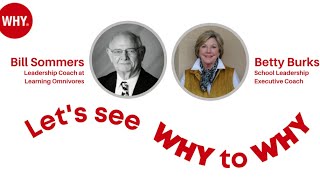
Betty Burks and Bill Sommers explain how the WHY Operating System helps school leaders clarify their motivations and strengthen teams. They describe using it with Marshall Goldsmith's coaching method, running team sessions in a Texas district, and planning pilots with middle and high school students.
Questions this video answers
January 28, 2022.
Y2Y (use at whyinstitute.com to get 50% off).
Chapters
There's a certain kind of coach who believes what we believe.
Who leads people to greatness, who gets people unstuck, who unlocks all of your passion.
A coach who helps people discover what.
Drives them to tap into their superpowers. Then knowing your why is the first step to untap potential.
To focus.
A coach who's looking for a better way.
Are you that coach?
Hello, everyone, and welcome to Y2Y for the month of January, 2022. Can you believe it? We're already in 2022. I am so excited for today's show because we have with us two amazing people who are in the education sector. So the title of today's show is using the Y operating system in the education sector, featuring Betty Birx and Bill Summers. Now, before we get started, I always like to start off by letting you know who I am. I'm Dan Dominguez, the chief growth officer at Y Institute. My why is to contribute. My how is to challenge the status quo. And my what is to make sense. So that probably doesn't make a lot of sense to you if this is your first time listening. So let me give you a quick introduction of the nine whys. The first why that exists is contribute. People with the why of contribute love to contribute to a greater cause, make a difference, add value, or have an impact. The second why is trust, to create relationships based on trust. People with the why of make sense, which is our third one, like to make sense out of things, especially if they're complex or complicated. They love to solve problems. Number four, better way. People with the why of better way love to find a better way to do things and share it. Number five, right way. These are people who love to do things the right way in order to get consistent, reliable results. Number six is challenge. These are people who like to think differently and challenge the status quo. Number seven is mastery. People with the why of mastery love to seek mastery and understanding and understand and learn nuances. Number eight is clarify, to make crystal clear and understandable. People with the why of clarify love making sure that they are understood and that they understand you. And the last one is simplify. People with the why of simplify want to decrease complexity in everything they do. Now, if you're listening and you don't know your why and you'd like to know which of those nine is, you, go to yinstitute.com and use the code Y2Y and you'll get 50% off the Y discovery code just for listening today. So I can't wait to Introduce our guest. So first person I'm going to introduce is Betty Burks. Betty Burke's why is better way. She believes that there is always a better way. She is the ultimate innovator. She constantly seeks better ways to do everything. She can't stop herself. She contributes to the world by creating better processes and better systems. She generally operates with a high level of energy because that is a better Way. With 30 years in public education, serving in rural, suburban and urban districts in she has developed experience and expertise in leadership development at all levels of the system, facilitating processes to help improve education systems. And leadership is her primary objective. And her passion is helping develop leaders through executive coaching. Now, Bill Summers, his why is contribute. He believes in contributing to a greater cause and making a difference in the lives of others. He loves to support others and he relishes success that leads to the greater good. He seeks to add value in everything that he does and is often referred to as the go to person. After a long career over 35 years consulting with schools and districts on a variety of issues and being a leadership coach for leaders in schools, helping leaders, helping good leaders be better is a primary goal for Bill. So, guys, how did I do with those introductions?
A thank you.
You know, I can't help. I'm talking to two education people. And when you said A, you don't know how good that made me feel, Betty, because we're all, we all want that A from our teachers. So. So, Bill, you are a contributor. How did that description fit you?
Well, fit. The only thing I would add is that I've been a principal and a superintendent or assistant superintendent. So when you're a practitioner, as Betty is, we learn it from the grassroots.
Yes. Excellent. How about you, Betty? You're always looking for a better way. How did that description of your why fit you?
Oh, just perfectly. In fact, when I discovered my why and I started reflecting on all my experiences and even when I was a child, it was like, duh, that is what I've been doing. And sometimes it was a blessing and sometimes it was a curse, depending on the situation. But yeah, I'm always looking for ways to make things better. It drives my family crazy sometimes, but it's just who I am.
So what we know about the whys is that they're our greatest strength and they can also be our biggest challenge. Right. So the strength is you're the person we want to go to if we're looking for innovation. If I've got an idea and I'm stuck, I want to take it to Betty because she'll find a better way to do it. However, if I have an idea that I love and I think is ready to go to market, the last person I want to show it to is Betty. Right. Because Betty's going to say, well, I don't think it's quite ready and you're going to find better ways to do things. So.
Great.
We'll definitely have to dig into that. Now, Bill, on your side as a contributor, you've always wanted to help people. You're driven by making a difference, making an impact. So that's the strength. I think people love us contributors. By the way, I share your why. So our challenge is that we always want to help. Right. We tend to spread ourselves too thin. Did that resonate with you when you discovered your why?
Well, absolutely. And that's what kind of pulls me into urban education. Looking for the kids that maybe not have all the advantages that some of us have had. Also standing up and having enough values to stand up and make the case and not just get pushed around.
Excellent. And so that, that drove you into the place where you are in education. So talk to me a little bit, Bill, about being a coach in the education realm, because you've done both executive coaching and you've done education coaching. What's the biggest difference that you see when you're working with educators versus executives?
Well, I think one is in education. They're so other oriented. They come in because they want to help kids, they want to help communities, et cetera. And that's true of business people as well. Although I find business people will read few more ideas and be able to put them into. Put them into play quicker because there's a quicker feedback loop in business. In education, we may not know whether or not we contributed to the kid for 5, 10, 20 years. So.
There'S just a different feedback loop. But you know, both when you're working with executives, if they really have their strong values at heart, they're going to shine through.
So, Bill, with the yos of contribute and better way, contribute challenge and better way, how does that play into the coaching that you do and the clients that you attract? Has that made a difference for you? Are you working better with people that share your yos? Are you attracting people that are looking to do things differently and. And better?
Well, I think there's an immediate for people who contribute. There's a fast food chain, local establishment that I'm working with about eight people. And it's interesting that as I did the why with all eight contribute and trust became the two big issues that kept surfacing, maybe at different parts where most people want to want trust, that's what they want.
But I find that knowing that I can bridge the gap or bridge because all of them are important.
Right.
It's what grabs your heart, you know, attracts you to things. So I think that's been a real plus.
Excellent, Betty, on your side of it, you're always working with educators.
Working.
What's the biggest advantage that you have found using the yos in that realm? Bill talked about working with the business. What about you? Who are you working with?
I work with principals. Most of them are new to their school or to their position. And I also work with administrators that are new to a central office position. Many of them have trans transition from a campus level leadership to the central office. And it's very different because you have a lot more control at the campus level than you do at the district level. You know what I found with the yos that I think is so insightful? For me, coaching leaders is one of the questions I always ask at the very beginning is, who are you as a leader? And I'm amazed at how many people can tell you a lot of characteristics about leadership or attributes, but they can't really tell you, who am I? You know, what am I passionate about? What do I bring bring to this? And Simon Sinek says, you know, you start with the internal why, and once you've internalized your why, then then you can broaden it to your how and your what. And so this has just been such a blessing for me as a coach to also offer my clients because now they're really discovering, oh, this makes sense to me. But it's also, this is what's driving me. And so there's two different kind of camps here, Dan. One is those folks that have almost lost their passion in a way, and they're not sure that they want to continue this. And then this has just kind of reinforced their passion and giving them a different perspective, if you will. On the other hand, you've got folks that are so new and fresh, and it's just a delight because they're just like, oh, wow, this makes total sense to me.
So I love that you talk about, about making sense, right? Because that's not in your yos, but it's in there somewhere. So you're always looking for a better way. You like to simplify things. It's how you find better ways. And ultimately what you do is deliver solutions that deliver reliable results because you do them the Right way. How has that impacted the clients you attract, the school districts you work with? Are you working with administrators that match your yos or are you finding that you just bring your system and then you're able to express it better?
I think it's the latter. It's yes and no, both and both in that I do have clients that share several of my same yos and so it seems like we can kind of get into issues a little bit quicker. However not I mean also serving folks that have a different yos has helped me grow as a coach and how to help them best and also to help understand those folks that have a different yos than me. What I found though in education sector is contribute is kind of the underlying somewhere that characteristic is universal, it seems like. And if it's not their one, two or three, it comes as their fourth or fifth.
Right. So you take them through the full assessment so you kind of get to know everyone, not only their why, how and what, but the entire thing. So thank you. Thank you for that perspective and we'll talk a little bit more about that. Bill, you've got a website, Learning Omnivores, and I've been privy to some of the articles you've been writing recently. Here's my question for you. WW learning omnivores.com what are people going to find if they go to your website? What should they be expecting?
Well, a couple of things they'll find and it's obviously more educational. Although you'll find book summaries. I try to do summary, two to three pages. I find a lot of educators are so busy they don't read. That's true in business as well. But the principals and assistant superintendents that I'm coaching just don't have the time because they're trying to deal with everybody, with everything. And so the book summaries. One superintendent told me they read my summaries to see if they really want to buy the book. They may not read the book anyway, but at least it's a reference. You also find what I call new rules. My partner and I, Skip Olson, who has recently passed we started thinking about what are new rules for education. So you know, like I did the why why not, right? Another one I did on why because.
I write new rules for education that I always think is kind of funny. I got it from Bill Maher when he started doing new rules. At the end I'm going, I can do that for education. In addition to that, I also have put up posts that I think are Just good information. And there's certain people that I'm always tracking. So I think also one other thing, just to piggyback on what Betty identified. When I'm working with educators and principals, assistant superintendents. I had a superintendent that I went through this with, and she looked at me and she says, that's me. That's me. It was like they finally got validated for who they are and what pulls them together. And those people who know about 12 step programs, the 11th tradition is a program of attraction, not promotion. What I'm finding is why is attracting them, like, for the first time. This is who I am. This is what my gift is.
Now, Betty, it's probably no surprise to you with a how of challenge that Bill writes his own rules, right? So it's contribute challenge and then delivers a better way. And, you know, we talked about that in our first conversation we ever had, Bill, you know, and I was reviewing your yos, I said, so. So, Bill, you're a person that loves to contribute to the success of others. And the way you do that is by challenging the status quo and doing things differently. But ultimately, what you bring is a better way to do things. So what's really cool is that, number one, you guys agreed to come on together. You're friends. And I think, Betty, you. You brought Bill on, right? So you, you recommended him, and he and I met, and then he joined the team. But you're so different. And even though you share the why of better way, Betty's why is better way. So that's her primary driver. That's what you deliver, Bill. But in between, there's a big difference. What Betty delivers in the end is she does things the right way. She wants to follow processes and systems that deliver reliable results. And Bill, that's probably the last thing you want to do, is follow rules and systems. So how does that play out in your relationship? Tell me a little bit about that.
Well, I have to rein him back in. That's what I would say.
Often. But no, I think that what attracted Bill and I, we've been friends for like 20 plus years, is because we're both learners, number one, and we're constantly reading. And what was interesting is I'd never met another educator that read as much as many books outside of education as Bill did. I thought I was the only weird one that did that. And so that kind of pulled us together. And so we just started tinkering with just ideas. And we would find ourselves in conversation going, yeah, but you could do it this. Yeah, you could use it this way. So it was that better way was kind of the common thread, I think that linked us together.
And yeah, so that's my two cents. Bill, what do you think?
Well, I think there's always this warrior in me. Growing up next to the tracks makes you a survivor. So I am fortunate that Betty gives me adult supervision because I can get in trouble real quick but I don't have a lot of patience for if it ain't working, let's do something else. I mean, this is continuing. Doing the same thing is not going to get us anywhere in my opinion. So I want to contribute. But if it ain't working or if there's a challenge to an individual or whatever and it's just not the right thing.
I'm the war horse that probably will get off the. Get off the horse and go right into battle.
But I think sometimes teachers and kids need that. They need to know that there's somebody that's going to stand behind them. So what allows, I think what allows Betty and I to work together is there's this trust that we've built up 20 some years ago. And she can say something, I'm going, well, geez, I don't know how's that work?
Well, you both have found a better way. I mean, I think at the end of the day you're looking for better ways. Betty is that's her why but at the end of the day that's what you want. And so I think that, as Betty said, that is what brings you together. So our next topic on our coaches call that we are going to have in February. You guys have to attend because that is exactly what we are going to talk about. How do the different whys work together and how do they the ones that are so different, like challenge and right way that we would think, oh my gosh, can those people ever get along. And Bill, you said it. Betty reigns you in. Betty keeps you on track because get left to your own devices, you're going to jump from topic to topic to topic and go on and do and you're a contributor so you're going to have a lot of things you're going to be involved with. But Betty's going to say, wait a minute, that's not a better way. Bill, she's going to remind you to bring it back in. How do we turn that into a better way? So what we find is that people that you would think, oh my gosh, they'll never get along actually complement each other quite well and we'll Talk about all the nine whys during the coaches call in February. So this is my shameless plug for the coaches to attend the coaches call. But those of you that aren't part of the why society, that is a monthly call that we do with all our coaches and we share best practices and we talk about challenging issues like how do the different wise work together. And it is a continuation of the team yos, which, Betty, you did a fantastic job. You shared a document with us about how you did a recent session of team yos. Tell me about that experience. And it was your first time doing it. I know you said, I'm not sure exactly how I'm going to go, but I tell you, Gary and I both looked at that document and said, this is a best practice. So tell us about how that went.
It was great. I was invited to work with a technology department in a school district here in Texas. And this was a fairly new team. And so the leader really wanted to.
Provide her team with an opportunity to get to know each other at a deeper level. And so she completed her yos discovery and decided that this would be the route to take.
I thought it went great. They loved it. I had a couple of people that got stuck and it was like 20 minutes into discovering their yls and they were not past one because they were just, you know, spending too much time dwelling on it. So we got over that hurdle. But then the beauty of it was at the very end when the team came together and started talking about and they, we displayed their yos, their why, their how and their what and they, they just took it from there in their conversation as their facilitator, I just stepped back and let them talk because they started seeing the commonalities and it was interesting because it was like, oh, now I get why you do the things that you do and why I do the things that I do. And, you know, you really need me when you go out there to the teachers because if you don't have someone like me, you're going to screw the whole thing up. And so it was just really fun, you know, watching how they come together. And so since then, she has done some follow through, the leader with them and she's going to continue every team meeting that they have, which I think are bi monthly or bi weekly. She's going to bring something in about their yos for them to talk about. You know, one of the things I suggested was just ask them a question. Who has realized that their yos impacted a relationship that they've struggled with? In the field or who has found that that has enhanced a relationship. So, you know, those are some of.
The things I love that. So thank you so much for sharing that document. Gary and I went through it. That was part of our coaches call in January, which unfortunately you couldn't make. But know that your INP was felt. So thank you very much, Betty. So you are a Marshall Goldsmith stakeholder centered coach, and you have been doing that for about five years. What's been the biggest lesson or learning that you've had in that five years as you work with your clients?
Well, I think I started out with a real reflective model think tank that develop cognitive coaching, which is more reflective activities and you can reflect all you want, but you still got to be able to deliver the goods.
Right.
So I read about 75% off the business side because I'm looking for creative mental models. I don't find as many inside education with the research. I didn't say they're bad people at all. They're great people. But sometimes you got to look outside your system to see what else could happen. So I read the book what Got yout Here Won't get you There. Where in the Heck has this Been?
So as I went through the training and I actually invited or introduced Betty to stakeholder coaching. So we keep initiating things on each other. So stakeholder coaching is actually about behavior and if you're working, developing leadership. So as a principal, I go in and talk to the teachers who are receiving the leadership from that principal.
Right.
That people that they trust, that principal trust, those are your stakeholders. What do they think are things that you can improve on? And then we coach around that. And then I go back to the stakeholders. Is he or she getting better at what we're doing or worse? And so what happens is it's very behavioral. This is what I want to do. Are you doing the things that are going to promote trust, be more of a communicator or whatever it is. So it's really good to clarify what the goal is and then start working with real people who have. I'm receiving that leadership. That's who's going to evaluate me.
Excellent. How about you, Betty? Biggest insight from your. Your time as a Marshall Goldsmith?
I think it's. It's helping leaders realize that being vulnerable is an asset and showing your humility to others. And that's what the stakeholder process does because you're putting yourself out there. You know, I'm not really good. You've told me I'm not really good for Example at communicating. I want to get better at that. So here are some things I want to do. And Bill mentioned feedback early on in one of his responses. You know, the other big aha for me with Marshall's work is feedforward. You know, feedback is lagging indicators. What we want our leaders to do is, you know, look at the. What are the leading indicators that are going to help you. And that's what feedforward does, is it. It gives you that, here's some ideas that I have in ways that you can get better. Every client I've used it with has grown in their leadership, except for one. And it wasn't because he didn't try. It was just a very. He was very challenged with what he needed to overcome. But it's just a very powerful process. And probably that's what drew me to it as a coach is I wanted. I wanted the people that work with the leader to be involved in helping them grow as a leader.
I want to add one thing. Dan, please. Both Betty and I are looking at using Y as well as stakeholder coaching with kids. I've got a program going with a principal in Michigan that she's now got teachers who are willing because she did it. She's got teachers who are willing to do it and they're asking kids, how can I be a better teacher? How can I deliver this better? I think this has huge upside for education.
I love that. I know that in one of our posts. Looking forward to this. One of the things we wanted to talk about is how do we get this into the hands of young people who are making decisions on what career to pursue, what area they want to go into. You know, we know that certain why's are going to fit better in certain careers. We don't want to put somebody with the why of challenge in accounting. Right. We don't want that person trying to make up their own rules the way Bill does when it comes to accounting. You're going to go to jail, right? Same thing goes with, you know, you don't, you don't want to force somebody with the why of right way into a creative department where they have to come up with constant new ideas because that's a place where Bill will thrive. Maybe not that person. So knowing that about themselves so they can make those decisions ahead of time. So that's great. Have you guys had the opportunity to work with a young person, to have them go through the YOS process yet? Either of you?
Well, actually, I'm gathering with several districts, some middle school and high school students that I'm going to administer the yos. I want to do it in person though, if possible. You know, anti Covid if we can. Because I think for students going through the why discovery and helping them understand all of those nuances that go along with the why might be a better way than just having them take the yls. So I'm going to be working with some 8th graders for middle schools and some seniors in, you know, some of the same districts and then bills. We're trying to do this regionally so that we can kind of capture a preponderance of evidence. Is it, you know, is it a universal trend? Which I think it probably will be. I think kids are kids for the most part. But we also want to include, you know, urban, suburban, rural, those inner city. So that's really a lot of our work this next year is just gathering that information and then we'll probably come to you and Gary and say, okay, here it is. Now what do we do with it?
I love that. And that I was, I was just about to say that's going to deserve a follow up interview because we definitely. I know that people that are listening are going to want to hear about that. So how does the new YOS process. So when you joined, we were using the Y only and we'd go through a manual process to get to yos. How has it. How does it fit into your coaching practice as Marshall Goldsmith practitioners?
Well, here a couple of things. One is, even though we're working with the students right now with Goldsmith stakeholder coaching, the next thing I'm doing in this program in Michigan is Career and Tech Center. I think that is just a mat. It's a perfect match for yos. And so that's where we're, that's where we're headed now. I forgot your question.
So how does, how does the YOS fit into the framework that you have as a Marshall Goldsmith coach?
Well, I think it fits because what are you going to do with what you know, you know you're good at? Where do you leverage that strength and how do you have. Benny said this earlier vulnerability or being able to listen to other people with a different point of view so that we move forward. And I just think it's a connection that I didn't see going in, but I just see it as very positive down the road. Another thing that I think that we haven't even discussed yet is there are so many teachers and principals leaving education.
One state person, Superintendent said 40% of the principals are thinking about just saying, the heck with this, I'm done with this. I can't, you know, I'm getting beat up in board meetings for mass or vaccinated, whatever it is.
Right.
I think what as I've talked to principals and they're and finding their why, how and what, it's like, oh my God, here's that thing that pulls my heart again. I'm getting back in touch with who I am and why I went into education to make a difference for kids for long term. And I really think this has a real upside for retention and attraction to education. And we haven't even realized how much of an impact that can be.
I love hearing that. We see that in all realms. We actually worked with an attorney who went through that same realization. When he discovered his why of challenge, his how of makes sense and his what have contribute, he was able to say, wow. Because one of the characteristics of people with the why of challenge is they, they like, they stand up to bullies. And he was a personal injury attorney and he saw it as his mission in life to stand up to those insurance companies that want to take that person that was in a terrible car accident and give him $10,000 and send them away. And he says, my job's to stand up to them and get my client what they deserve because guess what, they're not going to ever walk again and work again. So his why of challenge was to stand up to those bullies. And he saw it as his mission to make sense of the law so his clients didn't have to. That was his how and his what was ultimately to contribute to the long term well being of his clients. And you don't normally think, we don't normally think of personal injury attorneys as noble, but what a noble way to state why he got. That's what he said. Now it reminded me of why I got into law in the first place. Sounds like you're hearing from people that reminds them why they got into education in the first place. So, Betty, what about for you? How does the yos fitting in?
Well, thanks for asking. You know, I was thinking about what I heard Gary say on one of the last recordings. He was talking about.
Like Myers Briggs and some of these assessments, behavior assessments, and he said those are all really good and I've used quite a few of those in coaching. And he said that's your how. And so when I was thinking about the stakeholder centered coaching, what we're looking for is your behavior. How are you? How is it you're doing things that aren't working for you. What yos does though, is gives you. Gives the person the what, you know, this is what is driving me. And so coming back to that, how I make, how I'm playing that out is this way, my behavior. But getting them back to centered on, you know, what is it that that's my passion that drives me and how do I go about that passion. And then, and I've heard either you or Gary say this, I love this at the very end, your what is the gift that you bring? So what is the gift that you bring? And so how do we, you know, it's balancing that with stakeholder centered coaching. We're going to work on your behavior, but we're not ever going to forget that this is who you truly are and this is what drives you.
Right. Thank you so much. Bill, did you have something to add? I know you were going to say something right before.
No, I. When I, when I teach leadership in college or whatever, one of the things I always early on say, what do you be? What are you willing to get fired for?
And of course there's silence, crickets.
Because, oh, and if you're 40 and you got three kids, I get all that.
Right.
At some point you got to decide where is the bottom line. And that kind of courage is very hard in a non profit or, you know, social system. It might be easier in business. I'm not sure. It depends on how the management. If we don't have psychological safety, nothing's going to work anyway. So I just, I think the why really opens up. This is how we work together. This is how we leverage our differences. We need everybody at the table, not one person and do it all anyway.
I love that. So I'm going to end with one question. I always love asking this question. Now you guys have been using the yos for about five months. What's the biggest insight or breakthrough you've gained either for yourself or one of your clients since you've started using it? Bill, we'll go with you first.
I think sometimes as you go through as an author and a principal and all that, you sometimes hide behind a mask. You say, well, I don't want to be too aggressive or whatever. And I've always tried to sometimes hold back. Although it's hard for me, I think the biggest for me personally, it was like, I've been validated. I am a contributor. I'm not hiding anymore. This is who I am. So I took a lead from Betty who put a little thing at the bottom of her Emails. So that's where mine is now. This is why. This is how I do it and this is what I want. So I'm putting it out there. You want it, I'm here. You don't want it, stay away from me.
I love it. Bold. So you gained boldness and you said validation. I love that word. So thank you, Bill. How about you, Betty?
I think there's two things that come to mind with response to that question. One is.
It has helped the leaders that I'm coaching really be okay and comfortable in their own skin with who they are. And so I've encouraged them. Have you shared this with your staff? Have you told them why you do the things you do, how you do them and what you do? You know, are you going to leave it up to chance if they have to guess all the time? Just tell them who you are. And then the second thing, though is don't wear it as a badge of honor because you still have to work with other people and your why, like you said earlier, Dan may not work so well with others. So how do you learn to live through your why, but also adjust it so that you have positive working relationships?
Excellent.
Here's a final question. You're both in Texas, but you work across the entire US across the world. If somebody wants to get a hold of you, what's the best way to get a hold of you? And we'll start with you, Betty.
Probably go through my LinkedIn account or, you know, just email me. I don't know if I can. Can I add that?
Yes. Tell us your email. We'll put it in a banner.
It's real easy, Betty, with a Y. Burksmail.com that's the easiest way to get a hold of me.
And then on LinkedIn it's just Betty Burks, right?
Yes, that's correct.
Fantastic. How about you, Bill?
Same way, actually. I spent 35 years in Minnesota, so even though I live in Texas, it's because my kids went to ut. So I want to be by my grandkids. I think, number one, you find out about me on my Learning Omnivore website. That gives you a little bit about who I am. You can find me on LinkedIn as well. And Twitter account Bill Summers, 8. All lowercase, but my. My what? My email is Summers. S O, M, M, E, R, S, B as in Bill. Number four, mail dot com.
Perfect. So one last thing that we're going to do is we're going to let everybody know, remind them that if they are listening to the show and they want to discover their why. They want to go to the whyinstitute.com website, www.whyinstitute.com click on Discover your why. And if you use the code Y to Y W H Y T O W H Y you can take Your Y for 50% off and get some amazing insight like Bill and Betty have been sharing. And guys, it's been a pleasure talking to you both today. Thank you for bringing the YOs to the education realm. We look forward to hearing your success stories.
Thanks, Dan.
Thank you, Dan.
More from Dr.




Women In Leadership: A Need For A Greater Systemic Change With Belinda Clemmensen






