Becoming a Breast Cancer Surgeon, Breast Cancer Treatment and How One Diagnosis Changed My Life
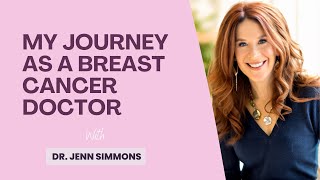
Dr. Jen Simmons (breast surgeon) recounts growing up in a family devastated by breast cancer—highlighting her cousin Linda Creed’s death from metastatic breast cancer—and how that motivated her to become the first fellowship-trained breast surgeon in Philadelphia. She describes a successful surgical career focused on oncoplastic techniques, then a personal health crisis (Graves disease) that led her to refuse conventional treatment, study nutrition and functional medicine (IIN, IFM), and ultimately heal herself over three years. Influenced by speakers like Mark Hyman and cases like Terry Wahls, she concludes that traditional acute-care medicine fails at chronic disease by not asking “why.” At age 50 she left surgical practice to pursue functional/integrative approaches and to broaden her impact on preventing and treating chronic inflammatory diseases like breast cancer.
Questions this video answers
"Becoming a Breast Cancer Surgeon, Breast Cancer Treatment and How One Diagnosis Changed My Life" by Jenn (Jen) Simmons, MD (YouTube).
July 18, 2023.
Linda Creed, Dr. Simmons' first cousin, was a 1970s–1980s singer-songwriter who wrote 54 hits including "The Greatest Love of All" (written 1977).
Whitney Houston released it in March 1986; it spent 14 weeks at the top of the charts.
She was 16 years old when Linda died of metastatic breast cancer (one month after the song's release).
Chapters
Hello, and welcome to keeping abreast with Dr. Jen. I'm your host, Dr. Jen Simmons, the doctor with the answer to breast cancer. I don't come by that title lightly. There has really never been a time in my life where I don't remember breast cancer and when I didn't know what breast cancer was. I come from a breast cancer family. I know probably a lot of you listening to probably do as well, or you're affected by breast cancer in some way. Because it's nearly impossible to not be affected by breast cancer. And I was from the very beginning. So growing up, I had a first cousin. Her name was Linda Creed. She was a singer songwriter in the 1970s and 1980s. She wrote all the music for the Spinners and Stylistics. She was the Queen of Motown Sound in Philadelphia. Beautiful, brilliant, larger than life, and she was my hero. She wrote 54 hits in all. And her most famous song was the Greatest Love of All. She wrote that song in 1977 as the title track to the movie the Greatest, starring Muhammad Ali. But it really received its acclaim in March of 1986 when Whitney Houston recorded it and released it to the world. At that time, it would spend 14 weeks at the top of the charts. Only Linda would never know it, because Linda died of metastatic breast cancer just one month after Whitney released that song. I was 16 years old at the time when my hero died. Now, I knew that Linda had breast cancer because I watched her journey. I watched her lose her hair. I watched her become bloated and almost unrecognizable from the steroids that they give you when you get chemotherapy. And I watched her wither away and be in horrible pain when the disease spread throughout her body. I knew the suffering and devastation that breast cancer caused my whole life because I grew up with it. There really wasn't a woman in my family that didn't have breast cancer. And most of them died of breast cancer with the exception of my mother, who had colon cancer. Cancer was front and central to me and to my childhood and Linda's life and ultimately her death, it gave birth to my life's purpose. I never wanted another family, another woman, another community to suffer the way that my family suffered. And I did the only thing I knew how to do. I knew that I didn't want to be helpless. I knew that I didn't want to go through life watching this happen to someone else. And statistically speaking, I was going to watch this happen to someone else. And so I did the only thing I knew how to do. So I go to medical school and I become a doctor and I become a surgeon, and I become the first fellowship trained breast surgeon in Philadelphia. And I'm doing really great things, and I think I'm making a difference. I'm doing cutting edge stuff. I train in oncoplastics, which is the combination of cancer surgery with plastic surgery. I really think that I'm making a difference because I'm asking each woman who I'm diagnosing with breast cancer, what is it that you didn't like about your breasts before? Let's take this opportunity for a silver lining. Let's correct it. If they were big and you want them smaller, let's make them smaller. If they were small and you want them bigger, let's make them bigger. I was really, unfortunately caught up in the really superficial part of it, But I did think that I was making a difference, and I did that for a really long time. And I did it really well. And at one time, I'm running the breast program for my hospital, and I'm running the cancer program in general for my hospital, and I actually took them through the NIH certification process. And at the same time, I'm a wife and a mother and a stepmother and an athlete and a philanthropist, and I have a lot of balls in the air, and I consider myself an expert juggler, until one day, all of the balls came crashing to the ground. And I literally went from being seemingly invincible to seemingly an invalid in one day. I remember it like it was yesterday. I was on the tennis court, and normally I could play tennis for hours and hours. And on this day, I was warming up, and all of a sudden I had chest pain, palpitations, couldn't catch my breath, went to the emergency room, had three days worth of exhaustive testing. And on that third day, I'm sitting in the office of my friend and colleague and physician, and he tells me that I have Graves disease. This is an autoimmune disease of the thyroid, but it's life threatening and it's treated just like cancer. So he tells me that I need to have surgery and chemo, radiation, and take lifelong medications. Now, for anyone who has faced a breast cancer diagnosis, this is very familiar, right? This is the exact same thing that you're told. And believe me, I appreciated the irony. I appreciated that everything that he was saying to me were things that I said all day, every day, without hesitation or reservation to the women that I cared for. And yet when these words were coming at me, it was like I was having an out of body experience. I was in Charlie Brown's classroom. And I still don't know to this day, call it God, call it universe, I don't know. But I walked out of that office that day refusing treatment. My doctor, who was my friend, who was trying to be caring and concerned, did what he was trained to do the same way that I would have done had the roles been reversed. I would have said the same thing. He told me if I didn't do this, if I didn't accept this treatment, I was going to die. I told him that I didn't believe that was true. I understood where he was coming from. I respected where he was coming from. I agreed to sign off on something that said that I was refusing treatment. And I was refusing treatment. I went home, cried a lot and started to figure out how in the world I was going to heal myself because I just didn't inherently believe that God would give me an organ only to have me remove it and have to replace it with synthetic hormone for the rest of my life. It just didn't make sense to me. And so I did what I tell everyone never ever, ever to do. I go on Dr. Google. Now, I consider myself a fairly educated consumer, so I thought I was safe in doing it. And let me just put a disclaimer out there, even as an educated consumer, there are a ton of fallacies out there. So do not do this at home. Beware and be very careful with what you hear about and learn on the Internet. But in any event, I googled how do I heal my thyroid? And again and again and again, I get the same answer. Diet, diet, diet. Now, I am a traditionally trained physician. As a traditionally trained physician, we have about 15 hours of required training in nutrition. It generally happens your first year in medical school. Now, as a fellowship trained surgeon, I had 10 years of medical training, specific medical training. And in those 10 years, I had 15 hours worth of training around nutrition in my first year of medical school. And then never again. Never again. And as a traditionally trained physician, we are taught to think that if it's not taught to us, it's neither important nor true. And because I wasn't overweight, I really thought that I knew everything I needed to know about nutrition. But here I am, I'm sick and I'm not doing well. I'm afraid for my life. And so I decide that I better do something. Maybe learning about nourishment is the place to start. And so I enroll in a certificate program called iin, the Institute for Integrative nutrition. Now, before I enrolled, because I was a physician at this point for nearly 20 years, I think I drove them crazy. I called and called and called, saying, I'm already a doctor. Are you sure I'm going to learn anything here? And they said, I'm sure. So I reluctantly go to the first lecture, and a man named Mark Hyman walks onto the stage. He introduces himself as a functional medicine physician. Now, again, at this point, I'm a doctor for 20 years, and I say to myself, there's no such thing as a functional medicine physician. What is this quack talking about? Then I remember that I'm sick and I'm there for a reason, and I don't know the reason yet, so I ought to check my ego at the door and shut up and listen. And that's what I did. And thank God, because within five minutes of this man speaking, my whole world makes sense. And I now understand why I got sick. I got sick so that I could be in that room on that day to listen to this man speak. Because what was wrong with me is what is wrong with medicine in general. I was so out of balance. Everything in traditional medicine is so out of balance. We're trying to make a square peg fit in a round hole, and it doesn't work. Now, the traditional medical system is awesome at acute care. At acute care, if you need an antibiotic, if you break a bone, even if you have a heart attack, we're really good at fixing it in that moment, however, what we're really bad with is chronic disease. We're really bad with chronic disease because we try to use an acute care system to treat chronic disease, and it doesn't work. So I'm so moved by what he's saying, and he's talking about focusing in a different way. He's talking about asking the questions, why? Why are we sick? What led us to be sick? What led us to become out of balance? Instead of focusing on the sickness, the tumor, the failed organization, asking the question, why did that organ fail? Why did that tumor develop? Why? Why? Why? And we're not really asking those questions. And if we are, we're not answering them. I know in my 17 years as a surgeon, when women would ask me, why did I. Why did I get breast cancer? I would give them the biggest bullshit answer, that it's multifactorial. There are a number of things that kind of combine. It's a perfect storm. That's what I used to call it. And no one can do anything with that because it's A bullshit answer, but it's the answer I was trained to give for all those years. That was the acceptable answer. The perfect storm theory. Like, you can't do anything about it. It's just the weather, right? Except that's not true. And we have so much more power than we think. And I learned that that day. I learned that we can control way more than we think. But we have to think differently. We have to think about our why, we have to get to our why. And we have to change. Because without change, you can expect change. And the definition of insanity is doing the same thing over and over and over again and expecting a different outcome. The truth is that most of us, when we get our diagnosis of whatever it is, and we take the pill or the surgery or the chemotherapy or the radiation, and all we're doing is managing the symptoms, but we're never thinking about why we got sick. Unless you deal with that underlying reason, there's nothing to stop the next manifestation. What I did was I'm an early adopter. I enrolled in the Institute for Functional Medicine one time. I'm a full time surgeon, wife, mother, also enrolled full time in iin, now enrolled full time in ifm. And I spent the next three years trying to heal myself. Remember, this was a selfish journey. This was about how am I going to heal myself? How am I going to save my life? Because I wasn't ready to die. I wasn't ready to leave my two young children, I wasn't ready to leave my husband, I wasn't ready to leave my family. I wasn't even ready to leave my practice. I had so much to live for and I wanted to figure out how to live. And what I learned on that one day was that I have the power. I have the power to correct this. I have the power to do this in the way that I'm going to do this. And so it took me three years, but I healed. I learned how to drive health, I learned how to create health. I learned what is good for me, I learned what is not good for me. And I learned to prioritize my health. And try as I might, I did try to bring that into my surgical practice. I did. And one day in the office and this 19 year old is on my schedule. She's coming to see me for a breast lump. And she gets wheeled into my office, which is about 30ft from the elevator. She gets wheeled into my office by her mother. She's in a wheelchair because she has such progressive Ms. That she can't walk the 30ft from the elevator to my office. I had only just met Terry Wahls the week before she came in. Now, if you don't know who Terry Wahls is, she is a Midwest physician who had primary progressive Ms. In a course of seven years she went from running the residency program in internal medicine in her hospital and having a patient load. And she's a high, high, high functioning physician. She goes from that to a zero gravity wheelchair in a matter of seven years. She gets let go by her job because she cannot perform her duties. And this is someone who is in academic medicine who, who has access to every drug, to every drug trial, to everything that traditional medicine has to offer. And yet she's failing and she's failing miserably. And so with no options left, she starts to experiment with food and she radically changes the way that she eats and she starts to get better. Now, she did not completely stop the traditional treatments, but she started to add in, she started to add on. And she really started with diet and nourishment and then she added in some alternative therapies, some electro stem. And she gets better and better and better and ends up going from a zero gravity wheelchair where she can't even support her own weight to riding her bike 20 miles a day. And the hospital where she used to work calls her back, please come back to work. And not only are you to come back to work, but we need to market this and we need to make a protocol here. And from that, the Wahls protocol is born. And she goes on to help thousands of people with Ms. Recover their health. So I'm brimming with excitement to tell this young girl about the Wahls protocol and the fact that there's hope for her. And I'm going on and on and on and really trying to create and instill hope. And I'm like a giddy schoolgirl because I am so excited for the change that can happen in this young girl. After about two minutes of my going on, she puts her hand up and she says, are you going to do my biopsy or not? I thought, oh yeah, not everyone wants to help themselves. Some people just want the pill, just want the procedure, just want whatever it is because they don't want to take responsibility either way. They don't want to take responsibility if it works and they don't want to take responsibility if it doesn't. It's so much easier to do that. Except the vast majority of the time when we're talking about chronic disease, it doesn't work. It doesn't. When we think about women with breast cancer. Breast cancer is like the end of the line of inflammation. Chronic inflammation builds and builds and builds and builds and builds over time until you find yourself with a breast cancer diagnosis. Doing surgery is not impacting that inflammation in any way. And doing chemotherapy actually makes it worse. Radiation makes it worse. Even the long term drugs, the hormonal blocking drugs, they make it worse, too. And so you take someone who's already inflamed, who already has a diagnosis, and you make their inflammation work. And this is a recipe for more disease, more chronic disease. And we're seeing that, we're seeing that borne out in the literature all the time now. Women treated for breast cancer with higher instances of heart disease, higher instances of Alzheimer's, we're going to see higher instances of fractures. This is a result of treatment and not asking the why. And so the day I had that woman with Ms. Who I really wanted to help, and she really did not want my help, was the day that I decided that that surgery suit that I'd been wearing for so many years, for decades, it didn't fit anymore. It was time for me to move on. I gave my notice that day. I knew that if I was going to go forward and make the impact that I had promised that I would make all those years ago when Linda died, if I was going to make the impact that I promised myself I would make when I healed myself, I knew that I had to share that with the world. If I was going to fulfill my promise, if I was going to fulfill my destiny, if I was really going to leave this world a better place than when I found it and make an impact on breast cancer and health, then I had to do it a different way. I had to take a different tack. I had to get away from that definition of insanity. Because without change, you can't change. And so, at the ripe age of 50, I walked away from my surgical career only to step into something amazing, something beautiful, something impactful, something enormous. And that's right here. So I'm so glad that you're here listening. I have amazing things in store for us, and I just really look forward to this journey. It's Dr. Jen Simmons, and I'll see you real soon. Bye for now.
More from Jenn






Stem Cells, Peptides, GLP1s and the New Blueprint for Preventative Medicine with Dr. Vass



The Truth About GLP-1 Drugs and Who Should (and Shouldn’t) Take Them with Dr. Susan Brian

What 100 Days Underwater Revealed About Aging and Healing with Dr. Joseph Dituri
