My Answer to Breast Cancer Spotlight on superstar Krysten Gentile
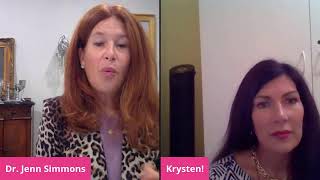
This is a recorded conversation between Dr. Jenn Simmons and Krysten Gentile about Krysten’s lived experience with breast cancer and her participation in Dr. Simmons’ "My Answer to Breast Cancer" course. Krysten credits the program with significant physical and emotional improvements (weight loss, increased energy, improved hair/nails, better mood), and both speakers emphasize lifestyle changes — especially whole-food plant-based eating, regular exercise, journaling, and community support — as central strategies for improving health and resilience during and after cancer treatment.
Chapters
Hello, hello, hello.
We're here.
It is Tuesday night.
It's.
Well, it's around 7 o' clock and it's my answer to breast cancer. And I am super excited for my very, very, very special guest. She's special in so many ways, but you probably know her as the host of the Making the Breast of it podcast and she so graciously has agreed to come tonight and talk about about her experience in my answer to breast cancer. So, Kristen, welcome, welcome, welcome. Thank you so much for being here. I'm so grateful.
What's up, breasties? I'm so excited to be here. I'm back. I love you, Dr. Jen. I'm so excited to be back on the mic with you. This is awesome. I locked myself in my parents spare bedroom. In case you're wondering where I'm at right now. They're like half in and out of this bedroom. It's crazy. Oh, no. Okay. There you are.
You're back. You're back.
Great. So sorry about the delay. The thunderstorm seemed to cause us a ton of technical delays.
No worries. We're here and we're happy to be here and it's all good. So we actually started a new My answer to breast cancer course last night and you were there and I was so happy to have you back. I can't remember if you were in the first version or the second version, but now you're in the fourth version and it's so great to have you.
I was in o. In the first one. Yes.
I really wanted you to just come on here and kind of share your experience because you are very educated. Right. And thank you. You've been in this, like, breast cancer ecosystem space for more years than you ever thought that you would be in this space. Right. Been in this space at all. And you've gotten a big education over this time. So can you talk about the course and what it's meant to you and for you, that kind of thing?
Absolutely. Well, I have to thank you because a lot of my education came from you and I was absolutely stunned to see all the beautiful women last night in the group. It's sad to see that many women with breast cancer in the group, but at the same time, it was so nice to be men who, who are living a similar lifestyle and doing their best every day to have the very best outcome. And I was absolutely floored at how many listened to my podcast. I was so, like, honored, like, oh, my gosh, these smart, intelligent women. Listen to me. I'm. I'm so.
They Should I would say, I think that you have a lot of very worthwhile things to say, so I'm glad they listen to you.
Well, a lot of it is from working with you. And for those of you who don't know, I started with Dr. Simmons when she first started her practice, and I was thrilled to get started. A tough road to change my entire lifestyle, but I absolutely am thrilled with the results I've had from the program. So when Dr. Simmons and I first started working together, I was tired, I was overweight. The doctors had put me in menopause. I am a mom of three. I had no energy. This woman turned my life around. I dropped 10 pounds like that. My skin started to glow. My hair got shiny again, even though I went through so much chemo. Same with my nails. They started to grow back again. And then my eyebrows and eyelashes started to come back. It was just a complete game changer for me, not only physically, but once I started to see the physical changes, it really helped with a lot of the emotional stuff too. And Dr. Simmons course definitely touches on more than just physical ways to, you know, deal with this in the best way possible. Because honestly, it's not the best lifestyle to be living, let's be honest. But when you're trying to make the best of it, Dr. Simmons is unbelievable at helping you get there between food, nutrition, exercise. She doesn't force you to do anything. She doesn't force you to change everything overnight. She will guide you through this program. She will hold your hand through the whole thing. She will set you up with her coaches to help you figure out, you know, what does my new day to day look like and how do I make that work for me? Not just this is cut and dry. You're changing your lifestyle. Wake up at 6am and run six miles. It's not like that at all. I was a little nervous when I started, like, oh, am I going to disappoint her if I eat, like, this piece of chocolate? But no, definitely not. You're incredible. You are such a force to be reckoned with because you have so much knowledge from the oncology side, let alone the nutritional, functional, wellness side. So the combination of your pieces of knowledge from both worlds is just unbelievable. And I can't thank you enough for giving me so much education because I get to get behind the microphone and share that with the world. And that's why Dr. Simmons is our official doctor of making the breast of it.
That was so incredibly sweet, all those wonderful things. And thank you. And I'm so Glad that this experience has been such a positive one for you. Because, like we talk about in group, breast cancer is not a blessing, Right? Like, it's not a blessing. It is. It's horrible. It's disruptive. It is not a blessing. But it is an opportunity. And for many people, they learn a lot about themselves throughout this process, and they learned that maybe they weren't living their best possible lives. And this is an opportunity to improve the way that you live your life. And that's really. That is the main theme behind this program, is that it's all about how to live life.
Definitely. I mean, before we started together, I was miserable, and I didn't even realize it. I had no idea how sad and down and depressed I was. And when I started to change my lifestyle and the way I approach work and fitness and diet and exercise, I was floored at how much better I felt. I felt like I was taking an antidepressant and I wasn't. And then everything else sort of fell into place, and I was like, oh, my gosh, this woman's on to something. It's amazing. So it's not just, like I said earlier, the physical transformation. It was also the mental, the spiritual. You got me doing so many great habits every day, like journaling and thinking about what I'm doing, grateful for every day, and it really changes my outlook every morning. People ask me every day, like, you have terminal cancer. How. How do you stay so positive? Well, you are definitely a major, major part of trying to figure that piece out. Because I'm not like a therapy girl. I am not going to go sit with a therapist and talk about my feelings. Nothing against anybody that does. I just. I sit there and I'm like, I don't know what to say. So you helped me find other ways to really explain, express my emotions and deal with them in a really healthy way and not hit the wine bottle like I used to. And again, nothing against the wine. I just read 5k and I did enjoy some wine after.
I wanted to say, like, you know, you think about what this does for your. Your physical health in the here and now, and you look at. At someone like you, who's been in treatment for this many years, who's getting chemo constantly. You went out and ran a 5K and, like, yeah, did it with gusto. Right.
I didn't have the best time like, I was. Now I'm going to be competitive with myself and go back next year and cut my time in half. But I'm like, that's A way better way of looking at it instead of laying on the couch and saying, I can't do that. I'm a sick person. No. I am a healthy person with an underlying chronic condition, and I'm going to continue to live my life. And I understand that a lot of women out there are probably thinking to myself, I can't do that because my bones hurt or this hurts, and that hurts. But guess what? When you start fighting back and saying, not today, cancer, that's when you get the energy. That's when the pain starts to subside. It's. It's not only just a physical game, it's also a mental game. And my friends look at me and say, are you really going to run a 5k tomorrow? Like, if I don't run that, then the cancer wins. F that. Not today. Keep on living your breast life, because.
Exactly.
Life is short. Go do it.
It's so much like begets, like, right. You think that you've had chemotherapy, so you're too tired to exercise. Really the reason that you're too tired to exercise is because you're not exercising.
Exactly.
Exercise is going to give you more energy. That exercise is going to make sure that you have sounder sleep, and that's going to give you more energy. And if you're out exercising, then you're going to be more conscious about what you put in your mouth. Because if you did all that hard work, you want to fuel your body properly. And so all these things layer on to one another. And that's what we talk about. We talk about building your best health.
Yep, definitely.
And you are a shining example of what that looks like. I am so grateful for you in my life. So grateful to be a part of your ecosystem. I love the show. Oh, I have a football player in my back.
I have a couple downstairs that are trying to break in.
So if anyone is interested in joining the My answer to breast cancer course, I just put the link to the landing page in the chat. I'm happy to meet with you, talk to you, and I know that it can be as meaningful for you as it has been for Kristen. It had been for all the past participants. I'm so. I'm so, like, amazed by the fact that the group just keeps growing and growing and growing, and it's just such a wonderful space for. For me and for everyone.
It 100% is, especially if you feel alone with your diagnosis. Like, there are definitely, you know, other cancer patients that we run into at the oncology office or so. And so had cancer Let me connect you with them. But sometimes you run into people and they're more like cancer muggles and they judge you based on the decisions you're making. And you don't get that here. Like all the women are so open minded and kind to one another. And I keep in touch with a lot of them and they're huge part of my support.
And I think that there's a lot of like minded people. And so people might be at different ages and at different stages, but they're all there with a very similar goal, which is that they want to do whatever they can bring on health. Right. Everyone is very motivated by that. And the energy and what we feed off of each other is so tremendous.
Definitely.
And it actually doesn't end up mattering like where you are in the stage because we're all after the same thing 100%, after driving, health and being the best version of ourselves.
You wouldn't believe how many people I come across who say, you know, you're sick, you're on chemo, you're this, you're that, why don't you just eat whatever you want? And I'm thinking to myself, if I eat whatever I want, then I'm not going to have the best chance at fighting this off, right? So if I feel amazing, even think about the people who don't have breast cancer and then who imagine how incredible they would feel and how their mental clarity would improve and their physical appearance and just everything comes together and you're much happier in life and those endorphins are coming from the exercise. I don't need the antidepressants.
And quite frankly, they could be preventing a breast cancer diagnosis, which is really what we talk about a lot in that group, is preventing not only breast cancer, but all the other manifestations of inflammation. Because as it turns out, most people who get breast cancer don't die of breast cancer. Most people who get breast cancer die of heart disease because it's the same underlying inflammation that drives both things. So most people who get breast cancer never really deal with the underlying reasons they don't do what you did. They don't figure out why they were angry all the time, how the stress was eating away at them, how they could change their environment to drive health rather than to promote illness. Definitely think about if, if more people did that, we would be in a much, much, much different place. A much, much, much healthier, less vulnerable world.
Last night in the session, you reminded me of something and that's why I love, even if you have joined the session before jump into another one. Because as Dr. Simmons continues to evolve her business and as I go back, I. I'm learning new things that I forgot because of either chemo brain or mom brain. But I love that you reminded me about those Netflix documentaries, because even if you're not fully sold on this, go watch what the health. Go watch forks over knives. Go watch those documentaries and watch the Game Changers. The Game Changers. That's right. I was trying to tell my friend about that one today. I'll have to text her Game Changers, one of my favorites.
Even if you don't want to buy in 100% plant based, you cannot deny the power of plants. Just watching those documentaries will solidify it for you. And spend one more day a week being plant based than you did the day before.
That's.
That's 1/7 healthier that you're going to be in your lifetime. That's 1/7, one more that you're going to extend your life. Because every stage along the way, being whole food plant based prevents progression to the next stage. And so it's just powerful stuff.
It really is. And it's funny because in the beginning, I would think to myself, okay, if I'm going to eat this huge Greek salad for lunch or dinner and my protein is chickpeas on top, I'm not going to have energy for my workout. I. I'm not going to be able to do, you know, jumping jacks with 15 pound weights like I used to. I had more energy, more energy than I did when I was eating the meat and the cheese. Which is crazy to me because you would think protein, protein, protein. That's not always the case. Maybe it is for some, you know, other people of underlying conditions. I don't want to say I'm a doctor by any means, but for me personally, I was like, oh, no judgment.
Right? Everyone has to do what feels right for them.
Exactly.
But the less toxins our bodies have to process, better it works. And that's where you're feeling that energy. That's where you're finding that energy. Because your mitochondria, which are our energy producers, are not bogged down with toxins.
Yep, yep. And I love that you tell us how to, like, boost the way the mitochondria fights is the powerhouse. It's amazing. I'm like, oh, I should have this and turmeric. I can hold my own. Talking about herbs and spices and supplements thanks to you.
Well, thank you for spreading the gospel. I will be forever grateful to you. I'M so glad that you came on here tonight to share this program with the breast cancer community. And so if you are someone who is at risk for breast cancer, who has a BRCA mutation, who's recently been diagnosed, you're in treatment. You've completed treatment, and you're wondering now what. Because there are lots and lots of ladies in that position. And you can do so much more than just wait for that other shoe to drop or you're living with metastatic disease. If you're in any of those buckets, we have a home for you. Right. And we have. And we have something great to offer all of you. So thank you so much for being here. Kristen. Thank you. Everyone listened. This is Dr. Jen Simmons from Real Health md.
Bye.
More from Jenn






Stem Cells, Peptides, GLP1s and the New Blueprint for Preventative Medicine with Dr. Vass



The Truth About GLP-1 Drugs and Who Should (and Shouldn’t) Take Them with Dr. Susan Brian

What 100 Days Underwater Revealed About Aging and Healing with Dr. Joseph Dituri
