My Answer to Breast Cancer- Spotlight with past participant Chelsey
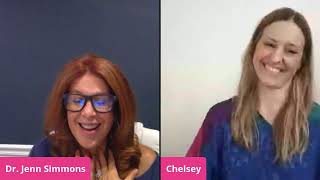
YouTube interview (Sept 15, 2021) featuring Dr. Jenn Simmons and past program participant Chelsey. Chelsey describes a breast-cancer timeline: originally diagnosed triple-negative in 2017, later found metastatic in April 2019 at age 34, received standard chemotherapy and then entered a trial (Olaparib). She joined the "My Answer to Breast Cancer Group" during the early COVID-19 period, applied lifestyle and environmental changes (diet, sleep, stress, movement, toxin reduction, social connection), and reports a recent scan (about 12 weeks before the interview) showing NED (no evidence of disease). The interview emphasizes the program’s inclusivity across the breast-cancer spectrum and its focus on health-promoting, anti-inflammatory lifestyle pillars.
Questions this video answers
2017.
April 2019; she was 34 years old.
Olaparib; she has been on it for over two years (as of the interview).
Scan about 12 weeks before the interview showed NED (no evidence of disease).
September 15, 2021.
Chapters
Hello, hello, hello, it's Dr. Jen Simmons from Rural Health MD and I am so excited to talk to Chelsea tonight. Tonight we're talking about the My answer to Breast Cancer Group program. And Chelsea actually was an early adopter. I think you were in the first group. We have since had three groups come through. And I know that this group has such tremendous value for really anyone along the breast cancer spectrum. So whether you are at high risk, if you're a mutation carrier, if you've had a bunch of biopsies and you know that you're at increased risk for developing breast cancer or you've been diagnosed or you're in treatment or, or you're through treatment and you're wondering now what. Or you're living with metastatic disease. There's really something for everyone along the breast cancer spectrum in that this course, which is a group course, it really teaches you how to live an anti inflammatory life and prevent breast cancer, prevent recurrence. But really the main thing about this group is that it really teaches you how to live. And that's where our focus is. We're not focused on disease, we're focused on health. And so Chelsea was so kind to come on and just share her story, share her experience so that other people can know what this is all about. So, Chelsea, thank you so much for being here. Thank you for having me. Of course. So you were, you were in, I think, one of the first groups. But tell us a little bit about how you, how you wound up there. Tell us a little bit about your story and the impact that breast cancer has had on your life. Sure.
I was originally diagnosed triple negative in 2017. I actually had one year, kind of my one year clear, and I actually found a couple spots on my back and had some really stressful experiences in my life and just really kind of got off my regular path. And I was then diagnosed metastatic in April of 2019 and I was 34.
Is that what the spots on your back were for the people listening?
Yes. So the spots that I had found were in fact triple negative as well. So I had spent, I had known a little bit and worked on, on my diet and incorporating different sort of modalities into my routine and really trying to switch up my lifestyle. And right at the beginning of COVID.
You did traditional treatments too, right?
Oh, yes. So I did act originally and then I got onto a trial.
You had traditional chemotherapy, Nitoxan, Taxoline. Yep.
Traditional standard of care. And then, and then I searched elsewhere because my doctors did want to put Me back on basically, you know, chemo, and I just was not going to do that at that point. And found Dr. Trainer at MSK, and she's an expert in triple negative, and was really grateful because she wanted to do further, like, genetic testing on my tumors to, you know, understand and sequence them and get the genomics of my test. And that really was sort of the determinant in how I ended up on the Olaparib trial. And so I've actually been on Olaparib now for over two years and I have had very minimal side effects, which is really grateful for that. Obviously, like, slowly, my blood work is, you know, kind of slowly declining at different times. And. Yeah, so right when. Right when the pandemic had happened, I was really struggling to, you know, feel understood. I was feeling really alone and feeling really just. Just kind of out there, hanging. Hanging out there by myself.
Right, yeah. And isolation is something that's, that's very, very dangerous in terms of your health. We know that animals who are isolated, they die. Yeah. So we are, we are very social creatures. And if you are going to reverse disease state in your body, then you, you can't, you can't do it alone.
Absolutely.
Right.
So.
So I, we met right around that time.
Exactly.
And. And you joined the group. Now, I know you spoke about this a little bit, but you, you did start to make some dietary changes, you did start to make some lifestyle changes before. So you came to the group as a pretty educated person.
Yeah, definitely independently, you know, and I think that that was really what was so amazing for me about the group is that I had done a ton of research and trying to read about different things and, you know, just try to educate myself as much as, as.
Possible.
To combat the things that were going to happen with Olaparib, to combat the things that, you know, try to, you know, try to reverse my sort of situation, to be really honest. And that was, and still is my, My continued goal was to. To present as. No. No evidence of disease. And so, yeah, I, at that time, you know, in March of 2020, I was not at that stage yet. And again, like, feeling isolated, looking for some sort of camaraderie and, you know, reinforcement and encouragement. And that's when I found you and the program.
Yeah. So as a fairly educated consumer, I mean, the things that we talk about in the program, we talk about nourishment and where nourishment comes from because it's not just about food and supplements. Right. Because we get nourishment from lots of different avenues in our lives. And we talk about the other pillars and foundations of wellness. We talk about nourishing sleep, we talk about managing stress. We talk about mindfulness, we talk about movement. We talk about your environment, toxins and the electromagnetic field and de. Plasticizing. And then we talk a lot about social connectivity and the meaning of all of that. And having come in as an educated consumer, because you knew a lot about these things before you even came to the group course. So tell me, as an educated consumer, what did you get out of the course? And I know that you were quite amazed by how much you got out of the course.
Yeah, I think the full spectrum. Exactly. Really what you had just mentioned about electromagnetic fields, about deplasticizing, Being educated even further beyond nourishing myself internally, but then really creating the environment to help me heal and just being more conscious of those small things that we tend to forget about all the time. I think having. Having the course go, you know, week by week and sort of peel back different layers was really great for me because it, you know, you need your foundation and then you can kind of incorporate other things. And I really found that to be more easier for me to apply those things into my life after, you know, starting from a foundational place and then working, you know, further and really being able to increase the differences and the impact that I want to make in my life.
Yeah. I mean, I know for me personally, like, there are topics that I can listen to the same speaker again and again and again, and each time I get more out of it and really try to design the course for people along every spectrum of knowledge. Right. So for people who were just starting out in this space, I tried. I hope I succeeded in talking to those people as much as I'm talking to people like you, who are already well along the journey to living a healthier life. Yeah. And I also tried to intentionally be inclusive of everyone along the breast cancer spectrum, from people who are previvers or mutation carriers to people who are living with metastatic disease and everyone in between. Because ultimately the message is the same. We're not focused on the disease, we're focused on driving health. And there are, in fact, concrete things that do drive health.
Absolutely.
And, you know, we talk about. In. In the probably fifth week of the module, we start to talk about sleep, because there's really no avenue to healing if you're not sleeping at night. And, you know, I say to everyone that I work with personally, like, if you're not going to commit to some sleep hygiene, there's not going to be anything that I can do for you. I'm going to stay up all night and watch Netflix. You're not. You can't. There's no path to healing that way. And so I, I really feel like I put something in there for everyone and I feel like I'm talking to everyone. But being someone who is living with metastatic disease, did you feel like I was talking to you and did you. And. And was that the tone for the whole time or did you feel like things didn't apply to you? Like what was your. What how did you receive all of that information?
I think that you did an incredible job as to making it be a full inclusive. I never felt like an outsider or like I didn't belong. And sometimes with different stages of breast cancer, you know, it can feel like that you can feel very different. And I never felt that way. I always felt very included and a part of and that it was definitely things like, exactly like you said, like I took the course twice and so through that I. Exactly what you said was able to pick up different things each time that were really, you know, an area that I could see that I needed to work on. And so I think that, that I could do it again and I would do it again. And that's the thing that I think is really special is that it is so important for us. I did the Anna Anno fashion week in 2019 and the idea and the premise was that it was from zero stage zero to stage four. That was so awesome. And really having that highlight the idea that we are all similar and we all are different. And I think no matter even a metastatic patient sitting next to me, we're going to have different journeys and we're going to have different places that we start from, from the knowledge that we have, from the way that we're treated, from where we go, you know, all the different, you know, stories that we have. And I think that that again is. Goes back to like bio individuality and understanding that we're. We have our own code and we have our own specific needs and having a framework and realizing the things that do affect humans and then being able to decipher through that is really powerful.
Well, I'm so glad and I want to personally extend an invitation to you to join our next group. We will start, I think the 29th, so we're going to start in a couple of weeks and what is so exciting for the next group is that we have completed our resource guide, so you will receive a copy of that resource guide which basically highlights all of the pearls that we spoke about each week. And then at the end, there is a phenomenal recipe book for all of those people that are, you know, making or on that plant based journey, since I do think that that is a critical part of healing for so many people. And so it's. It's just an incredible value add to. To the course, and so you'll be receiving that as well. And I look forward to seeing you again and that beautiful face every week and being on your journey with you, it's really. It's been every bit as special to me and as meaningful to me. So thank you so much for doing this and I really look forward to seeing you again real soon.
Thank you so much. I actually would love to share with you. I haven't shared with you, but I did have my scan about 12 weeks ago and it did come back as Ned, so. Chelsea, I have chills.
Yeah. Oh, Chelsea, that's amazing. I'm so happy for you.
Thank you so much for you.
Not completely surprised, as I say. Like, I expect all of my people to be the exception and you are definitely one of my people. And so I'm not surprised, but, like, incredibly delighted for you and how awesome that must feel. And I hope you are so proud of yourself because I know that you worked really, really hard for your health and that is just incredible news.
Thank you so much. Really happy to share that with you. And thank you so much for being an advocate and a supporter and just being a part of my journey. I really appreciate it so much.
Well, you are going to be a great inspiration to so many. I know that the narrative towards people with metastatic disease can be really negative and really difficult, and I love that we can tell a different story and we can share a different story and one of hope and one of success with the breast cancer community. So thank you so much for sharing that with us and for being you and for doing what you do and inspiring others.
Thank you so much.
All right, thanks, Chelsea. This is Dr. Jenny. Bye for now.
Bye.
More from Jenn






Stem Cells, Peptides, GLP1s and the New Blueprint for Preventative Medicine with Dr. Vass



The Truth About GLP-1 Drugs and Who Should (and Shouldn’t) Take Them with Dr. Susan Brian

What 100 Days Underwater Revealed About Aging and Healing with Dr. Joseph Dituri
