The Benefits of Functional Medicine for Breast Cancer
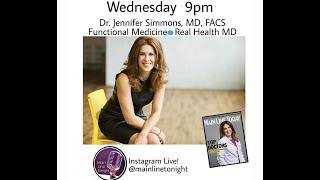
This is a recorded interview (June 18, 2020) with Dr. Jenn Simmons about functional medicine. Dr. Simmons recounts her own Graves disease diagnosis which led her to study nutrition and functional medicine, and she discusses root causes of chronic disease (inflammation, toxins, gut microbiome), thyroid and hormone health, practical interventions (diet, sleep, probiotics, testing), COVID-19 implications for chronic inflammation, and a 21-day health challenge.
Chapters
Welcome to Mainline Tonight. My name is Melissa Jacobs. It's an honor to have you on the show, and it's so good to see you. I haven't seen you, I think, since our photo shoot.
I know, the last time we saw one another. And it's great to see you.
Yes, yes. So, of course, you are our cover doc for Mainline, Today's Top doctors issue in December of 2019. A few things have changed since then.
Yes.
Just a few.
Yeah. Yeah. Yes.
But when I was thinking, you know, I was thinking about our conversation that we had, I think, even before that, about the relationship between medicine being preventative and not just treating symptoms, and that people who sort of take care of their health on a regular basis are the ones who do well pretty much throughout all crises. But let's get started by talking about real health MDs. So for 17 years, you were the leading breast cancer surgeon in Philadelphia. You are an innovator, a groundbreaker, and a glass ceiling breaker, we should also say. And I first interviewed you when I was an editor at the Jewish Exponent, so that was at least 15 years ago. So you decided to present pursue functional medicine. Tell us why you decided to do that.
Yeah, so I don't know if I chose it or if it chose me. I was about 15 or so years into my surgical practice, at the top of my game, really seemingly having it all, having this great career, marry, children, athlete, like all of these things. But I'm thinking that I'm juggling all these balls in the air really, really well. And then one day I'm on the tennis court, and I'm accustomed to playing tennis for three hours at a time and looking around saying, anyone won another game? And I'm on the tennis court, and it's only 10 minutes that I'm on the court, and I. My chest is beating, so my heart is beating out of my chest. I can't breathe. I think I'm having a heart attack. And I end up having a workup and getting a diagnosis of Graves disease. So this is my first autoimmune diagnosis. And with Graves disease, your body sees your thyroid gland as foreign, so it attacks your thyroid gland and spills all of this thyroid hormone into your system. And you have all of those symptoms that I was talking about. So you're. You have palpitations, you have shortness of breath because your heart is beating too fast. You have insomnia, like, all of these. All of these crazy things. And this is actually the kind of thyroid disease that can kill you. So it's life threatening because you can have a heart attack. So I'm sitting in the office with my endocrinologist and I'm having this out of body experience because he's talking to me and he's telling me I can either have surgery to have my thyroid removed or have radiation to obliterate my thyroid, or I can take lifelong medicine to suppress my thyroid. And here I am hearing all of these options that I say to people every single day. Every single day. I'm telling my breast cancer patients to have their. Have a surgery to remove their tumor, have radiation, have chemotherapy. I'm telling them all of these things. Yet when it's coming at me, I'm thinking, that doesn't sound right, doesn't sound like me. We can't possibly be talking about me. And so started my journey to figure out how you can heal yourself. And, and you know, conventional wisdom and conventional medicine says you can't reverse chronic disease, you can't reverse breast cancer, you can't reverse autoimmune disease, you can't reverse diabetes. Yet I. Cause I couldn't sleep anyway. I had insomnia. I stayed up and read every single person's story online about how they cured themselves. And so it was so interesting to.
Me that you cut because your education and experience is in cancer. And it's interesting to me that you took that perspective to autoimmune. They're not dissimilar, right?
In some ways, they're actually. They're very similar because what ultimately what we're talking about is dysfunction of your immune system. Because in a competent immune system, you're not getting autoimmune disease. But in a competent immune system, you're also not getting cancer. And if you carry an autoimmune diagnosis, your risk of Breast cancer is 25% over your lifetime. That's a high risk. That's double the normal population. So they have to have something in common. And what's in common there is inflammation. Now, there are multiple reasons why we get inflamed, but at the base of chronic disease, and it doesn't matter what you name that disease, and we do a lot of disease naming in traditional medicine that, you know, if it looks like it, we just give it that name. But not everyone has the same thing. Just like, you know, it's ridiculous to think that everyone's breast cancer is the same.
So let's go back to your story. So you're diagnosed with Graves disease. You take it, you say, I'm gonna do my own research. I'm gonna figure out what's going on with my body. So what happened next?
So I. I hear people's stories, and everyone's talking about diet, diet, diet, diet. And so I figure I need to learn more about food and the meaning of food and what. And what role food plays in all of this.
But you had been thinking that you were in great health.
I did. Well, I suffered a lot of ignorance for two reasons. First, I wasn't overweight. So I thought, if I'm not overweight, I must be healthy. And as a medical doctor, I thought I got some training in nutrition. I'm not overweight. I must know about nutrition. And the truth is that as a traditional medical doctor, I got 15 hours worth of education around nutrition, and that's it. So I knew that there was more to know. And so I signed up for the Institute for Integrative Nutrition. I was going to start a master's in nutrition. And I end up learning more than I could ever imagine. And in learning all of that, realizing how much more there was to know. But one of the first lecturers that I listened to was Mark Hyman. So Mark Hyman, for those people who are listening and don't know, is for all intents and purposes, the figurehead of functional medicine. He didn't create it. He's not the founder of the functional medicine movement.
He's like an apostle, really.
But he is, for all intents and purposes, the face of the functional medicine movement. And I listened to him speak, and it was like a light bulb went off in my head, like, oh, my God, this makes so much sense. And I realized through him, the difference, the primary difference between traditional medicine and functional medicine. Whereas traditional medicine, which is great for acute disease, it's great if you have a broken bone or, you know, a trauma or something like that, but terrible for chronic disease, because what it does is it just manages the symptom. So traditional medical doctors are great diagnosticians. They listen to a constellation of symptoms, they give it a name, and they give it a medicine or surgery. Whereas functional medicine, it's the medicine of why? Why do you have that symptom? Let's figure that out. Get rid of that and see how your body heals itself. So it is.
Inflammation, because people think, oh, I have, like, an inflamed, you know, cut or something. And like, they confuse inflammation with infection. But it's really two different things.
But inflammation is something that we all need. It's very intentional because without our inflammatory response, we couldn't heal a cut in our skin. We couldn't heal a broken bone. We couldn't adjust to, you know, we're eating tons of bacteria in our, in our food every day. And so you, you need your inflammatory system. It's when your inflammatory system is out of balance, when you have chronic inflammation. So acute inflammation is what we're supposed to have. It allows us to adapt to our environment. It allows us to survive. But when you're having that inflammatory response triggered day after day after day because you have deadlines, or you're not sleeping at night, or you're eating food, like substances, you know, Frankenfoods, and you're doing this day after day after day. Your body thinks that you're in a constant, you know, state of stress. You're running away from a whole herd of saber tooth tigers at every moment. And so when that starts to happen, you exhaust your immune system. So it does one of two things. It either underreacts because it's overwhelmed, or it overreacts because it's dealing with so many toxins all the time that it just doesn't have a chance to turn off.
And your thyroid gland is like ground zero for a lot of hormones.
It certainly is. And it's also highly, highly affected by what's going on in the rest of your body. Because in order for our thyroid gland to function normally, you have to have an intact GI tract, an intact gut. And our gut is actually where we have the most exposure to the outside world, because eating and drinking all day long, and the most surface area that we have, far greater than our skin, is what lines our GI tract. And also that's what houses 70 to 80% of our immune system.
So I think that there's been. I don't know if it's always been here and just undiagnosed or if it's now or something has changed in the environment. But there is really almost a pandemic of thyroid disease. There's Hashimoto's, there's Graves disease. There are many, many other.
Yeah, autoimmune thyroiditis and. Yeah, absolutely.
Yeah, yeah.
And you think of these different organs as, you know, think of them as buckets. Right. And each bucket is a different size. So you're in a rainstorm, that's the inflammation, that's the toxins. And we have more and more and more toxins every day. And that thyroid bucket, it's pretty small, right. As is the breast bucket. So the rains coming down, they're gonna fill fast. So the whole thyroid disease is largely resultant from toxins in our environment. And they come in all different kind of ways. They come as the Frankenfoods that I was talking about. They come as the chemicals that the Frankenfoods are growing.
So let's explain what you mean by Frankenfoods, because I know what you mean, but, yeah, because this is also where people get like, oh, she's gonna tell me what I can't eat. You know, and people get a little, like, they want to have their food that they enjoy, and they don't want to be on what they think is a really strict diet. So how do you define the Frankenfoods?
Well, when I'm talking about Franken foods, I'm talking about processed and highly processed foods. So I try to tell people I believe in living by the 80, 20 rule. So maybe closer to 90 10, where 90% of the 80 to 90% of the time, you're eating real food. Things that came from nature. So if it grew in the ground, fell from a tree, and those are my preferred ones, walked, swam, or flew, you can eat it. And otherwise, it needs to be a very small percentage of the time because you want your body to recognize it as food. And so, you know, if it. If it grew as a plant, your body recognizes that if it was created in a plant like Frankenstein was, your body doesn't recognize that as food. And it's going to. It's going to mount some degree of inflammatory response. Unless you're eating real food, you're going to have some degree of inflammation. So if you're eating a little bit of processed food, then hopefully you'll just have a little bit inflammation. But if you're eating a lot of processed food, you know, it's not Dr. Jen being mean. It's just the reality of life. Your body does not recognize processed food as food. It just doesn't.
So let me reintroduce you. You are Dr. Jennifer Simmons from Real Health MD My name is Melissa Jacobs. This is Mainline. Tonight we're talking about functional medicine and the role it can play in improving everybody's overall health. So I want to go back to the GI tract because, again, I think it's something that people don't know enough about. But I want to ask it to you this way. So if I'm a new patient at Real Health md, You start with a whole battery of tests and questionnaire and a very, very long first appointment with you. So walk me through the process, because what you're looking for, you know, a lot of medicine treats symptoms, and they.
Treat it with a pill but you're looking for root causes.
So walk me through, if it's my first appointment, what happens?
So you've already filled out a questionnaire that talks about all your different exposures, different lifestyle factors, what your health issues are, what you. What. What is important to you, what you would like to see happen, what your ideal health looks like. And then. And then all I ask you about all different symptoms of all different. All the different systems of the body, and I go over that, and then we have a detailed discussion about what your health history is like from the time that you are in your mother's womb till today. And I am looking for different triggers. I'm looking for things that derailed your health, and then I'm order from there. And I'm also talking to you about lifestyle. I'm asking you, how's your sleep? Because if you're not sleeping, you're not healing, and if you're not sleeping, you're getting inflamed. And if you're not sleeping, your body is not manufacturing the hormones that it's supposed to manufacture, and then your body's not working the way that it's supposed to work. So I have a lot of focus around sleep. I want to hear how you manage your stress. I want to hear about the toxins that you encounter. I want to hear about your relationships, because toxins can come in as chemicals, but they can also come in as relationships. And.
Even the blood workup that you do and a lot of the tests that you do go beyond what a normal physical is.
Yeah. So most people who come to me and they say, my doctor ordered my labs, they're all normal. So. But the labs that they ordered probably are. But we're looking for fine nuances. We're looking for, you know, looking to see, are your metabolic processes working? Right? Do you have any nutrient deficiencies? Do you have too much of something? So we're both looking for what, Even the thyroid.
Right. There's like a general thyroid test, but then There are like 10 other things you can test for thyroid.
Absolutely. Absolutely. And we're. We're looking at, you know, are you making enough hormone? Are you converting that inactive hormone to the active hormone? So we're looking at the process. We're looking to see, like, is it an enzymatic problem, or do you not have enough. Enough of the things that you need to actually make the hormones? So there's a lot of nuances that go far beyond what your traditional doctor is going to look at in terms of function. Yeah.
And let's go back to the gut for a second. I'm like obsessed with guts for, like the past year. And microbiome, I'm fascinated. If I could do my life over, I think I would stop studying microbiome. Explain what.
Yeah.
Explain what it is.
So we have micro. We have this ecosystem of organisms on, in and on every surface in our body. So you have a microbiome in your eyes, in your nose and your ears and your mouth, lining your entire GI tract. Everywhere that you, that every surface that you have, you have a microbiome. However, the vast majority of the microbiome sits in the lining of our gut. And from a genetic perspective, we are 10% human. 90% of our genetic information is in our gut and mostly in our gut microbiome. So that's. So when you say you have a.
Gut feeling, you really do.
That's what it is. That's your gut communicating with your brain through the vagus nerve, through chemicals that are being synthesized by these bacteria. And, I mean, it's just an astounding concept. Right.
So what you put in your gut has a lot to do with how healthy your microbiome is.
Absolutely.
And that can affect your entire body. So that's why we say that food is medicine, right?
It is. And you are only as healthy as your microbiome. So you can have an unhealthy microbiome and be healthy. Now, how do you test microbiome so that. That's a stool test. So you know, everyone who has the ooze, you need to get over that because it is, it gives us so much information about how healthy you are, but it also gives us great opportunities to improve your health. So. And we find stuff. I, I have never had a stool test come back that I haven't been able to say, oh, my God, look at this. This is a great place for us to focus to improve your health.
So it's because it's basically what your body's eliminating, Right? I mean, it's by definition.
So, you know, there are some organisms that are good and some that are bad, but mostly it's about a balance. It's about the symphony. And if all the instruments are working together, the symphony is beautiful. And so it's just a matter of finding that balance. And everyone's microbiome is going to be different. So it's not like, oh, just add a little of this and add a little of that.
There's no pill, there's no one solution, but there are programs. But let me tell everybody again, you are Dr. Jennifer Simmons from Real Health MD it is your practice that you opened in Bauer Kenwood and my name is Melissa Jacobs. This is maemind. Tonight we are currently talking about microbiome and poop. And so let's talk about, let's talk is if you have a dysfunctional microbiome, how does one go about fixing it? You may have different solutions for different people. But is a microbiome or a gut imbalance rectifiable?
Absolutely. Okay. I think that the solutions are different for everyone. So if you have parasites, then we treat the parasite. If you have an overgrowth of one bacteria or another, then we treat that. We often treat with herbal remedies, but sometimes it does require an antibiotic and then repopulation. But the important thing is what you do after you intervene. Because you know it's one thing to intervene, but then if you go back to what you were doing before, you're just going to revert back to that previous situation.
It's like re. Polluting your gut.
That's exactly right. So you know, oftentimes when people have like a heart bypass, they just know that that's borrowed time because they go right back to their old eating habits. And so the same thing that happens to the first set of vessels happens to the next set of vessels, only faster. So it's the same thing. So what functional medicine is about, how we're different is that we're saying, yes, we can help you hit the reset button, but then you have to take it from there. It is a but you give people.
Programs, you help them and you monitor and support.
Yeah, so. And you know, there is hope for people that love processed food because the truth is that you love what you know. So once you start to eat vegetables, once you start to eat these healthy fruits that drive health, then you're feeding a whole different population of microbiome and that's what they want to eat. So once you start to eat vegetables, once you start to eat fruit, once you have a rich, high fiber diet, that's what you want, that's what you crave, that's your microbiome.
Things taste artificial after when you had real food? Yeah, absolutely. Where do you stand on probiotics? Because a lot of people have for the past few years been taking probiotic like shakes or pills or whatever as part of their daily routine. Do we need to be taking them regularly?
So quality really matters. So most of them that you're getting at the drugstore and the supermarket and stuff like that, they're not helping to drive your health at all. And there are some people that need them and some people that don't. And that largely depends on, you know, what is the diversity of your microbiome now. And so how we address that with people in the functional medicine world is that we check, we look to see do you have enough diversity. But for the average person that's not going to engage in that testing, I would say that if you can get a hold of a quality probiotic, you know, you can take it. But I think it's more important to eat a really vegetable, colorful, rich diet that covers all the colors of the rainbow and has a lot of fiber in it. And that will help to make your.
Garden grow right in your gut. Okay. Dr. Jennifer Simmons from Real Health MD in Valley Kenwood. My name is Melissa Jacobson. This is Mainline. Tonight, let's talk about hormones. And not just thyroid hormones, but the change and how changing levels of estrogen, progesterone, and. What's that other one? Testosterone. Yes. How are changing levels of hormones or mine, I guess I should say how functional medicine can play a role in helping us get through that time of imbalance. Yeah.
So I think that it's a common misconception that you're supposed to suffer in menopause, and it absolutely, positively doesn't have to be true. You are going to suffer if you don't do the things that your body needs, but you do not have to suffer. So I work with people on stress reduction over those times. And because stress isn't real, it's just the meaning that you give to it, that's real. So working on stress reduction, working on improving sleep, working on getting on an exercise routine that's right for you, because if you're doing too much or doing too little, that's stressful. So figuring out the things that your body needs, just instituting those principles of functional medicine, make sure you're eating a nutrient dense diet, make sure that you're drinking enough water, make sure that you're staying away from the toxins that contribute to hormone imbalance, and then getting the right movement, getting the right sleep, making sure that you are in relationships that are safe and fulfilling because the disruptive relationships will disrupt your hormone balance.
Yeah, yeah. And so what has been your take the past two, three months on COVID 19? Because when I think about it, I think, you know, there's still so much that we obviously don't know about COVID 19, but we do know about coronaviruses, previous ones, and we know a little bit about underlying conditions and that some people who had underlying health conditions were more susceptible to the virus.
Absolutely. So what is in your thoughts? Underlying immune imbalance. Right. So people who are already chronically inflamed. So, you know, we're really talking about two groups of people. We're talking about the elderly because they, they start to lose immune capacity over time. And we're talking about people with chronic disease. So if you're overweight, if you have heart disease, if you have diabetes, these are, these are conditions that are predisposed to an, an overreactive immune system. They're already triggered. Right. The gun is loaded and then they get this, this infectious trigger from the virus and they overreact. So it's this overreaction that causes so much tissue disruption, that causes people to have a complicated course, hospitalization, put on a ventilator. You know, so. And it's the population of people that don't have that underlying chronic inflammation that have almost no course. It's all of these people walking around that are asymptomatic or pre symptomatic, but then their symptoms are so minor, they lose taste or they lose smell or, you know, they have some minor, minor nuisance. So I think, unfortunately, this is a huge indication of how out of balance from a health perspective we are as a society.
Yeah, I agree with you.
We have really.
And I have heard that there are upswings in people doing some positive things like growing their own food and cooking at home because the restaurants were closed. So even if you're like, you know, baking, you know, maybe things with sugar or a lot of white flour, at.
Least you know where your food is coming from. Yeah, that's a major problem because food cooked in a restaurant is always going to be of a lower quality. They're going to use lower quality oils in order to cook your food. They're going to, in general use a lower quality meat than you would have lower quality poultry. And so I think that when, when you're preparing your own food, you would not put preservatives in, you would not put the things in that other people would put in to stabilize it, to make it last longer. You know, you're not going to add flavor, flavors, you're not going to add colors. It's just a safer environment for you to cook at home because you're not going to consciously do these things that, you know, would hurt you.
It would sort of be interesting if people came out of this with like lower blood pressure and having lost some weight.
Yeah, you know, the only problem is that people panicked. Yeah. Still, the things that you can't find in the supermarket are the processed foods and the things that have a long shelf life. So it would have been nice if people consumed more vegetables and fruits. Fruit during this time. But every time I go to the market, that's what's all, you know, there's plenty of produce and then everything else is gone. So. Yeah, but I, I, from what I can see, I think that most people have made an effort to be more active, to be outside more, mostly because I think they were sick of staring at their four walls.
Yes, indeed.
But I hope that people saw this as an opportunity to improve your health, because if nothing else, if you improve your health, your vulnerability to something like coronavirus lessens significantly.
Yeah, yeah. So let me just ask you one question, because my mom has a question. She is in her 70s and she has terrible, terrible insomnia. She slept, she never had a problem sleeping until the past like five years. And she has terrible insomnia and has tried a lot of different things for it. So it's with somebody in their seventies. Is there anything. I know it gets harder to sleep when you get older, harder to sleep.
For the longer durations, but there are still plenty of things that you can do. So sleep hygiene is very, very important. So the environment that you're sleeping in, make sure that it's not cluttered. Make sure that when you look at it, it is visually. Yeah. And then think about the things that promote sleep patterns. So I tell people one of the best sleep hacks is to watch the sunset. So make sure that you're watching the sunset every night. And that signals to your brain that it's getting to be time to sleep. And then once the sun sets, lights should be dimmed. You should be wearing your blue light glasses, and that's really a time to avoid blue light. So, yeah, a lot of people turn.
Off the computer, turn off the tv, turn off everything. Yeah, yeah.
And then our maximum melatonin production happens between 10 and 2. So it's really important to be in bed, ready for sleep by 10 o' clock because you want that to happen. And sometimes I do tell people to supplement with melatonin, but don't take it at 10 o' clock at night. You should take your melatonin at 7 o' clock because it takes a couple of hours for your body to recognize that and for you to pull, put you to sleep. And there are extended release melatonins. So maybe you're just taking a little bit of the short Acting and a little bit more of the long acting to try to get you through the night. And then what you do during the day is really important. So first thing, when you wake up in the morning, you should get exposure to natural light. So go for a walk. Go look out a window. But some way to start the routine of your day, to start the flow of your hormones to set that rhythm. So natural light first thing in the morning, and then making sure that you're active during the day because you want your body to know there's a lot of day night confusion. So you want your body to know this is the time that I want you to be active, and this is the time that I want you to sleep. So you have to continue to reinforce that. So sleep hygiene and routines around sleep are so important.
Yeah, I agree. Thank you for sharing that. So you're about to launch a health challenge. Are you ready to talk about that, or should people just.
I am. I am.
Okay, so what is the health challenge?
So it is 21 ways in 21 days. So it's 21 videos. You'll get one a day of ways that you can improve your health. And if you continue to just make these small changes every day, and you'll get them for three weeks, and then if you carry them out for three months, it will be life changing for you.
Wow.
It's these little hacks, and it's really something for everyone. So if you want to lose weight, there's tips in there on how to lose weight. If you want to get stronger, if you want to have more endurance, if you want to have more energy, if you want to want to have better sleep, if you want to have better sex, it's all in there.
Oh, that all sounds Good. All right, Dr. Jennifer Simmons from Real Health MD, everybody, who's following me and watching from my features, go follow her and do the challenge. It's a great time to restart your health. If you've maybe fallen off the wagon with, you know, being quarantined in your house, Summer, it's a great time to get a new start and new information from Dr. Jennifer Simmons. Thank you so much for being on Mainline tonight. It's good to see your face. It's an honor to have you here, and it's almost your bedtime, so I will let you go. Thank you so much. Have a wonderful rest of the evening. Bye. So that's our show.
More from Jenn






Stem Cells, Peptides, GLP1s and the New Blueprint for Preventative Medicine with Dr. Vass



The Truth About GLP-1 Drugs and Who Should (and Shouldn’t) Take Them with Dr. Susan Brian

What 100 Days Underwater Revealed About Aging and Healing with Dr. Joseph Dituri
