The FAST way to healing
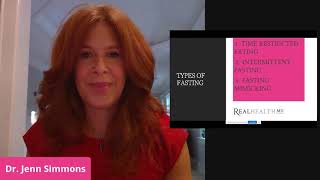
Dr. Jenn Simmons explains why fasting works through evolutionary biology and inflammation. She covers three approaches: time-restricted eating, intermittent fasting, and fasting-mimicking diets. The mechanisms include reduced immune activation, apoptosis, and fat mobilization.
Questions this video answers
July 22, 2020.
16-hour fast/8-hour eating window (16:8) and 18-hour fast/6-hour eating window (18:6).
A 5:2-style program: eat normally five days, and on two nonconsecutive days severely restrict calories (~500 calories) with fat-based calories emphasized.
Black coffee, unsweetened tea, and water are allowed; non-caloric sweeteners and sweet-tasting additives (e.g., monk fruit) are said to break a fast.
Chapters
Hello, everyone out there in Facebook land. This is Dr. Jen Simmons from Real Health MD. And tonight I'm talking about the fast way to wellness. And essentially what we're talking about is fasting, because I think there's so much talk around fasting, and I really want people to know and understand what that's about, why it's meaningful, why it's important, and allow people to really make a choice to see how you can incorporate that into your life. So should you choose to incorporate it, and I hope at the end of tonight's talk, I hope that you do decide to incorporate it because it is still very important for your health, and it's a great way to not only improve your health, but to preserve your health. So for the people that are out there listening, can you type a hello to me in the chat box so that I know that you hear me? And I really want to try to make tonight's talk interactive. I want to hear what you want to hear. I want to answer your questions and make this much less me going on and on and much more of value to you. So post in the comments, say hello, and we'll go from there. So. So I'm going to share my screen just so let's hope it doesn't crash. And go into my slideshow. And again, I hope that everyone, everyone sees me here and we're talking about the fast way to wellness. Again, I'm Dr. Jen Simmons from Real Health MD for those of you who are new and don't know me, and if you're here, hi, welcome. I'm so glad you're here. Tonight's talk is really about the health benefits of fasting and why we should fast. And, and I really want to first talk about the reason for fasting. So I like to think of our health, of everything. I try to approach everything from an evolutionary standpoint. So what would our ancestors have done? Because though we are living in modern times, we're living on very old genetic codes. So our genes have not evolved in order to compensate for modern changes. So we are meant to be fueled on food. And that food that we recognize as food is food of yesteryear. It's not the food that we're eating today. There have been so many genetic changes to the food we're eating today, and our bodies just don't recognize a lot of it as food. And so, and also from an evolutionary standpoint, we are designed to fast, which is why fasting is in every single religion, because fasting is an integral part of health and Those religious leaders, they knew that, they recognized that. So we are actually designed to fast and our bodies are designed to work as well in the fasting state as they are in the fed state. Because you didn't know when there was going to be a saber toothed tiger to run away from. You didn't know when there was going to be a desert to cross. You didn't know when you would have to cross a waterway. And so there were long periods of time when we didn't have access to food, but we did okay because our bodies are programmed to fast. So in staying in tune with our evolutionary roots, with our evolutionary function, we are meant to fast as humans. And actually the people that could fast for long periods of time and then store fat, well, that was a survival mechanism. Those are actually the people that did quite a quite well because they were able to sustain a fast and then they were able to organize their calories, organize their energy effectively in order to take get the most out of the feeding time of the year and then survive the scarcity. So if we think about what happens when we eat, it's actually an inflammatory process. Eating food is an inflammatory process because what happens is that 70% of our immune system is actually housed in our gut. And so every time we eat, our immune system has to take a look at that food and say, is this friend or foe? So all eating is an immune challenge. And the more we eat, the more frequently we eat, it is more of an immune challenge. And so if you're eating very frequently throughout the day, for long periods of time, your immune system doesn't get to rest. So you're constantly driving the immune system and that's gonna result in inflammation. And inflammation ultimately is the root of what we see in all the chronic diseases in our lives. So it's the root cause of obesity, of heart disease, of neurologic diseases like Alzheimer's, like depression, anxiety, adhd. Inflammation is driving all of these things. Inflammation is driving heart disease, it's driving lung disease, it's driving autoimmune disease. All the arthropathies, all the different arthritis, it's driving that, it's driving digestive issues and it's driving cancer, which is the most relevant part in my world, because at real Health MD I mostly. Not exclusively, definitely not exclusively, but I mostly work with people who have had cancer, which is the ultimate manifestation of inflammation. So food is actually mostly responsible for the inflammation in our lives. Not entirely. There are definitely other causes of inflammation. There are environmental causes of inflammation, like toxins and Things like that. Trauma is a cause of inflammation, lack of sleep is a cause of inflammation. There are lots of other causes, but food is the one that we are most frequently exposed to because we're eating every day. Most people are eating multiple times during the day. There are some people who are eating, you know, five and six times during the day. So they're constantly, constantly getting inflamed. So that, that is the reason why frequent eating causes inflammation, because your immune system has to check out that food and see if it's friend or foe. So conversely, the health benefits of fasting are that it allows our body to heal. In the simplest form, if you think about it, if the road, if our road is our GI tract, then it's very hard to heal a road with traffic on it. So by resting the gut, we allow for healing. And what that healing looks like is different for every organ. But if you think about healing the brain, first of all, most of the inflammation that happens in the brain comes from the gut. It's transmitted from the gut to the brain through the vagus nerve. So people with Alzheimer's, with dementia, with depression, if we calm the gut and allow that to settle and heal, then the brain doesn't get inflamed and that gets to heal as well. So, and it allows for cell repair mechanisms. We have ways, inherent ways to fix damaged cells. But if we are constantly building, if we're constantly digesting, if we're constantly being inflamed, that then that healing process can happen. That healing process can only happen in our rest and repair state. So that's a non feeding state. And so in order for healing to happen, in order for our brain cells to heal, our lung cells to heal, our gut cells to heal, cells everywhere to heal, we need to be in a non feeding state. The other thing that happens, other than cell healing, is a process called apoptosis, where the cells that cannot be repaired are put to death. And that's a good thing because when we're not eating, all the cells get quiet and the ones that can get repaired get repaired, and the ones that can't get repaired get killed off. And so when we start to eat again, we're renewed with these cells that have been fixed and we get rid of the cells that have died off. And that ends up being a really good thing. But that process of apoptosis isn't happening in the feeding state. It only happens in the resting and the fasting state. The third tremendous benefit of fasting is weight loss. And it's not only Weight loss, but it's kind of weight maintenance and weight ideal. So for people that are overweight, weight loss is definitely something that is important for their health. For people who are at appropriate weight, but they are over fat, meaning that their percentage of fat to their lean muscle tissue is skewed so that they have more fat than they should. Fasting allows to get rid of some of that fat, to mobilize some of that fat and allow their portions to balance. Because we know that fat tissue, especially around the middle, that fat tissue is not a benign entity. That fat tissue is producing inflammatory cytokines or chemicals that are driving that inflammation. For people who are underweight, fasting even helps them, because being underweight is a constant state of stress. So it's about eating during the right times and allowing their gut to heal during a fasting time so that they can absorb their nutrients and get what they need out of their diet. So fasting, again, is an evolutionary phenomenon in that we are absolutely designed to go through periods where we don't have food, because we had periods where we just didn't have access to food. Remember, though we were hunters and gatherers, we gathered a lot more than we hunted. You know, plants can't run away, but plants are very plentiful in some seasons and not plentiful in others. So there were times during the year where it was very difficult to find food. And for those people, they would go through long periods. You know, you can only collect and gather and store so much in those times. So when they ran out of food, they ran out of food. But their bodies still were able to function and survive. So we have moved away from that kind of living. But it is what we're designed for. And if you want your body to work the way that it's supposed to work, we need to get back in touch with that. So the three types of fasting that I'm going to talk about today are time restricted eating, intermittent fasting, and fasting mimicking. So which one is right for you may be a little bit of a trial and error. And it may be a combination. And for many people, for most people, it is a combination. And that's largely how it looked from an evolutionary standpoint as well, where there was a combination of, you know, you were always living in a time restricted eating fashion. And we'll talk about that and why that's true. And then you had periods where you were doing intermittent fasting, and fasting. Mimicking is just a type of intermittent fasting. So everyone wonders, well, you know, Is fasting for me. Who does fasting apply to? Well, as I said before, fasting applies to most everyone. Everyone benefits from fasting. You just may have to start slow. You probably can't go into, if you're, if you're someone who's grazing constantly throughout the day and you don't have any limitation to when you're eating and when you're not, you may have to build up to fasting. But fasting specifically helps with insulin resistance. So people who are pre diabetic or diabetic, or people whose blood sugar goes up and down, who are, who don't feel well if they don't eat for long periods of time, people with problems balancing their insulin, people with diabetes, again for the insulin resistance reason, people who have trouble maintaining their weight, they go up and down and up and down. Fasting helps you to stabilize that and to not have trouble maintaining your weight. With people who fast, maintain their weight quite effortlessly. People with dysbiosis or an abnormal balance of organisms in their gut. We are all, our health is all driven by our microbiome, that, that ecosystem that lives inside of us. And when that gets out of balance, fasting alone can correct it without antibiotics, without anything else. Fasting alone can correct dysbiosis. So for people with sibo, or small intestinal bacterial overgrowth or, or sifo, small intestinal fungal overgrowth, people who have that dysbiosis, again, what we talked about before, an imbalance in the organisms in their gut, they benefit tremendously from fasting. And then people with other digestive disorders like inflammatory bowel disease or irritable bowel syndrome, these people especially benefit from fasting because they have so much inflammation in their gut. This allows you to clear your road and allows your road to be repaired. And really any inflammatory condition, and we talked about what all those inflammatory conditions were before. So anyone with heart disease, with brain disease, with lung disease, cancer, arthritis, autoimmune disease, all of these conditions benefit from fasting. And for any of you that are just joining us, this is Dr. Jen Simmons, Real Health MD. And tonight we're talking about the benefits of fasting. So let's break it down and talk about the kinds of fasting. So we break it down into essentially two different types. So the first is time restricted eating. And if you've seen anything about that, that is generally reflected in a ratio. So it's the time that you're going to be fasting to the time that you're going to be eating. Ideally, that looks like a 16 hour fast. With an 8 hour feeding period or an 18 hour fast with a 6 hour eating period. So it basically comes down to maybe somewhere between one and a half to two and a half meals a day. But you're restricting your eating over an eight hour time period. Now for people who are very focused on weight loss, it's basically best to do that calorie loading. Eat most of your calories in the beginning of the day because as the day goes on our metabolism starts to drop as we get ready for bed and that those cortisol levels start to drop and the melatonin levels start to rise. We get less efficient at metabolizing food because our body's getting ready to sleep. So time restricted eating is the way everyone should be living their lives and that you should be eating over a restricted time period with a long rest in between. So the most popular one is because dinner has become such a meaningful time in our society. So most people do attend to sadness. Six feeding period with you stopping eating at 6pm and then you don't eat until 10 o' clock the next morning. And that is including you can have coffee or tea or water in that time, but you can't have anything in it, even, even the non caloric sweeteners that will start the digestive process. So black coffee, tea, water, but you want to have a long period of rest, 16 hours, 18 hours. There are some people that do 23 hours. That gets to be more on the intermittent fasting side. So time restricted eating is you're eating over a period of time and you're fasting over a period of time every day. And it's ideal to keep that same schedule every day. And then intermittent fasting are long periods of fasting interspersed with normal eating patterns, whatever that normal eating pattern is for you. Now Valter Longo made the fasting mimicking diet popular and he has all the data around this and what his program looks like is a five and two program where you're eating normally five days a week and two days a week, ideally not on consecutive days. Two days a week you are fasting. So you're severely, significantly restricting your calories on that day. First of all, they're fat based calories. So you're restricting the carbohydrate calories on that day and you're restricting your calories to around 500 calories on those days. And then the other five days of the week you're eating however you normally eat. And this was designed for weight loss, but it can be used for weight maintenance and It's a very good way to do a reset on your system. So, you know, wherever you are on your health journey, I hope that you will consider some kind of fasting. And you know, if you're just starting, maybe start with 12 hours eating over a 12 hour period and fasting over a 12 hour period. But I think the main part should be that you are staying in the rhythm of the sun, staying with circadian rhythm, trying not to eat after dark, which I know is very hard. I always get comments from people who work the night shift. Unfortunately there's just no way to get around it. We are not meant to work the night shift, but trying to eat your calories during the day when the sun is out and when the sun is down, we're not meant to eat anymore. And if you think about it again from an evolutionary standpoint, what was out after dark? Nothing good. It was very dangerous to be out after dark, right? So after dark you're not going to want to light a fire to cook your food, you're not going to want to make noise, you're going to want to sleep after dark. And so we are meant to eat during the day, to eat during waking hours, to eat when our metabolism is working its best and most efficient. And after the sun goes down, we're meant to sleep, rest and repair. And if your body is busy digesting, then it's not going to be able to do all those repair mechanisms that we talked about. So I hope that this was informative for you. I hope you enjoyed it. If you want to leave a comment here, I'll be sure to be back and check. And I'm going to stop sharing my screen. But just so you all know, you can reach me@realhealthmd.com you can check out my blog there. There's lots of helpful information, there's links there to great curated different things to help drive health. So I hope to see you@realhealthmd.com if you need help on your journey. You can sign up for a free discovery call with me there and I can learn more about you, you can learn more about me and see if functional medicine and real health MD is right for you. So I'm going to stop sharing now and see if there's any. Oh I hope I didn't lose you. See if there's any comments here. I have one from Kenny who says I had so much inflammation when I was eating vegan. Does that make sense? So anyone who knows me knows that I talk a lot about being a vegan but there are whole food vegans and, and I'm not saying you are Kenny at all, please forgive me, but there's a lot of junk food vegans, a lot of processed carb vegans, and that is going to cause a lot of inflammation. The other thing that vegans that you have to be careful of is that if you are using oils in your diet as your fat, there are a lot of highly processed oils and so they will cause inflammation. And so for your healthy fats, and I absolutely recommend people have lots of healthy fat in their diet, but it needs to come from natural sources. So the best sources are like avocado and nuts and seeds and then the minimally processed like the olive oil, coconut oil, things like that. But you want to get away from the highly processed oils, all the vegetable oils, peanut oil, safflower oil, canola oil, especially corn, corn, almost all the corn is gmo. So that's definitely going to cause a lot of inflammation. So I think being a vegan is great if it's right for you, but what it needs to look like is you need to look at the quality of the food that you're eating, make sure that it's, that it's whole foods, organic when possible, but if it's a whole food, I don't worry about that so much, but just making sure that there's not GMO in your diet. So GMO soy, GMO corn, GMO wheat, all of those things. And there's lots of vegans who still have gluten sensitivity. So you have to, you have to know you can tune into your body and see if that's what you're responding to or you can get tested. And I have a question from Howard wanting to know if Monk fruit in the coffee breaks a fast. And yes, it does. The thinking is that anything that's sweet will set off your digestive cascade, so it will start insulin secretion and then that will drive your blood sugar down, which will give you a hunger signal and sets off a cascade of events like you've eaten so best during your fast to just keep it about water, unsweetened tea, that kind of thing. So I hope that this was really helpful for everyone and great for everyone and that if you have questions about fasting, definitely put them in the comments. I'll go back in the comments and try to look through, through and answer everyone's questions again. For those of you just tuning in, this is Dr. Jen Simmons from Real Health MD and you can follow me at all of my sites. I'm at Dr. Jenn Simmons on Instagram and Real Health MD on Instagram, Dr. Jennifer Simmons on Facebook. And you know that if you're here and Real Health MD on Facebook. And it was great seeing everyone tonight. Thank you so much. And if you need help on your journey, realhealthmd.com let's jump on a call together and talk about how I can help steer you in the right direction or work with you. So good night, everyone.
More from Jenn






Stem Cells, Peptides, GLP1s and the New Blueprint for Preventative Medicine with Dr. Vass



The Truth About GLP-1 Drugs and Who Should (and Shouldn’t) Take Them with Dr. Susan Brian

What 100 Days Underwater Revealed About Aging and Healing with Dr. Joseph Dituri
