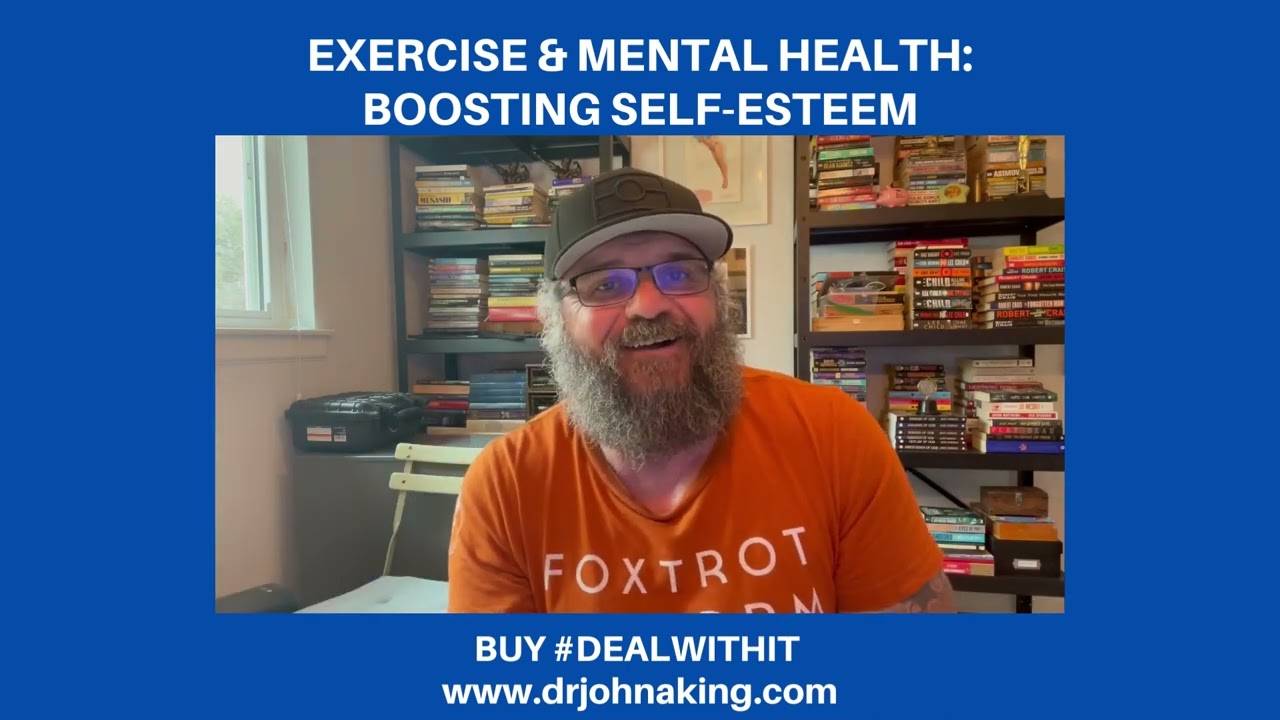
Dr. John A. King manages PTSD through daily exercise, which builds physical strength and a sense of control that counters the fear response. He tracks small wins like getting to the gym and staying hydrated as measurable achievements that boost self-esteem, and uses the gym's predictable environment to manage anxiety.
Chapters
Hey, I wanted to continue our chat about mental health and physical exercise and how they can both positive— one positively influences the other and the lack of one negatively impacts the other. I think exercise is very important. Out of all the things I've done over the last 10 years or so to manage post-traumatic stress, and you do manage post-traumatic stress. I've had people talk about getting healed from post-traumatic stress, overcoming post-traumatic stress. Leaving post-traumatic stress behind. I, I don't subscribe to any of those things. I think PDS, PTSD, um, is something that you learn to manage, and the better you get at managing it, the better you are with interacting with the world around you. And one of the biggest keys I found with managing PTSD has been exercise. Because a lot of what happens with PDS is you're fearful, you know, the fight and flight thing kicks in. You're concerned about your environment and the things around you. And I found being physically strong and physically healthy has enabled me to feel like I can interact in a positive and a protective and a confident way in the environment around me. I stay physically strong to take care of my own body, to have a body that can protect those that I love and protect myself. And I think that's a very important part. And I'm not playing to a weakness. What I am is establishing a strength. The second thing is it really gives you a sense of accomplishment. You know, sometimes the biggest achievement I make or do every day is just to get out of bed. And then I try and add another one onto that, which is going to the gym and then maybe drinking a gallon of water and then getting my meals in for the day. And then, and so it goes on. And I think a regular routine that's tick-a-boxable That's a word. I'm sure it is now. Um, tick-a-boxable. And a regime that is tick-a-boxable, you can sit there and measure your progress during the day, and it also impacts you. And I find helps compound my sense of self-esteem and growth. I've achieved these goals over the last 30 days. I've achieved these goals over the last 60 days. And with that, mixing up workout regimes, there's nothing like getting a new workout. Because, man, it's got to come with a new t-shirt and it's got to come with a new playlist. And often those little tiny things, if you think about it, you're talking about an expenditure of probably an hour making a playlist and $20 on a new t-shirt, is something that you can actually look forward to. And you go, man, I'm putting my game face on, putting my new shirt on, getting to the gym on my new playlist. Boom. And I've got a new program. I'm working it out. And the gym can be a social activity. Now it's a controlled social activity. I don't do You know, maybe social too well. I'm not all that of a social person. I find large crowds and large gatherings are not necessarily a positive experience for me. But if I can go into a place that I know, if I can go to a place where I know where the doors are, where the stairwells are, I've got a sense of the people that are normally there around this sort of time. I can expect a certain level of behavior. Then what I find is I naturally de-escalate. I stay aware because awareness is always, and situational awareness is always very important. Important, but I de-escalate some things where I allow myself to de-escalate. There's nothing like, you know, coming off a black and fading into a nice little red or a little golden hue of orange and getting about and getting a good workout in. And I think having that sense of community, the odd faces, the people that are saying hello, is actually very healthy for us, very especially those people who find it challenging with PDS and even going through the toughest times. with it, going to something like a gym or meeting a mate up there and having— getting a workout in together is very, very positive. And I find it's one of those things that I force myself to do and I never regret. It's a little bit like, you know, eating vegetables when you're a kid. The thought of it was always terrible, but you kind of thought it was okay once it got done. And I find that with the gym, it's very, very helpful, a very, very helpful tool. Uh, for my mental health. Hope this helps. Leave a comment, drop us an email, give us a phone call. Anything we can do to help you, if we can, we will. If we can't, we probably know someone who might be able to help you. Cheers, bye-bye. Cheers.