Finally Friday with John & Melissa
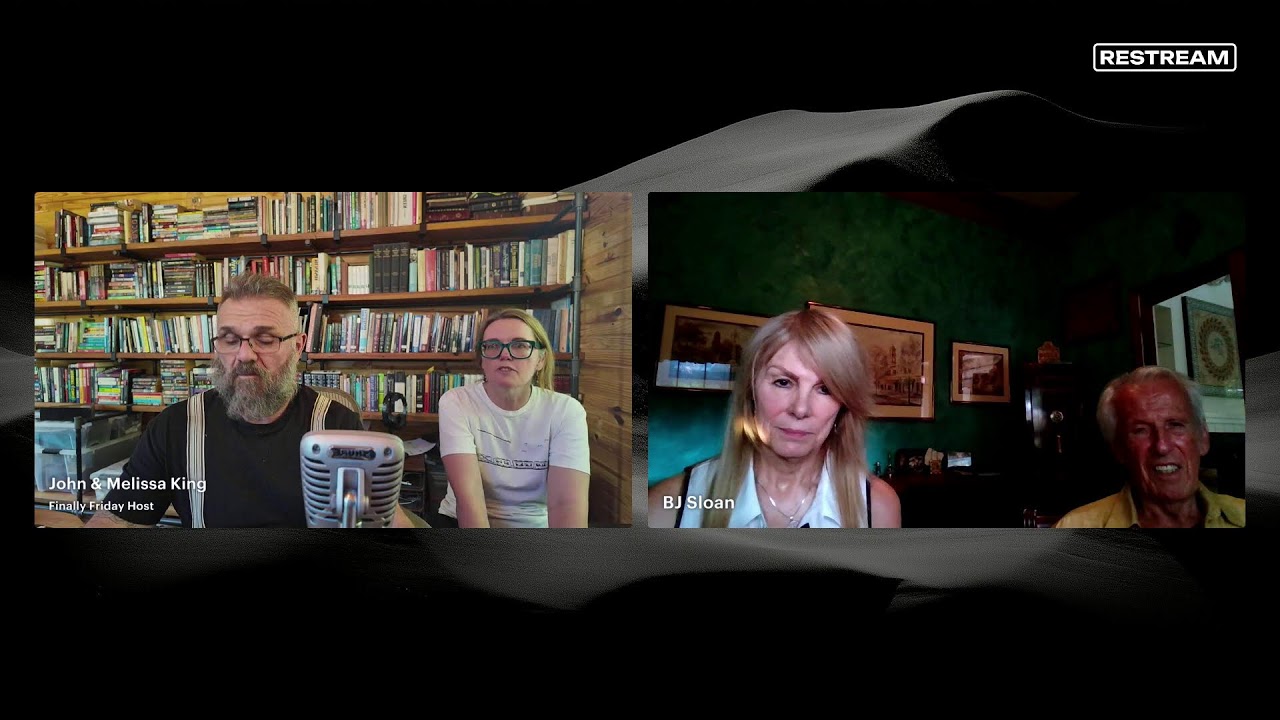
Dr. John A. King and Melissa talk with writers BJ Sloan and Darryl McGinnis and painter Jonathan Frosby about writing habits, critique groups, and how AI is changing publishing and visual art. They discuss plotters versus pantsers, the value of reading, and whether to treat AI as a tool or a threat.
Chapters
Ladies and gentlemen, we are just logging into Instagram. We're just going live now, BJ. Hey everybody, we're here! TikTok's here with us, YouTube's here with us, Facebook's here with us, and we're just waiting for Instagram to get its stuff together. And here we are live on Instagram. So hey everybody, welcome to Finally Friday with John and Mel.
Hey, yay, it's Friday! We made it!
We did make it, and we've got a couple of great friends with us. We've got BJ Sloan and we've got Darryl, and both of them are great writers.
Darryl McGinnis.
Yes, Darryl McGinnis. Great writers, become good friends. We're in a, a couple of workshops together where we talk about writing, which we'll touch on in a little bit. So yeah, so the aim of Finally Friday is to just have a chat, to talk about life, love, all the great adventures, and what it is to be a creative person and how you keep those creative juices going. So after we get to talking and introducing BJ and Darryl, we'll be talking about AI today and the role of AI in publishing and painting and some of the conniption fits that people are having about it. And, uh, Welcome to folks. Welcome to Matthew and Sandy Deep and Steve Cook on Instagram. Good to have you here. And don't forget, you've got chat available. So if you want to talk to us, drop us a message, ask us a question, um, we would love to have you involved in all of that. So off you go, great friends. Now I've got to have one complaint about BJ before I start. Don't buy this book if you want to sleep. It's terrible. Bloody thing kept me up for 2 nights straight. So, and I got to that horrible bit in the end where you got about 10 pages to go and you just— and you got to go back and read it again.
Stayed up until midnight to finish it.
And you know, it ruined my circadian rhythms. It's BJ's fault. So The Forgotten Son, do not buy it. Do not go to bjsloanwrites.com and buy this book and give it a great review if you like your sleep. Now, if you're a fanatical reader like we all are and you don't mind a great book that's going to keep you up Get yourself a copy. Phenomenal.
Thank you, John.
So there you go. So off you go, BJ and Darryl. Introduce you, tell everybody, uh, who you are and what you do and why we're here and all that goodness.
Um, well, I'm BJ Sloan, and of course I know John and Mel, and they're good, good mates. He's taught me that word from Down Under. Uh, and, uh, I write and, and Darryl writes, and that's how we met each other, and we've been friends for several years. So, The Forgotten Son that John was just talking about was based on a true story, so that ought to give you nightmares.
So what's your genre, BJ? What do you write? What sort of books do you write?
Well, I call it country fiction because most everything I write is based in small town or rural Texas. So I think that's, that's a good term for it, country fiction.
Yeah, that's great. What about you, Del? Tell us a little bit about yourself, Mike.
Okay. I always liked to write. I remember in grade school being excited about writing, and so it just came natural. But that's not what I did for a living. I was an airline pilot for Delta Airlines for a living and also a trial lawyer because Vietnam got involved in law school, and I had to stop long enough to be a pilot in the Air Force. And then I came back, finished law school, then Delta hired me. And so I did both. And out of both came a lot of really interesting stories. Out of both flying, flying for the airlines, because I did it when it went from glamour to cattle car, got involved in the fights when that happened. And so anyway, that's what I write about. It's fun to have something to write about that you have some passion in.
Yeah.
So one question we like to ask our writers about is, are you A plotter, or are you a— what's the other one? Plotter or a plodder?
So do you write a whole outline before you start the book, or do you just start writing and let the story develop as it comes?
Well, I've always heard it as plotter and pantser, and, uh, because you fly by the seat of your pants.
Oh, that's a good one.
Pantser.
But, and I am definitely a pantser. I usually start with an interesting character, and I might have a good idea of where this is going to end up. But everything in between is just totally when I sit down, then I let my fingers guide me. I don't like to outline because invariably I'll start to write with an outline and go, I don't like that. I'm going to change it. So—
We've just been joined from Australia by Jonathan Frosby. Jonathan Frosby is one of Australia's Foremost painters. If you've never had a look at his page, um, on Instagram, you need to have a look and buy his artwork and donate it to me because I can't afford to buy Throsby's artwork. So if there's someone's looking to patronize my art collection, please do. Sorry, BJ, please go ahead. He loves your stuff. I've introduced, uh, Throsby to your stuff as well.
Oh, thank you.
Yeah, so, uh, so John is definitely a pantser too. Sounds like you're a pantser. Yes, BJ.
Yes.
And, and Janine said on YouTube that she's a fly-by-the-seat-of-her-pants sort of girl too.
Yeah, I agree with that. Darryl, on the other hand, he's— he writes true stories, so he knows, he knows exactly what he's talking about.
He's probably spent his life flying by the seat of his pants, but that's in another context.
I, I've tried to imagine how BJ comes up with the plots and the stories she does. Because I, A, couldn't, B, never had to, because all I had to do was write what I knew. And so I thought, boy, am I lucky. A, I couldn't have done it. B, I didn't have to do it.
So, Darryl, for your characters, do you, when you're thinking back on a funny story and you decide to write something out of it, do you have to embellish the characters at all, or is it like pretty much true to life?
It's pretty much true to life. The only thing I got to be careful about is using real names because some of them, their names just launch what they were. And so I, if I gave them a different name, they wouldn't be the same. So therefore, the books that I have published and people can buy, I had to change names. The ones that I just did for myself and giving my friends, I left the names the way they were.
Uh, yeah, that's a very interesting point. So you've probably had a bunch of experience, or, or at least a background with legal about you know, libel and what you can do and what you can't say. That's a really interesting point.
Yeah, that's— you're very good to see how interesting that was because not only is it interesting, it's also you got to be careful.
Yeah, yeah, yeah, for sure.
Awesome.
Are you guys both entirely digital in your writing or do you write anything longhand?
I don't write anything longhand because I mean, I like I like to write in cursive. I like to write longhand, like sign my name in books. I like that. But my, my writing has gotten worse over the years. I can read it, but probably not a lot of people could. So I don't, I don't write it out. I know some writers do. They think that's a better way to create.
Yeah, I, I can't do that. Do you have a particular software program that you use? I know I've got one. I've tried a couple, but I've fallen in love with one in particular that I'll just, you know, it's great.
Right.
So do you have any sort of programs that you use to help you capture ideas?
I have a correction program, but no, I don't have anything to capture ideas. I haven't got into that part. I just have, you know, things that help me correct because I've never been a good speller at all, as Darryl can attest to. So Correction helps me, but as far as ideas, no.
So what do you use? Do you use a Word document or what?
Yeah.
Okay. And do you, do you have little files for every chapter? Is that, is that how you do it?
No.
No, just one manuscript?
Yes.
Oh, she's a real pantser, isn't she?
She is a pantser. I'd be so scared. I'd have like 40 backups of that thing saved.
Oh yeah, for sure. Absolutely.
No, I just write it linearly from, you know, start to finish and just keep going. plow through it.
So I think my mind doesn't work that way. Yeah, I think my mind pops around all over. I use a program called Ulysses, which I love because I can reshuffle the chapters, um, and I can have it on my phone and I can have it on my computer. And so if I'm somewhere and I've got an idea on my phone, I can do it on my iPad, I can do it there on my computer, and it all just keeps it synced up for me.
Oh.
And, and then I've got it backing up to the cloud and I religiously, like every 15 minutes, back it up because you know what it's like when you finally solve that problem in that one chapter and you've been— it's kept you up all night and you got it. And then my greatest fear is, and I'm paranoid, is, oh bloody hell, you know, what if my computer gets stolen by some sort of Martian alien being and I don't have a backup? So, you know, backup to the backup to the backup, just like that.
Sounds like you back up your backup.
I have— seriously, you got to see my desk. It's stacked with— and, you know, anyway, I'm a bit paranoid that way.
I just— I am obviously— I'm an analog artist, and a really important part of my process is getting my hands dirty, like using a marker or paint or, you know, whatever it is.
Yeah.
Um, and so I'm trying to wrap my head around your creative process When you're interacting just digitally, so, you know, sitting in front of your computer, do you have a— do either of you have like a ritual that you go through? Like, do you write at the same time every day, or do you go fix your cup of tea and you know you're coming to like have your creative time, or is it just all over the place?
Well, for me, it's all over the place. I like to have a drink. Coffee or water or something. But I can write anywhere at any time. It's just a matter of sitting down and concentrating on what I'm doing. I like to write in the car a lot. If we're going somewhere, we're traveling somewhere, I do that. I guess the weak point would be late at night because I like to save that for reading. That's my homework, and I read. I know Darrell has a ritual, though. Tell us about your ritual.
Like most things, it's the exact opposite of BJ's. Very late at night because I stay up until 2 or 3 in the morning. That left leftover from college. In fraternity— I was in a fraternity in college. There was always something to do until everybody went to sleep. When everybody went to sleep, then I would study, and I just got in the habit of mental stuff that you had to think for. It kind of kicks in after there's nothing else that needs to be done or can be done.
Interesting.
So when everyone else is asleep.
So you, you mentioned something there, BJ, about reading as your homework. Do you— what do you— what do you— I know what I think about it, but what do you guys tell us about why reading is important, or is reading important to you as writers?
It is so important. It's probably the most important thing that you can do as a writer is to, to be well read. Uh, I read the authors that I love, but But more than that, I try to read the authors that I would like to emulate and also that write the same type of stuff, same type of genre. And then I write— then I read other things too that are just off the chart, things that I would never write because they give you another dimension to your writing.
Very good.
So I read a lot of various things, but I do that intentionally. It's like last couple hours that I'm awake, that's read time.
Okay, what about you, Darrell? Do you, do you read much, or—
I don't read near as much as I ought to, and I can see it because in my writing there's things that I think if I had read a lot, I would have seen this before and I would naturally do it, but I haven't, and so I kind of have to figure it out for myself. Yeah, but it doesn't bother me. It's fun. It's just the answer to your right is it says is no, I don't. But what I do read is all nonfiction. I like to read about what really happened.
So when you're reading a nonfiction book, are you reading just for enjoyment, or does your writer head kick in every now and again and go, man, that's interesting how they did that, I really find that fascinating?
It's, it's both. Like, the book I'm in right now is, uh, the settlement of the Ohio Valley after Congress made the Ohio Valley a territory of America. And it's really, really good book. Let's see, it's by David McCullough. And to see how those people lived back then and what they had to do to turn the Ohio Valley into Ohio and Indiana and West Virginia, that just fascinates me to see what had to be done and how people did it, and then to compare it with— they did it in their time, and we would probably do it in our time, but it would be so different because they didn't have internet. At best, they had terribly slow postal service. They got everything thirdhand. When disease came through, half of them died, and the rest— yeah, I mean, so that's what I really like about it, is reading what really happened.
Sure. So I'm, I'm, um, do you, do either of you like audiobooks? Do you, do you listen to books at all?
I don't, I don't. I've tried that and I go to sleep. So I, I don't do the audiobooks, although I do have an appreciation for them, uh, but I, uh, I just don't do that. It doesn't work well with my mind. I absorb it better if I am holding it in my hand and looking at it.
Yeah. So I, I really haven't done much until I was in Australia and I was traveling over these vast distances. I was actually staying down where Throsby was.
We—
I was just down there and I had a 5-day trip to get to up to my tribe where my people are. And I, I put on an audiobook for the first time and it changed my ability to be able to hear and get more, more books into me. So currently I am— BJ put me onto a book, it, you know, we've probably seen a movie, um, called No Country for Old Men by McCormick. Okay, so at the same time I'm reading that, I'm listening to Ian Fleming's, uh, 007 From Russia with Love.
Oh.
Now, now, people, uh, will dismiss a lot of those books, but I have never in my life read an author who has the power of description that Ian Fleming has. I mean, I've learned more in the last two weeks on how to write description that stays with you from Fleming than from anybody that you see behind me. I mean, I was stunned. It was like one of those. Oh well, just blah blah blah. Oh, so so I've got that, and over here I've got McCormick, who doesn't even use bloody punctuation. It's like like he just vomits words on a page and says, "La, figure that out. Try and work out what I'm saying." But he writes it in such a way— this is what BJ put me on— writes it in such a way as you don't get lost. So here I've got Fleming describing everything with beautiful nuance, and McCormick, who just says good luck. And I thought— I literally feel like my head stretches between going to the gym and listening to Fleming and going to sleep and listening. I probably should switch it out because I don't know if listening to— reading McCormick before you try and go to bed Um, with some guy killing you with a cattle prod is necessarily a good— maybe that's why I'm not sleeping at the moment.
Maybe.
Maybe. Uh, but I find that really interesting, is, is, um, is different reading styles. I mean, and it's changed me. Like, listening to Fleming has changed my ability to write. It's changed— and I, you know, I've always tried to be good at description. I think in the last week My— I, I was telling Mel, I think my ability to describe a scene, uh, has gone up by probably by about 15%.
I just listening to you guys, obviously I'm not a writer, I'm a visual artist, but, um, you guys all are stuffing your creative or stoking that creative fire by either reading books or listening to books, and for different reasons it sounds like, you know, John is learning, he's listening for technique. And BJ is, well, also technique, I guess. You said you read art artists that you want to emulate, emulate. And then it sounds like, Darryl, you're reading for the technique, but your, your writing is so different because you're reading nonfiction and you're— the stories you're writing are based in reality. So that would be a different sort of creative fire, I think, to stoke. I— my, my stoking my fire, I watch YouTube videos, I look at other artists, I read art books.
We like— we watch a lot of art documentaries.
And so I will constantly consume, you know, and then when it's time to go to the studio, like, I've got a zillion ideas coming out, you know.
So, so books are like mentors. Talk about mentors for a moment. Like, have there been people in your life— because I'm watching Throsby and we've got a great story about Jonathan, I'll get Mel to share in a little bit. Um, so talk to us about the role of mentors and how important mentors have been to encourage you and to critique you, um, and to help you along the road.
Well, I can start with Darryl. Darryl's always been a mentor to me. When I first started, uh, joined the writing group There would be some times when I was very discouraged after hearing, you know, something I'd written was not there yet and needed work and—
Crap.
Yeah.
Critique is hard.
It's so hard. Anyway, and Darrell would say, well, you know, just keep going. And he would build me up and he would also help me with edits. And so he's always been a mentor. So that's— I'm so glad that he's here with me today because He's, he's been a great friend and great mentor.
How important are mentors to you? Like, and where do you find them, particularly when, when our art is an isolated thing? So it's, it's because it— you really— you— it's not like you go, go and there's 15 other people and you're playing rugby and you've got a coach. And, um, you know, it's not, it's not like that. How do you, how do you get those mentors?
Well, I think in our writing group, at least, the people whose writing is somewhat similar and writing that I admire, you, uh, or at least I do, develop bonds with those people. It's like, I want to hear more of this. I like what you write, and, uh, I admire your writing. So for me, that's the people that you gravitate toward. Now, there's a lot of different styles, a lot of different genres, but The ones that I like are similar to me.
Okay, so why don't you share about Frosty, who's our mate that's on Instagram at the moment listening, that we love to death? Um, why don't you talk about the impact that a 15-minute conversation, how it can change your life?
Little tiny interactions can set you off in a whole new direction, and I love it so much. The first time we met, Jonathan, he He took time. He was busy. He was working at someone's house, and we met him, and, um, he took time, 15 minutes, to sit down with me and talk about art. And I had just started, and here he was. Like, we find out later he's really famous.
That was the funny thing. Like, this guy— and I love Froz— he's got the best Volvo in the world. It's total crap. No, it wasn't a Volvo at that time, was it?
No, it was a, like, a Land Cruiser.
It was a total crap Land Cruiser, and it was the best thing I'd ever seen in my life. And he's in scruffy jeans and scruffed up, and, and, uh, he just comes wandering over. And we didn't know— what was interesting was outside watching Mel, who was open to anyone who would be positive, and Jonathan, who just had an open spirit. And it was like this divine collision.
It was. And he had been to art school, and so I would say, oh, you know, well, I didn't go to art school, you know. And he was like, you don't need it. He's like, don't go, you don't need it. And so he just really encouraged me. And so then about once a year since then, I've been— we've been able to get together with him. And he'll look at what I'm currently doing as far as my art, and he'll just give me little inputs. And he always says exactly what Darryl said to you, BJ. He always says, keep going.
Yeah.
Keep going. You're on to something. Keep going. And he always, you know, he'll have little technique inputs to give me and things like that. And it really is so encouraging and so replenishing to spend all this time sort of by yourself in your studio or at your computer making something, and then to have someone just give you that little pat to keep going. Yeah, keep going, keep going. I think it's wonderful.
Darryl? While we're on this subject, I've got something that I think is really relevant. Talking about inspiration, I had— I was going to say I've got nothing here because I didn't think I did. Then as you guys talked, I saw it. In law school, I had one professor and he would be talking serious, serious law. serious, serious stuff. But it was fascinating because he would interject lightness and humor into it, and you could never tell when he was going to do it. And it would lighten the whole story, and it would make the depth of understanding law get to be more, more interesting. It'd make you understand what really went on in the case. And that carried over to my writing because—
Wow.
Because some of the stuff I write now could be pretty dull. And, you know, what happened to the airline industry? How did it go from glamour to Yeah, yeah, I could write that and make it boring as hell, but when I put in funny stuff, stuff that tells you the personalities of the people that made that happen, then that makes it all come alive.
Yeah, that's great.
That's true. Darrell's writing is very humorous, so it's, it's like, uh, satire almost.
Yeah, so last week we did this incredible interview It was phenomenal. It's one of the best interviews we ever did.
It was just the two of us.
Just the two of us.
It was phenomenal. It was like game-changing, life-changing. But we forgot to turn the audio on, so we had no audio. So it was one of those tremendous things that we were having a great conversation just amongst ourselves and no one else, and no one else could— you know, 1,000 people watched us and just lip read.
You know, we were like, what are you doing?
Yeah, that's what we got.
So, um, yay technology!
So we were talking about AI, uh, because AI, particularly in writing, and I think in some of the visual arts as well, has really, really scared— got people scared.
Yeah.
And so I was just— I've got some thoughts on that, but I wanted to know what, what you both thought about it and the role of AI in writing and publishing, because publishers are talking about it. So all agents use AI, even though they say they don't. All publishers use AI even though they don't necessarily— so if you give them a manuscript and they drop it in their AI program, there was a case just recently of someone who had a $2 million advance and they decided to drop a manuscript, uh, in, uh, an AI program, and it came out and said that person's writing is 100% AI. And that person's got manuscripts going back before AI was released to prove that it wasn't. But they've lost their contract, they lost the biggest nonfictional advance, and their reputation is ruined. So what do you think? What does AI feel like and sound like to you in writing or in creative spaces?
AI is here whether we like it or not, and I think it's something that we're going to have to embrace. Now, it is scary, particularly in the beginning, because you think, I don't know, is this going to take over? Is it going to take my craft? You know, is it going to take my words and claim it? And I know that's what scares people about AI, but I think it's just something we have to embrace and see how we can utilize it and use it. Now, can we do that today? No, because as you pointed out, you know, that's not what publishers and editors want. But there probably will come a time where it's a useful part, and it's an incredible thing. We just have to learn what to do with it.
So with books at the moment, the book industry, the number of books published has gone up by 200%.
Yeah.
But the numbers of people buying books hasn't changed. And the same with audiobooks. And the majority of those books are AI-generated. So I've got one friend I know who just listens to AI science fiction. So People, people look at that and think, well, I'm not even making a living as a writer, so now I'm competing against AI. And I think what we're going to go through is like a little bit of a bell curve. We've got all this rubbish that's coming out now. They're all like the, the equivalent of those Elvis velvet pillows, and they're going to be at every, every mall and secondhand, which is fine for you if you like. If you like the Elvis knockoffs from China. But I think at the front, once we get out of this muck, people are actually going to want 100% analog human. And AI cannot— it can emulate human behavior and human writing, but it can't— it doesn't have the nuance of a soul.
Right.
And as you said, Bijou, I think it is a tool. And I think it's a force multiplier for creative people. And if you are self-funded in your writing, then AI can do a lot of the tasks for you that can actually free up creative time. And that's what we use AI for.
Like to build your website or run your social media, post to your social media account for you.
Right.
And even on social media now, you know those filters that there's a whole generation of young people that put those filters on their phones? And that's now being classified as AI by Instagram and TikTok and Facebook, and it's being suppressed. So people are getting over the whole AI thing and they're wanting authenticity. And that's one of the pushes behind Final Friday is messy conversations that sometimes have audio and sometimes don't, that sometimes start around 4 and sometimes don't, that sometimes work and sometimes don't. Because I think that's what people are wanting. People are wanting that messy creativeness.
Right.
The human element.
The human element.
Yeah.
So let AI— because if you think about it, spell check is AI.
Yes.
Grammar check is AI. We're now getting, you know, people would have thought at some point that typewriters were AI, you know, pens and, you know, AI or whatever, you know. It's like we're at the front end of this thing.
Yeah.
And I know I'm using I use a couple of bits of software for social media, for building websites, for getting a message out there that are all AI driven. Because what would normally take me as an artist, I'd have to find 5 to 6 hours a week to do. It's literally doing it for me in 15 minutes. So the temptation is to fill that 6 hours for something. But the discipline is that's now freed up an entire day for me to write.
Exactly.
And I think that's part of what we're—
use it as a tool and not so much as your creativeness, but as a tool to help you to have more time to create.
I'm happy for it to build my website because I'm going to be the one standing over there with the paint and stuff.
And, and for the painters that are watching today too, it's like, um, people want to see the brush strokes. You know, I think visual artists that are computer-based are going to have a little bit of a challenge. Um, and, you know, I'd love to hear from— if you've got comments out there and you're a digital artist, uh, please.
Yeah, we'd love to talk.
We'd love to talk around that, maybe have you on the show one day. Um, because how does AI do that? Because if you have a look at what Gronk and ChatGPT can do now, um, you know, it's repa— it's replacing advertising agencies. So, you know, or if you're, if you're an actor, like, what do you do when you're, you know, the bit parts you would have in an advertisement are now being 100% AI-driven?
I didn't even know about that.
You know, there's ads that are running now on, you know, some of the streaming services that just use AI actors because it will cost them $100 in credits. Wow. To run it.
Well, the imperfect parts are sometimes the best parts. Because, you know, again, the human element. So yeah.
Yeah, that's very, very cool.
I like it.
So where can people buy your books? And what would you, what would you encourage an artist across the board who's just starting out? What are some things that you've both learned from a lifetime of writing that you would say to someone who's saying, you know what, I want to give this a go, or I'm not sure, or etc.? What would you do?
Darryl, you want to—
I'm sorry, ask the question again, please.
How would you frame, or how would you help a growing artist? What would you encourage them with?
I would say first, it's funny you'd ask me that, because once I was asked to be on a panel that addressed a bunch of people, and they were asking questions, and one of them asked me a very similar question. It said, You know, what is the most important thing? And I said, if God came down and told you you will never make a cent writing, would you write anyway? And if the answer is yes, write. If the answer is no, give it some serious thought, because very few people make a lot of money writing. And, and I, I really believe that, because the whole reason I do it, I enjoy doing it. If it makes money, fine. If it doesn't, I don't give a damn. Because all I wanted to do was to tell a story and see if I could tell it correctly.
Yeah, I think it's something like 80% of all money is made by 2% of the writers, right? I think it's $1,000. If you're selling $1,000 worth of books, it's on— it's the average writer makes about that. I think they make that about $1,000, $2,000 a year to be a bestselling author. Well, the average book, I think it's only 2,000 or 3,000 copies. It's, it's over time. It's as life goes on.
So, Darrell, where can folks find your books?
Well, they can find it by— anybody wants to write it down, it's mcguinnessbooks.com.
mcguinnessbooks.com.
Yeah, right. And they can't find the books there. All they can do is to tell me what they're interested in, and if You know, but you're also on Amazon with this one. Yeah, this one's on Amazon.
Come on, hold that up and show it off. Yeah, come on now, come on.
Okay, the title of the Waterfall in a War.
Boy, you can read good. I couldn't read it.
She went to school.
Okay, that, that is, uh, a story about during the Vietnam War, an Air Force pilot helping the mountain Vietnamese primitive people, him deviously getting around the war rules and helping them with a terrible problem that has befallen them in the war.
Wow, that sounds good.
Sounds like somebody we know.
Yeah, yeah, yeah.
It combines really the neatest— if you call it the neatest— and the most horrible things about war. You can do anything. You have to disregard the rules if you're going to stay alive. And if you introduce a human element into it, like wanting to help innocent people who've been hurt by it, then that gives you a good rationalization and justification for breaking a lot of rules.
Wow, that's great. A little bit of moral ambiguity. Yeah, a little gray area.
Sounds like one of your characters.
Yeah, for sure.
About half of it is biographical, I guess.
So BJ, what about yourself? Have you got a book there?
Yeah, I've got a couple of them. Uh, of course the one you were talking about, Forgotten Son.
Don't buy it if you want to— don't if you want sleep. And that's a multi-award-winning book, isn't it?
It is. That one won the, uh, Best Suspense and also the Reader's Choice Award at Killer Nashville. Uh, and that's—
My copy doesn't have like stickers.
I'll get you— I'll get you some stickers.
I need some stickers. Yeah.
And, uh, this is The Unfavored Children's Club, which came out this year, and it also won the Reader's Choice Award this year.
That's wonderful.
Congratulations.
Thank you, thank you. Um, and I would— those are both on Amazon. Yeah.
Great. Excellent.
What advice would you have for folks who are thinking about starting to write or have just started writing?
Well, I would say you have to keep yourself accountable and Fortunately, we have a writer's group, and if you're not— if you don't belong to a writer's group and you're a serious writer, I would say join one, whether it's a Zoom group or it's an in-person group, whatever it is, so that you know that every week when you go, you should have something prepared to read. And you read, and then you get critiques on that. It keeps you accountable, and that's the only way a lot of people have to have a goal. I, I don't— I mean, I love that. I love the writing groups and I love reading and critiques, but I just have a plan. I put out a book a year. I write approximately a chapter a week and it works well. I don't, don't have a problem with that and keeping up with everything else in my life.
That's great.
That's excellent. So what is your process during a week? So what does it look like for you, both of you, for writing? I know I write on Mondays. And I try and write on Wednesdays, and I try to pick up some Sunday afternoons because, you know, um, right, I do what I got to do.
I try to write some every day if possible, but I would say the majority of my writing gets done on Thursdays, Fridays, and Saturdays, and then bleeds into Sundays because, uh, the rest of the days, the Monday, Tuesday, Wednesday, I have writing groups and, uh, things that I do. So I would say that's the majority, but I try to write some every day and You have to when you go to sleep, and I dream about it. I dream about my characters.
They're talking to you.
When I wake up, I got to put it down, you know.
Sure. What about you, Darryl? Do you have a process or a day of the week or a time?
Ditto on what she said. I do it on weekends because the writing groups meet early in the week, and so therefore I kind of get it out of my system there. But then the weekends, I've kind of got it built up and I want to write some more. But a question you asked a minute ago, I'd like to kind of add to it. You said, what's something you tell writers? The thing about writing groups that BJ started talking about, but she didn't really say it, it is great to get around people like you because all writers have got something in common. We all are communicative. We want to say something. We want to hear what other people have got to say. And so therefore, uh, when I got into writing groups is when It all blossomed and became much, much better. Wow.
So writing groups have come up. So I know I met you both at the DFW Writers Group, which meets in Grapevine in Texas. And then there's another one that you also both go to, which is a Zoom group. So are there benefits from one, an in-person one or an online one, or what's— how does that work for you?
Well, they're different type of, uh, listeners and different type of critiques. So I appreciate if you read the same chapter on Monday night, the Zoom group, and then you read it on Wednesday night, you'll get a total different set of critiques. And I think Darryl has had the same experience.
Yeah, the, the Zoom group to me is better because it's a little bit more disciplined. Uh, the camera is on whoever's reading or whoever is responding. Whereas when you're in an in-person group, there tends to be distracting things. Like, just a funny story, we've got one guy in one of our groups who is a bit of a pain in the ass, and he tends to make faces when he doesn't like what you say.
That's great.
And although you want to just blow it off, still you're looking out of the corner of your eyes saying, screw that guy. Yeah, right, right.
That's very interesting. So you actually like them and prefer a Zoom group over an in-person group?
If I had to choose one or the other, yeah, I would take the Zoom group.
Interesting. So how, how easy is it to take criticism for you both?
It's easy now. It wasn't in the beginning because it feels like you're, you know, someone's attacking your child. But it's easy now because you have to look past that and go, well, if you If you'd had privy to know in the chapter prior to this what had happened, then you wouldn't have that question. So you have to sort through the critique and go, they don't know, so I'll just chalk that up to ignorance.
Yeah, because they don't know.
Yeah, yeah.
What about you, Darryl?
Critique doesn't bother me because of my experiences in trial law. You just get, you just get used to having people attack you. And try to tear down what you've said. So it doesn't bother me at all for that reason. Uh, the trick of it is to sorting out the really good critique.
Yes.
Will do some good to sorting out somebody who's got a hard-on about something or somebody— we, we had, we had 3 ultimate feminists in our Wednesday group once, and I'll give you an idea of the problems that caused. You all, I'm sure, know that the airlines in their glory era were very sexist. Flight attendants were hired entirely for sex appeal. And so of course there was stuff that came out of that. And I would read something, it was really a good story, and one of them would stand up and say, that is the most disgustingly feminist, anti-sexist thing I've ever heard. And I'd just shrug and say, if you would have been in the airlines in that era, it wouldn't be. It would have hurt 10 times worse than that.
Based on real events.
Sorry, what can I tell you? Yeah, sorry for your feelings, sweetheart. Yeah, I know. And there's part of that, isn't it? Like, we live in a generation where everyone's got to agree with them. They can't agree with you or see it. And that's, and that's, I think, one of the challenges with criticism is that it's like people don't assess the craft. They're assessing you through the lens of a personal agenda. And, and even like, if I hear someone, I'm automatically assuming I don't know what's come before. And if they're not in my group next week, I'm not going to know what comes ahead. So I'm looking at craft. And, um, and even, you know, I read last week and something was very clear at the front of the chapter and someone just wasn't listening.
Mm-hmm.
And so, but they want to make a big point about that. And it's like, you know, Whatever, man.
I think that being, um, a good critiquer is, is actually a skill.
I think so too.
You know, I think there's some skill involved in that, and, and it is a skill to separate your, your personal agendas and your viewpoints from a piece of literary work.
Yeah.
And just be able to look at it as a story. And, and, you know, sometimes though, I would say If your story makes someone mad, it means that you wrote well enough to—
yeah.
So what about, what about you as a visual artist? What about you as a painter?
For critiques?
Yeah.
Oh, I'm, I'm not quite to the point yet where I have like the thick skin like you guys. You, you go to group every week and you got a lot of practice at taking critiques. I do not. So I have not shown my work to that many people, and I make sure to show it to people who like me enough as a person.
And I lie.
Yes. So I'm still showing it to, like, you know, my close friends and, like, you know.
You're blushing.
Mel, you should have more confidence. You should have more confidence. Your work is really good.
You should show it off.
Yes.
Thank you. Well, I built a new website today. Well, chat built it for me. So here we go.
Here we go.
Good.
And I think, like, I noticed when I first went to the in-person group, I think in those first 3 months, I probably improved my writing by 30 or 40%. It was profound. But then it got to a point where it was like, you know what, there is so much padded wasted time in this thing. I would rather be writing, I would rather be at home having a sleep because I'd like to get up at 4 o'clock in the morning and write. What I've really enjoyed with the Zoom group is I actually find it's more focused, like, and it's, it's shorter, and you're there, like Darryl said, you're in there, we can read it on the screen. And it seems to me— and but even in there, like, you know, even in some of the groups, my personal rule was, and this is why I, I've really pushed into the Zoom group at the moment. Because it got to a point at the in-person one where I wasn't walking away with even one or two critiques that helped me move things along. And coming to a new group of people, I'm now— I'm going to get down to getting two or three things. Now, I don't have to agree with them, but if they're enough to poke my thinking, like the thing I mentioned about someone wasn't listening, I stopped and I thought to myself, okay, I can wipe that off because they weren't listening. Or I can think that I wasn't obvious enough. I wasn't obvious enough. Even if they were distracted, it should have seeped in there somewhere. So I went back and added another 4 words to make it more obvious. And so I think even 1 or 2 things, if I can walk out with 1 or 2 things that is going to make this chapter better, uh, because you know what it's like, you start with 1 or 2 things and you made a dozen things and then you're crying in a fetal position on the floor because you're going to give this up, and then you've got to go again and you turn up and like, it's okay, you know.
Yeah.
Yeah.
So yeah.
Well, I have found that when people— when you have a bunch of people after you finish a reading, a bunch of people are giving opinions, even if a lot of them are inaccurate because they don't know what came before, that they're at least showing an interest because everybody wants to say something. Everybody's interested in what it was. And, you know, the, the idea about no publicity is bad publicity. So yeah, at least they're interested. Uh, if nobody says anything after you read, now that's, that's worrisome. It's like, uh, it's either so bad nobody cares, nobody was listening. Yeah.
Or they got totally lost.
Yeah. Well, maybe that's it.
I've sat there through a few ones thinking, nah, nah. What? I'm not going to say nothing because my grandma said, you know, if you can't say anything good, just don't say anything nice. And like, okay, well, that's good.
And it's hard with different genres. It's hard— something that you have a difficult time relating to, uh, it's hard sometimes. But you just have to, to focus on that little snippet that you're hearing or reading and hearing, whichever group it is. And concentrate on that and nothing else.
See, another thing— excuse me, but another thing that enters into this on the video part of it, you've got it on the screen ahead of you and you can watch it.
So you might want to explain that. Let me— so in the video group, it's a Zoom meeting, but you actually share a screen, so you're actually able to read along with it. And, uh, that does make it a lot more—
there's 2 2 things about it that make it good. One, if you're like me and your hearing is a little bit bad, you can follow it easier if you're reading it. But the second one is some people read very, very well, and when you listen to them, it's like being entertained, and you listen and you know what they wrote. Other people that talk in a monotone and don't elevate and decrease their voice, no, you don't follow it that well. And so you will confuse somebody being an entertaining reader with being a good writer.
And if you're out there and you're a writer and you're looking for a writing group, why don't you drop either BJ on BJ Sloan Writes on Instagram, or myself, or Melissa, and we'll, we'll get you a link to that particular writing group and invite you to come along.
Definitely.
For artists, you've been to a couple of groups and they're an absolute flop.
Yes, I haven't found my, my people yet.
But what you did find was something in an art gallery.
I did. I, I joined an art gallery local here in Fort Worth, and they offer classes that are, you know, just on technique, and you can try lots of different mediums and stuff like that. And I was actually able to connect better with folks in that environment. It seems like when you join like an art league or an art group, everyone's sort of jockeying for position. And they're all competing against one another to participate in the shows. And so it's a very competitive environment. Whereas if we're all just going to the museum to learn a new skill, it's not a competitive environment and folks seem to connect. I found more intentional connection in that environment.
That's a great idea. Which museum was it?
It's the Kimbell. Kimbell in Fort Worth.
Yeah, I know the Kimbell well.
So she actually— there's something else she does is, is once every 2 months she— or every month, yeah, she goes down there and there's a docent, someone who's well-versed in, in art and history, and they walk around and look at something in particular out of these famous paintings. And when she comes home, she's so inspired because she's learned something about it and she's learned some I would love that to be a writer. Like, could you imagine if, like, you had someone sit down and explain to us, well, this is Cormac McCarthy's book, and this is what— how he writes it, and this is what his characters do, and this is how he developed it? I would find that incredibly fascinating. But she does that with, you know, Raphaels and Da Vincis.
It's like taking a course in art history, but a very fun one, you know. And so I I really enjoy that. Yeah.
And it's broadened her knowledge of art and broadened your ability to appreciate— well, this is me just telling you what you've learned, but anyway, but it seemed to me like it's broadened your ability to appreciate art across all genres.
Yeah, even art that, like, I may have walked by before tons of times in the gallery. If somebody's standing there telling me the story behind it or Uh, this person— I— one of the classes was called Artists and Masters, and, um, they went around and this artist studied under this artist over here, and this artist studied him. And it was really cool to see them, all the paintings, be linked together. And it would not be paintings that I would normally stop and look at, and it gave me a whole new appreciation.
So Mel's a folk artist, which is up here, and Raphael and the Renaissance is down way, way down here. So, but there I watched Melissa up here watch this go on and learn things about technique. So that's been fascinating to watch her get an appreciation from it and apply it in white— in, in painting pink cows.
That's—
that sounds like foreshadowing and writing. And someone points out what, you know, what transpired to get you to this point. After you know, you can't unsee it. It's like, yeah, yes, yes, it's true.
It's like true.
Even like, as I said, James Bond and, and, and what's his name, Cormac McCarthy, at the moment is— once I've seen how Ian Fleming did description, I can never unsee or unappreciate that level of time and precision. And, um, what's his name's ability to be able to just place dialogue without any indication of who's saying it. So there's something, and I haven't got it yet. I've got— yeah, I've got all those books you told me to get. I haven't got it yet, but there's something in how he does it which ascribes the writing to a character.
Yeah.
Build on it. And I want that. I know it's not about the punctuation thing, but I want people to be able to pick up my work and read it and know who's talking. And I want them to be able to see it. And like, Fleming had an entire chapter about James Bond walking up a hill. I was so captivated by that bloody thing. I mean, it was the most fascinating— I was smelling turkey, I was smelling, I was tasting turkey. And I hate descriptive works. And but, but I want that, and I want that, those tiny little things.
Perfect. I read authors much more than I do titles because there's people I just know anything they write I will love.
Yeah, yeah.
Here's a question for you. My wife and I spend about half our time in Austin, and Austin is overflowing with artists. Okay, a couple of restaurants that we go to have walls all around, and they have pictures hanging on the wall. Usually are either some artists just want their picture to be seen Some have got a price on it. Do you know places around here you can do that?
You know, there are some, and it's really— it's a viable way if you're not gallery represented or, you know, whatever, and you want to get your artwork out there. It's a viable way to do it. I know, like, there's a lot of coffeehouses around, not the chain ones, but the locally owned ones who will have a— yeah, and you can go into a place like that with a proposal, say, look, I've got 8 pieces, I'd like to do a show for Mental Health Month. Yeah. So it's a good idea. Yeah. And there is so much of that in Austin, I guess, because the art school— there's a very art scene down there, I guess. And there's an art school and all that.
Well, Denton would be another area for that. Yeah.
So there's some of the things we're exploring with leveraging AI to actually help us get out there and meet and connect with some of those things. And again, I want to encourage people, don't be scared of AI, like, make it a force multiplier. And if you want some insight into some of that, I work with a couple of great companies that do that. And I can introduce you to people like that. And it's just All I know is I want to do it. So Mel's heavy metal test, tell people about that before we go.
So last week I mentioned that I was going in for a heavy metals test with our friends over at WisdomOS. That's wisdomos.app. And so I said I would—
Why would anyone want a heavy metal test?
I said I would report back on all this this week. So what the test actually does is it looks at heavy metal toxicity, it's actually how your body is responding to its environment and its minerals, heavy metals, and vitamins, and so you can see if your body is making use of the vitamins and minerals, and so it was a really cool test and everything like Michelle said, I had a—
You're winning.
Yeah, I was winning. And so, uh, but they are doing that for 30 women for Breast Cancer Awareness Month. Breast Health Month is October, so 30 women, 30 free tests in October. They've given us a code to give those tests away to folks.
I'm gonna put it in the chat. What's the code?
Um, so the website is— oh God.
And if you want that, if you're like a woman— so Darryl, you miss out.
Sorry, Daryl.
Throsby, you're out as well. Mac, you're out, mate.
No, can't do that. So the website— I'm sorry, I—
is it a blood test?
No, it's actually a voice test.
You upload a picture of your face and a recording of your voice.
Really?
Yes.
So I'm gonna just send this to myself and I'll put in the chat.
So we're gonna put this in the chat. And, um, we'll give you a coupon code to go get your free test.
And, um, give me a minute, I'll do that. And also, if you're out there and you want to, just drop us a DM. Um, you know, it's free, and it's— we've used this stuff for a long time. It's part of our— we're pretty serious about our health, um, because, you know, you know, I want to— I like living. I thoroughly enjoy living.
You can make a lot more art if you're healthy, is all.
Yeah, and alive.
Yeah, yeah.
And these, these people are great. They've been good friends for a long, long time.
So I did want to just report back on that, uh, since I mentioned it last week. Although I don't know if anybody heard me last week.
So, no, they said you were doing well, huh?
Yeah, she did. I, um, the only like sort of thing that I need to support In my body right now is lymphatic flow, and so I've been trying to do some things for that. We have an infrared sauna, so I've been doing my saunas.
Babe, what's your code?
PHX thirty.
So that's thirty people for free. So I would get on there quick smart.
Yeah, everybody, anybody watching, any ladies.
You should do it, BJ. Like seriously, these people are great, and the stuff you learn. Um, it's pretty kind of awesome.
Yeah, I was, um, I was pretty, pretty pumped about my results there.
That sounds cool.
Yeah, you know, you, you don't ever know because we live under the airport and, you know, all sorts of environmental things could be happening. So I was really excited to like, uh, get it done.
Yeah, so it was nice you got it done on a personal level like that.
Yeah.
Because medicine can be kind of like what we're talking about, writing. It's a big, broad, general thing. As soon as you narrow it down to people caring about people, that's a whole different story.
Yeah, for sure.
It is. That's what we love about our friends, uh, Matthew and Michelle over at Wisdom OS. They, um, they really do— they are as nerdy about healthcare stuff as we are about painting and writing. Like, it's Their passion.
Yeah, they're totally cool.
Yeah.
So, so yeah, very, very cool. So anything else, guys? You want to take us out? We've hit the hour, and I don't want to tie up all of your night because I'm out of um I'm out of beverage, and I've got half a stogie here. I'm through, which I'm thoroughly enjoying.
Yeah, we're gonna go get a beverage after this too.
All right, you guys have a good time.
I really enjoyed talking.
I really enjoyed talking to you all. Yeah, because, because I, I vaguely knew John a little bit from the groups. Of course, I'd never seen Melissa before, but this has really been fun to get to know you guys on that depth and see which— and see you guys really talk about what you care about.
Oh, well, thanks, Darryl. And, you know, we, we— I think part of it is we work from home, we run our business from home, and we create at home, and we've had to be really intentional about connecting. And, uh, it was a big thing, uh, for Melissa to go out there and try these things. It was a big thing for me to go out there, really out of our comfort zone. I, I don't do, for a lot of neurological reasons, groups and noise and stuff, um, but I— it's been worth it for us. And so part of what we were trying to do is how do we connect people in a real authentic way, and how do we encourage people to be creative? Because You know, people are hesitant to create in this environment, and everything is moving, and people are fearful. And it's like, we just want to encourage a creative community and really helping. And, you know, you guys have been very— we were very warm and very accepting when I joined the writers group. And, you know, we want to champion other writers, champion other artists. Go on, everyone should go and buy Throsby's artwork today. Sorry, sorry, BJ.
I said it's a great way to do it. Your podcast is another, another brick in the wall.
Yeah, it is, and it goes out to a bunch of people.
So we would say anybody who's watching, like, connect with us, connect with, um, BJ, and connect with Darryl. Um, Darryl is at mcginnisbooks.com. BJ is at BJ Sloan Writes. She's very active on Instagram. She has a great account.
So she's got lots of horses too.
Go connect with us all.
And yeah, you know, one of the challenges— Steve, BJ's husband, um, is tremendous. He's a great guy. He really is.
Thank you.
I think so.
Yeah, he is. BJ makes the best lasagna in the world. In the world. And, and I think her skillet apricot pie was terrible. Um, I think peach pie was terrible.
Horrible.
So good.
I'm prepared to give her a second chance. It's a little bit like a writing— horrible if you want to sleep. Cobbler— horrible if you want to lose weight. Besides that, both are brilliant. So thank you both for coming on, um, Finally Friday. Appreciate you. And if you're out there, please follow our friends. Um, if you've got— well, I know we've got Chris Offutt, a phenomenal noir writer, coming on. I've got Gina Pantera. from Talcott Agency coming on. And we've got a great bunch of people. We've got, uh, I think we're going to reach out to a couple of your artist friends.
I am.
And see if they want to come on as well. So we're looking forward to connecting with people and connecting people with people, connecting friends with our friends.
That's a very, very good goal.
Yeah, it is a great goal. Appreciate you both. Have a great—
Hey, thank y'all for coming on.
And beverage responsibly. That's on you, Steve. You gotta drive.
Happy Friday.
Happy Friday, everybody. Cheers, Instagram, YouTube, Facebook, TikTok. Thank you for joining us and have a great evening. Bye-bye.





