Finally Friday with John & Melissa
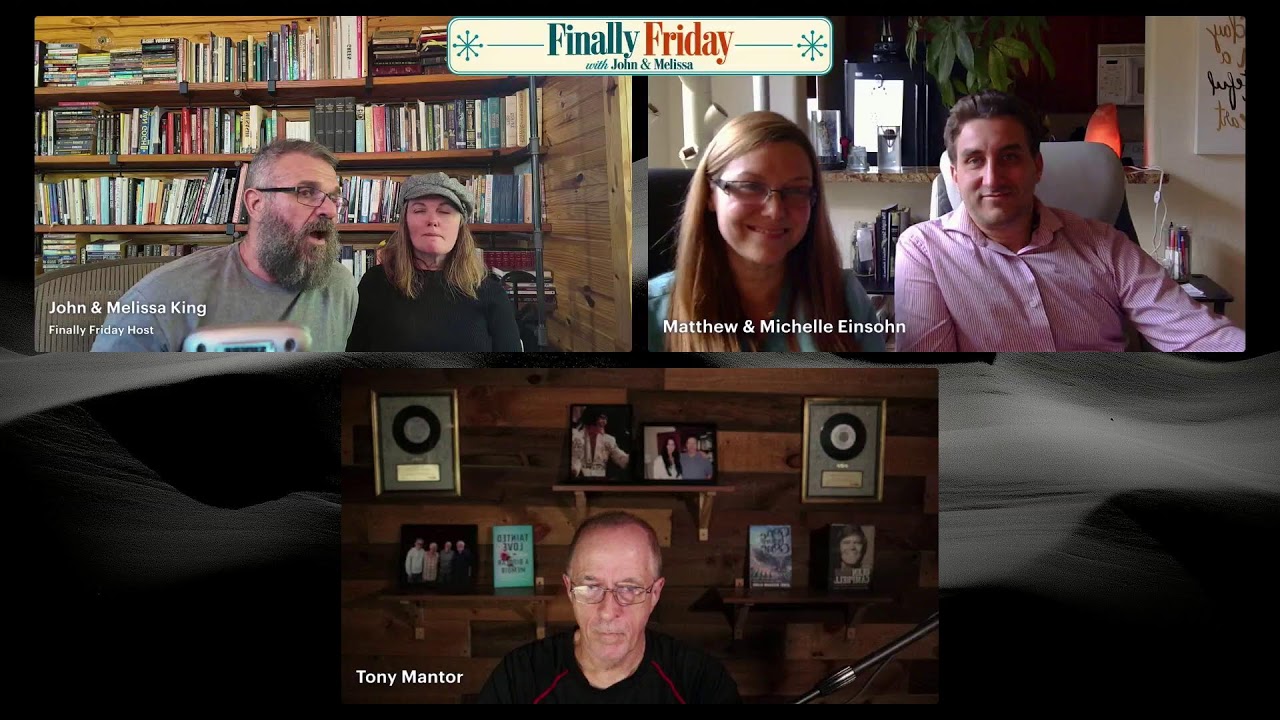
Dr. John A. King and Melissa host a live show with guests Tony Mantra and Matthew and Michelle from Wisdom OS. They discuss Tony's rapid podcast growth with Why Not Me, starting a podcast from scratch, and Dr. King's late autism diagnosis alongside broader conversations about neurodiversity and creative practice.
Chapters
Well, that was the longest three minutes in the world.
Welcome to Finally Friday, everyone.
Yeah, for sure. So I think what we'll do is we'll reduce that three minutes down to a minute next time. Oh yeah, I know.
Okay.
Well, I'm just telling them.
Okay.
Good to have you all here. Great to have you here. Instagram, YouTube, X, all that. We have got some longtime friends and some brand new friends. So let us introduce you to our longtime friends.
First, let's introduce ourselves. Okay, if you're new here, thank you. I'm Mel, I'm a painter, and this is John. He's an author extraordinaire, and we do Finally Friday every Friday. Um, we get to the end of our creative week and we spend an hour-ish talking to fun creative friends. We'd like to find interesting people who are passionate about whatever it is they're passionate about and talk to them about creativity, which is her today.
So yeah, so that's what we do. And we've got some great— we've had a great week, great creative week, and, uh, we'll get to that in just a little bit. But why don't you introduce Matthew and Michelle?
So our good friends Matthew and Michelle are the team, uh, the force behind Wisdom— the force behind Wisdom OS. And, uh, they are some of the most creative people and passionate people that we know, and their particular area of passion is traditional, um, naturopaths and iridologists. So if you've never heard of iridology, I'm sure they're gonna talk a little bit about what that is.
They're passionate about the body, they're passionate about health, they're passionate about holistic living.
Yeah, but you know what, what people don't know is that there's a really secret behind that. The secret behind that, guys, is you need to email John and ask him about the squirrel. If you ask him about the squirrel story, it will change your life. Or the boat story.
Oh yes, it's always that.
So just, I mean, when she was underplaying his writing, you really come into it. these stories. And so, uh, that inspiration is what helps my creativity. So he's like the muse to the—
Right, well, that's not weird. So let's just swap straight over to Tony and try and interrupt that flow.
So our, um, Tony, Tony Mantour is—
Tony needs to tell us about him.
Yeah, okay.
Well, why don't you think— yeah, do you want to tell us about you, Tony, or we can just We've been stalking all week online, so we can either make it up or you can tell us.
I have kind of felt that stalking, so yeah, it was true, brother. So what did you find out? That's what I want to know.
Congratulations, first of all, for your—
yes, we wanted to congratulate you on your 1 million downloads.
1 million download for your podcast.
Actually, actually, that was last month.
Which is awesome.
So what are you up to now?
About 25 million.
25 million?
Yeah.
Okay, I'll rewrite this.
25 million. I thought 1 million was awesome.
25 million.
Tony, how did it jump up so fast? What did you do, or what was your story?
I've been doing this for about 4 years, you know, so Believe it or not, it took, uh, it took me almost 2 years to get to a million. And then with everything that— all the seeds that I'd planted and, and different people that I'd met, everything just started kind of falling in place. And then all of a sudden, the downloads just started happening.
Wow.
I mean, so congratulations. So in the last, in the last 2, 2 and a half years, I've, I've done over 20 million downloads, whereas it took me 2 years to get one.
Wow. Wow.
Yeah, that's crazy. But I mean, it, it's, uh, it's partly— and that's just on one. I mean, I'm at 15, 15 million on my other podcast, which is about music.
Wow.
You know, that leads me straight into my question, is that you're a serial podcaster Did you go into this whole adventure with a plan? Like, were you planning to do more than one, or—
Actually, I wasn't even planning on doing one.
So how'd that— tell us that story.
Okay, the, the journey is, is pretty unique, um, because I'm in Nashville. I've— I'm a producer. I've, I've worked with a lot of the major stars. I've, I've, uh, You know, worked with people that you hear every day or see every day on TV. And then COVID hit. And when COVID hit, production stopped, shows stopped. I mean, everything came to a screeching halt. So before I moved to Nashville, I was a singer-songwriter doing everything like everybody else, trying to be a singer that goes out and performs.
Yeah.
And I had the opportunity through people I was working with to get off the road and get behind the scenes to do production and management. And that was a big choice for me. Do I want to give up my dreams of being on stage? So I chose that to stay in it and have the longevity and do everything I wanted to do. I chose to make the move to Nashville and get behind the scenes. So now I came off the stage and I became unknown, so to speak.
Yeah.
Other than the people that I was producing and working with. So when COVID hit, I had always said to a lot of, a lot of my major people that I work with here in Nashville, songwriters and, and the, the, uh, session players and everything, it's like, man, if I get a chance and I get some downtime, I think I'm gonna do another album just for fun of it for myself. And so I get a call one day And this guy's played on number one songs and just everything. He goes, remember you said that you was going to start working on your own project when you had time? I said, yeah, I do. He goes, well, you got time now.
Ah.
And I'm going, well, I guess you're right since we're not doing anything. So I started working on my project, and then during the recording process, a song called Why Not Me came to me. And it was written by a friend of mine that I had produced one of his songs a couple years earlier on another singer I was producing. And he says, man, this is one of the best songs I've ever written. I think, I think, you know, you— I'm hoping you like it. So I listened to it and I'm— and I said to him, I said, did you write that song for me? And he goes, what do you mean? I said, because everything in it is stuff that I put on my social media every day.
Wow.
Which is Which is never give up on your dreams. You're never too old to do anything. You don't want to be 70 years old sitting on your front porch wondering what if.
What if? Yeah, that's right.
So, uh, I told him, I said, man, you wrote that song for me. So I, I recorded it. And then my promoters that I work with in New York, Nashville, LA, and London knew that I was working on my own project. And they said, we want to hear something you're working on. I had just finished that song.
Right.
So I sent that to them. And they said to me, they said, you got to release this song. I said, no, I'm not getting back on the road. I've already done that. I'm, I'm just doing this for the fun of it. So they talked me into releasing it. And with any record that goes out there, if it starts getting any traction, it's gonna, it's gonna last 6, 7, 8, 9 months before it falls off the charts and goes into the abyss, you know.
Yeah.
So mine lasted about 9 months. It, it hit, uh, some of the top charts and the independent charts around the country and did well in the UK. And, and, and then I said, you know, if I'm gonna, if I'm gonna put this song out there, I'm gonna pay tribute to someone. So I did a video supporting our first responders.
Wow.
Oh, cool.
You know, and I just called it Why Not Me? And it's out there and it got out, no, 125,000 or so views and it did okay. And then after the song was all done, I got this email and a phone call from this lady that says, can you do something like that for us? Because we love your song. And it turns out she was an autistic speech therapist for young children.
Wow.
So I told her, I said, you know, I don't know anything about autism. I've got friends that, that have autistic nephews and nieces, but I really don't know anything. I think— I don't think I'm the right person. So ultimately, long story short, I met with their CEO and I met with their regional manager and And it looked like it was going to work for the charity, but ultimately it didn't because charity is a charity. Sometimes the inner workings just don't match the outer workings. So I told her, I said, you know what I'll do? I said, I'll just re-record this song as, as a more adult contemporary pop version, and I will get some autistic and special needs people here in Nashville. We'll create a video.
Wow.
So I did, and I called it Why Not Me Nashville. So that they could separate the two. And it immediately got like a quarter of a million views and it was just going berserk.
That's awesome.
Wow, Tony.
And I had at that time agreed to do a co-host podcast with a company out of New York about business. And my part of it was about the music business here in Nashville. So I told them, I said, you know, do me a favor, the last 5 minutes, let's talk about my autism video that I did and the song, and they agreed to it. So it went really well. The response was good. The feedback was good. They wanted to renew my contract, and something said to me, you know, do your own. So I figured, you know, I don't know anything about podcasting. I really don't know anything about how it works. I'll just put together a podcast and see how it goes.
That's great, mate.
So I I recorded a couple, 3 podcasts because I didn't know how I would be accepted because here I am, you know, neurotypical, no autistic people in my family.
Yeah.
Are they going to accept me for what I, you know, doing this? And it turns out they did. And with— so I figured I'd put out 2 episodes a month. Within the first month, I had so many people wanting to come on my podcast, I turned into a weekly show.
That's great.
And it's just kept to grow and it's growing and growing and growing ever since. It's crazy.
So with all of that awesomeness, to someone who's wanting to start something, what, what would you suggest? They don't know where to start. They don't know how. They don't know.
Do it.
Just, just do it.
Yeah, put it out there. I mean, because I knew nothing about podcasting, you know, and I just, all I did was I went on, I Googled, how do you podcast? How do you do this? And the only good fortune I had is I've got my studio here in Nashville, so I've got all the equipment to record. So that wasn't a problem, you know. But, but just other than the recording part— I had, I had the recording part, no problem— but it was the publication, the distribution, the promotion of it, you know, all that kind of stuff, you know, I didn't know anything about. So I hired a publicist here in Nashville that, that I've worked with on on music projects to, to put it out there. And I keep hitting those type things, and it just kept growing and growing, and people kept telling people, and then it just, uh, it just blew up on me, you know, a couple years later. And now it's just like I do not have enough time in the day to record everybody that wants to be on my podcast.
Wow, that's a great problem to have.
That's great.
We had a question come in, um, from YouTube for Matthew and Michelle. They wanted to know, how do you energize your creative self?
Energize your creative self.
I mean, I would say I go through different stages depending on what I'm trying to do. Uh, you know, is it for business? Is it personal? Um, is it for another client, right? Because we do a lot of muscle testing, and so, uh, when it comes to muscle testing, muscle testing is, is only as good as your question. And so sometimes you have to get really creative with your questions and kind of come out of the box. So I— what I try to do, which is something that my mentor has taught me over the years, uh, and I don't always do it.
Yeah.
But it's, uh, can you imagine yourself in a theater looking at the screen, right, looking at a movie happening, and you're the movie, right? So can you see what you see in your world without going to what you see? And that sort of opens up a lot of different, uh, ways of, uh, kind of viewing the world. And that, for me at least, allows a lot of creativity if I need to get out of my head. I go on a walk or I do rebounding because rebounding is really great for me in particular because I'm a blue eye, uh, person, which in our world the blue eye is, uh, lymphatic. You have to really support the lymphatic system more than anything else. So rebounding is really great and I love it.
Yeah, part of it is knowing yourself, and we use iridology along those lines. So like for myself, I'm a mixed eye person, which means I run out of creative juice if I don't top up my B vitamins and my minerals. So for me, a lot of it is digestion and digestive processing and biochemical. We know that people with dark brown eyes, for them it's blood stasis and blood flow. So there are physical things you can do to support your creative process. And then as Matthew mentioned, there are emotional and creative things that you can do. One of the most basic ones that I like if I'm getting stuck in How do I engage my imagination? Why is cloud pictures? Yeah, cloud pictures. We all did it as a kid. We went outside, we looked up at the clouds, and we made pictures out of it. And it's such a basic way to engage your imagination and just get that muscle moving.
That's great.
Yeah, that is great.
I love it. We had a question coming from Tony, for Tony. Um, so artist, singer-songwriter, or producer? Like, different styles of creativity, which one feels most like home for you?
Oh, music, of course. You know, I mean, I was born and raised, you know, with music. I mean, I've been playing piano since 8 years old, and performing and writing and working with people. So when I'm in the studio recording music and creating and helping new singers, find their voice and find their style. That is my comfort zone. That's where I just sit back and just let things happen and, and sit back and create. Whereas with, with, um, with the podcasting, with, with that type of thing, you've got to do a little bit deeper dive. You've got to find out the person that you're interviewing, look, find out what makes them tick, find the questions that, that will resonate not only with, with them but will resonate with the listeners that hopefully they can relate to. So there's a lot more that goes into podcasting, you know, from, from that standpoint, to make sure that it's enjoyable, relatable, and, and informative to the listeners. Whereas with music, you just go with, man, that feels really good, you know, and I think we need to do this. And oh, let's get this emotional part with your vocal on this word, you know. So it's, it's still a lot of analytical process, but it just flows more because it's music.
Matthew and Michelle, so Tony's talking about the back and forth that happens with the podcast thing as a creative thing. Do you find that with your patients that in the midst of the back and forth of a conversation about something, there comes like an epiphany or a realization or an understation— an understanding that helps you connect or helps you, you know, coach them in some way. Is it a similar thing for you guys?
Oh yeah, like even today, uh, one of my clients, uh, they text me and they have an autistic kid and I She was just sharing some stuff about what was going on with him. And I actually introduced her to the Telepathy Tapes. I don't know if you've ever heard that, Tony.
I have.
Podcast. It's unreal.
Yes.
And so like, it's just, you know, how they're able to communicate between the autistic kid and the parents and using music, you know, and sound and doing that dance, which is really incredible what they're doing. And so You know, having access to all this information, all, you know, these people kind of push us into, uh, unknown things. Like, I had never come across that until recently.
We learn as much from our clients as I think they learn from us.
You know, that's what I wanted to ask you. In— when I first started podcasting on autism, I knew absolutely zero about autism, and now I I find 4 years later I can carry on a conversation with anybody about autism, even though I don't have the lived experience. So have you felt that too? You know, that— oh yeah, yeah, because of what people tell you, you haven't lived it, but you understand it.
Yeah, absolutely. Because, you know, and it's such an intimate conversation, as you know. I'm sure you get equally, um, interesting and personal things on and off the screen, right? Um, you know, for us it's all off the screen, right? It's just between us two. So We get a lot of different, you know, experiences that way. And obviously a lot of, you know, then we dive into the research. You know, when we started, we started with breast cancer. So, you know, after we went beyond that, then it started coming in from all different, you know, people and ways. And autistic came, you know, as a huge one because there's a huge holistic community within that spectrum.
Absolutely right. Speaking of breast cancer, can you guys tell us about your little promotion that you're doing for breast Awareness Month, because you've been so generous in giving us a coupon code to put out there to our folks.
Yeah. So we decided to do something. We like to do something every year for October because it's Women's Health and Breast Cancer Awareness Month. And as Matthew mentioned, that's where we started. So this year we're doing 30-30-30, 30 gifts for 30 women in 30 days. And we do still have some spots left. And what that entails is a voice-based heavy metal and mineral and vitamin report along with the consultation. That means it can be done from anywhere using your phone. And Mel, recently we did one of those together. Mel, what was your experience like with it?
It was really, uh, it helped me to understand how my body was responding to its environment. And I, I don't know, I don't know if I came to the test with a ton of expectations. And so, um, I was really just open to learn whatever it would teach me. But, um, I do know that I'm a blue eye, and so lymphatic is an issue, and all of those little markers came up on my test. So that was cool. And I love the fact that I left with clear next steps, like, here, here's something you could do tomorrow to support your body. Um, and feel your best. And so I love that part of it.
Yeah, we dropped the code in there. What, what website do they go to register, Michelle?
Actually, you know, let's just make it easy, you guys. You know, you can just email us, right? So if you just email us, which is info@wisdomos.app. So just Email us and then put in the subject line John's Code Phoenix 30, which is PHX 30 in the subject line, and then we'll just get you booked. And it's at no cost; it's usually $150. Obviously, our website is also wisdomos.app. But info at if you just send us an email, and then we'll figure out the calendar thing later and what time and when and. You know, so we can make it easy for you guys.
So we've got a friend, Janine. She's going to take some notes and put all that in the chat. Hey, Tony, I've got another question I want to ask you, mate, but before we do that, could you give us the name of your podcast so we can put that in the chat for people as well?
Sure. I've got, uh, Why Not Me, and it's, uh, embracing autism and mental health worldwide. And then I've got Almost Live Nashville.
Great. And we'll, we'll make sure that goes out and, um, all that. I was thinking about something you said, Tony, about, um, never give up, just keep going, just try again.
Sure.
I'm that guy. I'm, I'm with you on that. I'm 63. Like, I'm living my best life now. But the, the one of the challenges is that sounds really trite to people. Like, they've probably lived their whole life trying. Yes, I'll just try again, try again, try again. And I fail and I fail and I fail and nothing comes around. So, so how do we help people like that? Because I believe the same thing too.
You just have to keep going because, you know, it does sound trite, you know, never giving up, you know, just keep going. And you're going to have down days that things just don't go well and you say, screw this, you know. But, but I, I, I, my analogy is You've you bought this car, and you pay $500 a month for it. Then all of a sudden, you get it paid off. Then you start having problems with it. So you spend $200. Then you spend $100. Then you spend $500. And then you get to the point of where I'm I'm never stopping. Fixing this car, and then you finally get to the point where you get one more thing that going to cost you $500, and you say, "That's it. I'm done with it. I sell the car." Well, when you sold that car, the person that took it over spent that $500, and was able to keep that car going for ten years. That was the last thing that needed to be fixed. You know, so if you always go into something thinking that. I can't do this anymore. It could be that one thing that you're not willing to do that could be the one thing that could fix it. And then all of a sudden things just start working. And it may start out working at a small basis, you know, but, but you can't start— I mean, most people don't start out on top, you know. I mean, it's like my podcast when I first started, you know, I was struggling to— I, you know, I'm going, okay, Am I going to get any downloads? Am I going to get people that want to come on this? You know, and now 4 years later, I get, I get as many downloads as I could possibly want. I, I'm turning away people because I don't have enough time. And it's— and I've got people finding me all over the world. I've got people that want me to speak. I've got people that want me to, you know, do so many different things. But it all came from starting a podcast not knowing what would happen. And there was many times I'm going, you know, this isn't going to happen, this isn't going to work, I'm not getting what I want, are people listening, am I making a difference? And then I got this one email from a lady that lived in Bulgaria.
Yeah. Oh, come on now.
Okay, she says, I Have an autistic son. I moved to the Czech Republic. I moved back to Bulgaria. I moved to Prague. I moved back to Bulgaria. And then there was another European country in which she moved to. I can't remember which one it was. And she moved back to Bulgaria. Then she says, "I found that Belgium is an autism-friendly country." Yeah, that's right. So my Son, myself, and my niece left our family in Bulgaria. We moved to Belgium, and your podcast gave us the courage to do it.
Wow, that's incredible.
That's a great story.
So I'm going, it's like, oh wow, one person.
It's always just the one, isn't it?
It's just one, one, you know, all it takes, you know. So when a person's trying their podcast, no matter what it's about You just gotta take and put it out there and keep doing it. Because I don't know if you realize or not, but the average podcast length is 8 episodes.
Yeah. Wow. That's great.
Because 8 episodes, they find out that there's a little work that goes into it. It takes a little time to do it. It's, it's more time-consuming than they expected. You know, it's not going to make them a lot of money right from the start. So 8 episodes is normally the end of a lot of podcasts. So if you make it past that number 8, then you've made it past a lot of people. So you've just got to keep plugging away, and no matter what the subject matter is, and find your place. And I'll add one more thing to it before I give it over to you. But, and I, I laugh at this, I just got signed Last year, I was signed by a company that I, that I, that wanted to get me ads and wanted to help build my company, my podcast. I signed with them. It didn't work out. I left them. Everybody said to me, they said, what are you leaving them for? They're making you money. I said, you know what? It's not about the money.
Yeah.
It's about the fact that they're not doing what I was hoping they would do.
Yeah.
I wanted to brand this. So I figured I was starting back at point zero again. Within two weeks, I had four companies that took their place, wanting to have my podcast.
Yeah, that's great.
And I wound up signing with the one that partnered with iHeart. Okay, and iHeart, for those that don't know, is the number one podcast distributor in the country and radio distributor in the country. Now, my story behind this is two years ago, my publicist. Told me, he says, I'm gonna pitch— he goes, I know the people in New York that run the podcast part of iHeart. I am going to pitch your product to them. I said, okay. I said, I don't expect anything, but fine, knock yourself out. So a month later, he calls me up. He goes, okay. He goes, I got good news, I got bad news. I said, okay, let's start out with the good news for a change. He goes, well, he goes, number one, they love your quality. Number two, they love your, your interview style. I said, okay, what's the bad news? He goes, your subject matter is too niche, they can't take you on. I said, okay, no problem.
Yeah.
So now fast forward 2 years, okay? So I sign a deal with this new company that partners up with iHeart. Last week, and we all laugh at this now, but last week my podcast was, was iHeart's number one podcast in the mental health category and the health and fitness category, and the only podcast in the top 20 that was an iHeart podcast.
Wow, that's great. Congratulations.
And that was mine. But the— but my point is, is it, it goes back to never giving up because you just got to keep going. And people are going to tell you, oh, you're too niche, you're too this, you're too that. But if you believe what people say and not believe in yourself and what you're doing, then you've failed.
That's, that's really good.
Moving forward, no matter what happens, you're winning.
I think that's great advice for any pursuit, any creative pursuit. I can't tell you, there are several painters that I took my very first painting class with that they gave up. Like, they don't paint anymore. They, they couldn't find their thing or whatever. And you just have to keep going.
We were talking, so I'm 62. We started building some technology about 10 years ago, and it's literally sat on the shelf for Um, 10 years minus 1, 2 weeks.
Yeah.
We literally feel like the last 2 weeks, everything we've had our hand around has now finally worked. And it's— we've just been buried for the last 2 weeks or so, and everything just seems to be coming together. But like you said, if we'd stopped one payment beforehand, we never would have got— and you know, it was discouraging, man. From there to here, we've been borderline homeless, we've been bankrupt. We've been pursuing this dream, you know. We've, you know, I mean, Matthew and Michelle are more than just great friends, they're business partners. And we started these endeavors together, and like, it just is just now starting to come together. And I, I like, what are you going to do? Your choices are keep going and succeed or fail and have to live with that.
There's 1,001 reasons why you can quit. Oh, there's only one reason why you keep moving forward.
Yeah, and it's that view of yourself at like 70, 80, or 90. Like, did I do it all? Am I happy? Like, I don't, I don't even know if it's about the success. I think it's about the attitude of trying. Like, I think if I fall into glory having given it my all, reaching for my dream, then that's going to lead to a much more satisfied life Then, you know, I just gave up halfway along the way because it was just—
Yeah, absolutely. When I started this podcast, I had no, no clue that it would reach these type of numbers, and I wasn't even thinking about those type of numbers. I just said I want to make it the best. I, I, like I tell any singer I work with, always do your best because you never know who's watching you, and you never know who's around the next corner that can help you.
Yeah, that's, that's great advice. Sorry to interrupt the flow. We just had a question come in on Instagram, and it's from Vidal and the Shadow Figures. And they said, have you noticed the correlation between the people that are pushing mental health focus, and all they do is focus on mental health, and all they see is mental health? And there, it seems like they're willing it for their children. So I think the question or the statement is trying to say, is there a correlation between a focus on mental health and kids with mental health issues? Issues, mental health issues.
Oh, who is that? Which— who is it for?
It's for anybody. It's just a general comment.
You guys want to take that or you want me to?
I mean, either way.
Why don't you say first and then I'll join in?
I mean, my answer is simple. I don't think there's a correlation.
I think that, you know, when it comes to mental health and autism, I think that it's individual. I think that people have to look at every scenario, you know, because there is no— there is no one thing. There's multiple things. You know, when you look at— when you look at mental health, you, you think ADHD, bipolar, anxiety, schizophrenia, anosmia. You think of all those things when you think of autism. You you have another of what you think it is, and I think people tend to look at things that the talking heads out there say. Some of them are right; some of them are their opinions, and I think that sometimes they can write things in there that aren't there. But I think that if a If their son or daughter has serious mental illness or any type of illnesses that, that's going to stand out, or if they are autistic, those are going to show up. They can't will it upon them, you know. If they do will it upon them, then what they do is they go see a therapist or a doctor, do go through the test, and then the doctor will say, you know, you're just finding that stuff that's not there. Yeah, but I think overall Most people that I have talked with over the years, when they take their son or daughter to a therapist or a doctor, they're doing it because they're not meeting their milestones or markers. Yeah, I mean, when that happens, then you need to find why.
Yeah, Tony, I mean, yeah, our goddaughter, uh, she, you know, our close friends and goddaughter, she was having some trouble and they just went in and got, you know, tested and And they, and they found that she was, you know, neurodivergent and definitely slightly on the spectrum and autistic, just because of how she was, again, developing, like you said, right? You know, there's usually a pretty good development track, you know, within that scope that allows us to see that.
We've come at it literally from the other angle. I went in for a series of tests earlier on this year and came back so very clearly on the neurodivergent autistic spectrum. So we're in this process of understanding history as well as understanding future. It's like looking back and so many things that, you know, I was, you know, trafficked as a kid, and that comes with a diagnosis of complex post-traumatic stress and an automatic assumption—
ADHD.
ADHD and an automatic assumption of a series of behaviors. And what's been really interesting and somewhat turbulent in a lot— she laughs now— and somewhat turbulent is starting to understand that maybe some of the adverse things or behaviors, or I don't know how to say it, it's a bit complicated, but that a lot of them were tied to this autistic autism that I didn't understand. And, and so here I am at 60.
So, you know, you were on my, my podcast and we talked pretty, pretty deep.
That was just after the diagnosis.
Yes, I remember that. Yeah, you know, and, and you— since I've talked with you, I've also talked with people that have been as old as 70 years old just finding out they're autistic. I mean, usually late diagnosis in their 30s and 40s. Not their 50s, 60s, and 70s, you know. So, but the one thing that I got from every single one that I talked with, and I think I got it from you too, was that by finding that diagnosis even at that late an age, it clarified your life up to that point where you understood it a little bit better.
Yeah, and I'll, I'll give you kudos for, for one, having me on the show and the conversation we had. It actually propelled me to be comfortable trying to unpack some things.
Yeah.
And trying to come to terms with things. And it really has— it's changed the way we manage our day-to-day. And that has freed up things emotionally, and it's freed up things around the house. And I mean, it's been, uh, it's been a journey. And I, I think there is a Uh, a conversation that needs to be around— had around the fact that people want to grab onto labels today. I, I think we grew— all grew up just, we're going to cope, we're going to work this shit out.
That's right.
We grew up with a latchkey, you know, it's like we— you run around until you— you're only allowed into the house when, you know, dinner was served, and you weren't allowed to talk in front of the TV and all that sort of stuff. And so it was really like, suck it up, bucko, you know. So you're right, so you're a retard, get over it, get out there. So, all right, yeah, right, it's true, it's true. Yeah, and you just have to get on with it. But, you know, it's not necessarily the best way to do things, you know. It certainly lacks a level of compassion.
I, I do, I, I do think, going back to the question about willing it on children, I think every generation of parents Um, comes with its own challenges. Um, you know, our parents certainly were not overparenting, I'll just say that. But, um, like now the, the parents that are, you know, have young children now, they've got social media and they've got all these things that were not a deal back then. And so I think every generation has a specific set of challenges to do with mental health. And, uh, I, I hope that most parents are sincerely just doing the best they can with what they got.
Do you think that— and general question— do you think that because we're, we're able now to have public conversations around things like mental health that people could go looking for it? Or do you think because we're able to have conversations, people are just aware And make allowances for it? Or what do you think that balance is?
Uh, well, what do you mean allowances for it?
Um, you're allowed to have autism now. You weren't allowed to have autism 40 years ago. And if you did have autism 40 years ago, you were put literally on a special bus in a special classroom. And you weren't allowed to mix with other kids.
Well, autism back in the 1900s— a lot of people doesn't realize that autism was first diagnosed in like the early 1900s, and it was a severe mental illness. They treated it like with electrotherapy. They treated it all the wrong ways. And, and then in the 1940s, they actually got a real autistic diagnosis Which means— which meant that it was more of a, a mental brain pathway rather than a serious mental illness. But that's kind of the way it's developed. And in the '50s and the '60s, autistic people were treated differently, but they weren't labeled. In the '60s and the '70s and the '80s and even the '90s, autistic people were treated differently, but they weren't labeled. Only now are we looking back and seeing that, you know, maybe this person was autistic, maybe this person was autistic, or maybe I was autistic, or because they're seeing patterns that's being put out there on social media, on platforms like our podcast, on situations like like Zoom calls like we've got here, you know, where everybody can have an opinion. But the problem is, just because a person has an opinion doesn't mean it's correct. It just means it's their opinion.
It's an opinion.
You know, until they get a full diagnosis, which leads to why a lot of people say, oh, there's more autism now being diagnosed than there was 50 years ago. Well, of course there is, because we are more analytic now than we've ever been. We have science behind us now that we didn't have back then. We have ways of interpreting things that we didn't have back then. Back then it was like, is that red or blue? You know, I mean, you know, they didn't have all the things that they have. So the fact that we've gotten better with technology and now all of a sudden we can say, yes, you are autistic. Or you have this, or you have that, then what's wrong with that? Because now you get a better chance to understand what's going through, why you perceive things differently. Because I had a, I had a gentleman that was on my podcast, and he had a fantastic way of working his autism into his life. And he got married to a neurotypical woman, and they had to, to learn each other's habits and their little idiosyncrasies. And what they came up with was they treated each other like they was from a different country.
Really?
So they had to learn— like, imagine if I'm this American and I married a Japanese woman. I have to meet and learn Hmm. So now they had to learn each other's culture in order to live together. And then they had kids. And now this just goes— now, one of the next statements I'm going to tell you just goes to show you exactly how uninformed we still are as a society. Because he's a speaker, he talks about his— the way he treats his culture now with his wife. And he will still get people that will come up to him and say, I never realized autistic people could have kids.
Wow.
I think there's a— I think maybe we've got some pushback on some stuff on one of the socials. I think what people are looking at or concerned about is there seems to be this victim narrative that turns up over everything, like everybody's a victim of everything. And that's not what we're talking about here. And I don't know how we ended up in the mental health space, but here we are.
Here we are.
Welcome to Finally Friday. So we're not talking about finding a reason for something. We're trying to understand so it's no longer an excuse.
Exactly. Understanding is the key.
Yeah, it is.
And you bring up mental health. Okay. Last year, I rebranded my Why Not Me?
Uh-huh.
And now I include anything that falls under the mental health umbrella.
That's good.
And how that happened was I was asked to do a special month-long scenario of podcasts on autism for Autism Awareness Month.
Uh-huh.
And a lady came up to me and said, May is Mental Health Awareness Month. Would you be willing to do the same thing for us?
Wow.
But she only dealt with people that was serious mental illness, schizophrenia, you know, psychopathic thoughts, anosognosia, all that. And I'm going, oh, do I want to do this? And then I thought, you know, I said the same exact thing to when I did my autism one, because autism had a perception, or this stigma is like a lot of people like to put to it, Well, so does mental health. Well, when I started talking— so I agreed to do it. So when I started talking to these 31 people that told me their stories of serious mental illness, I sat back and I'm going, wow, I have got to do this because they don't have a platform. Because so many people do not want to talk about mental health. They want to talk about the easier stuff.
Yes.
You know, and now because I've done this, I look at everything completely different from an analytical side. And when I say analytical, I mean just my personal opinion. So if I see someone on TV that has done something where they went out and killed 3 or 4 people or stabbed 3 or 4 people, before I started my mental health umbrella, I would look at that and say, you know, that person or people need to be put in jail and throw away the key. Now that I've actually talked with people that deal with mental illness on a continued basis, and I've heard their stories, my first thought process is not put them in jail. My first thought process is, did the system fail them?
Hmm.
And 9 chances out of 10, if you start looking at some of these things, you're going to see where we have a systematic healthcare disaster. People are not looking at things from a— from the perspective. They're not seeing that these people that have serious mental illness are grasping for help, but our system doesn't give them but a couple of days in the in the emergency room or a week or 10 days in the hospital, and then they kick them on the streets. And then when they run out of their meds, what do they do?
Right.
They go back to what they were.
Going back to your—
we need a lot of overhaul.
Going back to your culture example of the husband and wife, Tony, John and I, when we were first together, he explained it to me like his volume would increase because he felt like he was in a foreign country and he was drowning. He was just asking for help. And he's a drowning person in a foreign country. And he said, so, um, I— when I feel like you're not understanding me because we're speaking totally different languages—
Yeah, I forgot all about that.
His volume would go up and up and up. And so when, when it started raising, I would understand, okay, he, he doesn't know that I'm hearing him. I need to stop. I need to give him some physical cues that I'm focusing, I'm listening, and Sure. So I, I think anytime you have a system that is supposed to be helping people, you, you lose that focus, that human connection of being able to listen and act, because each person's situation is so very different. Each person, it is, you know, needs a different thing. And I was, I was actually going to throw to Matthew and Michelle about that because you work with a lot of people, um, giving them ways to, uh, help, help naturally. Yeah, naturally help their system, their, uh, parasympathetic-sympathetic balance and all that kind of stuff.
And they've been a tremendous help to us as a couple. Yeah, um, everything diet to like this, like Supplements and stuff.
So the reason— and like, for me to have someone that I know is hearing me and is fully listening to my situation is, uh, gold, you know? And that's what they've done for us.
Yeah, it's awesome.
And I think it's to circle back to the creativity question at the very beginning, right? All this, the root of it is difference And understanding.
Yeah, right.
Very good.
And the more that you can recognize difference, it can sort of instigate creativity. Yeah, because along the way you have to then create understanding about that difference.
Yeah. And when—
yeah, that's good.
And when you have your, your parts, when you talk when you— with your patients and everything, and you're listening to them, you're, you're learning more about them, you know. Then you're listening and you're understanding, and then you understand what they're going through, and then they can understand why you're addressing some of the things that you're doing. It makes a better connection.
We— a lot of times when we can understand, especially from the iridology point of view, we can understand nuances about, for example, how they like to learn, how they receive information, and that helps us tailor how we're even communicating the health information to them Because we know those.
That's great. That's a great— how we're communicating. That's great.
So we have to constantly get creative with— we won't say the same thing to everybody, right? Everyone is so unique on how they receive the information, whether or not they're going to comply with that information, right? In order for me to comply to something, I have to connect with it, right? If I don't connect with it, forget it. I'm not doing it. I don't care who says it. So, you know, it's a great art of creativity using essentially what this entire topic into mental health but back into creativity went to, which is difference and understanding allows the creative juices. Because the more difference you can see, then the more unique you can—
And, and the beauty of what you just said is, is unique. That's the key word. Everyone— there's a, there's a statement out there: you've met one autistic person, you've met one autistic person. But, you know, that goes beyond autism. That goes into mental health as well. You know, everybody is unique. So that's a— that word that you just said, unique to themselves, is, is huge because you're not going to treat everybody the same because there's no one-size-fits-all. Well, yeah.
So it goes across not just mental health. This is all of life, right?
Yes.
You want to appreciate the difference and learn to understand.
Exactly.
And that's a— that takes a level of maturity Which I think, coming back to the artistic side of things, I wonder if we've lost some of that. Because it seems like if everyone's not on the same page, believing the same thing, having the same opinions, then you no longer can have arguments or discussions and stay friends anymore. And I think we've lost some of that ability to be able to appreciate the diversity of difference.
I think it's changing though, because—
Talk about that a little bit, Tony.
Um, because back in the '40s, '50s, '60s, '70s, no one understood autism, what it was. They just thought they were quirky, you know. Now they've actually got science they've— they can delve into, they can find out things. So there is a certain percentage of our population that is growing empathy for people. whether it be mental illness or autism or what it may be. And they're understand— they're trying to understand more, and they're trying to integrate this into the school systems and, and just all these different things. The only thing is, is we're doing it at a slower pace because the funding's not there, you know. So it takes a while to get all this done, but I do believe that we are headed in the right direction overall. Even though there are still some people out there that still hit that brick wall of not acceptance, they're going to say that, that Tylenol did it, or, or they're going to say something that is so far off base, but they're going to put it out there. And there's going to be a certain group of people that's going to believe what they say. But I think there is a greater group of people now that are starting to lean towards the scientists. that are starting to lean towards the people that have the lived experience that are out there talking about it. It's like Temple Grandin, you know.
Yeah, that's been a great— that's— she's come into her own, like, really, really been incredible.
She's 79 years old. I just had her on my podcast for the 3rd time, and she is old school, you know. Everything she approaches and how she approaches it is still old school. Yeah, but old school still applies. Yeah, you know. And she'll always bring it back to help get these people work. Let's get the autistic person working, you know. So she has her, her thought process. But people like that, that are willing to get out there, put themselves on the line and talk about it, and not be afraid to tell them, hey, this is how I was when I grew up and this is how I am now. I think that is creating— a better awareness, which hopefully will get into acceptance and a better understanding in the future.
That's great.
I find that there are sort of pockets of people in the sort of creative community where they're looking to connect and have that appreciation of differences and understanding, like Matthew was saying. There are pockets of people around everywhere. And I think, um, if we, if we go into situations where we're going to connect with people and we expect to find those pockets, I think we will.
I think you do that expectation effect.
Yeah.
And if you go to and expect to find understanding, I think you'll find it. If you expect to find negative judgment, I think you'll find it.
Yeah. Well, Of course, we know social media, you can go looking for whatever you want to find it, whatever it is. Yeah.
So, but I think in life also, like, I know when I was doing the podcast outreach, I was expecting to have intentional connections. And Tony was one of my first ones, like expecting to find people that were willing to have an open conversation. And I think it's always been like that since I started talking about the trafficking side, particularly men who have been trafficked. Even with Matthew and Michelle, it's been a very interesting business relationship because there's a level of acceptance that you just expect. We came to trust it, find it to be real, and then it's been, you know, very important. And I think that's— I think everybody's looking for that. And I think it doesn't matter if it's in life and mental health or if it's art, people are wanting to find a place for their voice and I think one of the challenges we, we have now is that people hear great stories. You know, Tony, you know, fantastic story. Awesome. You know, we've had an incredible week. My agent has decided to take, um, 3 of my books out, um, to publishers, all 3 of my current manuscripts. I mean, it's incredible to happen, um, in just literally a week. And, um, instantly an overnight success after 40 years of writing, a little bit like your podcasting career, and Matthew and Michelle with what they're saying with their, you know, with everything they're doing with, um, naturopath— after some incredible trials, um, all of a sudden this thing's coming together for them. And I think, I think at some point we have to continually go looking for the best, even if it's not out there, like believing that this next thing is going to be up there for us.
And I think, uh, Tony said it earlier About sowing seeds and those seeds sprout up. And I would want, I would want anyone sort of who's still here, thank you for staying with us for like an hour. But anyone to take away from this conversation is what I would want to take away is that we should all be out there sowing our seeds of appreciation and understanding and expecting to reap on those.
And what about this one? Like, You know, if you, if you feel like you need a friend, the best thing to do is to be friendly. So if you're wanting to find success, how can you help somebody else be successful?
Yeah, absolutely. And, and, you know, the, the good point of social media and the bad point of social media— the good point is, is that you can find other people that you— that, that thinks the same way as you do, that believes the same way that you do. You have your differences, but you can find ways to make it work. Then you've got that group of people out there, they're going to try and shred you apart and find anything wrong, disagree with you any way they possibly can, because that's what they do, you know. So all you can do— you, Matthew, Michelle, myself, and others like us— all we can do is put the best things that we can out there so that people can see that we're trying to take and create a wider scope of intelligent conversation about things that people might need to know more about. And if they learn one thing from any one of my podcasts or anything, if they've learned one thing from this, this Zoom meeting that we've had, then it's a win because they learned one thing, you know. So you don't have to change the world all at one time. You just got to have that one thing. That helps somebody.
So as we wrap up, Matthew and Michelle, why don't you tell people again where they can find you? And I'll put the code in again. I'll ask Janine to do the same for the, uh, the Phoenix 30, PHX30. And, um, please go.
Oh yeah, it's, it's info@wisdomos.app. The website is wisdomos.app.
Just send us an email.
Shoot us an email and subject line PHX30. We will say hello. We'll get you set up with a free appointment. It'll be a lot of fun.
Excellent. And you, Tony, where can people connect with you, brother?
Easy. Just tonymantra.com.
Fantastic.
And I'm on all the social media under Tony Mantra, so it's pretty easy to find.
So, mate, listen, I've got to go see her brother. And then the Cherokee mob. And if you're up for a beverage and a burger, I want to swim by Nashville, take you for lunch.
Yeah, absolutely. Yeah, it'd be great.
It'd be great. Just go kick it. I don't know Nashville, man. Last time I was there, we got nearly got in the middle of a bar fight. So maybe you can take me somewhere other than where the bar fights were that night.
Yeah, we can do that. We can do that.
I appreciate it. Hey, listen, thank you for everyone for Friday. Finally Friday. We've had a bunch of people on. Next week we have Sam Lee. Now, Sam is actually an ADHD coach, a PTSD coach, and he is the most California person I've ever met in my life. Like, he is a combination of Joe Dirt and every other person who's ever come from Hollywood in California, and he's going to be on there. And he is an absolute hoot, crazy as a loon and fantastic. And a great friend of ours, uh, Nikki out of England. Who started up a bookshop on a road called Reading in Reading, I think. And Nikki is phenomenal. She's been a good friend for a long time, and so we'd love to have everyone back to connect with some other great friends. And thank you again, Tony. Thank you, and again, Matthew and Michelle, for coming on Finally Friday. And we hope you all have a good week. Get a beverage, get a burger.
You know, thanks for having me.
Kiss someone you love.
It's been great. I really appreciate you inviting me.
Yeah, great meeting you, Tony.
Yeah, same here. Um, we need to connect. Maybe, uh, you know, put us on— I'll put you on the podcast and you can tell everybody what you do.
Oh, okay. Yeah, appreciate it.
That'd be great. We'll make sure that you have their contact information.
Okay.





