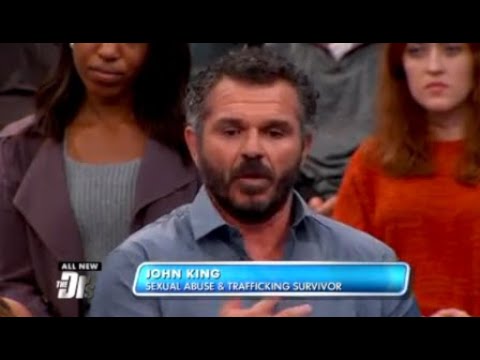
This content was created by Dr. John A. King. This content was uploaded by Dr. John A. King. This is a YouTube TV interview segment (title: "The Doctors TV interview Dr John A. King"; published/created 2019-01-09) featuring a panel discussion about human/sex trafficking. Participants include Dr. John A. King (survivor), two survivors identified as Anna and Carla Jacinto (Carla speaks in Spanish), the show host/interviewer (Speaker B), another panelist (Speaker E), and filmmaker Sadhvi Siddhali Shree (director/producer of the documentary Stopping Traffic). The excerpt contains graphic survivor testimony describing abuse, statistics and scope of trafficking, discussion of recovery and prevention, bilingual elements (English and Spanish), and viewer-discretion advisories. Resources and calls to education and action are also mentioned.
Chapters
The following program contains mature subject matter. Viewer discretion is advised.
You may be shocked by this statistic. 27 million people are victims of sex trafficking. Even more shocking, human trafficking could be happening in your own backyard.
I thought sex trafficking was just prostitution. I found out that pornography can be a form of sex trafficking. When I was a junior in high school, I met a man. He was 40 years old. He asked me to be a part of his art project. They were more innocent at first. Over time, the photos became sexual in nature, more extreme, and I was forced to do unthinkable things that no one should have to do. There was times I would wake up on the kitchen floor naked, and he would say, oh, you were sleepwalking, when really he was drugging me. I found thousands of pictures of me in a drugged state. I looked so dead. I realized looking at these pictures that he was distributing them.
My first memory was a sex act with a female family member at 4. It seemed like it was abuse everywhere I went. Family members, their friends. I was taken to parties. I was used in those environments. It wasn't safe anywhere.
Desde los 12 años a los 16 años de edad, me tocaban más de 30 hombres al día. Me pegaban todos los días. Me veía yo misma como una basura. Ni siquiera había una persona que te pueda ayudar. Cuando nace mi bebé, me la quitaron. Estuve un mes con él y me lo quitaron. Y ahora era la amenaza de que si no hacía todo eso, pues prácticamente iban a matar al niño.
I have these invisible chains and I started self-harming by cutting. I knew if I didn't deal with my problems, I'd probably end up dead or in jail.
9 years ago when I was 45, it all came back like an old 8mm film. My wife at the time found me in the backyard with a gun, screaming hysterically, saying that they raped me and abused me. I just wanted the pain to stop. I received a phone call from someone out of the blue just asking me how I was going. It made me stop and think that maybe I could still contribute something. Maybe there is hope.
Como salí de aquí gracias a un cliente que me ayudó, nunca me tocó, nunca pensó que era un objeto sexual, una cosa, sino que era alguien importante, que podía ser alguien importante para el mundo, ¿no? Me metió la idea de huir y eso fue lo que pasó.
I started speaking, trying to be that voice for overcomers of human trafficking, helping them find their voices.
Y ahorita para alzar la voz y decir ya basta.
I want to bridge a gap between people, particularly men, and give them permission to talk about this stuff. Because if I don't do it, then then who's going to do it?
My name is Anna, and I'm an overcomer of sex trafficking.
I'm a survivor of sex trafficking.
Yo me llamo Carla Jacinto, sobreviviente de trata de personas.
Join us now our two survivors, Anna and John, who I want to thank personally for being here today and opening up and. And I wanna ask you, because you acknowledged being drugged and exploited, how did you uncover the truth?
I uncovered the truth after he passed away. I met up with someone, they gave me a huge box of pictures, and that's when I opened it up and I found there were thousands of them. And so it really came down to an awareness of what it looks like, but also a change in perspective of what power and control really does to a person.
And John, we think You know, more of women being exploited or young boys in a homosexual connotation, but in your case, it was women that were taking advantage of you. Yeah, it was my most intimate female family member and her friends.
And when it starts at such a young age, at age 4, this is your normal, this is your reality, so it's even more difficult for you to see it as a very Unusual, unkind, cruel.
In fact, if I didn't participate, then I would have no physical contact or affection. The only reward I received, the only contact I received, the only affirmation I received is if I performed as required in that situation or at a party situation. So that was my normal. And people, when they ask you, well, why didn't you break out or run away? You know, I tried it once and I was taken back. And told that intimate family members don't do that to boys. And from that point on, it was like, well, this must be normal. The following program contains mature subject matter. Viewer discretion is advised.
It's in all 50 states. It's in DC. All throughout the world. It is 150. Billion, with a B, dollar industry annually. Right, and there's, there's a misconception that it doesn't happen on US soil, that somehow it's happening only in other countries, and it's just absolutely not true. Every year about 50,000 are brought into the US, or maybe they were already in the US. And to your point, John, 1 out of 10 victims tends to be males. We don't even really know the numbers though, because as both of you guys have experienced, there's a lot of stigma around talking about it, not even know that you're part of it until You've really successfully emerged from it, and that's what I wanna talk to both of you about. Anna, what helped you to get through this?
I got a lot of my healing through counseling. I went into a restoration program and did some even more in-depth counseling, just practicing that self-care and finding more identity in who I am now versus what I went through because I'm a thriver, you know, I'm an overcomer, I'm not a victim anymore.
Sean, what have you done Especially for other men who might be victims. How have you gone through it for yourself, and what have you heard when you've interacted with other victims?
You know, I'm an old rugby player and a boxer, so we're a little slow and we like a good fight. And I think that's the only thing that kept me in the game. And through the process, I actually started to write a bunch of poetry and post it anonymously just for my own purging, trying to reconcile this stuff. But the response I started to get back from men and spouses of men who were abused. And all of a sudden we end up with these people that we're trying to help. And I wasn't interested. I didn't— I was just doing stuff, you know. I went from left brain to right brain. And here I am, you know, gazing at stars and writing poetry. And I thought, you know what, if no one was there for me, if there was no one to speak to me, then maybe there's a chance for me to be a voice for them.
Well, and I love that the two of you represent that you can survive, you can recover, Obviously, in an ideal world, we would be able to prevent these cases from occurring. Their stories and others like them are highlighted in a new documentary. It's directed and produced by Sadhvi Siddhali Shree. It's called Stopping Traffic, and not only is she the director, an expert on the subject of human trafficking, she was also a sexual abuse survivor. What can we do to stop so much human sex trafficking?
Well, first and foremost, I think it It comes down to education. Parents need to be educated, the school system needs to be educated, also politicians need to be educated on this horrific crime. Then we'll be able to, you know, see kids in school and maybe pick out the signs and symptoms either of sexual abuse at home or possible trafficking symptoms.
As a parent, because this is so pervasive, what are some things to look out for?
You can't profile them, in the sense that they are across all different races, they're both genders, different ages. It doesn't matter if you're rich or you're poor. If you're vulnerable, they will come after you. And so we need to take a step back. We need to stop commodifying women or men. We need to stop watching porn. We need to stop clicking on that image because As long as those temptations are there and you haven't mastered yourself, you will fall into it. And people are being bought and sold because of this.
It's tough to imagine the scale of this problem, and I think we can all play a part. I wanna thank the 3 of you for raising awareness. So very important. And you can find out how you can help stop human trafficking, and you can also, where you can see the film, it's called Stopping Traffick. We'll have resources on our website.