You Cannot Get Good Fruit From a Bad Tree
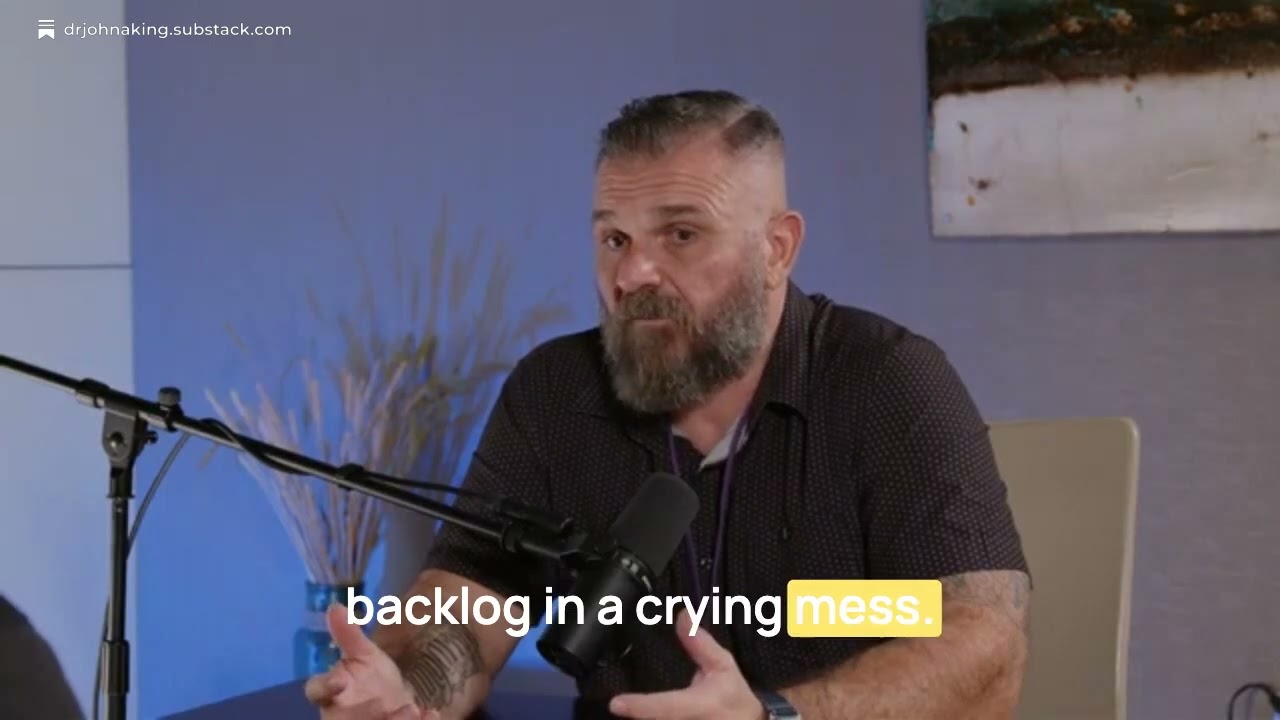
Dr. John A. King, an Indigenous Australian survivor of childhood trafficking and abuse, describes how suppressed memories resurfaced in his mid-40s, triggering PTSD and depression. He rebuilt his life through what he calls bio-hacking: analyzing diet, sleep, relationships, and reading roughly 200 books. His recovery led him to create the Phoenix Collective app and Give Them a Voice Foundation to help other trauma survivors.
Chapters
And today we have Dr. John King. Is that correct?
Yeah, that's me, mate. John's good. Whatever you want, brother.
Okay. We are in Dallas at a conference.
Yeah, great conference.
Tell me about yourself. Tell me about your background. You have an accent.
So I do have an accent. What are you talking about, mate? I have an accent. It's way South Texas. Australia was where it started.
Okay.
So I'm actually an Indigenous Australian. So from the red center of Australia. So my skin name is Djungarai. My tribe, my people are Wurundjeri. So I'm a Wara-Mungu man from the center of Australia. So that's where the journey starts, man. It starts there.
So tell us about that. Tell us about your journey.
What got me to biohacking conference in Dallas? I was trafficked as a kid, as a young boy. The people that raised me abused me, sexually abused me, and trafficked me to their circle. The woman, the woman that raised me did. Prior to that, my birth records are all distorted. And in Australia, at the time of my birth, They were taking children off their parents. So in Aboriginals, the skin tone, the melanin, is recessive gene, as opposed to Africans where it's dominant.
Okay.
So by the time you get to the 3rd generation, they're blonde-haired, brown-eyed, and that was me.
Okay.
And the government policy was to take those children and put them with European families to assimilate them, get rid of the culture, the language, the law, all that sort of stuff, and get that out. There's a whole ordeal about it called the Stolen Generations. So I ended up with this European family, and they were the ones that abused and trafficked me. So how that leads and ties into— I know it's a light topic.
I was going to ask that because that's amazing. How did you get separated from your parents?
And you just explained it. Yeah. Yeah.
So that's just common practice, or is that something that still happens nowadays?
They'll call it different things. They'll call it the interventionist policy at the moment. It's a real mess amongst Indigenous Australians. We don't have a lot of the rights and the opportunity Indigenous Americans have. And, and there's a lot of, there's a lot of brokenness. And I think that's what led me into dealing with trauma and mental health is my own story, but also historically the trauma you bring through from your ancestors. And so in 2008, I had recall of what happened to me as a kid. I was 45.
So you didn't have recall of this before? So you grew up—
I had little flashes, man. It was like those old 8mm films, just little frames. And it was on a Thursday afternoon at about 2:30. I remember the day. And they all came together and they played like a movie. And I realized what had actually happened to me. And it didn't stop playing for probably 5, 6 years. Constant orgies, the things that were done to me, these constant visions and movie was playing all the time. And I mean—
I'm so sorry. That's just so heartbreaking. And I don't wanna be morbid, but—
Yeah, sure. So.
How is it that this happened? As you're placed in a strange family, right? And so these people, do they send you places?
Do they— No, they had parties and they took me to— apparently I was a good-looking kid. And so my first sex acts was oral sex with the woman that raised me. And I was, I was trained to be very good at it. So I would be taken to party. I was a party trick. I'm so sorry. They'd make movies. They'd do a range of different things.
And as, as you grew up, right, so what did you go to school? How was your life?
Yeah, what was— probably it was— those were— these were very successful middle-class people, educators, very successful in their field, man. There's no trailer park, no trailer park boys here, man. Very successful, very wealthy, very academically professional people. They still are, from what I understand. I haven't seen them or talked to them for a long time. So that's the thing with trauma, mate. It's— it happens and it's around. It— people ask, you know what, I tried to run away when I was 7.
Okay.
But I was beaten by a neighbor and taken back, and she told me that mothers don't do that to their sons. And it's because they— that's just what the state was. And we still view it that way. We're more protective over our daughters than we are our little boys, yet 45% of all traffickers are female. And about 50% of all victims are boys. It's higher if you look into any of the stans. We've done a lot of work in Afghanistan, Pakistan, etc. And some— a lot of the people being trafficked over the borders, probably 60 to 70% of them are male for gangs, for war, for industry, building, mowing lawns, bro, all that stuff. Sex trafficking is only a small part of the overall thing that happens. About 240 million people a year are trafficked in America.
And I'm from Mexico, so that's a big topic, right? Because it's here close to the border. But So this is global.
Yeah, this is global. America has a real problem. There's more people slaves in America now than there were ever at the height of the transpacific slavery, which was 375,000 people. Now there's 2.4 million people a year in America. So it was a major thing. So here's this major thing, and I had recall because I'd suppressed it. For me, it was just a normal life.
Yeah, so you grew up, okay, and what did you choose to What was your career then before your recall?
Um, my first degree was in agriculture.
Okay.
My doctorate's in theology, and I went into ministry. I had a tough run, bro. And—
This was before the recall?
Yeah, this is all before the recall.
Wow.
And so I grew up church life, very successful business. I ran a, a boutique executive coaching, uh-huh, and training. Spoke all around the world, big organizations, profit, nonprofit organizations. Very successful. Flew 150,000 miles a year as a motivational speaker. Motivational speaker, preacher in churches, planted a lot of churches, did a lot of leadership training. I loved facilitate the dreams of other people.
And theology—that's fascinating. So are you? What would you? How would you describe yourself as far as the denomination?
I'm a Christian man, a follower of Christ, a follower of. I'm connected to my country, my people, my ancestors. But yeah, look, I've got no doubts about that's who I am. And it's been very important to me in my recovery is having that. Spiritual grounding. Yes.
So you had a spiritual foundation, but then comes the recall. So walk me through that. What was the recall like?
So it, it really went from little bits of these frames that I just thought were bad memories and that everyone just had memories like that because you don't discuss this sort of thing, particularly as a man. You don't discuss these things that you remember and whatever, and you think maybe you're making it up, or why am I having that weird thought? And then all of a sudden it comes together and it plays, and all of a sudden I see this movie before my eyes that was everything that was my childhood for probably 12 years. The events, the parties, the things I was made to do, the threats that were made, the places I was taken, the people I had sex with. So it all just played out. And it came back like a flood, and I spent probably 5 or 6, 7 years just constantly seeing these things. If back then we were here talking, it'd be playing behind you. Everywhere I look, it just— these— it was constant. I trained myself to only sleep 90 minutes at a time. I'd set an alarm because if I got into really deep sleep, I'd have horrible nightmares and recall. And so it got to a point where my life was a total mess. I'd lost everything. And I realized I had to do something. But no one— I couldn't go to counseling because no one wanted to talk to a man because men don't get sexually abused. That's what their thought was.
So as you say, you lost everything. You were married. You had kids at this point.
What was that? Yeah, kids. It was a cluster, man. Like, it was a mess. So she didn't cope. I understand. And you go from being one guy to another overnight, everything implodes, and you're lying in the backyard in a crying mess, and you don't stop crying for 5 years.
So you weren't able to work?
No.
Is that— it was life-shattering, right?
Everything. And I was a chronic stutterer and a lock-in. I couldn't go out. I couldn't, couldn't get in an elevator. I couldn't be— one day I got stuck in traffic on 114 and just totally lost it. I couldn't. I was scared of being locked in. Everything, man.
Now talk us through. You have this recall, you have this just life halt. It's a complete— how do you make it out of that? So you have the spiritual foundation, but that's obviously not just—
God, he's not my fairy godmother. Like, he gave me a promise that if I got up every morning and I did the work, he'd give me a tool from a toolbox. He's my heavenly Father, not my fairy godmother. There's no miracles when it comes to trauma recovery. Like, I believe in the supernatural and I've seen miracles, but there's no miracle where you've got to get up every day and do the work yourself.
Yeah.
So that's what I did. I identified the things in my life that were a problem. I drew a Venn diagram and I identified the things that if I could get that 20% right, it would impact 80% of my life. And I went after it. I read probably 200 books on different things and I started to work out food dye, red food dye. Now we're talking about it. Back then it would send me suicidal, right? Too much sugar. Wrong music, wrong clothing, wrong company, wrong environment, wrong smells. Everything was up for grabs, and I just had to pare it back and identify this stuff. And now we call it biohacking. For me, it was just survival. I was scraping the shit that was my life together and trying to make fertilizer because I had to, because I was trying to save my marriage, I was trying to save my relationship with kids, I was trying to find a job.
Yeah.
I had to do something. Your past will either Define you or refine you. And I chose to allow it to refine me, to make me a better man. And that's just what I wanted to do. I was going to beat this thing. So for the last 20-odd years, I've been biohacking trauma.
Okay, so that is— that's what I want to kind of ask. So how did you know to do this?
I didn't like me. I like— brother, I couldn't go out in public. Yeah. And my kids couldn't stay over at someone's place. I couldn't keep my shit together. Every day I was losing it. I didn't like me. What was I going to do, end it or get better?
Like, a lot of people choose to end it, right?
Yeah.
I just— so you, you described what you did. You, you said you mapped it.
Yeah, I mapped it. So depression, anxiety, paranoia, all these other archetypes sit around. But you've got to remember, this is 15 years ago. No one was talking about post-traumatic stress.
I'm saying, how did you—
Because I was depressed. I was paranoid. I was anxious. I couldn't sleep. I was— and all the— and I just looked at these things and said, okay. And I literally just listed out the attributes, turned it into a Venn diagram, and found all these things in the middle and said, they're the things I'm going to deal with. These things overlap. So if I can deal with these things in the middle, Pareto principle, 80/20 rule, then theoretically I should be able to impact 80% of my life.
And is this what you teach now? That after that, after you were able to turn it around, yeah, so you went back to studying, or what is it that you do?
I brought a box of cigars and sat in my shed. I sit with coffee, a book, and a cigar, and I tried to figure out who the hell I was and how the hell I was going to get out of this mess, right? Everything's a hard way. I didn't know— it's not school. Schools— I've read a lot of books, okay? I've been attributed— I've written a book, Deal With It, that's very popular, very impactful for people. And at the moment, we're forming a community called the Phoenix Collective to help create an environment. Because one of the things I realized is I didn't have an environment. I'm married to a wonderful lady called Melissa, and she's been my true north for the last 10 years, really helped me through this whole thing.
Right.
And the power of that partnership. So I— look, I fell into this, mate. Like, I was sitting alone in an apartment, and I had these people. They found me through social media, and they wanted to make a documentary on trafficking. So I spoke in that, and so I found when I was speaking in that at the premieres, half the audience was men, and they'd come down and they just hug me and say thank you. And they were standing with their wives and their daughters, and they're saying we never knew this about him. So here I am standing with these guys. I'm going okay, so that helped. So then I wrote a book, and that helped. And then I started to try and figure out. Because it's still ongoing. Nothing stopped. It's still— the nightmares are still there. I still can't sleep. I, I lose my crap all the time. I can't hold— I can't— holding life together is like juggling bits of broken glass.
Right.
And, and so every bit was like, okay, how can I deal with this? How can I be a better husband for Melissa? How can I be a better father for my children? How can I be a better human in society? It's like, how do I improve this thing? I'm still here. John 2.0. John 1.0 is dead. Like that guy, he's pre-recall. Now I've got to live with John 2.0, and I don't know this guy. I went from right brain to left brain. Everything, my frontal lobe shut down. All this stuff's happening, and I had to reinvent my life. And I just— so where I am now with helping people with mental health in our medical practice and with our app is I'm there by— I don't know, bro, this is just where I am, you know what I mean? Like, I followed the smoke and I ended up here helping people.
Yeah, no, that, that's amazing. Again, this is all amazing to me. You have this incredible life situation, and by incredible, I'm just speaking out of— the average person doesn't know this is happening like this. We hear about it, right? And it's being, it's being, what is it, more and more brought to light.
Yeah.
Okay, but the average person doesn't think this is happening that I know of. We live life, and yes, everybody has problems, there's bad things, but This is horrible.
What I reckon, mate, like, if I can beat this, then I know my story's horrible, but I wouldn't wish this for anybody. But if I can beat it, man, then they can too.
So you become the inspiration by— if this is happening to other people, then yes, you say it helped, but I— am I wrong? You've been helping others and now helping others helps you. Is that— would you say that?
There is a dynamic to that happens, but I actually— I'm always careful of that. It— I realized early on in my recovery, part of me wanted to instantly go and help people because then I'd feel better about myself. So I didn't do it.
Which is a very Christian thing to do, right? That's what the Christian philosophy is.
And I didn't do it because I wasn't ready. I wasn't whole. So this has been a 15, 16-year process. And I think in the last 2 years, I'd say I'm comfortable saying I've got my feet under me. I feel really solid now. I feel good. My marriage is good. My— I'm good. I'm okay.
I'm okay.
Yeah. And it took a long time to get there. Now, that doesn't mean the next person can't do it quicker because I can help short circuit that process. But the problem with the challenge I find with people who have been through something is they automatically want to go about and try either impose lessons or get validation from helping someone else. And they haven't done the work. They haven't sat on the ground with themselves. They haven't looked at this. I looked at this for years and I was self aware. And self awareness is key. I was self aware enough that I had. Major issues, and I wasn't ready to do this, right? I wasn't ready to help anybody, and I couldn't in all good conscience help anybody else because I wasn't, you know, I wasn't where I wanted to be.
You haven't, you haven't gone through the path yourself, right? So, wow. So knowing yourself, okay. And like I said before, I don't think everybody chooses to do what you did. So you're— I think that's pretty amazing, which is look at it, dissect it, and look to solve it. It's basically an algorithm, right? Yeah, exactly. You chose to say, I had to have problems, right, one, one at a time, and started addressing it one at a time. And then the other thing that you mentioned is— it makes sense to me as in the— in flight, whenever we're flying and the flight attendant tells us, hey, you have to put oxygen on yourself first before you put— it doesn't make a lot of sense. You want to put it on your kid, right?
Yeah, yeah, for sure.
But if you don't have the oxygen yourself— so it sounds to me like that's what you're describing, that you—
Yeah, that's a good analogy.
Have to know yourself and get—
Yeah. What I found was I was aware enough to realize I was going out to try and help people, try and validate my own recovery. But then I would try and do that, and it was so hurtful to me because I'd have to share this story over and over again. It's still difficult after all this time, and it would take me 2 or 3 days to recover from a coaching session or a speech or something. And I just said, this isn't good. This is not good for Melissa. This is not good for myself. I lose 3 days of my life just sitting in a black room depressed because I You relive this stuff, man. It comes alive again.
Is it like post-traumatic stress disorder?
It is, it is. So there's post-traumatic stress, post-traumatic stress. So after a traumatic experience, there's a period of stress. If that period of stress lasts for more than 6 months, it's a condition. It's diagnosed PTSD or something like that. So complex PTSD— so any PTSD is associated with trauma and after that trauma. So complex PTSD is And they've split up the things, and I'm not one for splitting up the terms. Complex is there's a lot of different issues and facets that happen that make this trauma experience. When our warfighters come home and have been through traumatic situation, and there's an interesting topic all around that, is that most of our elite warfighters have been abused as young men, like a massive percentage of them, because they they went and made themselves hard men so that never no one would ever hurt them and theirs again. So the problem with that. Is now I have this guy with PTSD, and a lot of the PTSD is manifesting out here. He's got— he killed bad guys, he's got no problem with that. What he's got is the problem that the fact that at the age of 12 he couldn't stop the baseball coach interfering with him, and he felt like a weak person. So he spent his whole life getting hard, and now he can't tell the VA about it because it's a pre-existing condition and he'll lose his benefits. So that's part of the space that we work in with mental health. Is trying to help police, first responders deal with that stuff.
So tell us about that. How can people find you?
So if they go to phoenixcollective.app, we're starting a brand new program. It's a new app and we're looking for 20 people to help us pioneer this thing. And then we're rolling it out. It'll be in the thousands. We get a lot of people in. We've got it. It's all based on very practical ways to recover. phoenixcollective.app. The other one is my website, drjohnaking.com. Okay. And we're all over social. And then there's the medical service, which is elitecareconcierge.health. So we run a very elite 24/7 concierge to, to, to people who can afford and want it. And we take— and part of that, but part of that whole enterprise is mental health because it's body, soul, and spirit, bro.
Yeah.
We can run around out here and sit in our red light therapies and whatever, man. But if you are not getting this right, if you're still calling yourself fat, ugly, and stupid, it's sitting in a red light sauna ain't gonna help you. Because it's all up here. You're going to undo it all. So we deal with some very high net worth individuals here, and out of that proceeds go towards— my portion of that proceeds go towards funding my nonprofit, which is called Give Them a Voice. So we fund the nonprofit.
Give Them a Voice.
Give Them a Voice Foundation. So out of that, Give Them a Voice. So we've spent— I've spent all this time in recovery. The challenge I had is I was only able to help one person 2 or 3 hours a day or a week, right? And I wanted to try and maximize that. So that's why we started the Phoenix Collection— Collective— phoenixcollective.app.
Okay.
And because I want to create an environment where we can talk about things like biohacking, where we can talk about how to have a supportive marriage, where we can be open and honest about these things. You understand, man, if you're sitting around a dinner table, you can talk about the horrendous thing that is sexual abuse and trafficking of women, but you can't talk about it as a man. No one wants to hear your shit. They don't want to talk about it. We're supposed to hold our shit together. And there's a whole bunch of men out there, millions and millions of men, that have no voice and no place. And the problem is that— is as they bottle that up, they're hurting their wives and their kids. And so we've got to be able to have this conversation and not feel like you're cashing in your man card.





