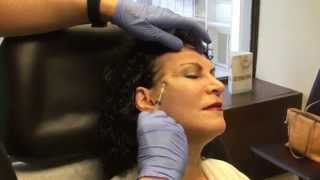
A demonstration video by Dr. Shervin Naderi showing a blunt-tipped cannula technique for filling temple hollows. He explains anatomy/risks (large-caliber temporal vessels), argues blunt cannula reduces bruising/hematoma risk, and demonstrates steps on a model: use of Juvederm Ultra (1–2 cc) diluted 1:1 with lidocaine + epinephrine, a small stab incision at the zygomatic arch to introduce the cannula, and a typical two-step treatment spaced ~1–2 months apart.
Questions this video answers
Juvederm Ultra, typically 1 cc or 2 cc.
Diluted one-to-one with lidocaine with epinephrine.
It tends to reduce bruising and large hematoma risk compared with needles (lower risk but not zero).
At the zygomatic arch (a small stab incision through which the blunt cannula is inserted).
Typically two steps, spaced about every month or every two months.
Chapters
Hi, good morning. We have a demonstration video in our injectable video series. People have asked me to demonstrate my technique for temple injections. Sometimes as we go through age, with time, the fat and soft tissue in the temples tend to hollow out and it can make the face look a little bit too sculpted. And softening that with some fillers is nice. Now, there's different techniques. The problem with the temples is that they're extremely vascular with extremely large blood vessels. The blood vessels up in the temples are large caliber blood vessels. And if a needle tip tends to hit one, which can happen, then not only will you get a bruise, you can actually get a large hematoma and blood collection. So my technique with a blunt tipped cannula actually tends to reduce that. You can't tell somebody that they're going to get zero bruises. It can still happen. Even a blunt tipped cannula can still hit a blood vessel that you can't see, but their risk is lower. Now what I do is typically take 1cc or 2cc's of Juvederm Ultra and I dilute it one to one with Lidocaine with epinephrine. The epinephrine causes vasoconstriction of the blood vessels and the lidocaine just makes it a little bit more dilute so it spreads better. I don't use blood tip cannulas for every procedure that I do. I think that they have their time and place, but they're not the cure all to everything that you may have seen online in some of the marketing material. I think in certain places it's fantastic and in certain places it's not as precise as the old traditional needle method. So I'm going to demonstrate this technique. We have a beautiful model who's going to show us this procedure. We've done this one time before on her. I tend to do it in C. We'll do it every month or two apart.
So we've already had a little bit.
Of injectables right here.
We've already filled up a little bit.
This was definitely more hollow. And now we're going to do our second step to fill it in further. Typically, two steps is enough for these procedures. So let's watch.
With the blunt tip cannula, you always.
Have to make a small stab incision because remember, the cannula is blunt.
You can't poke it through the skin.
So I take the zygomatic arch and I make.
I'm going to turn your head a.
Little bit this way. I make a small little Stab incision right there.
And through that, I can get the cannula in.
Now, getting the cannula in sometimes is.
The actual part that is the most uncomfortable for a patient, just because even.
With that little stab incision, getting through.
The skin does take a little bit of effort.
But once it's in, it's easy.
So we're in. This is the mixture of Juvederm Ultra. You can actually see the tip of it. You can see where I'm going with it. I can feel it right into the temple hollow. Then I can push up with it and get really up where I need to get to. Then it's just gentle, smooth, progressive fanning movements. You can see the cannula right there. I tend to leave a little bit of air at the very tip of it, which helps open up and dissect the plane. Again, it's blunt, so sometimes you're gonna see a little bit of resistance, but you kind of feel for where you're going to be. Slowly massage it into place. Slowly massage her into place. There's not a lot of stabbing or jabbing. Starts filling up as you see the volume right there. How are you doing? I'm fine. Okay, don't feel anything. Good. Pull back a little bit to see how it's doing. Then do lower areas right around there. See a little bit of depression right there going a different direction. Get it all filled out. It's important to understand anatomy. The temporal branch of the frontal branch of the facial nerve runs in this area. It's important to use a blunt tip cannula in this area. You don't want to be jabbing a sharp needle up and down this area. That's one of my problems, actually, with the feather lift or these thread lifts that you may have seen and heard of. There's doctors that kind of, without seeing what they're doing, push up these barbed wires in this area, and they can snag on the facial nerve, which is not good. So you can see and hold lower pressure at the entry site. This area is filled in nicely. I do a little bit of massaging to it. Just a little bit of massage brings it down. There's no bleeding, there's no bruising.